Who used the “black box” phrase first? (in press or during a presentation)
Monthly Archives: June 2012
Reflexive Ethnography of Infrastructure
Useful, relatively unknown nugget of interest for ethnography of infrastructure, buried deep in a seminal text.

(http://press.princeton.edu/images/k2417.gif)
After re-reading Laboratory Life — the 1986 paperback edition published by Princeton University Press not Sage Publishers, which published the original 1979 hardback — I am struck by a comment made in the postscript, which was published with the paperback 1986 edition only.
The authors respond to a few reviews of the book. For example, Westrum (1982, Knowledge 3(3):437-9) criticizes the format and presentation of the empirical materials; quoting Latour and Woolgar (1986:276),
Westraum speaks of a lack of a sense of unity, the lack of continuous action and the relative incoherence of the narrative. But our aim was precisely to avoid giving the kind of smoothed narrative characteristic of traditional constructions of the “way things are.”
The authors justify this move on the grounds of thier (anthropological) understanding of “ethnography” and the important role of “reflexivity”.
On ethnography, they choose it for the “analytical distance” it affords participant observers and elect “the presentation of preliminary empirical materials” (277) rather than a clean, sanitized research report.
On reflexivity, “Of course,” the authors write,
one interesting aspect of the exploration of reflexivity is that our writing is conventionally constrained by the use of report-like formats. This increases the tendancy of ethnographies to read as straightforwardly reporting on the “actual” state of affairs to be found in the laboratory. This kind of reading is not without use. … But such reading misses the point. We attempted (especially in Chapter 2) to address the issue of reflexivity by placing the burden of observational experiences on the shoulders of a mythical “observer.” We attempted to alert the reader to the nature of his relationship with the text (and by implication to the nature of readers’ relationships with all attempts to constitute objectivities through textual expression).
Now, I am not suggesting that ethnographic accounts of infrastructure — like habors, waterways, or information systems — adopt this second-order ethnographic reflexivity, although doing an ethnography of a sociologist doing an ethnography might be insightful. Instead, I am curious: how much hygiene/polish we should be putting into our research reports, especially ethnographic reports?
Here is why: As Latour enters the Salk lab he swears to report the truth about what happens in the lab, in particular, how scientists transform a series of personal observations into textual accounts called “articles.”
- Being a reflexive ethnographer affords the observer certain advantages, especially in seeing how truths (and non-truths) are constructured and circulate, and they can do this analytically because the truth of the claim is not what self-selects it for construction or distribution.
- Being a reflexive ethnographer also comes with another responsibility, which has, to this point, seemed more like a liability: being a reflexive ethnographer means that one must also be reflexive about one’s own ethnographic account.
As Latour and Woolgar (1986:275-6) put it,
The revision of epistemological preceptions about science raises awkward questions about the nature of its social analysis. Can we go on being instrumentally realist in our own research practices while proclaiming the need to demystify this tendency among natural scientists?
As the authors suggest, the reflexive turn seems to have reflexed only one way in the production of scientific accounts. What would further reflexivity get us in infrastructure studies? Insight into the sociological production of texutal accounts, or an infinite regress of sociolgists studying sociologists studying sociologists (and so on)?
ANT and ethnography
While the corpus of ANT research is full of ethnographic accounts, not all ANT is ethnographic. In fact, foundational work in ANT tends toward socio-historical accounts of science and technology. For example, in Latour’s (1987) work in Science and Action, which stands as the invitation to follow the actors, Latour conducts no firsthand ethnographic fieldwork. Through the lens of ANT, and as a way to hash-out constitutive concepts, he reviews historical portrayals of the genesis of scientific facts, for instance, that DNA is a double-helix, and the spread of engineering artifacts, for instance, the rise of diesel locomotives. Likewise, published shortly after, Latour (1988) presents the STS community with a historical revisionist attempt at re-telling the rise to prominence of Louis Pasteur through the lens of ANT.
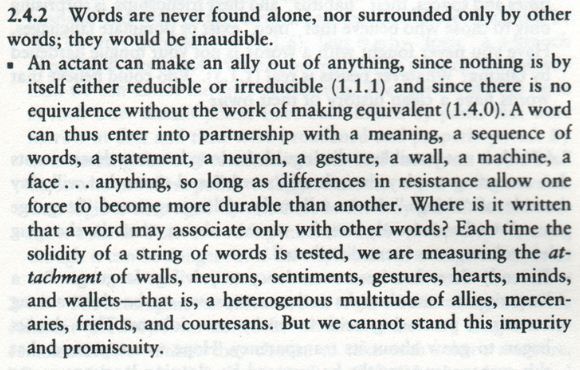
(my favorite passage from The Pasteurization of France)
As Hine (2007) suggests, ethnography is also not the way, or even the best way, to conduct ANT accounts of socio-material or historical phenomenon. Law’s (2002) work, especially his early work on aircraft design and related “stories” provides a rich empirical-grounded methodological alternative to ethnographic fieldwork as was his iconic ANT-imbued exploration of Portuguese sailing. Hence, there are many ways to “follow the actors” without following them “on foot” during participant or observation data collection.

(best part of the cover of Aircraft Stories: Decentering the Object in Technoscience)
And yet, ethnography appears to be a straightforward technique for understanding one of the latest and most important concepts in ANT, namely, multiplicity. The concept — as an alternative to fragmentation as a conceptualization of a lack of fixity or stability — was implied in early ANT research and, in a number of forms, has occasionally appeared in STS work over the last three decades. However, it was not until Mol’s (2002) The Body Multiple, an unorthodox ethnographic account of atherosclerosis of leg arteries, that a robust and coherent statement was made about how to observe multiplicity in practice. Seeing medicine as a practice rather than a body of knowledge provides the analyst with an important affordance: “what we think of as a single object”, for example, a body or a disease, “may appear to be more than one”, hence, she shows how atherosclerosis is at once a singular, seemingly unified object (i.e., a disease) composed of many things because “plaque cut out of an atherosclerotic artery is not the same entity as the problem a patient with atherosclerosis talks about in the consulting room, even though they are both called by the same name” (Mol 2002:vii). However, these are not merely different social perspectives about the same object (i.e., the disease) dividing doctor and patient because this is not just another pluralist account. In principle, post-ANT studies like Mol’s are post-pluralist, which implies that adding another perspective to a scholarly account will not make the account somehow more truthful, representative, or accurate. However, social scientists, for example, of medicine have often used this trope in their research accounts. They differentiate “disease” from “illness”, the former representing the medical perspective of doctors and the latter accounting for the personal, emotional, and social experience of being a patient living with illness, which they claim doctors tend to miss, ignore, or fail to account for from their medical perspective. Thus, sociologists did not get mixed-up competing with doctors over the truth of the object of biomedicine (i.e., the disease) and instead claimed that the social dimension of disease (i.e., illness) was an added layer of meaning representing the patient’s perspective. In ANT, however, Latour (2005) challenges the idea that a social dimension exists separate from the material world. In a non-trivial challenge to sociologists, Latour demands to know how “the social” can at once be a special dimension of reality, which social scientists have access to thanks to their methodologies, and the broader context that influences the everyday life of individuals and a description of how individuals are linked together through network ties (i.e., associations). Social scientists routinely oscillate between these three registers in their accounts of the social (i.e., dimension, context, and network ties), which, reflexively, appears to be a readymade case study in multiplicity in sociology about sociological practice. Latour suggests that an emphasis on associations is the surest way to return sociology to its roots. For once we shift to the practice lens, the core epistemological concern that truth faithfully represent the nature or reality of an object, human or nonhuman, is no longer sufficient as an endpoint of analysis. How knowledge practices are enacted, overlap, and hang together, therefore, becomes the empirical question and ethnography appears to be the preferred method for scholars to observe multiplicity unfold.
Does "infrastructure" automatically imply multiplicity?
No doubt, Annamarie Mol’sThe Body Multiple (Duke University Press, 2002) helped me to fully comprehend the implications of ontological “multiplicity” (as an alternative to singular epistemological truth), more so, by far, than even Latour’s early (dare I say, seminal) work on what multiplicity would mean for research and theory in science and technology studies.

Two of her key insights:
1. On the concept of entitivity (which she does not really develop, but it is so central to her argument that we see the term “entity” twice in the opening paragraph of the preface), she writes:
This means that the book comes to talk about a series of different practices. These are practices in which some entitity is being slided, colored, probed, talked about, measured, counted, cut out, countered by walking, or prevented. Which entity? A slightly different one each time. Attending to enactment rather than knowledge has an important effect: what we think of as a single object may appear to be more than one (vii).
2. On how entitivity matters for “ontological politics”, she writes:
If the objects of medicine are enacted in a variety of ways, truthfulness is no longer good enough … [thus] I contributed to theorizing medicine’s ontological politics: a politics that has to do with the way in which problems are framed, bodies are shaped, and lives are pushed and pulled into one shape or another (viii).
These two points, I contend, cannot be applied to infrastructure so simply, and here is why: “the body”, as a concept or a colloquial phrase, grammatically implies a one-ness or singularity. Therefore, when we see a title like “The Body Multiple” we note (as Mol, of course, details) a singular noun with a pluralizing adjective. Can the same be so easily said about other objects? “The <FILL IN THE BLANK> Multiple”? I am not certain that a “The Infrastructure Multiple” really works as a sensitizing concept for infrastructure studies, despite the vast utility of multiplicity to aid us in rethinking infrastructure. After all, infrastructure is already a singular noun used to describe multiple things/objects.
According to a fast/dirty Google search:
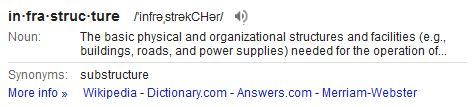
So, the multiplicity of infrastructure is at once already a part of infrastructure, and yet the vast and multiplicitous network structure of infrastructure occasionally punctuated into a seeming singularity is an idea worth mining.
Call for Papers: Workshop on Innovation in Information Infrastructures
Call for papers
III 2012 – Innovation in Information Infrastructures Workshop9th – 11th October 2012 The University of Edinburgh Business School
29 Buccleuch Place
Edinburgh, UK Confirmed Keynote Speakers:
Eric Monteiro – NTNU
Steve Sawyer – Syracuse University
David Ribes – Georgetown University
Geoff Walsham – University of Cambridge Rationale:
This workshop will focus on the emergence and continuing evolution of new kinds of information infrastructures (IIs) in business, the corporate world and other settings. By connecting a growing number of systems and data, Information Infrastructures support user work in everyday life, but also bring about increased organizational and technological complexity. As IIs permeate an increasingly broad range of social and institutional contexts, they generate both new kinds of challenges for information systems development, and new social, organizational and market forms as foci for social study. This is the second Edinburgh workshop on IIs in recent years. The first, in 2006, explored what were then emerging visions of the future1. Some of the computing models set out have subsequently failed to materialise as expected, whilst others not predicted have come into being. Today, we find that the ecology of players, services, software and platforms enabled by network connectivity and modern tools is increasingly complex. Information infrastructure standards and patterns of usage have been established, legitimating a growing set of user strategies, social competences and forms of expertise. In this workshop we ask how information infrastructures and related social, organizational and market forms innovate. Important Dates:
Deadline for submission of short paper: 30 June 2012
Decision of abstract acceptance: 22 July 2012
Final program available: 25 September 2012 Submission:
If you wish to present a paper at the III 2012 workshop submit a short
paper (3 to 4 pages). Please submit them as email attachments
(Microsoft Word files only) to this email address – i.i.i@ed.ac.uk –
indicating in the e-mail subject the title of the workshop: III2012 Selected papers will be considered for publication in a special issue
of an international rated peer reviewed journal. Themes:
The workshop will bring together researchers to share empirical studies, analytical approaches and methodological concerns in the understanding of Information Infrastructures innovation, and to explore what the future holds for research in this area. We invite papers on the following themes: Emerging Information Infrastructures – Social media applications that enable the sharing and collation of information between peers and across multiple sites
– The further integration and expansion of corporate enterprise systems (e.g. ERP, CRM)
– Patient health record infrastructures that connect up various health providers
– New models for the provision of computing services (such as Software-as-a-Service and Cloud Computing)
– The Internet of Things
– Data analytics
– New platforms that seek to leverage the time/expertise of globally distributed communities of developers (e.g. FLOSS, the Apple App store). Analytical approaches – The Social Shaping of Technology and its extension into the Biography of Artefacts perspective
– Socio-material understandings of Information Infrastructures
– Approaches influenced by ethnomethodology and micro-sociology
– Science and Technology Studies approaches
– Approaches which appreciate the “long now” and multi-sitedness of Information Infrastructures Methodological concerns – Adequacy of conventional methodologies for understanding the scale, scope and evolution of II
– Questions of fieldwork focus when researching information infrastructures
Submission and Registration Guidelines can be found on the University
of Edinburgh Business School Website:
http://www.business-school.ed.ac.uk/about/school-events?a=44968 Executive Committee:
G. Haywood
H. Mozaffar
A. Eshraghi
V. Wiegel Scientific Committee:
R. Williams
N. Pollock
S. Anderson
M. Hartswoood
G.M. Campagnolo
I. Graham
Commodifying infrastructures: the battle of maps and apps over territories is heating up
As the battle between Apple and Google continues to escalate, the Wall Street Journal features an interesting article about Google Maps, and mobile maps and navigation software and servives more generally, as a crucial stake this conflict. Over the next couple of days, Apple is expected to announce its own mapping service and will subsequently disembed Google Maps from Apple devices. Google Maps was in many ways crucial to the initial succes of the iPhone and both companies cooperated heavily in attracting and redirecting smartphone users to mutual advantage. This cooperation with, basically, Apple selling devices and Google selling ads deteriorated with the advent and increasing market share of Android devices. Now, “Apple is going after the map market to have more control over a key asset in the widening smartphone war”, as WSJ authors Jessica Vascellaro and Amir Efrati comment. Their article has interesting details on both the early days of cooperation, the ensuing suspicions, distrust and secrecy involved in waging the war of the mobile device ecosystems. You can check out the whole article here.
Anybody out there working on this? In terms of shaping technology/building society through infrastructural assemblages, this case is clearly a steal. It encourages, among, I’m sure, many other things, to think about the layering of different kinds of infrastructures – territories, maps, directions, ads, planners, pedestrians, etc. – and the different kinds of circulation these infrastructures attract, moderate, and redirect. What a massive case of heterogenous engineering.
 Installing (Social) Order
)