… the launch of the Discard Studies Compendium, a list of critical key terms.
Monthly Archives: June 2014
ON-LINE FIRST: Infrastructure and the state in science and technology studies

Our new article in Social Studies of Science about infrastructure and the state in contemporary STS books. It is ON-LINE FIRST so it is free to one and all (at least, for now). It is a relatively short piece, but the introduction and conclusion captures some of our emerging ideas.
As a review article/essay, we review a series of books (rather than one), which include:
1. Andrew Barry, Material Politics: Disputes along the Pipeline (Oxford: Wiley-Blackwell, 2013) xiv+ 244 pp., £60.00/€70,60/$89.95 (hbk), £24.99/€31,30/$39.95 (pbk). ISBN 1118529111 (hbk), 111852912X (pbk).
2. Jo Guldi, Roads to Power: Britain Invents the Infrastructure State (Cambridge, MA: Harvard University Press, 2012), 297 pp., £31.95/€32.87/$37.80 (hbk). ISBN 0674057597 (hbk).
3. Allan Mazur, Energy and Electricity in Industrial Nations: The Sociology and Technology of Energy (London: Routledge, 2013) xvii + 227 pp., £90.00/€114,05/$155.00 (hbk), £28.99/€37.96/$48.96 (pbk). ISBN 0415634415 (hbk), ISBN 0415634423 (pbk).
4. Sara B Pritchard, Confluence: The Nature of Technology and the Remaking of the Rhône (Cambridge, MA: Harvard University Press, 2011) xvii + 371 pp., £38.95/€40.62/$47.25 (hbk). ISBN 0674049659 (hbk).
I ♥ Foucault in Autumn!

New Book: Worlds of Sciencecraft

I just got a first-run copy of the new book “Worlds of Sciencecraft” which is written and edited by Sal Restivo, Sabrina M. Weiss, and Alexander I. Stingl.
In a series of posts coming-up I’ll review the book chapter-by-chapter and comment on matters of style and tone, content and controversy, and so on.
Upon even opening the book and casually reading the first few pages, I can already tell that the book will read something like a roller-coaster, which, in the academic realm, means that the book takes an unapologetic tone — in this case, both with the reader as well as between the authors, which is quite peculiar to my mind — and will challenge a few basic ideas most of us have (inherited) about the sciences. For starters, the book’s title, which implicates “Sciencecraft” is a play on “Warcraft,” as in, “World of Warcraft” the massive on-line role playing game … and so starts the roller-coaster!

Bravo, Sal and Co.!
Those curious for a blurb, here is the dust jacket:
A response to complex problems spanning disciplinary boundaries, Worlds of ScienceCraft offers bold new ways of conceptualizing ideas of science, sociology, and philosophy. Beginning with the historical foundations of civilization and progress, assumptions about the categories we use to talk about minds, identities, and bodies are challenged through case studies from mathematics, social cognition, and medical ethics. Offering innovative approaches to these issues, such as an integrated social brain-mind-body model and a critique of divisions between the natural and technological, this book provides novel conceptions of self, society and an emerging ‘cyborg’ generation. From the micro level of brains and expanding all the way out to biopolitical civics, disciplinary boundaries are made permeable, emphasizing the increased need for interdisciplinary scholarship. By rejecting outdated and restrictive categories and classifications, new horizons in studies of science, technology, and medicine can be explored through the incorporation of feminist, international, and postmodern perspectives. A truly interdisciplinary examination of science and technology as cultural phenomena, Worlds of ScienceCraft will appeal to scholars and students of science and technology studies, as well as philosophers, historians, and sociologists of science, technology, and medicine.
An Open Letter to Comcast / Xfinity

Hello,
My name is Stacie Huckeba I have been a customer of Comcast for over eight years.
I realize that it’s a dirty little secret and you don’t like to talk about it, but c’mon, between just you and me, you can admit it. Basically you have a monopoly on internet service, at least in terms of speed. It’s ok, I like money too. Nobody is happier than me when I deposit big fat checks. Sadly, I’m not quite as “connected” as you guys.
I’m a photographer and I think I’m really good, unfortunately, I live in a town with a plethora of talented photographers so I can’t just sit back and be lazy. I’ve sent emails to the Mayor, and Governor and even my Senators and Congressmen asking that they put in regulations to make sure I am the only photographer who can use professional and top of the…
View original post 1,765 more words
Graham Harman’s Bruno Latour: Reassembling the Political due out in October
Bruno Latour: Reassembling the Political

 Graham Harman’s new book Bruno Latour: Reassembling the Political is due out in October. Details in the Pluto catalogue (via his blog).
Please Show You’re Working
On-line publishing, paper, and detritus

This is an unedited version of my review for The Times Literary Supplement. The typos are, for that reason, entirely my own.

James Joyce would often write to his patron and unofficial archivist Harriet Shaw Weaver, adding “a little waste paper to get it out of the way.” He was sending her preparatory material, work in progress, which would later become part of the British Library collection. Of the estimated 25,000 pages of drafts and sketches, less than half of these words would be printed in his ‘final’ text, Finnegans Wake. Clearly, the presence of discarded drafts and proofs, and the economies they support, provide a range of opportunities for authors, literary executors, archivists, libraries and scholars. For the latter, establishing points of provenance, compositional order, and textual transmission of these wasted notebook drafts, ‘scripts, and page proofs, along with demonstrating a technical competence necessary to marshal difficult…
View original post 1,693 more words
check out rodney benson’s challenge to ‘new descriptivism’
Recent Critique of Latour: Know Your Enemy!

In case you missed it, Rodney Benson has an excellent piece here, delivered as a response on a panel at the Qualitative Political Communication preconference. It’s well worth the read, in part because the case he makes deserves to be considered and incorporated in many areas of sociology well beyond communication research. It’s also refreshing to see substantive, synthetic, and critical points raised in a panel response — #ASA14 discussants, read, consider, and emulate!
View original post 184 more words
Bruno Latour, the Anthropocene, and The General Strike
This is a great blog from Bill Connolly at Johns Hopkins on Latour and politics.
http://contemporarycondition.blogspot.com/2014/06/bruno-latour-anthropocene-and-general.html
New Book: the Multispecies Salon
Multispecies fieldwork … Coming to a library near you!

 Interesting new title from Duke University Press. Here is the description:
A new approach to writing culture has arrived: multispecies ethnography. Plants, animals, fungi, and microbes appear alongside humans in this singular book about natural and cultural history. Anthropologists have collaborated with artists and biological scientists to illuminate how diverse organisms are entangled in political, economic, and cultural systems. Contributions from influential writers and scholars, such as Dorion Sagan, Karen Barad, Donna Haraway, and Anna Tsing, are featured along with essays by emergent artists and cultural anthropologists.
Delectable mushrooms flourishing in the aftermath of ecological disaster, microbial cultures enlivening the politics and value of food, and emergent life forms running wild in the age of biotechnology all figure in to this curated collection of essays and artefacts. Recipes provide instructions on how to cook acorn mush, make cheese out of human milk, and enliven forests after they have been…
View original post 64 more words
why the hurricane study is not a referendum on whether “sexism kills”
Some interesting thoughts about interpretation of nonhuman
Entities, especially gender attributions

The hurricane study caught people’s imagination precisely because we had never thought about it before and, once we hear it, the basic idea sounds at least plausible. Unfortunately, the “hurricane name study” is a doomed research design for credibly testing what is actually a clever and even potentially useful public health hypothesis. I suggested why it was doomed from the start in my earlier post, and may elaborate more on that later.
What I want to take up here, however, is the pervasive hindsight bias that comes along with surprising findings like this. We’d never thought about the consequences of giving men’s and women’s names to hurricanes before, but, now that somebody has offered a finding that claims naming hurricanes after women actually kills people, it’s easy to get into our head this is always and naturally the direction we would have anticipated it to go.
Various stories about…
View original post 608 more words
On Taking Notes By Hand
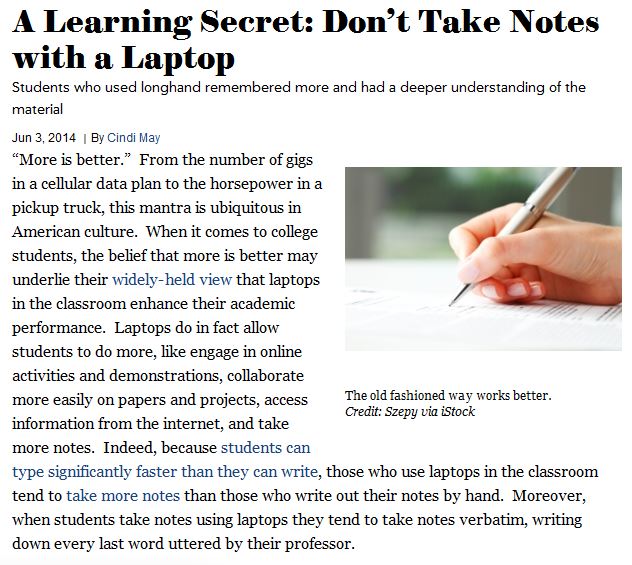
Evidence that writing notes by hand on paper results in greater learning (as compared to taking notes by laptop keyboard). Check out “The Pen is Mightier Than the Keyboard” by Mueller and Oppenheimer in Psychological Science.
CLAIM: In effect, quickly typing copious lecture notes by computer fails to (at least in the experiment) generate the sorts of conceptualization techniques that promote learning (the way that slow handwriting requires students to think about what to selectively write).
Obviously, as any educator will tell you, based on his/her experience, this is an imperfect explanation. Seeing this, the authors also conducted a content analysis, which shows that students writing longhand have to summarize in their own words and draw on conceptual mapping to digest the information.
PROBLEMS: Interestingly, nothing about in-class discussion is mentioned and very little is said about on-line learning. I am reluctant to draw too many conclusions just yet about what this means for practice. There is a powerful irony when I hear a student say “its hard enough to just write this down let alone understand it” … as if notes were really designed for “learning later what you’re learning now.” The active classroom full of discussion — even if some or much of it distracts from the topic at hand — seems relevant. Also, on-line learning wherein notes are often ready-made for the bill-paying student seems like a relevant consideration too in this regard. Also, very little is said about writing assignments: I have been using a technique where students write their first draft totally by hand and then only type it up after I give comments; the quality is outstandingly better, in my experience (using this in a high-level social theory course where conceptualization in significantly important to success on writing assignments).
STUDY: Back to the original study: Evidence comes from experimental research. Mueller and Oppenheimer used the following set-up:
Half of the students were instructed to take notes with a laptop, and the other half were instructed to write the notes out by hand. As in other studies, students who used laptops took more notes. In each study, however, those who wrote out their notes by hand had a stronger conceptual understanding and were more successful in applying and integrating the material than those who used took notes with their laptops.
Much of the argument is hinged on a sort-of-fair assumption that college students perceive having laptops in the classroom creates an advantage for the student; typing is faster than writing and this means that students are able to collect a more complete set of notes (as compared to handwriting notes). They write:
When it comes to college students, the belief that more is better may underlie their widely-held view that laptops in the classroom enhance their academic performance. Laptops do in fact allow students to do more, like engage in online activities and demonstrations, collaborate more easily on papers and projects, access information from the internet, and take more notes. Indeed, because students can type significantly faster than they can write, those who use laptops in the classroom tend to take more notes than those who write out their notes by hand. Moreover, when students take notes using laptops they tend to take notes verbatim, writing down every last word uttered by their professor.
Time to start telling student to ditch the laptop for the fountain pen? I did years ago.
 Installing (Social) Order
You must be logged in to post a comment.