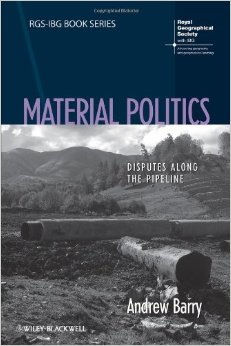
Free extended review of Andrew Barry’s Material Politics — even contains a reference to James Bond.
Free extended review of Andrew Barry’s Material Politics — even contains a reference to James Bond.

Dear readers,
Behind the scenes, Nick, Jan and I are hatching a new format for Installing (Social) Order.
More guest bloggers! Thrilling exchanges on new and exciting topics!
Premiering this fall on a blog near you!
In the meantime, check out some of our previous entries.
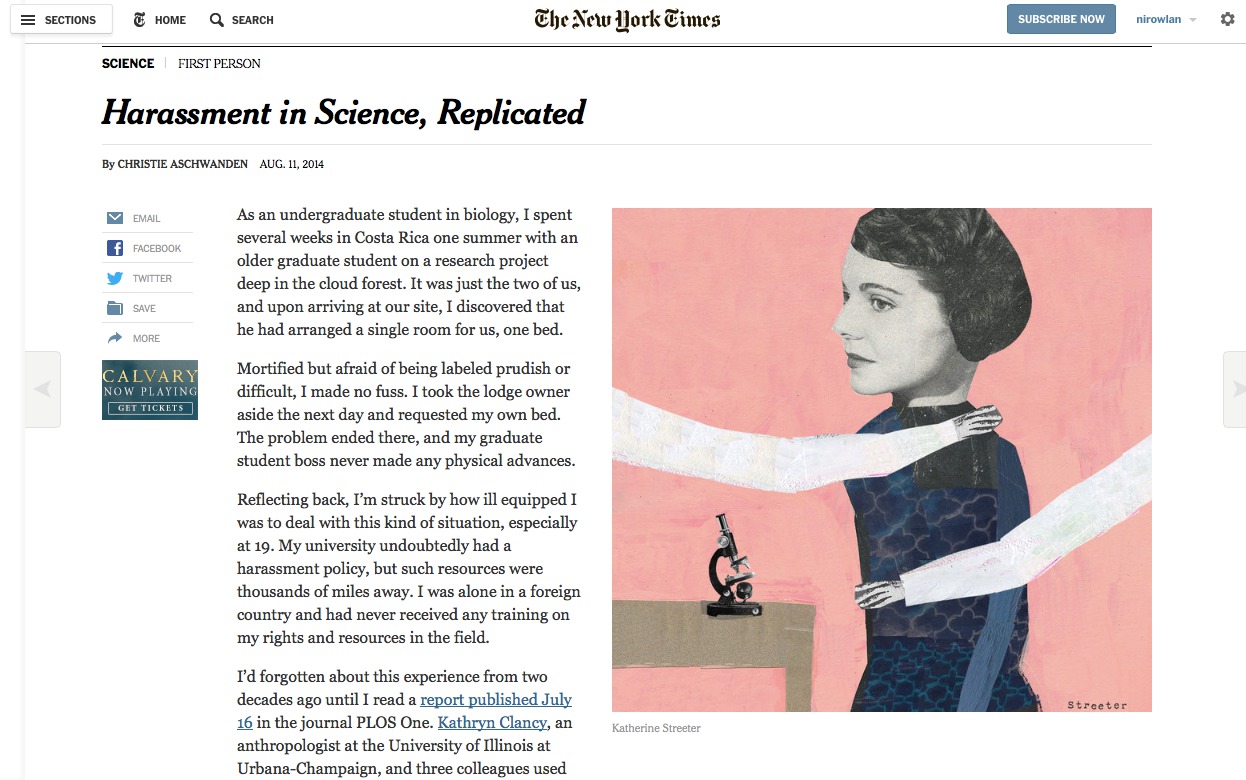
A piece in the New York Times recently discusses sexual harassment while scholars are out in the field conducting research.
A topic worth of discussion in its own right, I can see this being a solid introductory read for undergraduate students interested in how gender and science meet. A lot of the literature in that area centers of feminist technology, seeing the underlying sexism in scientific depictions (i.e., the sperm is active while the egg lays in waiting, and so on), and, of course, access to and participation in science and engineering broken-down by gender (sort of like a version of the Matthew Effect, only with women falling out of the pipeline to professional scientist/engineer, perhaps it should be called the Molly Effect or something like that).
At any rate, the piece covers a number of important issues such as power/gender dynamics while in the field, the issue of “sleeping arrangements” while conducting research at non-local venues, as well as the reality that when sexual harassment looms in university-based research activities the matters are often settled internally (rather than in a public forum).
These are matters worth of more public discuss, especially on college campuses, and, to my mind, the sooner the better (perhaps, even in high school)

Quote of the issue: “On 26 August 1975 … fifty scholars assembled … [to] declare themselves members incorporate in 4S” (August 26th is 4S’s birthday!) Aarnold Thackray and Daryl Chubin, 1977.
Issue in brief (PDF is here: 1977 Volume 2 Issue 3 Summer).
This newsletter contains information about the origins of the society. According to opening editorial, in connection with the Montreal Congress of the International Sociological Association (who knew?), the earliest foundations of the professional society were laid and an informal committee was established in 1974-75. On 26 August 1975, 50 members assembled in San Francisco to ratify a charter for 4S. Apparently, the 26th of August is 4S’s birthday!
Quote of the issue: “A new society resembles a new baby: all hope and weak sphincters,” (about the 4S professional society in 1977) Harold Orlans.
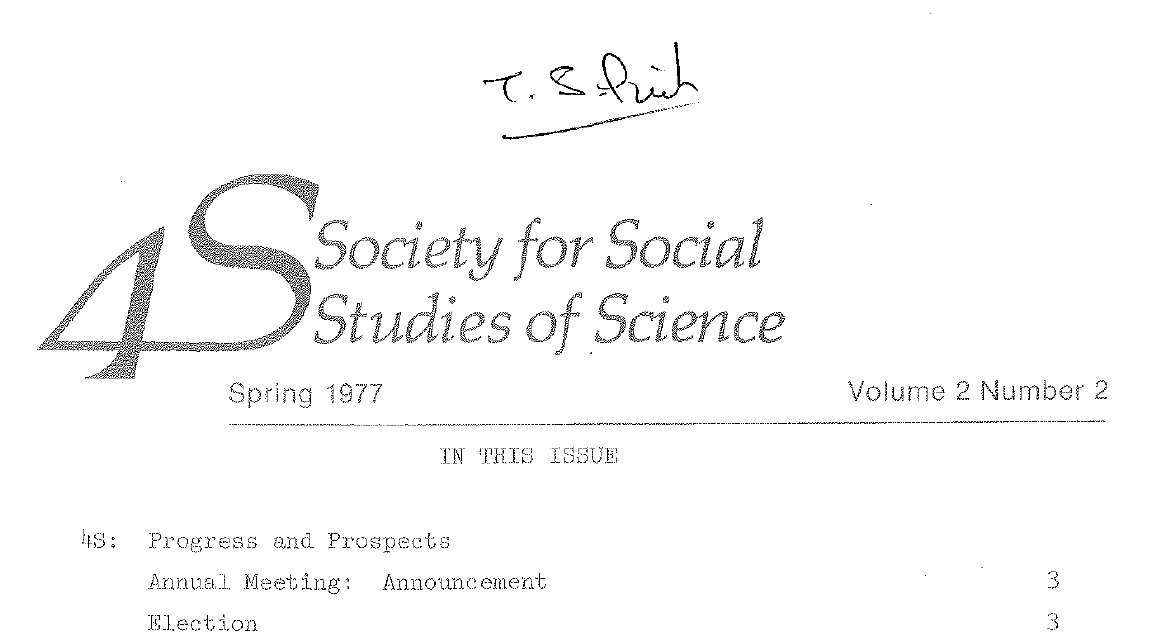
Issue in brief (PDF is here: 1977 Volume 2 Issue 2 Spring).
This newsletter (see the picture, as if it where signed by Trevor Pinch for us later on) is a nice historical piece. According to the council minutes, by January of 1977, 4S boasted 539 members (note to self: chart these). Council minutes also indicate that the professional society was still working hard to determine if a professional society journal partnership could be developed — candidates at the time were none other than the Social Studies of Science, Minerva, and Newsletter on Science, Technology & Human Values. I know that it is just part of training in STS, but we all develop early-on an appreciation for the question (roughly paraphrased here) “how did now-stable things get that way?” and (thank you chapter 7 of David Noble’s Forces of Production) “What roads were not taken?” … might be interesting, as a thought-experiment, to consider what STS might look like if the professional journal were Minerva rather than STHV …

BBC chimes in on the Lego gender battle, which we discussed here and here.
CHOICE QUOTE:
David Robertson, a former Lego professor of innovation at Switzerland’s Institute for Management Development, says such criticisms are unfair. “If Lego was still marketing sets the way it used to, it’d be out of business.”
In his book Brick by Brick, he details the company’s fear in the late 90s that Lego would soon be obsolete. The patents were out of date and a new approach was needed. Instead, the company focused on stories, which in practice meant tie-ins like Star Wars and Harry Potter.

“A salmon is … ?” that is the ontological question.
In this free paper, Jon Law addresses practice and theory, and he does it nice and slow with great care to unpack the context of this paper and the broader fields he contributes to, chiefly, of course, Science and Technology Studies.
Of all people, of course, Law can direct readers through the maze of ANT, but does an even nicer job than usual. For example, regarding theory as coterminous with practice (rather than an appreciable divide):
… And that is the problem when we start to talk about ‘actor-network theory’, or indeed ‘theory’ tout court. Theory including ANT sounds – and often it is – formulaic. It is as if it were there, sitting in a box fully formed, waiting to be applied whole and ready.
Then he shifts gears and moves to “animals,” … “But let me come to the question of actor-network theory in a different way by thinking about how it relates to animals.” He reminds readers that the differences between people and things like animals is not “natural” so much as the difference is an effect of their relationality (and an important step away from “human exceptionality”). Instead of studying scallops (like Callon in 1986), Law studies farmed Atlantic salmon in Hordaland in West Norway. Still, scallops are not irrelevant: “Starting with a focus on multiplicity, I consider how ANT started to put entities such as ‘animals’ back together again after the 1986 relational storm. This, then, is an exploration of strategies for reassembling objects within the ANT tradition.”
I won’t ruin the concluding remarks for readers, but suffice to say, he concludes trying to answer the basic ontological question: “A salmon is … ?”

We’ve discussed engineering for girls (re: Goldiblox here, here, and here), why not science too?
Legos responds to the reality of non-gendered blocks …. with science.
 Installing (Social) Order
You must be logged in to post a comment.