Infrastructuring the City (and its Leftovers)

A few months ago we had a discussion (here and here) about olympic stadiums and the fact that they are the products of large infrastructuring projects that remain long after the project is over. That was an eye opener — at least for me: it seems as if our (STS) focus on stability and material durability is biased; we tend to think that by building buildings we build a world of things that stand for us, our wishes, dreams, prejudices or our moral classifications. The whole “politics by other means is going into that direction. And the ruins of the olympic stadium in Athens (the 2006 one, not the antique one turned into a soccer stadium) reminded me that durability sometimes is a burden: what is build in steel and concrete is going to stay unless we “deconstruct” it. And even then the marks of it stay, leftovers are hard to avoid. Two days ago now I saw this:

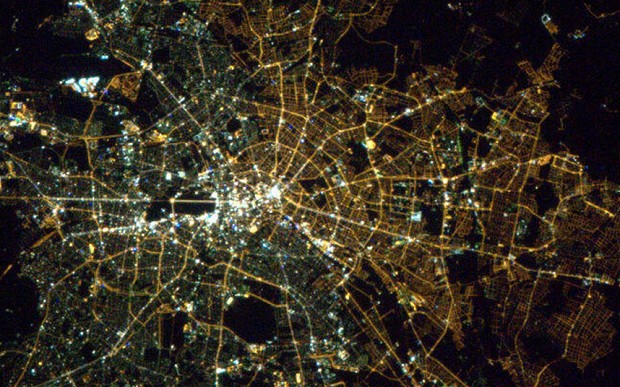
A city divided by light

A city divided by light (Photo by Chris Hadfield, Source: http://www.telegraph.co.uk/news/worldnews/europe/germany/10003467/Berlin-satellite-image-reveals-stark-east-west-divisions.html)

After 23 years,the city of Berlin is still divided — infrastructurally. On the one hand, a lot of the western part of the city still has gas lights: a relict of the cold war era where gas was easier to manage because it can be made from coal and storing or even delivering that was easier than providing electricity in times of a lock-down of the city surrounded by the GDR. But that is not the reason for that: To increase efficiency (and officially to avoid “capitalist/imperialist wastefulness”, I suppose) the GDR changed their preferred system of electric lighting to Sodium-vapor lamps (with a warmer and darker light), the FRG continued to use Mercury-vapor lamps (with that bluish lucid light). So: leftovers of projects of infrastructural politics, but not disturbing ones like politically incorrect street names, memorizing ones like memorials, problematic ones like the Athens olympic stadium. But mundane ones. There in every corner, unnoticed. What do they tell us?

The Bodies Politic

Image

Political theory and philosophy often speak of the body politic as multiple, or as a composite being.  Thomas Hobbes’ Leviathan is, for IR, our most familiar image and idea of how multiple bodies form into larger bodies.  As Latour points out in the introduction to Making Things Public,  Hobbes Leviathan always included more than human bodies:

But in addition to the visual puzzle of assembling composite bodies, another puzzle should strike us in those engravings. A simple look at them clearly proves that the “Body Politik” is not only made of people! They are thick with things: clothes, a huge sword, immense castles, large cultivated fields, crowns, ships, cities and an immensely complex technology of gathering, meeting, cohabiting, enlarging, reducing, and focusing. In addition to the throng of little people summed up in the crowned head of the Leviathan, there are objects everywhere.

As Latour stresses, this political body is filled with actants (Latour’s word that blends and loses the so-called modern distinction between a subject and object).  Actants have varying degrees of “agency,”  but more importantly, it is the connections, or translations between actants and what assemblages these connections form, that shows the unfolding story of communal life.

To add to this busy and complex assemblages of actants, I throw in the human body itself as a microcosm of these same connections and entanglements.  The human microbiome, studied and understood anew through metagenomics, systems biology, and epigenetics, becomes a body multiple, too.

By way of example, bacteroides are commonly found in the human intestine where they have a symbiotic, or commensal, relationship with humans.  They aid in breaking down polysaccharides that the human body would not otherwise be able to process.  Fifteen to twenty percent of our daily caloric intake is absorbed in this manner.   There are new studies that suggest that gut microbiota both cause and can be the cure for autoimmune disorders like allergies and irritable bowel syndrome and, according to the Committee on Metagenomics,   “[T]hese functions are conducted within complex communities—intricate, balanced, and integrated entities that adapt swiftly and flexibly to environmental change.”.

Consider, again,  that the DNA of other life forms in our body outnumber us 10 to 1–many of these invisible to us up until recently. To take metagenomics and the microbiomes of the human body seriously means the human body becomes a community, not only a container–a “mutualistic human-microbial”  series of interactions.  Not only are we embedded in our environment, but our bodies are home to our own communities of micro flora and fauna.

If we extrapolate this to the macro level and the idea of the body politic, what can these commensal, host-guest relations teach us about human communities?  Writ large: The State as Person (the body politic) based on these lively human containers becomes dynamic, pluralistic, permeable, heterogeneous. This idea of composite bodies is nothing new, as we spoke above about Hobbes’ Leviathan, humans have imagined, and tried to create societies that respect diversity while securing freedom, but these diverse bodies may need decidedly different security regimes. Regimes that flow, and understand complex systems–both emergence and other perturbations in the system (noise, as Serres, said)– differently. The body and the body politic as a hybrid forum, a nested sets of complex permeable, rather than autonomous bodies need different security assemblages.  It certainly puts a different spin on issues such as immigration (immigrants and diseases are often linked), for example.  We always already are immigrants and guests and aliens, necessarily.  This is health, not sickness, in a body as multiplicity. Purity and isolation will slowly poison this body from the center out, like a closed petri dish.

The preservation of the body and the body politic has had multiple figurations–the state and nation, of course, looming the largest in this horizon of politics, but these figurations have never quite worked because few have quite captured the extent to which we are blended and imbricated with each other–both between and across species boundaries.  These leakages, or how these problems exceed the capacity of the sovereign state and the system of sovereign states,  are the problems of modern politics.  We can see them reflected in current debates in international politics like immigration, refugees, predator states, and climate change, to name but a few.  These may be more aptly defined as symptoms of a larger misunderstandings about how relationships are formed with multiple bodies coexisting in a mutual biosphere.

I have tried, from the perspective of the human body as understood through metagenomics, to show the similarities between relationships in the internal relations between members of microbiotic communities in the human gut and the relations between members of a political society. If, through research like this, we can no longer uphold the fiction of autonomous selfhood–a hard shelled container body that collides with other bodies and has clearly defined and rational interests (bring up biology and physics); what must that mean for institutions we “create in our own image?”

Another Turn After ANT: An Interview with Bruno Latour:

Is a Post-Post-ANT Era about to begin (again)?

dmf's avatarANTHEM

Another Turn After ANT: An Interview with Bruno Latour:

Latour Interviewed About His New Book

by Adam Robbert

Another Turn After ANT: An Interview with Bruno Latour: ”This is a review, or preview, in the form of an interview, of Bruno Latour’s forthcoming book, An Inquiry into Modes of Existence. We discuss his intellectual trajectory leading up to actor–network theory and the pluralistic philosophy underlying his new, ‘positive’ anthropology of modernity.”

View original post

Abstracts are in for 4S 2013 San Diego!!!

Capture

Submissions in! Jan and I (Nicholas) proposed an open session for this year’s Society for the Social Studies of Science meeting in San Diego this fall. We already have 18 submissions for the one session, which — at least I think — is the highest level of interest we’ve had in the state/stateness area of STS in the last few years of organizing these panels/sessions. Obviously, this is very cool, and we are stoked. If you sent us an abstract, thank you; they look great. Looks like we’ve got a month to put the abstracts into order. We are being allotted 15 total spots to spread over 3 sessions, which will also be the biggest set of sessions we’ve been allowed to host.

Timing: According to the webpage about the conference, by 12 May 2013 abstract submitters should learn of their acceptance notification and the placement of their respective papers (the day afterward, early registration starts, coincidentally).

Capture

Also, for those unfamiliar with the sessions we promote: We called the proposed session “State Multiplicity, Performativity and Materiality: Current STS Research on State and Stateness,” and our brief description reads:

Annual Meeting of the Society for Social Studies of Science (4S), October 9 – 12, 2013 — San Diego, California


Open Session 43. State Multiplicity, Performativity and Materiality: Current STS Research on State and Stateness


Organizers: Jan-Hendrik Passoth; Nicholas J. Rowland


Currently, science and technology studies is rich with opportunity to conceptualize the state and comment on its consequences for global living. While long under the conceptual jurisdiction of traditional political science, political sociology, and political history, scholars in science and technology studies have, with their own concepts and style, taken to rethinking the state and, with renewed nuance, capture its many and multiple influences in our (decidedly) material world. Similar to the move made by scholars in the social studies of finance, when they showed us how to rethink economic sociology, recent work on the machinery and infrastructure of governing is growing in significance. We see large empirical studies of water infrastructure in India, Columbia, and US states such as California, research on public transportation systems and global logistics, work about census creation and population data gathering as well as growing and genuine theoretical contributions to state theory and theories of stateness have all been published in recent years.

The upshot: Conceptual lens such as multiplicity, performativity, and materiality, which are central to contemporary science and technology studies, provide one such direction toward an explicitly science and technology studies perspective on the state. We believe that this line of thinking, if properly developed in-house by science and technology studies scholars, has the potential to produce discourse-changing research even among our friends in traditional political science, sociology, and history. This open panel will consist of two or three sessions. We invite empirical and theoretical contributions on a wide variety of topics, regions, and theoretical approaches. We encourage work-in-progress as well as more mature projects to the session. We especially invite papers on the multiple ontologies of political entities such as states, the performativity of social and political theory, and the materialities of governing modern states and their environs.

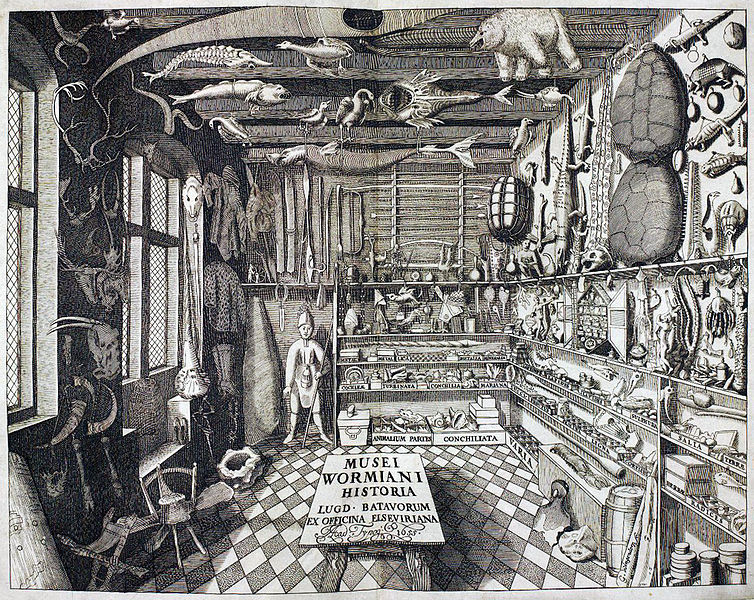
The Cabinet of Curiosity and the Levels of Analysis Problem in International Relations (IR)

Last October during the Millennium conference, Materialism and World Politics, STS and IR theorists met on the last day to discuss potential collaborations and resonances between the two discourses.  “Materialism” as a theory and as a methodology made a helpful facilitator for this conversation. One of the main points the discussion centered on during the conference was what “subjects” could be “objects” of study in each discourse.

It came down to this: STS likened choosing its subjects and objects of interest to looking into a “cabinet of curiosities.”  IR is decidedly wedded to its levels of analysis. The sovereign state and the international system of states, and–to a lesser degree–the sovereign individual. These are the legitimate subjects/objects of study in IR.  Of course, these levels are being pushed and questioned, as is evidenced by the conversation we had in London, but they figure large in the epistemology of IR.

To return to the subject of “bodies,” there is something puzzling about how IR, as a discourse and a practice, speaks of the body, or, more specifically how IR theorizes and and understands the human body in this tripartite schema of system, state, and individual.

In other disciplines, there has been an increased interest in the study of the body as a social and material phenomenon beyond a scientific or medical perspective, but, until recently, IR has never much about the human body. Conversations and analysis have focused on the state, and on the individual as connected to states.

But, how is this “individual” understood beyond the civil and legal terms that dominate our field?  Not just as a voter or a rational actor, but as an actual, material body that can be fragile, leaky, diseased, sold, colonized, male, female, multiple?

This body is a powerful body, one that cannot be fully securitized or regulated, but its seductive power to IR theorists is unmistakable.  Folllowing in the footsteps of Machiavelli, Hobbes, Kant, and other precursors that IR has adopted as its own, IR theorists have understood or likened the state to a person (Wendt and constructivism), or used body metaphors to describe it (organs of government, for example).

This “state as a person” debate and bodily metaphors show that the body never really disappeared (as sociologists and social theorists already said in the 1980s and on), it was just less visible. A variety of recent literature in IR, and the conference in London, can attest to a new (renewed?) interest in concerns of the flesh, so to speak.  This may be due, in part, to a concomitant questioning the sovereign state as the legitimate subject of study, and most relevant actor in IR in a complex, interconnected, and globalized world with diverse actors and multiple relations of power and accountability.

This is certainly where STS has the most to offer IR–some promiscuity, as Deleuze would insist upon, in methods and subjects/objects of study. Cabinets of curiosities rather than hierarchies and levels.

Image