
Not sure if I disagree, although destruction of books is not my style.
Not sure if I disagree, although destruction of books is not my style.

It is practically lore now that Latour is right that if only sociology had listened to Gabe Tarde instead of old Émile Durkheim, we could have obviated a seriously bad detour in the history of sociological analysis. Admittedly, that’s a super-glossy gloss, but that is basically what Latour argued in Reassembling the Social.
Now that I’m teaching social theory again, I am not so sure Latour was right, or, put another way, I think we made another even bigger mistake in sociology, but it was before the likes of Durkheim and Tarde ever went at it — before either were born. The break to be worried about, given our recent discussions about the austerity-infrastructure relationship, is one the divided Saint-Simon and Auguste Comte. Without going into the full details, Saint-Simon was a social thinker that kept infrastructure closely in mind; in fact, to him, a “socialist” (note: not socialist, as in the modern political moniker, but socialist in the form of a socially organized rather than religiously organized society) was somebody that supported pro-social endeavors, for example, projects that result in something meaningfully useful to “all” of us (hence, the social part of socialist). For example, his early plans were to develop canals indicating that nothing was more social than infrastructural developments (he even anticipated and offered a design for what would eventually be called the Seuz Canal). His best student, however, Auguste Comte, did not have such a practical mind. Instead, Comte gave us terms like “sociology” and “society” and devoted himself to arm-chair theorizing. This break, between “the social” connoting shared infrastructure and “the social” being more of the world of ideas if only they could be properly rendered from the comfort of an office chair, is the break we should be worried about.
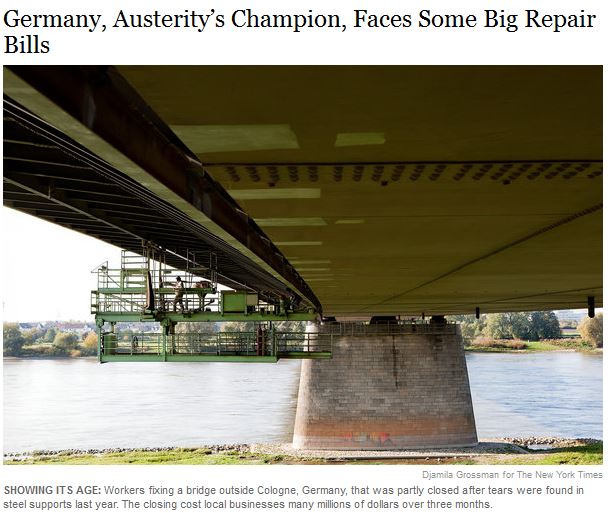
Infrastructure research might get a “shot in the arm” over the next decade, but perhaps only because of the deleterious effects of political/economic austerity measures. Perhaps we need to start developing more concepts around the topics of decay and decay-remediation over the next few years.
Suzanne Daley and Alison Small report that austerity in Germany has weakened its infrastructure, one of its most important public investments:
Germany was once known for its superfast autobahns, efficient industry and ability to rally public resources for big projects, like integration with the former East Germany. But more recently, it has been forced to confront a somewhat uncharacteristic problem: Its infrastructure — roads, bridges, train tracks, waterways and the like — is aging in a way that experts say could undermine its economic growth for years to come.
In the years to come, as austerity measures reach a fever pitch (in both popularity and critique), we should expect to hear more about the deleterious effects of austerity on infrastructure. Those of you in the “know” already have seen the wave of such discussion. For a merely a smattering of such discussion, consider American Dave Johnson’s blog, Colin Turner’s work on seeing austerity as a “pro-growth” model of governing infrastructure investments, or Mark Gongloff’s Huffington Post piece linking a bridge collapse with austerity measures, though there is much, much, much, more to say.
This should be a recurrent theme in scholarship in STS, although the topic seems only modestly addressed in our professional literature (with a few notable exceptions).
In a recent post on “Understanding Society”, Daniel Little discussed some recent development in the philosophy of social science: Analytic Sociology, Critical Realism and Actor-Network Theory. Here is how it goes:
Start with a few resonances between ANT and CR. Both are grounded in a philosophical system (Deleuze, Kant), and they both make use of philosophical arguments to arrive at substantive conclusions. (…) But a point of contrast is pervasive: CR is realist, and ANT is constructionist.
(…) The anti-philosophical bent of AS makes it difficult for AS scholars to read and benefit from the writings of ANT scholars (witness, for example, Hedstrom’s dismissal of Bourdieu). The model of explanation that is presupposed by AS — demonstration of how higher-level entities are given their properties by the intentional actions of individuals — is explicitly rejected by ANT. (…)
Finally, what about the relation between AS and CR? On the issue of causation there is a degree of separation — AS favors causal mechanisms, preferably grounded in the level of individuals, whereas CR favors causal powers at all levels. (…) But here there is perhaps room for a degree of accommodation, if CR scholars can be persuaded of the idea of relative explanatory autonomy advocated elsewhere here.
via Understanding Society: How do the poles of current PSS interact?.
Somehow I felt a bit like I was suddenly in an academic version of an episode of Doctor Who, jumping back in time, stranded in 1992. In a paper that came out in parallel to the well know “Chicken Debate” (Collins/Yearly 1992; Latour/Callon 1992), but that was burried in a edited volume (McMullin 1992), Latour moved ANT explicitly away from what until then was called the “Social Studies of Science” and towards a framework to deal with the moderns. He wrote:
“A radical is someone who claims that scientific knowledge is entirely constructed ‘out of’ social relations; a progressist is someone who would say that it is ‘partially’ constructed out of social relations but that nature somehow ‘leaks in’ at the end. (…) a reactionary is someone who would claim science becomes really scientific only when it finally sheds any trace of social construction; while a conservative would say that although science escapes from society there are still factors from society that ‘leak in’ and influence its developmentIn the middle, would be the marsh of wishy-washy scholars who add a little bit of nature to a little bit of society and shun the two extremes.(…)” (Latour 1992: 277)
And then concludes:
“If one goes from left to right then one has to be a social constructivist; if, on the contrary, one goes from right to left, then one has to be a closet realist. (…) It is fun to play but after twenty years of it we might shift to other games (…)”
Hmmm. Maybe it is not Doctor Who, maybe it is Groundhog Day and we are just waking up again at 6:00 to the voices of Sonny and Cher. Do we really have to have the same debate again, now not in the philosophy of science but the philosophy of social science? Maybe there is a reason to do that – after all, Phil Connors has to repeat his morning routine over and over again until he starts making himself a better man and finally finds a way to love and happiness. After all, Little does indeed think it is important to add “ANT to the menu for the philosophy of social science, at least as a condiment if not the main course” and there are others in that field today that share his opinion. Maybe if we don´t discuss those issues again and try to work diplomatically with the moderns (in this case: AS and CR…) on what they value most, we are selfish and grumpy fools – like the character that Bill Murray played so beautifully. But it is not tempting to know that the sound of “I got you babe” will be with us for a while. Is there a way out? A shortcut? A “shift to other games”?
Limn (“Limn is somewhere between a scholarly journal and an art magazine”), edited by Stephen J. Collier, Christoffer M. Kelty and Andrew Lakoff, just published its fourth issue on food infrastructures. Here is the opener, check it out:

Issue Number Four: Food Infrastructures
edited by Mikko Jauho, David Schleifer, Bart Penders and Xaq Frohlich
This issue of Limn analyzes food infrastructures and addresses scale in food production, provision, and consumption. We go beyond the tendency towards simple producer “push” or consumer “pull” accounts of the food system, focusing instead on the work that connects producers to consumers. By describing and analyzing food infrastructures, our contributors examine the reciprocal relationships among consumer choice, personal use, and the socio-material arrangements that enable, channel, and constrain our everyday food options.With articles by Christopher Otter, Franck Cochoy, Sophie Dubuissson-Quellier, Susanne Freidberg, Heather Paxson, Emily Yates-Doerr, Mikko Jauho, Kim Hendrickx, Bart Penders and Steven Flipse, Xaq Frohlich, David Schleifer and Alison Fairbrother, Javier Lezaun, Michael G. Powell, Makalé Faber-Cullen and Anna Lappé!

Open letter to readers:
This is Nicholas Rowland and Jan-Hendrik Passoth. This year we’re chairing sessions at the annual meeting of the Society for the Social Studies of Science (4S) (20-23 August 2014, Buenos Aires, Argentina) as well as the annual of the European Association for the Study of Science and Technology (EASST) (17-19 September 2014,Toruń, Poland). Consistent with years past, we have proposed a session with multiple panels, all organized around the broad and basic topic of STS and “the state.”
We invite you to submit your work to the sessions. Over the past half-decade or so, we have done our best to host papers on a variety of topics related to the state in some way (state and state infrastructure projects, policies, and practices, and anything related to state theory itself).
Also, consistent with the last few years, 4S and EASST leadership have required us to be a little more formal when it comes to submitting papers. So, if you do decide to submit your work (and we hope you do), please submit the paper abstracts individually through the formal 4S and EASST on-line paper submission process.
For 4S, the deadline for submissions is March 17th. Here is the website for the conference. You can submit here; they want 250 words and a title. We are track 74.
For EASST, the deadline for submission is March 28th. Here is the website for the conference. The submission site is not yet up (the deadline for session proposals was only 08 Jan 2014; they will likely want 250 words too and a title. We will update this as soon as the system goes live.
We look forward to expanding and extending in new ways the discussions we started in Cleveland in 2011, Copenhagen in 2012, and San Diego in 2013.
our very best,
Nicholas Rowland
Jan Passoth
p.s., our track to 4S is here and our track sent to EASST is so similar we don’t need to share it again.
Next installment of Foucault …
Lecture of twenty-fourth January, 1973
As my notes and comments on this expanded beyond the length of what I posted for previous lectures, I posting on this lecture in two parts.
Foucault sets up this lecture in such as way as to emphasise the political context of debates around criminality. Though some of this can be found in his book of 1975 Discipline and Punish, much of it is more taken up in the lectures of 1975 to 1976, Society Must be Defended, and the lectures of 1976 to 1977, Security, Territory, Population. Here he suggests that look at attitudes to towards criminality and the penal code in the context of the upheavals and debates regarding sovereignty, institutions, and the use of violence to change or preserve these things, which make up the French Revolution.
In the debates of 1791, Maximilien Robespierre opposed the idea that the…
View original post 639 more words
Borders.
Wired has some striking images of the world’s most volatile borders. Thanks to David Campbell for the link.

My work on drones has been invigorated by reading an outstandingly creative essay by Lucy Suchman on ‘Situational Awareness: deadly bioconvergence at the boundaries of bodies and machines’, forthcoming at the ever-interesting Mediatropes. It’s sparked both an e-mail conversation and an invitation to speak at a symposium on Security by remote control: automation and autonomy in robot weapon systems at Lancaster University, 22-23 May. Here is the call for papers:
Remotely operated and robotic systems are central to contemporary military operations. Robotic weapons can select targets and deliver lethal force with varying degrees of human control, and technologies for fully autonomous weapon systems are currently in development. Alongside military reconnaissance and the prospective configuration of ‘killer- robots,’ drone technologies are being deployed for ostensibly peaceful purposes, most notably surveillance of public space, private property and national borders. More generally, the frame offered by contemporary security discourses has redrawn…
View original post 726 more words
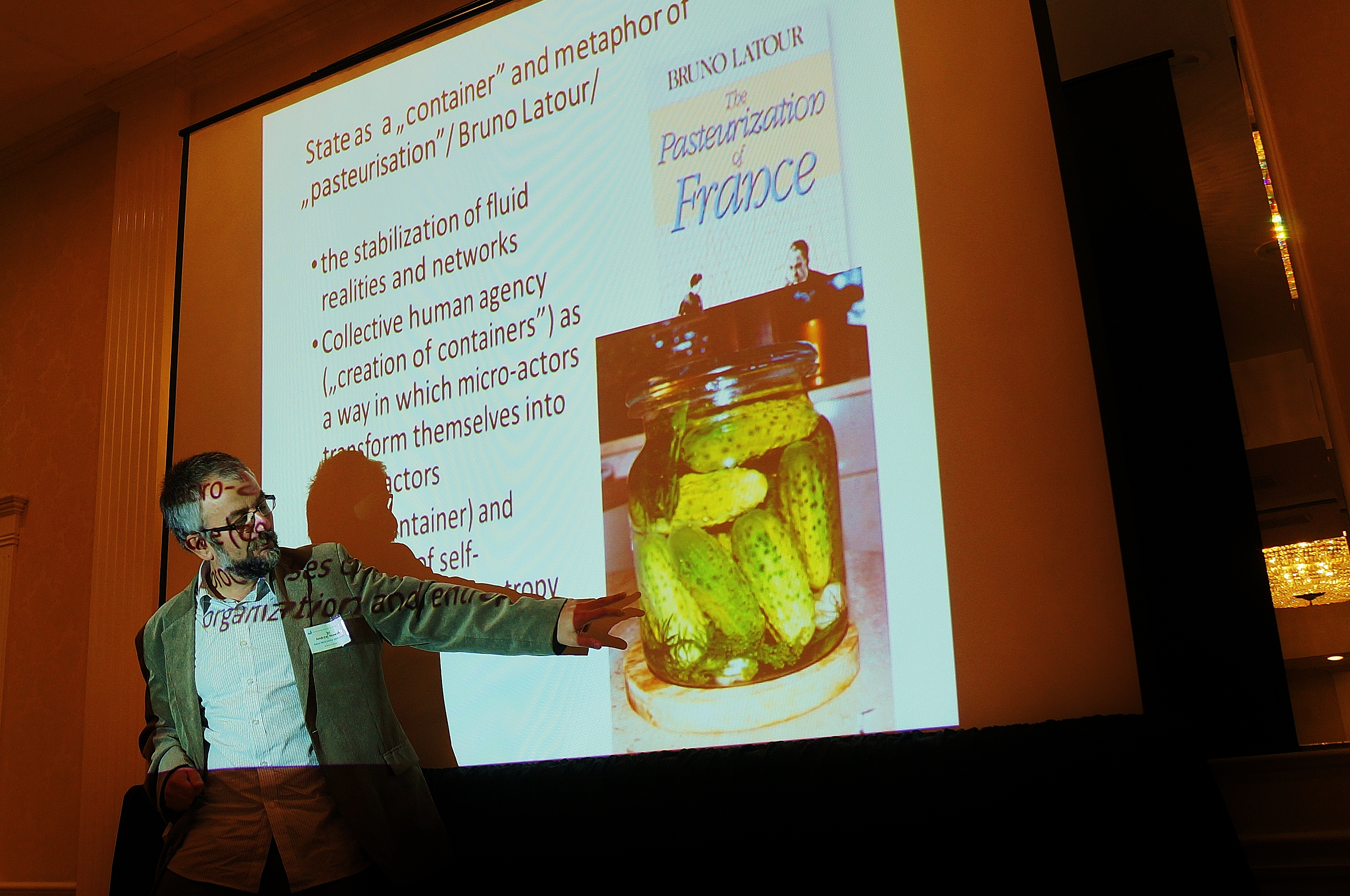
In this rather long post, Andrzej W. Nowak, now a guest blogger at Installing Order, asks whether or not we can collapse the boundary between information and structure. No doubt, given that these two terms mean so many different things depending on the tradition they are embedded within, this is bound to be a difficult task, which is why Andrzej is so careful to specify the unique traditions from which he hopes to, once and for all, decimate the boundary between information and structure. — Nicholas
Information as a Structure, Structure as Information. Power relation and dynamics of networks
I want to examine here, a problem of relation between the notion of ‘information’ and the notion of ‘structure’. My main thesis will be that the very distinction between these two notions can be abolished; in the perspective I want to adopt they can be understood as synonyms.
To describe this perspective I will use a term ‘network ontology’. I propose that we can combine two traditions where the notion of network is used: Actor Network Theory (represented by Bruno Latour and others) and “new science of network” (represented by Duncan Watts and Laszlo-Albert Barabasi). I am absolutely aware that such a comparison might be perceived as controversial, mainly because these two traditions are very different. I know exactly that Bruno Latour himself reject such comparison. But I am bold enough not to be Latourian, but to go my own way.
I am also aware that, at first glance, in these two theories the very term “network” refers to completely different phenomena and, in fact, cannot be used interchangeably. This is reason I would like to ask, about possibility of comparison and mutual translation of these two ways of understanding of the notion “network”. Could such experiment help us in expanding our view of network ontology? Material and ontological character of ANT gives us opportunity to show how information is structured and embodied in concrete world of things, objects, artifacts etc. “New Science of network” gives us rare opportunity to show dynamic process of self-organization (Novotny) and its consequences, also it is a useful tool for analysis of power relation.
Information as a Structure. The notion of ‘Network’ in ANT
When we try to explicate the notion of ‘network’ in Actor–Network Theory we should remember that Latour himself is very skeptical about this notion. In “Actor Network and After”, he declared that there are four things wrong with actor-network theory: “actor”, “network”, “theory” and the hyphen. On the other hand, in Reassembling the Social: An Introduction to Actor-Network-Theory), he changes his opinion and accepts the wide use of the term . What worries Latour about the term ‘network’ is its common understanding that associates it with World Wide Web. In his opinion this association is misleading because it suggests that the actor (or information) is moving unchanged on the network. To avoid this misunderstanding, as we well know, he refers to a Deleuzian term ‘rhizome’. He follows McLuhan’s statement that “medium is a message” and claims that every single operation (all forms of communication, sending information, creating knowledge) is always a ontological operation. New network, new information is always connected with work which has to be done. There is no single bit of information which can be send without hidden work.
The terms ‘collectivity’, ‘network’ and ‘actant’ are in ANT all synonymous of complexity. I claim, that there is a set of particularly important problems that in fact haven’t been fully scrutinized in ANT. They include the problem of structure of the complex collectivity and its dynamics and also the question of the rule of affiliation and association of new elements. I want to suggest that despite all his declarations and promises Latour doesn’t fully recognize the significance of these problems.
At this point I think we should examine the second part of the title structure as information:
To analyze this we should consider holistic presumption which we often accept when we think about complex systems and with some controversy when we think about Latour’s assemblage. This is the most basic Aristotelian presumption that complex system is something more than just a sum of its parts. Accepting this we have to acknowledge a phenomenon of emergence. I want to claim that the phenomenon of emergence causes some theoretical problems to ANT and that it complicates its “flat” ontology.
In ANT new networks emerge out of the already existing ones. Networks are growing and expanding and are stabilized. But in my opinion, while Latour rightly emphasizes the role of humans and nonhumans as parts of collectivity, he also neglects the laws of collectivity. The result is that the problem of internal dynamics of the complex network system remains unresolved. Latour shows us clearly how actors/actants are or become networks. But he does not put the same emphasis on explaining how networks are or become independent actors. If actants and networks together create a whole, a collectivity, which is a complex system, then there should be new emergent laws which rule this collectivity. At first sight it could seem destructive to “flat” ontology and “ocasionallism” of ANT. However, I think it is possible to save this ontology if we decide to treat the emergent laws of collectivity and the laws of affiliation as actants.
We can understand functioning of these actants when we move to Network Science
Structure as Information.
There are many theories which deal with the problems of emergence and complex systems. I will refer here to ‘new’ Science of Network. It is a set of theories associated with works of Steven Strogatz, Duncan J. Watts and Albert-Laszlo Barabasi.
Social physicians (among them Watts and Barabasi) recognize the problem of nonhuman in commonsense way. Because they concentrate on social network their analysis overlooks very complicated relations between the realm of ‘the social’ and the realm of “objects”. But in my opinion this shortcoming can be overcome with the help of ANT understanding of materiality. Social physicians are more like scientists than sociologists. In their research they draw on mathematics and theoretical physics. However, I want to claim that their traditional, naïve vision of the relation between humans and non humans can be transformed in accordance with Actor Network Theory without significant changes in the core of their approach. There are some elements of Watts and Barabasi theories that support my claim – for example when they use the same mathematical tools to describe processes of synchronization in case of clapping hands or crickets chirping.
At first sight Barabasi and Watts are using the term social in a traditional way, but when we look closer at it we can discover that they have much more in common with ANT. Watts and Barabsi concentrate on a type of linking, connecting and assembling things. They try to explain this in a traditional language of “hidden” social force. But I suggest that in the very core of their approach they can be treated as a Tardian sociologist.
However, in my opinion if we want to reconcile Barabasi and Watts network science with ANT we have to deal with one more problem. It is a relation between an actor and a network. Barabasi and Watts are widely recognized as scientists whose research field is World Wide Web. As we remember Latour strongly opposes associating his notion of ‘network’ with the internet and WWW. But the theories of Strogatz, Watts and Barabasi on one hand and ANT on the other reveal many similarities when we look at them a little closer. Watts, Granovetter and Barabasi seem to differentiate between actor and network. But the analysis of synchronization of clapping hands or crickets chirping made by Watts shows clearly that there is no single traditional actor, like a single clapping person. Instead, it might be the laws that organize complicated networks that we may identify as actors. It turns out that one of the implications shared by both the network science and Actor Network Theory is that the agency is not only a consequence of network laws, but it is a network itself.
Now I want to show in what way ANT could benefit from the insights developed in network science.
First advantage is connected with the idea of ‘small world theory’ (Watts). When we analyze the hubs and connecteions we can discover some other network laws governing power distribution within the network. Important hubs have tendency to become bigger and bigger and internal structure of the whole network is based on the existence of these hubs. But it means that the distribution of power within the network is very “unequal’ or “aristocratic”. It is desribed as a ‘power laws’ or – if we refer to Barabasi – by the term ‘free–scale networks’. (The phenomenon of ‘free-scale networks’ is often known as an 80/20 Pareto rule, or a Saint Mathew effect, etc.)
The highest-degree ‘nodes’ called ‘hubs’ play a significant role in the whole network. The most important and valuable insight of the network science is that the condition of having control over or influence on the network is the knowledge of the network’s structure. This knowledge must include the localization of clusters, cliques and – most of all – the position of ‘hubs’. It is only this knowledge that opens possibility to influence the network as a whole. In this context we can conclude that the structure itself is the information.
Conclusion
I wanted to show that incorporating ideas from network science into Actor Network Theory research program may seem to destroy simple and elegant “flat” ontology of ANT. I also wanted to show that if we want to compare the two network approaches (ANT and network science) we have to take up the problem of a growth of the network and of creation new macro actors. By referring to the ‘small world’ theory I wanted to show that the possible influence the actors may have on the network as a whole depends not only on their size but mainly on their localization in this network. As I mentioned before it is the hubs that concentrate the power in the network.
I wanted to show that apart from “black boxing” practice there is another way of creating macro actors. Macro actors can be also created by the internal laws of complex network system. This kind of macro actors, like the laws of complex network systems, should be treated as independent nonhuman actants. In Latour’s theory the collectivity of humans and nonhuman actants also include such actants as the laws of complex collectivity.
Network science and Actor Network Theory try to blur or invalidate the distinction between natural and social science, although they do this form opposite directions. I am strongly convinced that these two tradition should draw extensively from each other.
I would like to discus here, in public draft, some ideas which I get some time ago. I presented this ideas first time, in a paper at Wittgenstein Symposium (here). Now I am working on a article about this topic (still in progres). Feel free to give me feedback and suggestions.
/Andrzej W. Nowak/

One of the Horizon 2020 grand challenges for research and innovation is precisely that: Integrate the social science and humanities.
The value and benefits of integrating Social Sciences and Humanities
European Social Sciences and Humanities are world class, especially considering their diversity. They are indispensible in generating knowledge about the dynamic changes in human values, identities and citizenship that transform our societies. They are engaged in research, design and transfer of practical solutions for a better and sustainable functioning of democracy. Their integration into Horizon 2020 offers a unique opportunity to broaden our understanding of innovation, realigning science with ongoing changes in the ways in which society operates.
1. Innovation is a matter of change in organisations and institutions as well as technologies. It is driven not only by technological advances, but also by societal expectations, values and demands. Making use of the wide range of knowledge, capabilities, skills and experiences readily available in SSH will enable innovation to become embedded in society and is necessary to realise the policy aims predefined in the “Societal Challenges”
2. Fostering the reflective capacity of society is crucial for sustaining a vital democracy. This can be achieved through innovative participatory approaches, empowering European citizens in diverse arenas, be it through participation as consumers in the marketplace, as producers of culture, as agents in endangered environments, and/or as voters in European democracies.
3. Policy-making and research policy have much to gain from SSH knowledge and methodologies. The latter lead to new perspectives on identifying and tackling societal problems. SSH can be instrumental in bringing societal values and scientific evaluation into closer convergence.
4. Drawing on Europe’s most precious cultural assets, SSH play a vital role in redefining Europe in a globalising world and enhancing its attractiveness.
5. Pluralistic SSH thinking is a precious resource for all of Europe’s future research and innovation trajectories, if it can be genuinely integrated. H2020 offers this opportunity for the first time.
Conditions for the successful integration of Social Sciences and Humanities into Horizon 2020
7. Recognising knowledge diversity: Solving the most pressing societal challenges requires the appropriate inclusion of SSH. This can only succeed on a basis of mutual intellectual and professional respect and in genuine partnership. Efficient integration will require novel ways of defining research problems, aligned with an appropriate array of interdisciplinary methods and theoretical approaches. SSH approaches continue to foster practical applications that enhance the effectiveness of technical solutions.
8. Collaborating effectively: The working conditions of all research partners must be carefully considered from the beginning and appropriately aligned to set up efficient collaboration across different disciplines and research fields. This includes adequate organisational and infrastructural arrangements, as well as ties to other stakeholders in civil society and business. Budgetary provisions must be appropriate to achieve this goal.
9. Fostering interdisciplinary training and research: Integrating SSH with the natural and technical sciences must begin with fitting approaches in post-graduate education and training. Innovative curricula foster a deepened understanding of the value of different disciplinary approaches, and how they relate to real world problems.
10. Connecting social values and research evaluation: Policy-makers rightly insist that the impact of publicly funded research and its benefits for society and the economy should be assessed. Accurate research evaluation that values the breadth of disciplinary and interdisciplinary approaches is required to tackle the most pressing societal challenges.

Kyle McGee’s Bruno Latour: The Normativity of Networks was published late last year. Looks interesting, with an examination of Latour’s legal theory. It comes with two very positive endorsements, including one from Latour himself. Great shame about the price though.

Hello, since Jan’s friendly post before the holidays, we have been on break.
However, Thursday this week, we’ll be back on track blogging with our guest Andrjez.
Until then, consider this interesting case of an abandoned place, Sealand, nestled in a sandbar in the North Sea 13 kilometres (7 nmi) off the coast of Suffolk, England, United Kingdom.

Our colleague and friend Andrzej W. Nowak from Adam Mickiewicz University (Uniwersytet im. Adama Mickiewicza w Poznaniu) in Poznań, Poland, is joining the blog as a Guest Blogger.
Please welcome him.
I’ll introduce him through a bit of information that he sent me recently. He shared with me this 3-min film, which briefly shows the police’s violence at the Economic University in Poznan, PL. The police attacked a small group of people peacefully protesting against a pseudo-‘scientific’ lecture (“gender as a destruction of the human and the family”) delivered by a priest (& lecturer from theology dept at Adam Mickiewicz University).
The event took place on 5th Dec. Unfortunately, Andrzej couldn’t find any news in English.
Andrzej is falsely accused in Polish right wing blogs as well as a few newspaper as a hooligan; someone who was main provocateur of this event. Just the right sort of company for us on the blog!
WELCOME ANDRZEJ!
*And the photo above was taken at the event by one of Andrzej’s friends.
P.s., when I first asked Andrzej to join the blog he wrote back: “I don’t have time to make science when I really did STS and State exercise (batons, shield, electroshocks)” (!)
This has been an interesting year for all of us at installingorder.org. We had a number of good topics this year and we are very happy that the blog is now way more interactive than it was before. We have been a little quite over the summer, sorry for that, but we are back since 4S 2013 in San Diego which was a great conference and a fantastic meeting for all who study societies sociotechnical nerves.
Stefanie Fishel joined us, first as a guest blogger, then as full time author. Thanks for the great input, Stef! Next year will see guest bloggers again, starting with Andrzej W. Nowak from the Adam Mickiewicz University in Poznań, Poland. (See his TedXPoznan talk on youtube, sad that I don´t speak polish). We are looking forward to that! And there will be more! Expect 2014 to be as interesting as the last.
For the rest of the year we will, as most of you will too, take a little break and rest over the holidays. Have yourself a merry Christmas, if you want to have it, or happy Hanukkah, if that is yours, or a great flying spaghetti monster gathering. However you spend your days, think about Santa´s little elves at Amazon, FedEx or DHL and about the massive infrastructural work necessary to let you have some Eggnog, Chestnuts or that box of Breaking Bad episodes that you need for the upcoming festivities. See you all next year!
Is “the political always technical” or is “the technical always political”? An interesting interpretation of discussions we’ve had here: https://installingorder.org/2013/12/18/infrastructure-is-politics-by-other-means/
Jeremy Crampton has responded in a very interesting way to my comment that ‘the political is always technical’. I made that comment in my remarks to the ArcticNet conference last week – a summary and the audio recording are here. Here’s the key paragraph he is responding to:
One of the previous presenters had made the claim that there was nothing political about some of the techniques. While I made the comment that we could say that there is always a politics to the technical, I was most interested in turning his claim around, rather than disagreeing with it: suggesting that the political is always technical. I’ve made this claim before in relation to territory as a political technology, as dependent on all sorts of techniques for measuring land and controlling terrain.
Jeremy’s post is interesting on several levels. The first is that he sees this response as a…
View original post 413 more words

Call for Papers – *Spontaneous Generations: A Journal for the History and Philosophy of Science*
http://spontaneousgenerations.library.utoronto.ca
Submissions for the eighth issue should be sent no later than *March 14, 2014. *
**Science and Social Inequality:*Science and technology reflect and perpetuate social inequalities, but also serve as crucial sites of contestation, intervention, and hope. Over the past several decades scholars, particularly those engaged with feminist and critical theories, have questioned the ways in which inequalities among the producers of knowledge affect the kinds of knowledge produced. At the same time, investigations into the social engagement with science have pointed to the ways in which science can, and has, benefitted from the inclusion of marginalized groups. This focused discussion aims to encourage scholars in the history and philosophy of science or science and technology studies to consider inequalities within scientific practice, professions, and knowledge production. We will feature work that explores the causes and
consequences of—or resistances to—these inequalities and how they shape the experiences and knowledge claims of historically marginalized individuals.
We seek scholarship that pushes STS and HPS to re-engage with questions surrounding science as a professional “field” and, in particular, as one that has been—and remains—stratified in practice by inequalities of race, gender, and social class.
We welcome research that interrogates the various and intersecting forms of inequality, and resistance to inequalities, that shape power structures in science and technology at any time or place. We seek research comparing various areas of scientific practice. Submissions can focus on a variety of institutional and national contexts, can use both historical and contemporary cases, and can draw on a variety of critical and methodological perspectives. The questions below may help guide potential submissions:
1. What perspectives on inequalities within scientific practice
can we draw from critical theories, such as feminist and critical race
theories?
2. How has diversity and inequality affected inter/multi/trans-disciplinary scientific collaboration and “Team Science”
(inclusive of academic and non-academic science teams)?
3. What has been the role of gender, race/ethnicity, and
socioeconomic status in scientific education and training across the
educational spectrum?
4. What is the normative and instrumental value of diversity in
science, given science’s orientation as “value-free,” objective, and
universal? Why is scientific diversity a good thing? Have diverse
scientific teams produced better science?
5. What has been the role of the “invisible worker” in science
and technology at different times and places? What light can historical and transnational studies shed on the changing position of the “invisible worker”?
6. How have inequalities of race/ethnicity, gender/sexuality,
class, and ability permeated the ranks of knowledge production and affected the kinds of knowledges that are produced?
7. How have science and technology been (re)configured to alter
the course of social inequalities?
The eighth issue of Spontaneous Generations will appear in September 2014.
Submissions for the eighth issue should be sent no later than *March 14, 2014. * For more details, please visit the journal homepage at
http://spontaneousgenerations.library.utoronto.ca
*Spontaneous Generations* is an open, online, peer-reviewed academic journal published by graduate students at the Institute for the History and Philosophy of Science and Technology, University of Toronto. It has published seven issues and is a well-respected journal in the history and philosophy of science and science and technology studies. We invite interested scholars to submit papers for our eighth issue.
We welcome submissions from scholars in all disciplines, including but not limited to HPS, STS, History, Philosophy, Women’s Studies, Sociology, Anthropology, and Religious Studies. Papers examining any time period are welcome.
The journal consists of four sections:
– A focused discussion section consisting of short peer-reviewed and
invited articles devoted to a particular theme. The theme for our eighth issue is “Science and Social Inequality”* (see a brief description
below).
Recommended length for submissions: 1000-3000 words.
– A peer-reviewed section of research papers on various topics in the field of HPS. Recommended length for submissions: 5000-8000 words.
– A book review section for books published in the last 5 years.
Recommended length for submissions: up to 1000 words.
– An opinions section that may include a commentary on or a response to current concerns, trends, and issues in HPS. Recommended length for submissions: up to 500 words.

Times does not exist. At least, we think time does not exist.
According to Ferenc Krausz at the Max Planck Institute of Quantum Optics in Garching, Germany, time is unlikely real.
Efforts to understand time below the Planck scale have led to an exceedingly strange juncture in physics. The problem, in brief, is that time may not exist at the most fundamental level of physical reality.
Check out the original Discovery reading here. It is an easy read and would do well if presented students in-class to read on-the-spot and then immediately discuss it. It has worked well for me to get at issues of “reality” in a surprisingly concrete way. Admittedly, this might seem like a no-brainer for long-time friends of social constructivism. Still, time is generally a great concept for an STS class, especially issues of “standards” and so on. We’ve discussed it once before on the blog here.
One of the comments is particularly nice for students to chew on:
This article was written in 2007, and I am responding to it and commenting on it in 2013. Why? Because “time” doesnt exist.
Also, of interest: notice that you have to raise time as real to tear it down as not real, signifying the significance of real-time for understanding the un-realness of time.
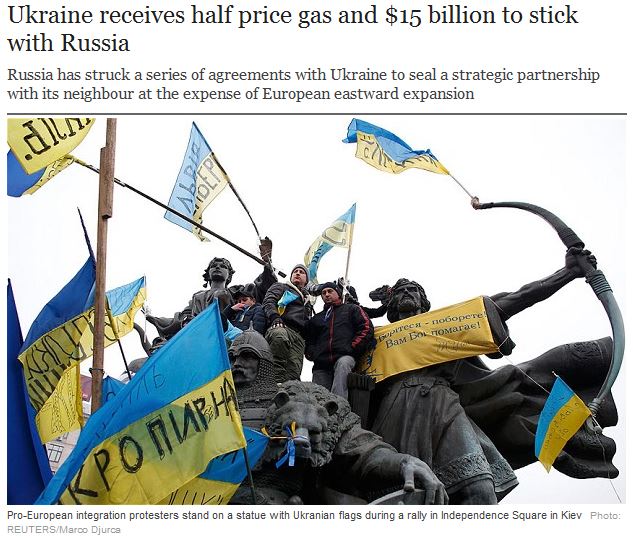
Spent the morning reading Petrostate by Marshall Goldman, and look what I find in my news feed: “Ukraine receives half price gas and $15 billion to stick with Russia.” Reminds us all that infrastructure (and control over infrastructure) is politics by other means. As Goldman mentions in the book (I’m paraphrasing): Who wants/needs nuclear weapons, when there is no mutually-assured destruction to curb the use of petroleum and natural gas!?
Stef wrote something about this recently too, but not about pipelines. Along these lines, I’m in the middle of reviewing Andrew Barry’s new book (about pipeline infrastructure and politics from a geography angle) for Science Technology ans Society (the EASST journal).
Virtual Special Issue is a great idea; here it is applied to post-apartheid geographies. Recycling research is good.
(real amazon.com message to me)
Theory through interview and over time.

According to Rebecca Savastio of Liberty Voice, there is good reason to believe that American news sources are purposefully not covering the political transformations of Iceland over the last five or so years:
Socialist and Marxist blogs here in the U.S. say that there’s been a massive U.S. news conspiracy and cover up about the revolution in Iceland because the U.S. media is controlled by corporations, including banks, and the “powers that be” don’t want U.S. citizens getting any ideas to stage a revolution of their own. Some conservative Icelandic bloggers claim that while there was, indeed, a revolution, it did not lead to a successful or widely accepted new constitution. They say the situation in Iceland is worse than ever, and that international news reports of an effective democratic uprising leading to a better government are simply myths. Social media commenters are scratching their heads over why they were robbed of the story of Iceland’s pots and pans revolution.
There is also a video (in the pic above) documenting this “pots and pans” revolution that is available here, which is quite good.

In the US, assigning papers seems like its on the way out. Here is why.
So, no more STS papers in my STS courses (?) … seems somehow a little sad.
Still, one solution the author proposes is that we, as faculty, engage the students in more oral exams and more “hard core” (whatever that means) written exams. This is bothering me.
Discussion of content over word count (on blogs)
A few days ago on this blog, Cheri took a look at this year’s successful National Blog Posting Month (NaBloPoMo), the month-long event during which bloggers write a new post every day. The end of November also signaled the finish line of the the granddaddy of all writing challenges, National Novel Writing Month.
This year, 311,575 writers set out to produce a 50,000-word novel in the course of a month. A healthy chunk of those word-marathoners also keep a blog or an author’s site here on WordPress.com. In honor of their labor (and the insane amount of coffee they’ve consumed over the past 30 days), let’s take a look at some of their hard-earned wisdom from the fiction-writing trenches.
NaNo projects come in all shades of the storytelling spectrum — from dark horror tales to uplifting narratives of redemption. The challenge brings together first-timers…
View original post 661 more words
Write a book; there’s a future in it.
Good piece from Duke University Press on the future of book publishing.
Technology—our use of and reliance on it—is a fraught topic in the modern world. Perhaps it is appropriate to begin this blog by noting that I sat down to make preliminary thoughts at the table with a pen and paper. I took these notes and keyed them into my word processing program later. I skipped the typewriter, but I think Heidegger’s concern about “proper writing” and technology is still worthwhile to reflect upon. Does my keying these words into my laptop separate me from myself, from my ideas in a dangerous way—in a way that is different from the technology of the pencil or pen? To add to this, I chatted with a friend on Facetime about the topic and will later post a link to this blog on Facebook. Maybe someone will tweet this blog. The technology behind this blog on technology….
More seriously, how do these electronically mediated encounters affect my relation with the world? Broadly, we can ask how do the mediums (pencils, laptops, internet) affect our writing and creativity, and even more importantly, how do different technologies enable particular ways of understanding the world and acting in it? While I very much believe that the pencil can be as fascist as the Mac, and that the pen is a tool like a mouse is a tool, the larger question regarding technology remains unanswerable at this time. These technological changes in communicating information over the last two centuries, showed above by the switch from pen to word processing, may be just a difference in degree. On the other hand, especially with the ongoing work on AI; robotics; chatbots; the Internet of Things; and iBeacon and Bluetooth LE, they may be a difference in kind. Will the singularity, or advanced information technologies, allow us to “transcend our biological limitations,” as Kurzweil contends?
Even without the possibility of uploading our consciousness into a server, many are concerned with the effects of technology on our personal relationships. Multiple studies are undertaken to understand how digital closeness may in fact make us more distant from our family and friends. How many Facebook friends are counterproductive to relationships made and nurtured in IRL? Do online dating site algorithms know you better than yourself? What is it about the cold intimacy of the online space that generates such love stories—both torrid and commonplace? Big data may change many things, including dating.
This doesn’t begin to address the relationship between particular institutions and technology. Every semester, I teach freshman about technology and violence. We cover the ongoing Revolution in Military Affairs, and more broadly, how technology is impacting how people fight and die in modern warfare. Surveillance and weaponized drones stand to change the face of war in the 21st century. Robots are increasingly used in conflict situations: IED detection units and so-called battlefield “killer robots” that take humans out of the loop in the future making autonomous decisions on targeting, to name but two.

DARPA has spent millions researching and developing micro air vehicles like the RoboBee. Spend some time on the DARPA site, look at Global Defense Technology publications, or peruse the archives of Wired Magazine’s Danger Room for countless more examples. Fiction becomes reality with exoskeletons reminiscent of Ironman:
and “smart weapons,” like the self-aiming rifle, that turn “novices into experts.”
A side note that is worth mentioning concerns Amazon.com’s stunt with drone delivery systems unveiled this Cyber Monday: drones or not, Amazon will likely control the entire infrastructure of package delivery in the future. Amazon Fresh, their next day grocery delivery service, will deliver all the goods with trucks (or perhaps drones in the future) owned by Amazon. They’ve already cut a deal with USPS to deliver packages on Sunday.
While these advances in technology bring up a host of ethical questions that often cannot be addressed with our current legal frameworks and institutions, this military technology goes hand in hand with increased executive power, increased lobbying power of defense contractors like Lockheed-Martin or Boeing, and increasingly militarized domestic policing techniques. In the US, drone strikes are decided by executive order with no oversight from democratically accountable committees or military command. New executive power in the National Defense Authorization Act of 2012 (among other provisions, it allows for indefinite detention of US citizens without trial and was signed into law by President Obama in December 2012), and an older increase in executive power through the War Powers Resolution of 1973, or the War Powers Act (allows the president to commit armed forces without a declaration of war or Congressional approval for 60 days). Also worth noting is the US military’s Joint Vision 2020, a document outlining the combined vision of the various military branches, especially focused on “full spectrum dominance” of all threats, both military and natural. A main focus of this document is Information Technology and robotics used to clear the “fog of war.”
There is also the disturbing general trend toward the militarization of the police in the US. Counterinsurgency techniques are adopted in urban areas, and some programs—like Massachusetts’s C3, or Counter Criminal Continuum, policing—explicitly draw on counterinsurgency techniques. Based on the Avghani Model, born from US experiences in Vietnam and Iraq, it adapts COIN and Green Beret techniques to target gangs and drug dealers in high crimes areas. The website explains, “This is accomplished by, with, and through the local population. C3 Policing creates multiple pressure points on criminal elements and establishes a robust intelligence cycle that drives law enforcement operations. As a result of these efforts, violent gangs and drug dealers are denied operational freedom to maneuver and one by one their networks are attacked systematically.” Along with the disturbing trend toward counterinsurgency techniques used on US soil there is a concomitant attack on civil liberties that intensified with the PATRIOT Act after 9/11. This militarization of police and the concentration of power to suppress the constitutionally protected right to assemble were well demonstrated by the coordinated attacks that forcibly suppressed the Occupy movement in multiple states by the police and the FBI. Last year, Naomi Wolf, writing in the Guardian, told of the findings of The Partnership For Civil Justice Fund. The FBI, the Department of Homeland Security, local police, and local mayors combined efforts to break up Occupy camps across the US. Not only were the attacks on Occupy camps coordinated, they often used illegal crowd control technologies like the LRAD Sound Cannon (and here), tasers, flash bombs, wooden dowels and stingball grenades.

Technology and civil liberties are definitely an area that needs more attention. As of late, another chapter has been added. In part through information provided by whistleblower Edward Snowden, the NSA was found to be surveilling and gathering copious amounts of information on “terrorists” while “accidentally” saving emails, phone conversations, etc from the average American internet and phone user. Apple, Google, Microsoft, Facebook, Yahoo, LinkedIn, Twitter and AOL have recently decried this bulk collection of data in an open letter to President Obama. As reported byThe Guardian, the big 8 will back radical reforms to protect individual freedoms over increased state power. Of course, much of the motivation behind this letter includes the fact that consumers will not purchase what they do not trust and that the NSA surveillance has “shaken the trust of our users,” according to Yahoo CEO, Mayer. In this letter, the above companies put forward five principles that should be put into action. Governments should limit their authority to collect data, have oversight committees when collecting or compelling data, support self transparency, respect the free flow of information, and improve frameworks to avoid conflict among governments through mutual legal assistance treaties (MLATS).
But keep in mind, these are the same companies (and corporations like them) that are behind the Trans-Pacific Partnership free trade negotiations, or TPP. While wanting the government and state power limited, corporations are quite happy to support radical new political powers granted, in secret, non-transparent, democratically unaccountable meetings, to corporations. Details of the TPP, recently made public by Wikileaks, reveal it to be the largest economic treaty ever negotiated, and it will eventually cover 60% of the world’s GDP. According to Wikileaks, the treaty negotiations have been so secret that even US Congress members have been unable to view most of the treaty while 600 “trade advisors” from corporations like Chevron, Haliburton, and Walmart, and Monsanto have been privy to most of the text of the treaty. In this treaty, supranational litigation tribunals will replace sovereign courts in enforcing far-reaching laws covering prescription drugs, intellectual property, patents, copyrights, and trademarks. Further, hearings can be conducted with secret evidence.
At first glance, this increase in corporate power and executive power may seem coincidental, but there is a resonance that bears further investigation. In the US, the entanglement of corporate money and politics (dark money) and the legal status of corporations through Citizens United have been a hotly debated topic, as well as foremost in the concerns of the Occupy movement. Remember, the full title of this resistance was Occupy Wall Street and the first camp was in Zuccotti Park, only blocks from Wall Street itself, and and an emphasis of Occupy DC. It is also not coincidental that additional support for the suppression of Occupy came through “private sector activity”: namely, the Federal Reserve, “Bank Security Groups,” and a “Bank Fraud Working Group.” As Naomi Wolf points out, this merger of the private sector, DHS, and the FBI puts tracking dissent into the hands of the banks. This could have disastrous results for freedom of expression for the average individual.

To conclude, I want to return to how technology relates to politics in the context of this short investigation. For the undergrads in my class, I always pair excerpts from Clausewitz’s On War with Foucault’s lectures Society Must Defended to show the intimate relation of politics and war. Foucault inverts Clausewitz’s famous dictum “War is the continuation of politics by other means” to “Politics is the continuation of war by other means.” In this inversion we can see the institutionalization of violence into society and culture. War never ends with the peace agreement; it is subsumed into state politics. Technology is often offered as a solution to problems we see around us. Wars will be easier to fight with “smart bombs,” but what about when these smart weapons continue to kill civilians, as was the case in both the Iraq wars? It will likely become apparent to those affected by these bombs that the launchers might be aiming for them, or perhaps even more likely, that the victims matter little to those aiming the bombs. What if, as Peter W. Singer asks, a robot malfunctions and kills civilians? Is this a programming error or a war crime? Robotic and smart technology do not answer the ethical and moral problems of civilian death–in fact, it defers it to a supposedly neutral realm devoid of careful reflection on the limits of that technology. This is technological solutionism at its most frightening. This isn’t just about the irony saving the world with a click on your smartphone built with REEs causing that bloody conflict you just watched a video about, but rather the obfuscation of multiple levels of undemocratic processes, corporate and government corruption, and unethical, immoral, and deadly political practices. Technology is not neutral, nor is always able to offer solutions to the complex world we live in.
Congrats, Nick. We like your work over at Installing Order.
Hot on Elke’s heels comes the news of the world’s latest doctor. Nick Srnicek, PhD. Awarded for his original thesis Representing Complexity: The Material Construction of World Politics, examined by Professors Iver Neumann and Alex Preda. A certain mastery thus attained.

It’s a couple of months now since the first press release announcing plans to rebuild the Crystal Palace. My initial response was amazement that it may be possible in coming years to see the rebuilding of one of the most important buildings of the nineteenth century; but as further details unfurl I, like many others, am increasingly ambivalent about the project, which would see a £500 million investment by a private Chinese corporation into the building and surrounding parkland. While the regeneration of the park seems long-overdue and supported by the local community, the corporation currently have an exclusivity agreement with the local council that prevents other proposals for the site’s development to be submitted until February 2015; during this time there is a call for the community to express their feedback on the scheme but it seems this has come rather late in discussions and from what I’ve read of…
View original post 1,250 more words
This image attracted a lot of attention around the web today:
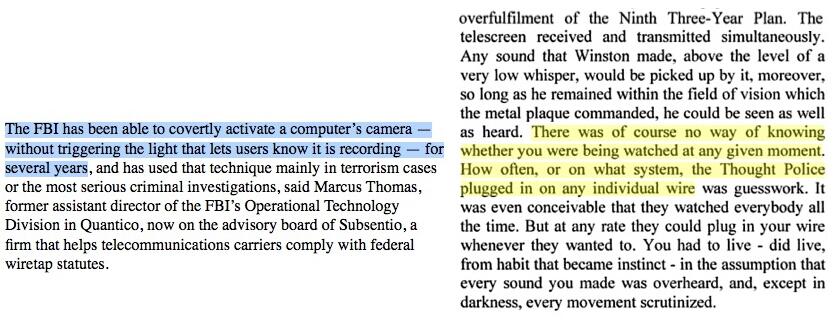
The text on the left is from a story in the Washington Post which discusses the FBI’s ability to exploit laptop cameras without enabling the indicator light. The text on the right is from Orwell’s novel Nineteen Eighty-Four discussing the dystopian state’s capability to view any given citizen unknowingly through their telescreen. (The comparison was tweeted out by @tinyrevolution.)
To which we can add:

Michel Foucault, Discipline and Punish, page 201.
This was originally published (in French) in 1975, well after Orwell’s book. So Orwell was first with the idea? Not so fast! Foucault is discussing the ideas of the social reformer Jeremy Bentham, who proposed the idea of the “panopticon” (all-seeing) in the late 18th century. According to one history, there are at least 300 prisons worldwide built on panoptic principles. You can see a classic illustration
View original post 138 more words
Petro-state and petro-state infrastructure
A recent talk on the Canadian petrostate. It is interesting to follow journalist Andrew Nikiforuk’s take versus those of industry, the government or academics who don’t think the idea of seeing Canada as a petrostate holds.

Proverbial “Door to Hell”, Derweze, Turkmenistan: Check out a video here.
The Door to Hell is a natural gas field in Derweze (also spelled Darvaza, meaning “gate”), Ahal Province, Turkmenistan. The Door to Hell is noted for its natural gas fire which has been burning continuously since it was lit by Soviet petrochemical scientists in 1971, fed by the rich natural gas deposits in the area. The pungent smell of burning sulfur pervades the area for some distance (Wiki).
Not the first time we talked about disasters on the blog. For example, about how Google worked in Japan post-Fukushima disaster to use Google-cars to help find missing persons. About how the intersection of infrastructure studies and disaster studies will likely grow in future years. More recently, we featured “Philip Mirowski’s Never Let a Serious Crisis Go to Waste … an important and distinctive contribution to debates around the politics and economics of the economic crisis”.
Infratheory today and now infrapolitics!
Dissertation Reviews is a site that features overviews of recently defended, unpublished doctoral dissertations in a wide variety of disciplines across the Humanities and Social Sciences. Their goal is to offer readers a glimpse of each discipline’s immediate present by focusing on the window of time between dissertation defense and first book publication. This review of Nikhil Anand’s dissertation, Infrapolitics: The Social Life of Water in Mumbai, written by Tarini Bedi, will be of interest to discard studies scholars because of the methodological approach and how it highlights the politics of infrastructure:
Nikhil Anand’s dissertation is a nuanced, theoretically ambitious, and timely contribution to political ecology, to the anthropology of the state, and to the emergent field of the anthropology of infrastructure. Anand’s methodological approach, where the city, the “urban,” is the site through which to study the state is provocative for scholars of urban studies. The work is…
View original post 284 more words
What is … infratheory?

Finally got around to reading Philip Conway’s blog Circling Squares. If you don’t know it, or you’re stuck in wordpress-land (like me), it is worth checking out. It is even a little funny in places, but the humor is dry.
Some interesting ideas for the intersection of infrastructure and disaster
Guest editor: Brett Christophers, Uppsala University
Philip Mirowski’s Never Let a Serious Crisis Go to Waste is an important and distinctive contribution to debates around the politics and economics of the economic crisis which began in 2007-8 and, as such, is well-deserving of the symposium convened here at Antipode.
 For one thing, the book is different. As Mirowski remarks in his response to our four reviews, the last five years have seen a veritable “torrent of crisis books”; so why single out this one for particular scrutiny? Because it does not profess, like so many other crisis books tend to do, to identify broad causes and consequences of the crisis. Instead, its specific agenda is to offer an “intellectual history of the crisis and its aftermath” (p.11). That is to say, while it tentatively “explores the economic crisis as a social disaster”, it explores the crisis much more…
View original post 973 more words

Recently, Jan and I completed a new paper about how the material infrastructure on states (and our actor-network state idea) might figure into contemporary theorizing about international relations. In particular, we are in the process of contributing to a book about the “human element” in IR, and the resulting paper now can be read, but it is only in draft form.
Check out the paper here or here; we do some of our earliest work on “state multiplicity,” play with decentering the human in IR, and we also dabble with non-scholarly state theorizing.
Amazon Drones? Ariel infrastructure might be the next bastion of infrastructure studies …
Material leftovers … interesting.
Hine, ethnographer-extraordinaire.
 Christine Hine is an early pioneer of virtual ethnography and has been at the forefront of movements towards redefining ethnography for the digital age. She is currently a Reader at the University of Surrey’s Sociology Department.
Editor’s note: In this post for our Being a student ethnographer series, I talked to Christine Hine about her forthcoming book, ‘Ethnography for the Internet: Embedded, Embodied and Everyday’ due out next year. In this interview, Christine talks about the current phase in virtual ethnographic practice, about what are her latest research interests, and about a framework that she believes can help ethnographers understand how to adapt their practice to suit multi-modal communication environments.
HF: What do you think are the key challenges that ethnographers face in trying to study the Internet today?
CH: Robinson and Schulz, in their 2009 paper, describe evolving forms of ethnographic practice in response to the Internet…
View original post 1,087 more words

This post is about fixing peer review. dmfant, who some of you might know from synthetic_zero, commented on a recent post on the state of STS scholarship, asking:
have you been following: http://www.cplong.org/2013/11/the-peer-review-coordinator-and-the-collegiality-index/ ?
Which is a discussion about making reviewers and reviews public (rather than granting reviewers anonymity). The idea is that we could improve reviewing scholarly work through a process of making it public and creating, in the process, a “reviewer score” for reviewers that would be known, esteemed, and productive. My response was so long, I will post it here for further consideration.
My response was (also, I write as a faculty member and about faculty issues, so it is a bit myopic in that way):
I’ve been critical of peer review for a long time, probably ever since I was “subjected” to it early on in my career. This new approach is not nearly as much of a solution as I think it is being presented as:
First, one of the few things that I like about PR is exactly that it is NOT a game of hierarchy. You might get a reputation with an editor, but that editor will be replaced eventually, so the influence of “being a good researcher” over “being a good reviewer” was primary.
Second, my guess is that this is just something that will further hurt in-coming scholars, meaning, it is precisely newer scholars that will need to be deemed “good reviewers” and it is senior scholars with tenure who are the most free to not care about being deemed a “good reviewer.”
Third, another problem will be: is this yet another thing I have to do in order to get tenure? Again, the young scholar is held to a higher standard than the senior scholars that will oversee their tenure file, and, again, the senior scholar hold the younger scholar to a higher standard for tenure than they themselves were held to. That, however, depends a lot on how university administrators see such activities: will young scholars be expected to be “good reviewers” as a part of the tenure decision OR will young scholars be rewarded directly for being deemed “good reviewers” in the form of larger raises? I would imagine that rather than being directly awarded for this hard work, it will be just another expectation for young scholars; it will be, in effect, just something that can held against a scholar (i.e., being deemed “bad reviewer”) than something rewarded (i.e., we expect our faculty to be “good reviewers”).
Fourth, the predictable counter-argument would look like this: “oh, silly Nicholas, don’t be so cynical, if we can “fix” the peer review process, then you’ll be able to publish even more research and publish it through a process that is more fair.” We all know that the publication process is unfair. It is a reality. We all come to grips with it one way or another. When I consider the work of my peers, I am able to keep this in mind. However, if we “fix” it, it will still be unfair (i.e., instead of a tyranny of advanced/high-prestige researchers having a strong voice in the review process, we will trade one tyrant for another, the good reviewer, and soon we will be forced to publish what they will accept) and there is no reason to think that “good reviewers” are going to be more fair, promote innovation, or let the author’s voice come through. We will just trade one set of intrenched values for a new set of values that will be intrenched later on.
Fifth, all of this would not work even if, by some magical coincidence it did align university officials, faculty members, and folks that populate promotion and tenure committees … its called “the internet.” Of course, whenever I get a paper, I could determine the author with stunning frequency by just looking-up the title of the paper, which was likely presented in some professional society’s annual meeting that I probably attended, moreover, most of the papers I get to review these days, I know them as soon as I see them because, if you’re an expert in a small area, you know all the main players already. If you want to promote their work, then you can. If you want to thwart their work, then you can. There is no reason to think that a new system should change this. We already know whose papers they are; anonymity for the author seems long dead among specialists. Then comes reviewers: “There seems to be widespread skepticism that peer review without anonymity can be both rigorous and fair” to quote the blog. The idea that anonymity allows one to be “fair” (i.e., fair being defined primarily in terms of being able to say difficult comments plainly) is just BS. There is no reason to believe that in the professional game of science that I (or any other reviewer) cannot be fully honest in a review. Some folks use it to be a jerk. I understand that. I am fine with that. The reason is that some people are jerks. They are jerks in the classroom. They are jerks in their correspondence. I guess I am open to the range of personalities and am not entirely sure that erasing this variation or marginalizing folks that don’t quite have strongly developed social skills or promoting reviewers with glycerine tongues (by rewarding them with higher education’s favorite currency, status) makes much sense. People fail. Editors fail scholars by not taking this into account. This is a human enterprise and because it is I think we need to embrace a level of uncertainty, improve the processes that we have instead of upending a tradition.
In the end, if you want to fix one thing, I would say that we need NOT better reviewers (after all, reviews are just what they are, reviews), but better EDITORS. Show me an editor with a real vision, one capable of making tough decisions, one that is not a total tool of the reviews, an editor that is not constantly looking for ways to reduce their workload and simply embraces the huge responsibility of selecting one paper over another or encouraging the work of a young scholar to develop or reject the sloppy work of a senior scholar whose work is popular among reviews.
NOTE: the picture is from http://kennyjonesradio.com/wp-content/uploads/2009/08/broken_window.jpg

This is based on some ruminations over the last year, which I’ve mentioned a while back casually and which our now full-time blogger Stef Fishel discussed more recently.
Here goes: Is STS a bordello or cabinet of wonders? (I write in the plural because Jan-H. and I were writing this together)
In STS:
… we recognize the unorthodox and outlandish agency of “nonhumans” like scallops, microbes, Portuguese sea-going vessels, and British military aircrafts. In fact, the way we just listed those example case studies into the minutiae of STS scholarship is more telling than it might immediately appear. You see, STS is populated by intriguing micro case studies, and, from a far, STS appears to outsiders like a “cabinet of curiosities.” Because our research is punctualized into individual case studies, and these case studies were so routinely juxtaposed with one another during the era of great edited volumes of the 1980s, a look back through history of STS research is akin to opening the door to a cabinet whose contents were filled with every manner of wonderful and ornamental trinkets that somehow capture the grandeur of other worlds even in their miniature size. Also, because this cabinet was populated during the Science Wars, its contents are all the more precious, and, in retrospect, to this day provide a sense of nostalgia to the scholars who filled it, marking the discoveries they had made, as they passed it down both as a gift and a challenge to the students they trained.
Also, in STS, however:
Before we are accused of fickle sentimentality for our academic home, our cabinet of curiosities might just as well appear as a “bar à hôtesses” to some insiders sickened by the excesses of postmodernity, or the bitter, personality-driven, concept-oriented turf wars over aurthorial copyright that have come to typify STS <FOOTNOTE: At feverpitch in the early 1990s, … collins yearly / latour callon etc.> and, to this day, distract the field from sharing any semblance of unity with regarding agreed-upon phenomenon to study as a group, all of which might spell the end of STS in years to come. Thus, calling our cabinet a bordello might be warranted in certain company.
*This post was largely inspired by Fabio’s early characterization of STS as a “cabinet of curiosities,” which has, since I first heard it, stayed with me. As he put it, STS is:
very anti-normal science. You end up with a cabinet of curiosities than a deep and precise knowledge of a specific issue.
Wold map of submarine cable infrastructure
 Interesting world map of submarine cables – can’t remember who alerted me to this, but thank you.
Just last week, I visited Cornell University to visit Trever Pinch, a well-known STSers from the early days. Trever has been an active member of the two most important professional association in STS, the Society for the Social Studies of Science and the European Association for the Study of Science and Technology.
With outstanding luck for me, turns out Trever is something of a pack-rat too, and has original conference proceedings for every single event in the history of both organizations. I’m in the process of using them to chart how different topics have been used in the history of the organizations. After my initial run, they will be donated to their respective professional organization.
While studies of 4S seem relatively rare, there was a recent (and interesting) project reviewing EASST, which is here: EASST_conf_summary. Still, a couple of older 4S programs are available on-line. In what appears to be Sal Restivo’s personal program from the first meeting at Cornell University in 1976, available here: 1976 4S at Cornell, we can see into STS’s past.
During the 1976 meeting, Bruno LaTour (sic!), for example, was still a member of the Salk Laboratories presenting on citation analysis, which would later be the groundwork for Laboratory Life (which, in the 1986 edition, as a great postscript). S. W. Woolgar was present to, at the time hailing from Brunel University, discussing sociological analyses of scientific accounts. H. M. Collins attended, speaking about replication in science, which, as many of you know, would be the work that Woolgar, along with his student Malcolm Ashmore, would later bring Collins to task on in Ashmore’s incredible (and incredibly playful) The Reflexivity Thesis (read the preface for a hilarious letter from Woolgar to the editor). R. K. Merton gave the lunch talk. Karen Knorr gave two talks and John Law gave one on Anomie(? Anybody know what happened to that paper? Maybe it’s sitting in an edited book nobody reads anymore…).
At any rate, as these are completed by my assistant, I’ll occasionally a comment or two.
Found some great notes on a recent conference on Latour in Baltimore, MD.
Ivakhiv: Latour’s Gifford Lectures and the Broader Context
Morton: Secret Agents ov Gaia
Taylor: Bruno Latour and the Seductions of Gaian Animism
Connolly: The Anthropocene, Spirituality, and Bruno Latour
Deudney: Reflections on Gaian Planetary Civic Religion
Enjoy!
http://blog.uvm.edu/aivakhiv/2013/11/24/querying-natural-religion-responses-to-latour/

Incredible video here.

Here is what’s wrong with STS. For a better STS, consider the following:
hmmm … My sense is that what’s “wrong” with STS is what’s “wrong” with a lot of organizational theory. There are no well-characterized phenomena to study (case studies are not phenomena, although they can lead to their discovery). Instead what you see is a proliferation of schematic “concepts.” In science, “progressive” cosmopolitan collectives build on phenomena and are pragmatic towards concepts and models (the one that provides a more satisfactory account of the phenomenon wins); “oppositional” enclave-based scientific movements deplore phenomena and focus on “authorial” concepts. Authorial concepts are those that are inherently associated with an author, who thus “owns it” (e.g. Latour –> actant). Because oppositional enclaves tend to be organized around “groups” and authorial charisma scientists do not compete to offer the best explanation of an explicitly recognized phenomenon (as in the Mertonian ideal type) but instead the incentive structure is biased for leaders of different subtribes to provide their own authorial concept. The reason is that without your “own” concept, you don’t have a reputation.
Thus, conceptual proliferation in oppositional enclaves is simply the outcome of a more basic underlying socio-structural logic. This contrast to the Mertonian ideal-type collective (which actually attaches names of authors to effects not concepts), which favors the proliferation of different explanations of the same (small) set of (clearly characterized) phenomena. Because authorial concepts, like all concepts, have the general structure (A as X) where X is the concept and A is some empirical setting, “progress” in oppositional collectives follows a “turf-war” model as you extend your concept to cover other realms, in particular realms that were previously covered by your rival’s own authorial concept (e.g. B as X and not Y, C as X and not Y, etc.)
This is not to say that well-characterized phenomena are absent from STS. Obviously one interesting phenomenon to emerge out of the STS enclave is what has become known as performativity (although Ezra might disagree as to whether this phenomenon is well-characterized), and not surprisingly, this is where STS has been the most influential outside of the enclaves. If you prefer the Mertonian model of science (and I’m going out on a limb here and presume that Ezra–who is a boy–prefers this model) then the good thing about phenomena (as opposed to let’s say “concepts”) is that they don’t carry authorial copyright, so that anybody can take a “shot” at (accounting for) them. Phenomena-centered science thus leads to cosmopolitan, interdisciplinary endeavors that follow more closely the “progressive” line traditionally associated with normal science. Given a phenomenon as a reference point, we can make a pretty good estimate of where we stand in relation to the immediate past.
Take for instance the phenomenon of “boom and bust” in industries (or organizational imprinting). You’d be crazy (or just uniformed) if you didn’t realize that we are in a better explanatory position in relation to these phenomena than we were let’s say a three decades ago. However, given a “concept” (let’s say “social structure”) no such “progressive estimate can be given, instead it seems as if we are stuck in second gear. Authorial concepts-centered science instead leads to either Spenglerian “coming crises” types of analyses or cynical, “nothing matters, there’s never progress, everything goes in cycles”(e.g. Abbott in Chaos of Disciplines) types of takes regarding the health of a given field.
It is obvious that STS is a “concept-based” enclave and the “system of thought” that governs most STSers is based on this make-a-”contribution”-by-offering-a-new-concept model. A typical example is Callon, who in a recent paper (2007: 140) argues that “Relying upon the anthropology of science and technology, we can define economic markets as socio-technical arrangements or agencements (STA) whose functioning is based on a set of framings concerning not only goods and agencies but also price-setting mechanisms(1).” Then if you have the patience to go to footnote one we get the definition of agencement:
An agencement is a combination of material and technical devices, texts, algorithms, rules, and human beings with their various instruments and prostheses. I discuss elsewhere the reasons why I prefer the French term agencement (which unfortunately has no equivalent in English) to assemblage or arrangement (Callon, 2007). Agencements denote socio-technical assemblages when they are considered from the point of view of their capacity to act and to give meaning to action. By defining markets as STAs we emphasize the fact that they are simultaneously malleable and capable of actions.
At this point, of course Ezra has already thrown the paper in the trash. Callon’s strategy here follows the template offered above (markets as agencement) But the main point is that throughout this paper, you will not find the usual Mertonian goodies; e.g. a characterization of a phenomenon, a specification of our ignorance regarding the mechanisms that generate it and the proposal of a new model of these mechanisms that does a better job of accounting for the phenomenon than other competitors, but simply more definitions, and stylized descriptions of sites that could be thought of as “agencements.” This is the style of thought characteristic of STS.
We can go hoarse trying to evaluate whether this is or is not a good strategy, but for now I’ll simply play the good anthropologist and say that it is “different” (I have been known to play both sides of this field) but in addition (and now putting on my more specific Mary Douglas hat) it should be noted that it is also exquisitely attuned to the social context within which it makes sense (enclaves where charismatic authority based on authorial concepts is the most natural reputational currency). Since, the main issue after reading this paper is that you come out with the impression that: agencement –> Callon so that you have to cite Callon (2007) if you want to use the concept (the same of course goes for agora, actor-network or what have you).
Please note: This is not my post; it is a recycled comment from orgtheory.net by Omar, a comment to a post that Fabio wrote about some eerily similar territorial scuffles I experienced as a guest blogger there.

Latour’s honor being protested … annually?
So, I just spoke with Dr. Ann Rudinow Sætnan (Department of Sociology and Political Science, Norwegian University of Science and Technology) who wrote that article about how Latour’s recent Ludvig Holberg International Memorial Prize and how Latour’s honor has been protested.
Here is the update on the Latourian protester. I asked “Has the redux fizzled out on a new-ish science wars or have there been any notable developments?”
She responded:
As for what happened to the Science War flare-up … yes, it fizzled. I just googled the theme to check whether anything new had been published in the debate since the pieces I cited. There was one more. This one was not so much a critique of Latour as a critique of giving prizes in general as a means of gaining public recognition for (social) science. The author of this last piece claims that giving away large sums of money to already famous social scientists doesn’t do much to advance the reputation of the social sciences, as evidenced by the small number of people who have even heard of the prize. He writes that the prize is almost most famous for Jon Elster’s annual protests of it and that if Elster had not existed then someone would have had to invent him in order to publicize the prize. … and there the whole debate seems to have ended. At least until next year when Elster protests whoever wins in 2014
If you are interested in the piece (and have a reading-knowledge of Norwegian), check it out here. The title translated (thanks, Ann) is “What price the Holberg prize?”
Here is the old post:
In an interesting essay from our friends at EASST (European Association for the Study of Science and Technology), documents a possible resurgence of the ‘science wars’ of yesteryear … at sitting in the cross-hairs is good old Bruno Latour, protested recipient of this year’s (2013′s) The Ludvig Holberg International Memorial Prize, or as some of you might know it, just the Holberg Prize. Check out the article; its free and interesting.
Theory group in PA
Latour on war
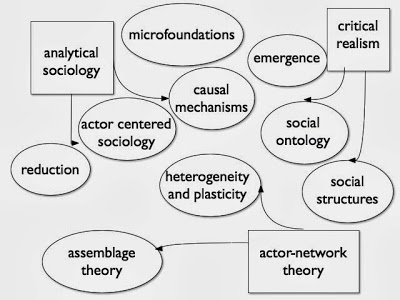





 Installing (Social) Order

You must be logged in to post a comment.