Homeopathy, Autopoiesis, and Global Complexity (with Walt Whitman)

Nick’s previous post about Machiavelli and the homeopathic state got me thinking about different approaches and sources that can inspire and provoke new ways of thinking about old problems or stagnant institutions.

As you know from the last post I wrote, one of the ways I do this in International Relations is by drawing on STS and biology. Microbes, nations, parasites, guts, and bodies became lively containers and contaminated states to better capture the flows, immersions, circuits, and heterogeneities between and amongst a plurality of actors. These are new models of affectivity to provoke and invoke new forms of intelligibility in politics and social life.

To bring this affect based in material entanglement and poetic critique of the status quo to the fore, another place I draw inspiration from is Leaves of Grass, Walt Whitman’s collection of poetry. They provide a productive subtext to the analysis of IR. I draw the insights garnered from Whitman and his poetry into the text and practice of international relations. Whitman penned that poets were best suited to “strengthen and enrich mankind with free flights in all directions not tolerated by ordinary society.” Poets know no laws but the laws of themselves, and are beholden to “mere etiquette.” Whitman said “Often the best service that can be done to the race, is to lift the veil, at least for a time, from these rules and fossil-etiquettes.”

Walt Whitman project’s was one of cultural and literary revision against the prevailing notions of the body and its relation to politics and sociality. Whitman produced texts that extended his reader’s conceptions of the body and the literary, and especially how these categories interact to exceed or overrule the cultural constraints of the time. Through Leaves of Grass, and its many revisions, Whitman joyfully supported the body as a fluid self struggling to negotiate identity and difference while committed to being responsive to as much of the world as possible.

Whitman can speak directly to my conceit of the contaminated state as I defined it my first post. When pondering the strength of America in regards to its relationship to wealth and poverty, Whitman cautions the rich to maintain strong stomachs as the wealth of the civilized world was built from “rapine, murder, outrages, treachery, hoggishness, or hundreds of years ago, and later, so in America.” He continues that it is the working- people, “vast crops of the poor, desperate, dissatisfied, nomadic, and miserably waged populations” that can truly offer a cure to the ills of American democracy.

“Curious as it may seem, it is in what we’d call the poorest, lowest characters you will sometimes, nay, generally find glints of the most sublime virtues, eligibilities, heroisms. Then it is doubtful whether the State is to be saved, either in the monotonous long run, or in tremendous special crises, by its good people only. When the storm is deadliest, and the disease most imminent, help often comes from strange quarters—(the homeopathic motto, you remember, cure the bite with the hair of the same dog.)”

He wrote that the true prosperity of a nation was not demonstrated by the wealth of a special class, or a “vulgar aristocracy,” but by having the bulk of people provided with homes and a fair proportion of the profits. It is this bulk of people denied these where the “glints of the most sublime virtues” will be found in a country. Simonson, a Whitman scholar, writes that Whitman “calls us to develop a democratic ethos directed toward recognizing and finding place for the world’s variety—not just its obvious beauty, but its “terrible rude, forms” as well (2003, 370).

With Whitman as poetic counsel, I approach the global with humbleness and care, but with a conviction that seeing possible alternative global orders is of the utmost importance. I hope to refresh a belief in the importance of plurality and respect for life in International Relations knowing full well that there is no one option that makes right that which is wrong with the world, but nonetheless we must respond. For this, Whitman offers a model for a cosmopolitan and pluralistic society based on complex individualism not dominated by rational choice. This response may not be as an actor who identifies a problem and then “fixes” that problem, but it creates awareness that humans are part of the problem itself, and as individuals we are likely to be party to many of the crises we are responding to globally and locally. Therefore, an ethos of care for the world is crucial.

To nurture this ethos, it remains important to offer creative and disciplined thinking about the relation of life to politics in the international. Too often the discussion in IR theory centers on negative instantiations of biopower, or a “becoming corpse” as Rosi Bradiotti writes. I take life as a creative intensity that can offer new solutions, and new ways of engaging with the world. Placing an idea of life as vital at the center of politics leads to two important implications: a rethinking of ethics and responsibility leading to a, said so beautifully by Bradiotti, “diffuse sort of ontological gratitude is needed in the post-human era, towards the multitude of nonhuman agents” that support us (2006, 270). This diffusing, or flattening, of social action and ties into a continuum of dynamic object interactions, or translations, between humans and nonhumans, states, bacteria, biomes and parasites, made the nested and imbricated nature of politics in the body politic more visible.

Another implication is explicitly political: we will need to organize collectivities and political organizations that reflect these “dreams” of nested subjectivities. As Latour queries, “Once the task of exploring the multiplicity of agencies is completed, another question can be raised: What are the assemblies of those assemblages?” (2005, 260). These discussions should be open, inclusive, and careful to reflect the values and ethics we feel are necessary in creating mutual public space.
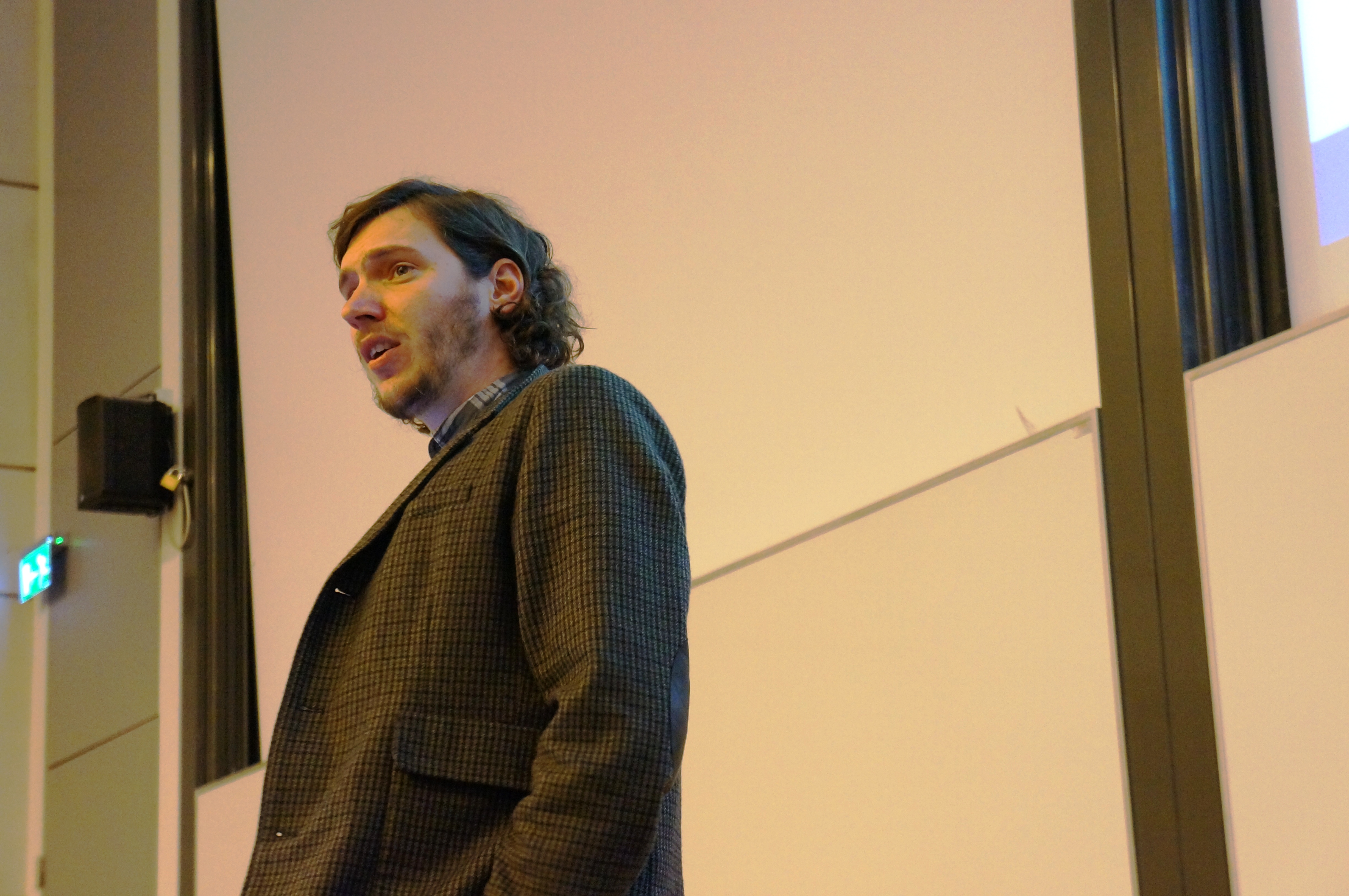

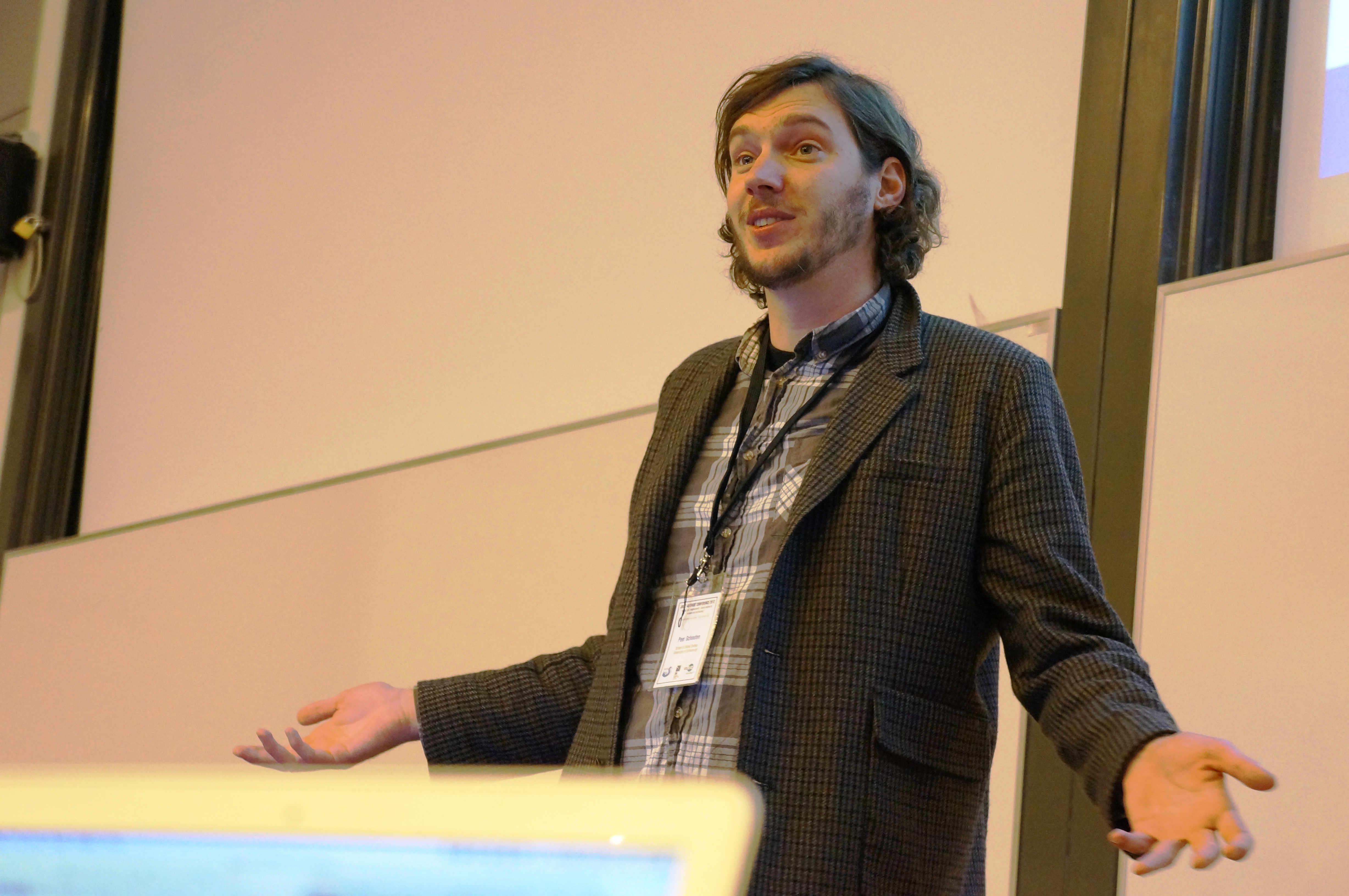
Peer Schouten, at it again!

We introduced Peer back in March … well, his paper presented in last year’s 4S meeting at the Copenhagen Business School (and subsequent ISA meeting at London School of Economics) is now in press!

Check it out; its an alternative answer to traditional interpretations of “failed states” in conventional IR research, and, of course, the alternative to orthodox social contract theory appears to be ANT (or, at minimum, ANT can draw our attention to alternative explanations … or, better yet, help us to understand the infrastructural underpinnings that make explanations possible, like those used by our friends in social contract theory [although their friendships seem oddly contractual]).

Image

Cheers, Peer!

Oh, he even mentions as much in the acknowledgements:

Further thanks to the following people for comments on a previous draft of this article:the editors Graham Harman, Maximilian Mayer, the participants in the panelOn States, Stateness,and STS: government(ality) with a small “g”?, Society for Social Studies of Science & European Association for the Study of Science and Technology Annual Conference, Copenhagen, October17-20 2012, and participants in the Millennium/Theory Talks workshop at the Millennium Annual Conference, London, October 20–22 2012.

Homeopathic Infrastructure: Machiavelli on Infrastructure

Recently, an old dissertation fell into my lap and I’d like to tell you about it. I asked my work study to find basically anything about the state and state theory for Jan and I’s book “The State Multiple,” which we are writing now. Well, the dissertation was from 1988 by Michael Soupios, now a storied professor at Long Island University here in the states, where he’s being teaching for three decades and more. His 1988 dissertation from Fordham *(he has multiple PhDs) is titled “Human Nature and Machiavelli’s Homeopathic Theory of State” wherein he tackles the basic quandary set forth by Machiavelli.

Capture

Quoting the dissertation:

The terms “homopathic” or “homeotherapy” are of medical origin and refer to a form of treatment in which an element similar to the causative agent of a disease is itself used in attempting a cure. It is precisely this approach that we find offered in Machiavelli’s political formula.

The dissertation goes on to explain how Machiavelli’s vision of humans was basically that we are a bunch of decrepit liars and thieves and, thus, deserved to be treated with as much manipulation and self-service as we would impart on others. Call this, let’s say, a Hobbsian antidote to the crisis of the commons and the natural order of man, although Michael Soupios refrains from the comment (good to stay on topic in a dissertation!). We are not to be ruled and governed by a force that helps us to repress our baser instincts and then choose to be together non-violently as a form of supra-self-interest (sort of like a dynamic where we cooperate just long enough to compete, like children playing nearly any game), and, instead, we see Machiavelli’s view that you treat like with like, or his homeopathic view of states. Michael Soupios tackles fear and force, fraud as an instrument of the state, and creative conflict within the state before setting his sights on how this approach could even be instantiated as a model for International Relations.

The dissertation is fascinating and essentially well-written. Now, this view of politics is politics by political means, if you will. Since this writing, STS has entered the discussion of the state, perhaps foremost by my friend and ally in state theory, Patrick Carroll, who, in his many written works, shows how the state, as we know it (i.e., as an actor, a macro entity capable of action, etc.) is a falsehood of sorts and instead the state is made-up of all things stately such as people, bogs, trees, and all the measurement techniques used to make the state’s ‘self’ register in formal documents of statehood and statecraft. For Patrick, the state is constructed and environmental rather than iconic and abstract; material rather than conceptual.

So, with enough force, could Michael Soupios and Patrick Carroll be collided with enough force to make the argument: if one model for the state is homeopathic (i.e., Mach’s), and if one model for the state is material, then could we have a hybrid theory, a homeopathic-material theory of the state?

If that is the case: what would the infrastructural equivalent of homeopathic statecraft look like? I don’t yet know, as I’ve only just completed the dissertation read, but it seems like a viable option forward if one wants to engage the cocktail of normative and empirical claims-making that is contemporary political theory.

Abstracts are in for 4S 2013 San Diego!!!

Capture

Submissions in! Jan and I (Nicholas) proposed an open session for this year’s Society for the Social Studies of Science meeting in San Diego this fall. We already have 18 submissions for the one session, which — at least I think — is the highest level of interest we’ve had in the state/stateness area of STS in the last few years of organizing these panels/sessions. Obviously, this is very cool, and we are stoked. If you sent us an abstract, thank you; they look great. Looks like we’ve got a month to put the abstracts into order. We are being allotted 15 total spots to spread over 3 sessions, which will also be the biggest set of sessions we’ve been allowed to host.

Timing: According to the webpage about the conference, by 12 May 2013 abstract submitters should learn of their acceptance notification and the placement of their respective papers (the day afterward, early registration starts, coincidentally).

Capture

Also, for those unfamiliar with the sessions we promote: We called the proposed session “State Multiplicity, Performativity and Materiality: Current STS Research on State and Stateness,” and our brief description reads:

Annual Meeting of the Society for Social Studies of Science (4S), October 9 – 12, 2013 — San Diego, California


Open Session 43. State Multiplicity, Performativity and Materiality: Current STS Research on State and Stateness


Organizers: Jan-Hendrik Passoth; Nicholas J. Rowland


Currently, science and technology studies is rich with opportunity to conceptualize the state and comment on its consequences for global living. While long under the conceptual jurisdiction of traditional political science, political sociology, and political history, scholars in science and technology studies have, with their own concepts and style, taken to rethinking the state and, with renewed nuance, capture its many and multiple influences in our (decidedly) material world. Similar to the move made by scholars in the social studies of finance, when they showed us how to rethink economic sociology, recent work on the machinery and infrastructure of governing is growing in significance. We see large empirical studies of water infrastructure in India, Columbia, and US states such as California, research on public transportation systems and global logistics, work about census creation and population data gathering as well as growing and genuine theoretical contributions to state theory and theories of stateness have all been published in recent years.

The upshot: Conceptual lens such as multiplicity, performativity, and materiality, which are central to contemporary science and technology studies, provide one such direction toward an explicitly science and technology studies perspective on the state. We believe that this line of thinking, if properly developed in-house by science and technology studies scholars, has the potential to produce discourse-changing research even among our friends in traditional political science, sociology, and history. This open panel will consist of two or three sessions. We invite empirical and theoretical contributions on a wide variety of topics, regions, and theoretical approaches. We encourage work-in-progress as well as more mature projects to the session. We especially invite papers on the multiple ontologies of political entities such as states, the performativity of social and political theory, and the materialities of governing modern states and their environs.

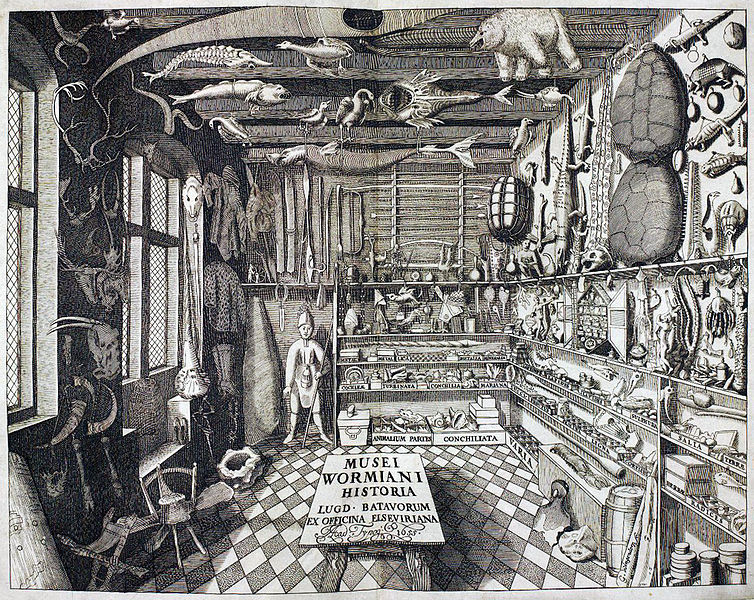
The Cabinet of Curiosity and the Levels of Analysis Problem in International Relations (IR)

Last October during the Millennium conference, Materialism and World Politics, STS and IR theorists met on the last day to discuss potential collaborations and resonances between the two discourses.  “Materialism” as a theory and as a methodology made a helpful facilitator for this conversation. One of the main points the discussion centered on during the conference was what “subjects” could be “objects” of study in each discourse.

It came down to this: STS likened choosing its subjects and objects of interest to looking into a “cabinet of curiosities.”  IR is decidedly wedded to its levels of analysis. The sovereign state and the international system of states, and–to a lesser degree–the sovereign individual. These are the legitimate subjects/objects of study in IR.  Of course, these levels are being pushed and questioned, as is evidenced by the conversation we had in London, but they figure large in the epistemology of IR.

To return to the subject of “bodies,” there is something puzzling about how IR, as a discourse and a practice, speaks of the body, or, more specifically how IR theorizes and and understands the human body in this tripartite schema of system, state, and individual.

In other disciplines, there has been an increased interest in the study of the body as a social and material phenomenon beyond a scientific or medical perspective, but, until recently, IR has never much about the human body. Conversations and analysis have focused on the state, and on the individual as connected to states.

But, how is this “individual” understood beyond the civil and legal terms that dominate our field?  Not just as a voter or a rational actor, but as an actual, material body that can be fragile, leaky, diseased, sold, colonized, male, female, multiple?

This body is a powerful body, one that cannot be fully securitized or regulated, but its seductive power to IR theorists is unmistakable.  Folllowing in the footsteps of Machiavelli, Hobbes, Kant, and other precursors that IR has adopted as its own, IR theorists have understood or likened the state to a person (Wendt and constructivism), or used body metaphors to describe it (organs of government, for example).

This “state as a person” debate and bodily metaphors show that the body never really disappeared (as sociologists and social theorists already said in the 1980s and on), it was just less visible. A variety of recent literature in IR, and the conference in London, can attest to a new (renewed?) interest in concerns of the flesh, so to speak.  This may be due, in part, to a concomitant questioning the sovereign state as the legitimate subject of study, and most relevant actor in IR in a complex, interconnected, and globalized world with diverse actors and multiple relations of power and accountability.

This is certainly where STS has the most to offer IR–some promiscuity, as Deleuze would insist upon, in methods and subjects/objects of study. Cabinets of curiosities rather than hierarchies and levels.

Image

STS Program at Penn State

As a member of the University Faculty Senate serving on the Faculty Affairs Committee here at Penn State during the 2011-2012 academic year, I got a first-row seat to witness the de-commissioning of the University’s STS program, which closed, formally, on July 01, 2012. This was a challenging thing to observe, given my commitments teaching STS courses to our engineering students; however, it seemed that no faculty push-back could reverse what was ultimately deemed an administrative dis-continuation of the program (which had considerable academic implications even if relatively little consultation with non-administrative faculty took place). A commonly heard comment was that Penn State was ending STS at the precise moment that Harvard initiated their program.

Be that as it may, I have often pondered why STS was de-institutionalized at Penn State … and so, when this landed on my desk, from a colleague and reformed STSer, Gary Weisel, I think I found a significant part of the story that I simply did not fully realize prior to reading it.

Image

So, Lehigh University published a curricular newsletter for their STS program. This is the cover of this issue I am referring to, which documents (like a miniature case study) the history of the STS program at Penn State. Interestingly enough, the program was “low church”, and I think this contributed to its failure to fully embed in the University. Long time STSers, no doubt, you recognize that high-church/low-church distinction. For new comers, this harkens back to old discussion from 1992 by Juan Ilerbaig, which could be summarized nicely as the following:

… [programs] with a problem-centered, social activist bent (e.g., Penn State) and ones with a discipline-centered, scholarly bent [constitute] … as a Low Church-High Church distinction (see June 1992 Science Technology and Society Curriculum Newsletter “The Two STS Subcultures and the Sociological Revolution” pgs. 1-6)

Thus,

The issue here reminds one of the contrast between high church (Roman Catholic) views of the religious life as a profession of it own versus the low church (Protestant) rejection of such religious specialization in the name of taking religion to the world, into all secular professions (see above image for source).

Somewhat unsurprisingly, the origins of the STS program at Penn State come from the fall of 1969 in the wake of student protest. The program has had, ever since, an enduring character of rebellion and resistance. At first, the program was going to have three components, a graduate minor, undergraduate course offerings, and “research and continuing education components” (see above). As it happens, then-President Walker granted only the course offerings to undergraduates, which constitutes the first step on a path toward the low church, or, put more plainly, a step toward advancing undergraduates and non-advanced degree seeking students and a step away from a department that produces top-quality research. During the 1978-1979 academic year, the program was evaluated and concluded that funding was too low, faculty typically volunteered to contribute the courses (and were not standing faculty), and that teaching and research were not well integrated (which, I assume, meant that the teaching mission took priority over the research mission of the program). However, Rustum Roy, who headed-up the program, pushed forward gaining some external funding (NSF) for the program and its educational initiatives. For Roy, the STS program was foremost about “technological literacy” which he saw as:

… a [1] good dose of science education, approach from the perspective of practical problems and technology, and some [2] critical awareness of the social interface.

This is somewhat perplexing for the university because the program aligned with pro-science and pro-engineering faculty, but also aligned with those faculty critical of science and engineering, which ultimately made of an uneasy relationship among faculty who generally taught STS voluntarily or as an overload. The STS newsletter called his program “bi-polar”, and loosely indicate that these unsettling relations did not bode well for the STS program in the historical context of the science wars. The program grew under Roy’s leadership, but, in 1989, when Roy retired, the STS program shifted its administrative home to the College of Engineering under the new direction of Carl Mitcham. External support for STS-oriented science education floundered (and this detail is unclear; either Mitcham did not pursue external funding, failed when he did pursue it, or whether or not the NSF grew tired of supporting STS educational endeavors.). Mitcham consolidated the program, and, upon external evaluation, the same set of concerns appears to have endured. The mission was:

… to broaden scientific and technological literacy outside the scientific and technical community, and … to deepen ethical, political, and social sensitivity within the scientific and technical community.

During the early 1990s, the program taught about 800 students per year, but “resisted creating an undergraduate major or graduate program.” At this time, the shift toward enhancing interdisciplinarity on many campuses across the U.S. was brewing, but interdiscipinarity and the joint-appointments they create for faculty did not embed well in the university setting (perhaps because of old entrenched reasons).

The entire analysis reminds me of Fabio Rojas‘s book about how black studies departments were similarly born of 1960s social/political protest. The programs that have sustained themselves over the years tended to be, to use the language we used above to describe STS programs, high church (i.e., academically-oriented research departments) rather than low church (i.e., student-oriented or community-oriented teaching departments).

The bottom-line: it appears that if you want to embed a department/program within the context of a large, research university, then even those departments born of radical social/political protest much make accommodations with the university in question by joining the research mission of the college. Whether or not universities are unresponsive to education-only or community-oriented programs is less clear to me, but in the case of STS, the programs that last may very well be the programs that publish.

Fabio writes for orgtheory.net, a great blog about organizational studies. Also, on black studies, one of my top undergraduate students looked into the historical roots of the Black Studies program here at Penn State and recently presented his findings at the Eastern Psychological Association’s annual meeting. He pretty much found the same things described above; if research is not the first priority of the department, then it seems that the department is destined to struggle over the long run, even if it satisfies important demands from the student body (like enhanced course offerings in black history, for example).

Liquid Infrastructure

I’m not sure if it is fair to say this, but … we all know that Zygmunt Bauman is a considerable force in contemporary social theory. I was first turned onto his work when reading his small tome on globalization. I was impressed by his ability, at times, to tackle seemingly insurmountable issues such as the space/time relationship and so on.

Today I got a promotional e-mail from Polity Press celebrating Bauman’s work on liquidity. This was part of the advertisement.

Capture A

So, Bauman has been developing this notion of liquidity for more than a decade (although, from what I can gather the quality of writing, the tone, and the style change little between the books). Bauman published Liquid Modernity in 2000, Liquid Love in 2003, Liquid Life in 2005, Liquid Times in 2006, and Culture in a Liquid Modern World in 2011. These pieces should be lauded for developing the same concept so slowly over such a long period of time. Obviously, there is some repetition within the titles, which will undoubtedly annoy some readers. I grabbed the titles from our library here at Penn State and started to page through them …

  • In Liquid Love, Bauman decries increasingly unfixed relational ties that bond us together, leaving the average person to connect to others with whatever resources they have at their disposal.
  • In Liquid Life, Bauman describes how we live in a world of stubborn uncertainty, perpetual self-re-creation, and which is marked by a need to rid ourselves of the worthless junk we accumulate.
  • In Liquid Modernity, Bauman in the years following the Second World War, a period of expanding wealth and commercialization in the West,
  • In Culture in a Liquid Modern World, which, while containing the liquid metaphor in the title of the book, seems not to develop the concept further within the book … at any rate, Bauman describes the history of the term culture and its failure to help or aid those cultures it was supposed designed to describe.

In the end, it is Bauman’s Liquid Times, the 4th title he published in the ‘liquid series’ that has the most insight about what a ‘liquid infrastructure’. The dust jacket reads:

Zygmunt Bauman’s brilliant writings on liquid modernity have altered the way we think about the contemporary world. In this short book he explores the sources of the endemic uncertainty which shapes our lives today and, in so doing, he provides the reader with a brief and accessible introduction to his highly original account, developed at greater length in his previous books, of life in our liquid modern times.

In Liquid Times, Bauman goes on to describe the un-fixity of social institutions, which he sees as too fluid to count and a poor base on which to plan for the future, which leaves individuals to scrape along the best they can to find alternative or innovative ways to organize themselves, their lives, and our times. Indidividuals, living under such conditions mirror them; uncertain times and unstable institutions require individuals to flexible and reactive; consequently, ever-readiness for change and personal adaptability become the hallmark of this liquidity Bauman uses to describe many facets of contemporary living.

This is perhaps the point to harvest to get some leverage on liquid infrastructure; hybrid-infrastructure, custom infrastructure, adaptable infrastructure … all seems like directions I’ve seen developed over the last few years. For example, Kathryn Furlong’s work on hybrid infrastructures or Govind Gopakumar’s work on flexible water and transportation infrastructure, both of these scholars are already dealing, to some extent, with many of the notions that Bauman is working with. My intuition is that ‘liquid infrastructure’ would be a fitting umbrella term to bring together these lines of thought. Might also make a snazzy book title.

(Installing) Order restored

ReconstructionWe are back to normal, at least in technical terms. It is a strange thing to notice, but even a blog on infrastructure can have infrastructure issues. Posterous, our old home, has announced that after being acquired by Twitter they are shutting down at the end of April. Unfortunately the rats were leaving the sinking ship, producing all kinds of hickups  and dropouts, forcing us to leave in a hurry.

But we are glad to announce that we managed the transition! Thanks to Nicholas for carrying each post individually to its new home — and that from today on we are accessible again both via our temporary URL https://installingsocialorder.wordpress.com and our beloved old URL http://www.installingorder.org. We will keep both up as long as we see traffic coming in through them.

Some issues are still to be dealed with — author mapping for example, but that is work for the following weeks. While we are fixing these issues and tweaking the new design as well as the new machine: Are there any features, any functionalities that you as readers and commenters missed on the old installing (social) order? If so, please let us know, we will try to make them a part of the new installing (social) order!

Installing order in transportation: some intelligence about artificial intelligence in the making

Check out the following call for papers to see what our colleagues in artificial intelligence are currently up to with respect to installing order in transportation:

*******************************************************************************
              ARTIFICIAL INTELLIGENCE IN TRANSPORTATION SYSTEMS

                               AITS @ EPIA2013

                            A Thematic Track of
     The 16th Portuguese Conference on Artificial Intelligence, EPIA2013
                 Azores, Portugal, September 9–13, 2013
                       http://www.epia2013.uac.pt/
*******************************************************************************

              PAPER SUBMISSION DEADLINE APPROACHING: March 15, 2013

ABOUT AITS'2013
-------------------------------------------------------------------------------
The Thematic Track on Artificial Intelligence in Transportation
Systems (AITS) within EPIA Conferences aims to promote an
interdisciplinary debate on current developments and advances of AI
techniques in a rather practical perspective, focusing on
transportation and mobility systems. This Thematic Track follows up
the first edition of the AIASTS Thematic Track, held at EPIA'2007, the
second edition of the AITUM Thematic Track, held at EPIA'2009, and the
third edition of the AITS Thematic Track, held at EPIA'2011. This
event will act as a unique platform gathering the AI community,
transportation engineers and practitioners, as well as social
scientists to discuss how cutting-edge AI technologies can be
effectively developed and applied to improve transportation
performance towards sustainable mobility settings. This forum is thus
an opportunity for the technical and scientific community to present
progresses made so far, and as a means to generate new ideas towards
building innovative applications of AI technologies into more
efficient transportation systems.

As from this 4th Edition of the AITS Thematic Track, the event will be
promoted by the Artificial Transportation Systems and Simulation
(ATSS) Technical Activity Sub-committee of IEEE Intelligent
Transportations Systems Society. The EPIA Conference Series has been
ranked by the Computing Research & Education initiative as a “CORE B”
Conference, whose proceedings are published by Springer in their LNAI
Series and traditionally indexed by Thomson Reuters’ ISI Web of
Knowledge.

SCOPE OF AITS'2013
-------------------------------------------------------------------------------
As in many multidisciplinary knowledge fields, much advance in AI is
fostered through challenges imposed by issues that scientists address
when applying theory to solve practical problems. Thus, the AITS
Thematic Track serves as a working platform to discuss current
developments and advances of AI techniques in a rather practical
perspective. It will stimulate a debate emphasising on how theory and
practice are effectively coupled to tackle problems in the specific
domain of transportation.

Besides its economical, social, and environmental importance,
transportation is a very challenging domain, especially due to its
inherent complexity. It is formed up by geographically and
functionally distributed heterogeneous elements, both artificial and
human, with different decision-making abilities, collective or
individual goals, making its dynamics rather uncertain. Also, mobility
plays a major role towards citizen’s quality of life. With resources
even scarcer and the imposition of uncountable constraints to
mobility, contemporary transportation has experienced a great
revolution and has become highly evolving. This means that a rational
use of transportation infrastructures and the way they interact with
the environment must be managed on a sustainable basis.

Within the last two decades, this scenario has witnessed the advent of
the concept of Intelligent Transportation Systems (ITS). Rather than
increasing service capacity, one underlying approach of ITS-based
solutions is to ensure productivity and mobility by making better use
of existing transportation infrastructure, featuring them with
smarter, greener, safer, and more efficient technologies. Indeed, much
advance verified in this field is due to AI that is a key ingredient
to ITS. The relationship between these two areas is certainly mutually
beneficial, suggesting a wide range of cross-fertilisation
opportunities and potential synergisms between the AI community that
devises theory and transport practitioners that use it. Therefore,
contemporary transportation systems are a natural ground to conceive,
develop, test and apply AI techniques.

TOPICS OF INTEREST
-------------------------------------------------------------------------------
The AITS Thematic Track welcomes and encourages contributions
reporting on original research, work under development and experiments
of different AI techniques, such as neural networks, biologically
inspired approaches, evolutionary algorithms, knowledge-based and
expert systems, case-based reasoning, fuzzy logics, intelligent agents
and multi-agent systems, support vector regression, data mining and
other pattern-recognition and optimisation techniques, as well as
concepts such as ambient intelligence and ubiquitous computing,
service-oriented architectures, and ontology, to address specific
issues in contemporary transportation, which would include (but are
not limited to):

• different modes of transport and their interactions (air, road, rail
and water transport);
• intelligent and real-time traffic management and control;
• design, operations, time-tabling and management of logistic systems
and freight transport;
• transport policy, planning, design and management;
• environmental issues, road pricing, security and safety;
• transport system operations;
• application and management of new technologies in transport;
• travel demand analysis, prediction and transport marketing;
• traveller information systems and services;
• ubiquitous transport technologies and ambient intelligence;
• pedestrian and crowd modelling, simulation and analysis;
• urban planning towards sustainable mobility;
• service oriented architectures for vehicle-to-vehicle and
vehicle-to-infrastructure communications;
• assessment and evaluation of intelligent transportation technologies;
• human factors in intelligent vehicles;
• autonomous driving;
• artificial transportation systems and simulation;
• surveillance and monitoring systems for transportation and pedestrians.

SUBMISSION INSTRUCTIONS AND PUBLICATION
-------------------------------------------------------------------------------
Contributions must be original and not published elsewhere. Papers
should strictly adhere to formatting instructions
(http://www.epia2013.uac.pt/?page_id=564) of the conference, and can
be of two types: regular (full-length) papers should not exceed twelve
(12) pages in length, whereas short papers should not exceed six (6)
pages. Each submission will be reviewed by at least three members of
the International Programme Committee of the AITS Thematic Track. This
process will follow a blind-review approach, so we kindly ask authors
to take reasonable care not to indirectly disclose their identity,
removing their names from the manuscript and any reference that might
explicitly identify them.

The best papers will be included in a volume of the Lecture Notes in
Artificial Intelligence (LNAI) Series, to be published by Springer
(proceedings indexed by the Thomson ISI Web of Knowledge). All other
accepted papers will be published in the local proceedings.
Publication of accepted papers is subject to at least one co-author
registering for the conference and presenting the paper during the
AITS session at the Conference.

Further and up-to-date information can be found on the official Web
site of the EPIA Conference at http://www.epia2013.uac.pt/

IMPORTANT DATES
-------------------------------------------------------------------------------
• Deadline for paper submission: March 15, 2013
• Notification of paper acceptance: April 30, 2013
• Camera-ready papers due: May 31, 2013
• Conference dates: September 9-13, 2013

ORGANISING COMMITTEE
-------------------------------------------------------------------------------
Rosaldo Rossetti
   LIACC, DEI/FEUP - University of Porto, Portugal (rossetti@fe.up.pt)

Matteo Vasirani
   École Polytechnique Fédérale de Lausanne, Switzerland
(matteo.vasirani@epfl.ch)

Cristina Olaverri Monreal
   Technische Universität München, Germany (olaverri@lfe.mw.tum.de)

INTERNATIONAL PROGRAMME COMMITTEE (to be extended)
-------------------------------------------------------------------------------
• Adriana Giret, U.P. Valencia, Spain
• Agachai Sumalee, The Hong Kong Polytechnic University, Hong Kong
• Alberto Fernandez, Rey Juan Carlos University, Spain
• Ana Almeida, Polytechnic Institute of Porto, Portugal
• Ana Bazzan, UFRGS, Brazil
• António Castro, University of Porto, Portugal
• Carlos Lisboa Bento, University of Coimbra, Portugal
• Constantinos Antoniou, National Technical University of Athens, Greece
• Danny Weyns, Katholieke Universiteit Leuven, Belgium
• Eduardo Camponogara, UFSC, Brazil
• Elisabete Arsénio, LNEC, Portugal
• Fausto Vieira, Instituto de Telecomunicações/FCUP, Portugal
• Federico Barber, U.P. Valencia, Spain
• Fei-Yue Wang, University of Arizona, USA
• Francisco Pereira, SMART/MIT, Singapore
• Geert Wets, University of Hasselt, Belgium
• Giuseppe Vizzari, University of Milan-Bicocca, Italy
• Harry Timmermans, Eindhoven University of Technology, The Netherlands
• Hilmi Berk Celikoglu, Technical University of Istanbul, Turkey
• Hussein Dia, AECOM, Australia
• Javier Sanchez Medina, Universidad de Las Palmas de Gran Canaria, Spain
• Jeffrey Miller, University of Anchorage, USA
• Jorge Lopes, BRISA S.A., Portugal
• José Manuel Menendez, Universidad Politécnica de Madrid, Spain
• José Telhada, University of Minho, Portugal
• Jürgen Sauer, University of Oldenburg, Germany
• Luís Nunes, ISCTE, Portugal
• Luís Paulo Reis, University of Minho, Portugal
• Maite López Sánchez, University of Barcelona, Spain
• Michael Rovatsos, University of Edinburgh, UK
• Miguel A. Salido, U.P. Valencia, Spain
• Paulo Leitão, Instituto Politécnico de Bragança, Portugal
• Ronghui Liu, ITS/University of Leeds, UK
• Sascha Ossowski, Rey Juan Carlos University, Spain
• Shuming Tang, Chinese Academy of Sciences, China
• Thomas Strang, DLR, Germany

From our friend Peer Schouten: IR and ANT at ISA

Last year, Jan-H. and I went to the Millennium conference at the London School of Economics. Following the conference, Peer and his peers put together an informal workshop to assess the relationship of International Relations with Actor-Network Theory (or just IR and ANT). It was a stunning success, in my estimation, and was quite interesting to see how the ideas in these different starting-points gelled (or failed to).

Image

Well, Peer is at it again, this year at the International Studies Association’s (ISA’s) annual meeting. ISA will meet in San Francisco, CA, and Peer is organizing another workshop.

Check it out here:

Dear all,
As we are looking forward to the great events and panels at the 2013 ISA we want to invite you for an informal (ANT) meeting. This meeting is meant to bring together the diverse group of people interested in (ANT and) IR. This should provide space for exchanging ideas on how to further the translation of ANT in IR, developing common projects including publications, future workshops or grant applications, as well as having a drink or two.
First of all the meeting is meant to stick together and to advance the drive of last ISA and the Millennium conference/workshop in London last year. The meeting is however open to everyone with an interest in ANT. We are planning to meet in the evening either towards the beginning of the conference or at the end. If you are aware of further persons interested in joining please do forward this email.
 bests,
Peer, Rocco, Maximilian, Julien and Christian

I think this direction has a lot of potential for growth over the upcoming years. So, please pass it along to any interested parties!

Reminder: March 17 is the deadline for 4S

As a reminder, the deadline for submitting abstracts to 4S this year is quickly approaching. As a break with years past, the leadership at 4S is getting a little bit stricter with each passing year so that submitting abstracts to session organizers informally is no longer been seen as an acceptable practice, and, instead, leadership would like all abstracts to flow through the formal system.

Annual Meeting of the Society for Social Studies of Science (4S)

Just a quick reminder: Only two weeks remain to submit paper and session proposals for the 4S Annual Meeting in San Diego. Deadline is March 17. Visit the meeting home page to begin. http://www.4sonline.org/meeting

October 9 – 12, 2013 — San Diego, California, Town and Country Resort and Convention Center. Meeting home page: http://www.4sonline.org/meeting

Jan-Hendrik and I (Nicholas Rowland) have organized Open Session 43, which we anticipate will host, with luck, two or three panels of presenters. Per usual, we are in pursuit of the infrastructure of the state in its multitudinous forms and incantations.

See our session proposal below:

43. State Multiplicity, Performativity and Materiality: Current STS Research on State and Stateness
Jan-Hendrik Passoth; Nicholas J. Rowland
Currently, science and technology studies is rich with opportunity to conceptualize the state and comment on its consequences for global living. While long under the conceptual jurisdiction of traditional political science, political sociology, and political history, scholars in science and technology studies have, with their own concepts and style, taken to rethinking the state and, with renewed nuance, capture its many and multiple influences in our (decidedly) material world. Similar to the move made by scholars in the social studies of finance, when they showed us how to rethink economic sociology, recent work on the machinery and infrastructure of governing is growing in significance. We see large empirical studies of water infrastructure in India, Columbia, and US states such as California, research on public transportation systems and global logistics, work about census creation and population data gathering as well as growing and genuine theoretical contributions to state theory and theories of stateness have all been published in recent years.
The upshot: Conceptual lens such as multiplicity, performativity, and materiality, which are central to contemporary science and technology studies, provide one such direction toward an explicitly science and technology studies perspective on the state. We believe that this line of thinking, if properly developed in-house by science and technology studies scholars, has the potential to produce discourse-changing research even among our friends in traditional political science, sociology, and history. This open panel will consist of two or three sessions. We invite empirical and theoretical contributions on a wide variety of topics, regions, and theoretical approaches. We encourage work-in-progress as well as more mature projects to the session. We especially invite papers on the multiple ontologies of political entities such as states, the performativity of social and political theory, and the materialities of governing modern states and their environs.

Please consider submitting to our session or writing us to inquire about whether or not your work would fit into the session’s framework.

Why are we using case studies?

One of the troubling features of STS for those in the “traditional” disciplines (in my case: sociology) is not so much its theoretical movements towards multiplicity, heterogeneity, symmetry and the like, but the fact that STS is doing theory not in specialized texts or on specialized conferences, but in the form of case studies. This is not my observation alone. John Law in his “On Sociology and STS” felt the urge to tell his fellow sociologists:

STS writing is not only highly theorised, but also works on and in theory. Its core concerns often have to do with epistemology (the theory of knowledge), and (more recently) ontology, the character of the real (I will come to the latter below). In theory it might make its arguments in an abstract manner (and there are some signs of movement in this direction), but its major mode of self-expression, discovery and exegesis has usually been through case-studies. (629)

John gives two reasons for this: It is because in STS theory and data are created simultaneously  and, more importantly, it is because STS works basically on the assumption that “abstraction is only possible by working through the concrete” (630). I am not sure if I agree: the masses of more illustrative than really empirical cases (for example: Portuguese vessels, keys in Berlin and keychains in Hotels in Paris, “Grooms” on strike or sleeping policemen) suggest that it might be the other way round sometimes and that in STS sometimes theory comes before there is data and sometimes data comes before theory.

But maybe there are other reasons for our love for case studies and I wonder if they are both the reason for STS´s success and for its incommensurability with traditional sociology:

  1. Case studies are hybrids: they allow the blend of empirical detail, conceptual work and methodological experiments in a single text. Take Aramis: a story about innovation in public transport (empirically), an argument for the temporal and relational coalescence of sociotechnical projects (conceputally) and a search (literally, remember, it is a mystery story) for interdisciplinary forms of reflexivity. Or take Aircraft Stories: a story about a failed military aircraft, about “fractional coherence” and about the impossibility to capture this with one method.
  2. Case studies are boundary objects: they allow heterogeneous cooperation between different disciplines and therefore interdisciplinary projects in STS because they are “weakly structured in common use, and becoming strongly structured in individual use” (Star & Griesemer 1989: 393). Cases allow a conversation about something very concrete (although it might be interesting for different reasons in different disciplines) while they are open enough to also allow very specific theoretical arguments (hidden in the empirical details and therefore not that bothersome for those not interested in them)
  3. Case studies are partial: their incompleteness (because one can always find out more about the case and tell its story differently) is a refexive argument. When science is a practice of turning matters of concern into matters of fact, there is no use of presenting ones own work as if it is part of a repertoire of STS-matters-of-fact.

Still I wonder: Can we find other ways? Do we have to stick with cases? What if we have a theoretical point to make — are we supposed to “make a case” then? Or are there other ways?

"Viewing the Technoscientific State through the Heteroscope"

“Viewing the Technoscientific State through the Heteroscope: The State, displaced or misplaced?” (could also be called “The Dancer and the Dance”) Alexander Stingl, European University Viadrina, Frankfurt/Ode.

Dsc01021

Alexander gave a dynmaic presentation in a style, for example, reminiscent of Deleuze. He opened with an interesting comment about governing and dancing, challenging audience members to rethink concepts they have happily taken for granted for decades. The high-watermark for me was hearing “The new State is, I argue, a nomadic entity that gazes at us just as heteroscopically as we gaze back at it.” The notion of a heteroscope implicates, in my best estimation, the idea of a complex state. Of course, actor-models of the state must be cast out in favor of a more diffuse and networked vision of the state. Put another way, it might imply what Patrick Carroll has been theorizing, namely, the state as a “complex gathering” or, as he sometimes says, “a thing” (the way that a party is a thing, both just one thing and also a thing made of other stuff like people and drinks and cake). The underlying theoretical justification for this ought to be found, and Alexander said as much during the talk, precisely where Patrick Carroll, Jan, and I find it … through the lens of actor-network theory.

I first met Alexander at 4S during the meeting in Copenhagen; however, I’ve seen his work, and he is quite prolific (see cv here).

I first read Alexander’s work in the American Sociologist. His paper, “Truth, Knowledge, Narratives of Selves,” is about:

Starting with a distinction of two types of discourse analysis—the analysis of a discourse and discursive analysis—the article discusses an analytical genealogy of truth and knowledge production, that can fulfill both empirical and archival requirements. The model’s main purpose lies in understanding diagnostic and therapeutic decision-making in doctor–patient interactions.

Stingl’s original abstract for 4S reads:

“How to govern?”, is a question that not only fazes governments, politicians and political parties but an increasing number of (world-)societal actors, enmeshed in the making of science policy and politics of science itself. They are subject to government while licensed to usurp governing positions over disbanded and unevenly organized societal collectivities, imbricated in regimes of governance that are post-legitimized, post-transparent, post-democratic procedures.

As STS scholars, we must critique the acceleration in dependence on techno-scientific practices of knowledge and management beyond the State: Citizens of nation-states and post-national conglomerates, and producers of techno-scientific knowledge demand legitimated representation, representative participation, and transparency, where post-democratic society and techno-scientific embeddedness of decision-making processes on the trans-local scale (trans-local meaning, broadly, that stake-holders and stock-holders do not share the same space of causes and effects) seem to suggest that people paradoxically proliferate and govern their existences in abandonment of the State, while transnational corporate entities rematerialize as quasi-state entities. STS critique demands suggestions for alternative forms of governance and novel conceptualizations of statehood: Does the techno-scientific state emerge naturally from the actual governance practices of actors such as corporations, NGOs and collective actors formed by interested private citizens as stakeholders? Will it redefine the boundaries of empirical and theoretical concepts in displacing or misplacing the State, and how does the state so placed see people and how do they look back? The new State is, I argue, a nomadic entity that gazes at us just as heteroscopically as we gaze back at it.

On imitation and isomorphism

Our friends at orgtheory discussed an interesting dilemma on institutional theory last week and this week that might be worth picking up to continue the discussion about institutionalism and the infrastructuralist agenda that we started last year: It seems that while institutional isomorphism (or more specific: mimetic isomorphism) is one of the most cited and most loved idea in institutionalism — although

If we look at various popular account of individual action in cultural sociology (e.g., toolkit theory), many don’t produce isomorphism. 

The way of putting the question might be a bit unfair: linking the “puzzle” directly to Colemans boat and to the debate on microfoundations of institutionalism sets the field for the struggle about the best microfoundation – as if the only task is to name a micro-theory that can explain institutional isomorphism. But the interesting question is: what is isomorphism in the first place and how on earth can we presuppose that practices of immitation will lead to isomorphisms? 

Maybe this is an entry point of bringing together institutional and infrastructuralist thinking again. When we look an infrastructural settings we are used to see entities that look similar but in fact are enacted in various, heterogenous forms.

Call for papers: Regulation of Infrastructure Industries in an Age of Convergence

The following call for papers just came out:

2nd Annual Conference on the
Regulation of Infrastructure Industries in an Age of Convergence
organized by the Florence School of Regulation (FSR), European University Institute
to be held in Florence, 7 June 2013

The main infrastructures ??? energy, transport, and communications ??? have experienced significant liberalization processes over the past 30 years. Liberalization has generally been accompanied by market dynamics, as evidenced by the emergence of new entrants. But we have also witnessed a reinforcement of the historical operators (incumbents), which have often diversified into adjacent industries and even beyond, raising the question of their regulation as well as the question of the regulation of converging industries, as in the case of postal services and telecommunications, electricity and gas, or intermodal transport for that matter.
This evolution constitutes as many challenges for regulation, regulatory bodies and regulatory policy more generally. This conference aims at exploring these challenges for regulation and regulators across the infrastructures and in an interdisciplinary manner, combining engineering, economics, law, and political science.

Interested academics and academically oriented practitioners are invited to submit a 600 to 1000 word proposal (word document) by 15th February 2013 to FSR.transport@eui.eu. Please indicate in the subject heading ???FSR Conference 2013???.

The proposals should be structured as follows:
??? Title of the paper
??? Name of the author(s) and full address of the corresponding author (postal, phone, fax and email)
??? The aim and methodology of the paper
??? Results obtained or expected
??? A few keywords

Acceptance (or rejection) will notified by March 15th 2013. Final paper submission will be May 15th 2013. Participants who do not submit their final paper by that date and are not registered to the Conference will not be allowed to present.
Paper proposals will be reviewed by:
??? Prof. Matthias Finger | EPFL and FSR Transport director
??? Prof. Jean-Michel Glachant | FSR Energy director
??? Prof. Pier-Luigi Parcu | FSR Telecommunications director

Locating the state? Kathryn Furlong

“Locating the state? Infrastructure, scale and the technologies of governing, a Colombian case.” Kathryn Furlong from Université de Montréal. Jan and I first learned about Kathryn’s work when discussing infrastructure, and in particular, the issue of scale, which was spurned by a discussion with Hendrik about flat infrastructure. Subsequently, we invited Kathryn to blog with us on installing order where we even saw a few precursors for the work she presented at 4S/EASST this year in a post from about a year ago.

Dsc01016

So, this year we saw a great presentation about understanding the relationship between scale and infrastructure. In her old published work, Kathryn Furlong in Progress in Human Geography titled “Small technologies, big change: Rethinking infrastructure through STS and geography“, we also saw the underpinnings of an understanding about scale. In the conclusion of that paper, which could have gone on at much greater length, there is an important Latourian twist included about “inversions” of scale (even if “large” and “small” are ultimately unsatisfactory with regard to measuring scale):

“This paper signals the need to look beyond infrastructure as a single unit, static in its physical state and social and environmental effects. Breaking infrastructure down into assemblages of small technologies that matter enables one to see the possibility to employ small change to mediate large problems.”

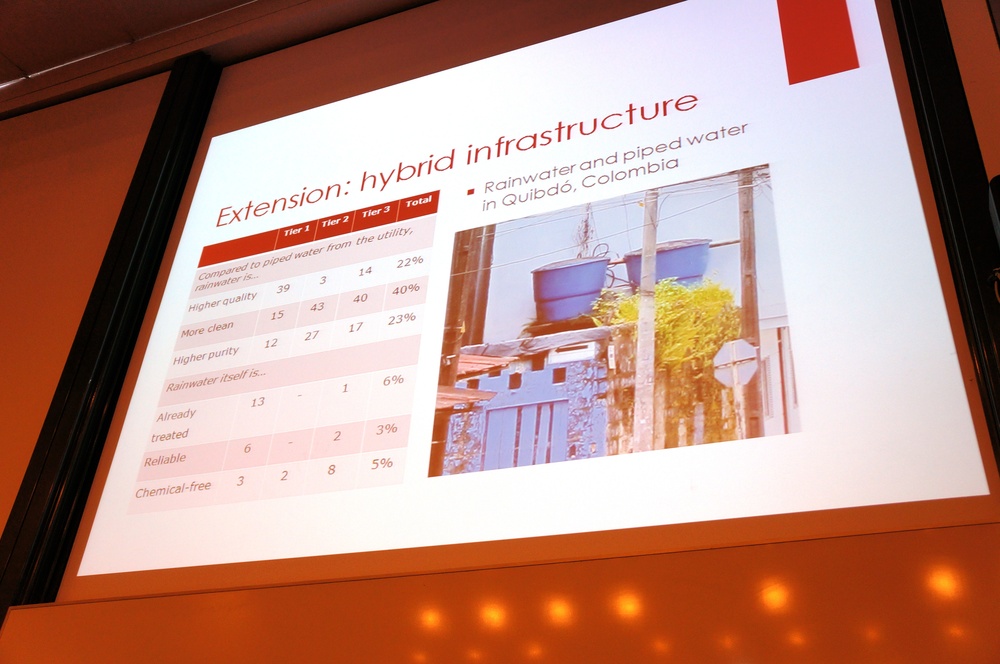
One of the ways that she ‘makes good’ on her previous claims about getting away from seeing infrastructure as ‘a single unit’ is to get at the idea that technologies might be hybrid (per the picture below) or, using my lens in ANT, seeing more of the multiplicity in water was a gathering point for many visions of water … in Kathryn’s case, this is a slide about comparing city wanter and rainwater. For example, her data collection shows that citizens consider rain water ‘more clean’ or ‘higher quality’ as compared to city water piped in from afar, but this importantly depends on the location of the person and the water.

Dsc01015

This all becomes even more interesting when applied to some of the central questions of state theory (e.g., what is a state? how do we make them? what can they do? can they do anything? etc.). Kathryn presents a commonplace distinction between the “North” and the “South”, but only for a moment, in order to get at the notion that in the Global South, the combination of government and infrastructure (which are otherwise imbricated in the Global North, comprising much of what is thought to represent ‘the state’) does not appear to operate in similar ways. Of particular importance, I think, is the idea that when a government attempts to impose a ‘unified infrastructure’ they will for sure end-up creating some sort of non-uniform thing variously composed of  especially in areas, and Kathryn contends, where infrastructure has not played a significant role in the previous years or decades (what she calls ‘omnipresent infrastructure’).

Dsc01014

Kathryn’s original abstract:

In the North, many authors have noted the passage from government to governance; that is from centralized and hierarchical to more diffuse and inclusive forms of decision-making (Jessop 1998; Peters and Savoie 1995). Infrastructure networks have experienced similar shifts, from the exclusive “black box” to more malleable and participatory systems (Furlong 2011). Yet, in many contexts in the Global South, including Colombia, neither the government, nor infrastructure managed to cover the whole of the state territory. By examining such a case, this essay seeks to add relief to some broadly held conceptualizations about the state, infrastructure and governmentality. One of these is in relation to scale. Drawing on critiques of scale (e.g. Marston et al. 2005), the essay questions where to locate the state in relation to issues of infrastructure and governing. Where the state has clearly not been omnipresent, it is easier to see how the assumed hierarchy of state scale breaks down. This is exemplified through the case of regulatory attempts to create a uniform infrastructure sector, which have yielded perhaps as much change in regulation as they have in service delivery. Moreover, where infrastructure has not been omnipresent, rather than imposing a new “black box”, managers may have to compete with a variety of pre-existing technical and social practices resulting in new forms of hybrid infrastructures. As such, just as new technologies create shifts in governing (e.g. the internet), the introduction of absent technology can yield shifts in both governing and how the technology is traditionally conceived.

Govind’s abstract

Dsc01009

The abstract for Govind’s project reads:

How do states act or exert their presence from a distance, especially when targets of action are separated by diverse and nested milieus of stateness? In addressing this question, the paper will draw centrally upon scholarship in three domains – governance of science and technology, anthropology of the state especially in postcolonial environments, and actor network theorizing of the state – to develop a conceptually grounded explanation. While a common concern across these domains has been to interpret the co-production of science/technology, society and state through concepts such as “boundary organization,” “state spatiality,” and “scaling devices,” one related theme that has attracted far less attention within these fields has been to understand how states act and make their presence felt at a distance across scale and space. This direction of inquiry is particularly intriguing when such actions intersect multiple and imbricated ontologies of stateness that exist at national, regional, provincial, and urban levels. Drawing from these literatures, in this paper I will use the example of a recent policy project in India as a case. NURM (or the Jawaharlal Nehru National Urban Renewal Mission) is a vast national policy exercise launched in 2005 that seeks to transform governance of technical infrastructures in 65 major cities in India by emplacing a host of new mechanisms, venues and devices to reconfigure state-society relations. Empirically investigating NURM, this study will situate and extend our understanding of how postcolonial states operate at a distance and across different scales from the national to the urban.

"Acting from a distance: States, scales, spatiality and STS." Govind Gopakumar

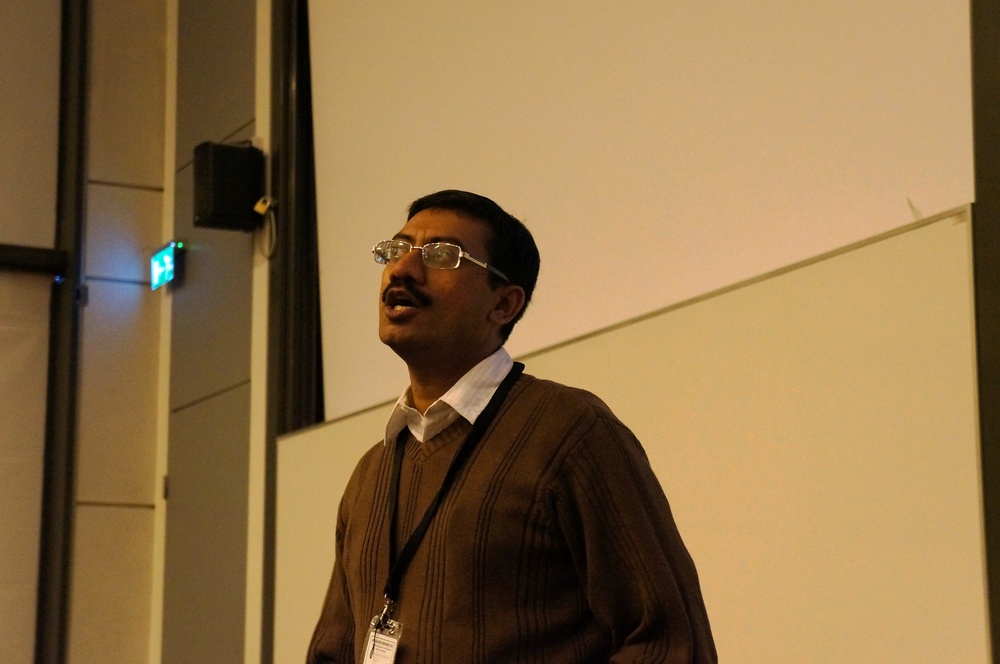
“Acting from a distance: States, scales, spatiality and STS” was presented by Govind Gopakumar of Concordia University in Canada. Govind is Associate Chair and Assistant Professor at the Centre for Engineering in Society.

Dsc01010

I first met Govind at last year’s 4S conference in Cleveland, OH, where he gave a terrific presentation on infrastructure and the Indian state. See below (CV available here):

“Knotty and Naughty: Seeing the Indian State through a Technoscientific Lens,” Society for the Social Studies of Science (4S) Annual conference, Cleveland, November 4, 2011.

I was immediately impressed by the work, which draws largely on Patrick Carroll‘s incredible and longstanding research on the technoscientific state. In fact, Govind had a book coming out that I subsequently reviewed for the Social Studies of Science, which you can check out here and was featured in a special issue about water (because Govind’s book is about water infrastructure in Indian citites and states).

Keep in mind that our 2012 theme for the panels was “On states, stateness and STS: government(ality) with a small “g”?” Govind rose to the challenge of seeing governments and governmentality with a “small g” — the small g meaning that instead of answering big questions in sociology by referring the power of macro structures that (must exist but) are always just immediately beyond firsthand observation (such as ‘the state’), we instead go to the micro-machinery of their makings (or even their underpinnings). And so, Govind did.

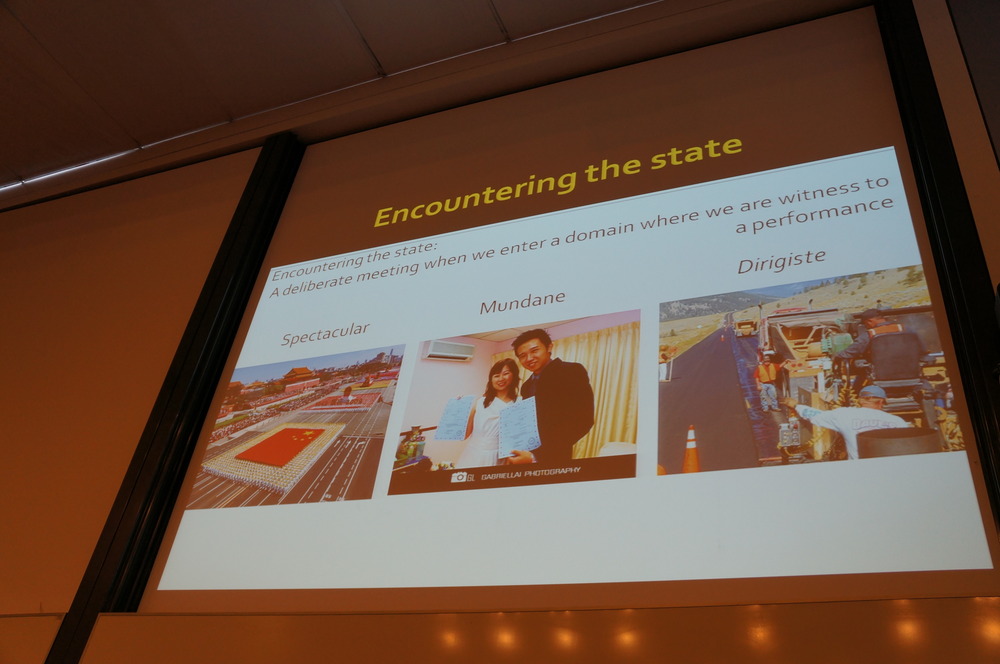
He took up the case of literally building state capacity, in this case, of infrastructural reform especially of the transformation of transportation. In the end, and these were short presentations that we asked emphasize theoretical points of relevance, Govind comes to a great conclusion. The state is not just out there (the state being the high-modern understanding of states as omnipresent actors forcefully shaping domestic and international matters of interest), the state comes to us during what he called ‘encounters’.

Dsc01011

As if Erving Goffman and Theda Skocpol had been fused together into some hybrid-Franken-theorizers, Govind suggested that of course the state is not out there, but that we occasionally come into its tenacles in the minutae of our daily lives, during spectacles where the state’s proverbial ‘muscles’ appear and are subsequently flexed, but also during (and this was quite nice) periods of construction, reform, and maintenance where the ‘dirigiste’ state is obvious.

In this way, instead of seeing like the state (a reference to Scott’s book from the 2000s), we see the state. We see these points of encounter (my words) as moments or locationalities wherein the state can be penetrated or penetrates our lives as citizens. These “close encounters” of another kind might just prove to be a great way to conceptualize the issue of macro-states from a relational, irreductive vantage point.

Bravo, Govind!

Back from 4S: Insights and Directions

This year, the Society for the Social Studies of Science meet at the Copenhagen Business School in Copenhagen, Denmark.

Dsc01007

As mentioned previously, Jan-Hendrik and I are returning to blogging again (after a long hiatus), and we’d like to start by commenting on the sessions that we proposed and that were delivered at 4S a few days ago.

We’ll take each paper in order, and comment on the work of our colleagues and friends.

Our first set of papers comes from the first panel, which ended-up being:

023. (66) On states, stateness and STS: government(ality) with a small “g”? – I

 9:00 to 10:30 am at Solbjerg Plads: SP216

Chair: Jan-Hendrik Passoth, Bielefeld University

Participants:

“Designing the Sustainable State: the Small (g}overnance of China’s Big “Ecological Civilization.”” Erich W Schienke, Penn State (cancelled)

“Acting from a distance: States, scales, spatiality and STS.” Govind Gopakumar, Concordia University

“Locating the state? Infrastructure, scale and the technologies of governing, a Colombian case.” Kathryn Furlong, Université de Montréal

ADDED: “Viewing the Technoscientific State through the Heteroscope: The State, displaced or misplaced?” (could also be called “The Dancer and the Dance”) Alexander Stingl, European University Viadrina, Frankfurt/Oder (check out his blog here)

“Territorializing, Calculating and Governing.” Peter Miller, London School of Economics and Political Science (cancelled)

“”Towards a Common Future”: On How a Diplomatic Training Programme Socialises States into the International Society.” Tobias Wille, Goethe University Frankfurt

We will comment on each paper individually, and then provide some comments about the papers as a group afterward.

After a long hiatus, we return

Planning for the 4S/EASST meeting for this year has kept us all busy working over the last month to prepare our papers, presentations, and (as Jan and I are discussants for two sessions) comments for our presenters. We will post on the blog as the conference proceeds, and following 4S/EASST in Copenhagen, we will blog about the Millennium conference at the London School of Economics in the days following 4S/EASST.

Capture

According to the website, there are a record number of presentations this year. Our panels, unsurprisingly, deal with states, government(ality), and STS. Come check out our panels on state theory, which happen to be back-to-back, both in Solbjerg Plads SP216 (for full program with abstracts, see here.

Our first panel will be:

023. (66) On states, stateness and STS: government(ality) with a small “g”? – I

 9:00 to 10:30 am at Solbjerg Plads: SP216

Chair: Jan-Hendrik Passoth, Bielefeld University

Participants:

“Designing the Sustainable State: the Small (g}overnance of China’s Big “Ecological Civilization.”” Erich W Schienke, Penn State

“Locating the state? Infrastructure, scale and the technologies of governing, a Colombian case.” Kathryn Furlong, Université de Montréal

“Acting from a distance: States, scales, spatiality and STS.” Govind Gopakumar, Concordia University

“Territorializing, Calculating and Governing.” Peter Miller, London School of Economics and Political Science

“”Towards a Common Future”: On How a Diplomatic Training Programme Socialises States into the International Society.” Tobias Wille, Goethe University Frankfurt

Our second panel will be:

051. (66) On states, stateness and STS: government(ality) with a small “g”? – II

11:00 to 12:30 pm at Solbjerg Plads: SP216

Chair: Nicholas J Rowland, Pennsylvania State University

Participants:

“The Tractor and the Plow: Commercial Agriculture and Ethiopian Statemaking since 2002.” Sarah Stefanos, University of Wisconsin, Madison

“Inside/outside again? Private security companies and the formation of ‘modern’ assemblages in Eastern Congo.” Peer Schouten, School of Global Studies (University of
Gothenburg)

“Port(al)s: How infrastructure flattens the world we live in.” Jan-Hendrik Passoth, Bielefeld University; Nicholas J Rowland, Pennsylvania State University

“Governing the environment: Guidance documents and the ‘making up’ of environmental practitioners.” Matthew Cashmore, Aalborg University; Tim Richardson, Aalborg University

“Nature, Environment, and the Technoscientific Enviro-State.” Patrick Carroll, University of California, Davis


Response to Hendrik about (ir)reductionism

Recently, Hendrik responded to one of Jan’s posts about Neil Fligstein, regarding irreductionism. He wrote:

I guess I am a little less skeptical than the two of you. Maybe it comes down to not minding reductionism that much. Some reductionism has to be accepted, obviously, if we would like to explain anything. And I remember phrases from Latour’s “Irreductions” claiming that certain things  – for example, knowledge – do not exist. Is that not reductionist? It appears to be more a matter of which reductionism (materialist, idealist, institutionalist etc.) to pick.
What would a general irreductionist epistemology look like? And if it claimed that fields did not exist by their own devices, would that not be a reductionist claim?
Anyway, thanks for bringing the Fligstein book and the orgtheory-post to my attention. I am eager to read it.

His point is a good one, no? We are left to simply accept one reductionism or another, and he rightly points out that even Latour’s move to irreductionism was a form of reductionism (in a certain light). To this, I made the following comment, which I think is a new direction for irreductionist thinking. Let me know what you think…

I wrote:

Hendrik, Sure, that is one position to take; accept one reductionism or another, its more a matter of choice than real alternatives. That sounds fine, and as you say, many people simply do not mind reducing or essentializing some facets of society and so on.
.
However, there is something of an alternative available, however, and I’ve been writing about it on the blog for the last two weeks. The basic point falls like this: how do we reject (but not fully do away with) essentializing or reductive ideas?
.
For me, of course, the state comes to mind immediately. How can we sit around like smart little scholars saying “the state does not exist” (with a Foucauldian grin), meanwhile the rest of the Western world thinks about states as actors with quasi-interests and so on (as Hobbes might have had us believe in Leviathan)? How can so many people mistake this reductive idea for what’s actually happening on the ground? How can so many people think of the state as somehow set apart from what must be, in principle, its constitutive elements?
.
From this vantage point, reductionism is not so much something to assume (as you suggest, we must assume one way or the other) and becomes a new source of questions: how did this reduction happen and how is it supported?
.
That strikes me as quite interesting, and not really such a trap; provided we think of irreductionism as a source of questions rather than just another assumption, some new territory might be pioneered (that was a nice, American metaphor, eh!?)….

New paper on crowdsourcing

An interesting paper on crowdsourcing just came out in the “Computational & Mathematical Organization Theory” journal. “Maximizing benefits from crowdsourced data” by Geoffrey Barbier et al. explores how crowdsourcing can be used for purposes of collective action and problem-solving, for example, in disaster response and by relief organizations.
Here’s the abstract:

Crowds of people can solve some problems faster than individuals or small groups. A crowd can also rapidly generate data about circumstances affecting the crowd itself. This crowdsourced data can be leveraged to benefit the crowd by providing information or solutions faster than traditional means. However, the crowdsourced data can hardly be used directly to yield usable information. Intelligently analyzing and processing crowdsourced information can help prepare data to maximize the usable information, thus returning the benefit to the crowd. This article highlights challenges and investigates opportunities associated with mining crowdsourced data to yield useful information, as well as details how crowdsource information and technologies can be used for response-coordination when needed, and finally suggests related areas for future research.

Besides being a very useful reference piece by providing a state of coverage with respect to crowdsourced data – like where to find it and what to make of it -, the paper is also a nice illustration of how social scientists become more and more involved in leveraging “big data” from informational infrastructures and from web activity in general. Crowdsourced data but also initially a lot less directed, if not accidental, information flows appear to increasingly be data-mined for a variety of purposes, not at least by – oops – us.
Check out the paper here.

Fields and Infrastructure? A comment to Fligstein on orgtheory

As a guest blogger on orgtheory Neil Fligstein started a series of posts about his and Doug McAdam´s new book “A Theory of Fields ” (Oxford 2012). It seems to me that to continue the debate on Instiutionalism and Infrastructuralism we should take his analysis that most of what is called NI today is – although continuously citing Meyer/Rowan, Dimaggio/Powell and of course the Powell/Dimaggio book – no longer working out the “old neo institutional” programm but try to deal with problems of ongoing activity, constant and gradual change and overlapping fields. In Fligsteins words:


One critical argument of the “new” new institutionalism is that actors are always jockeying for position in existing fields. They are always trying to better their situation and in doing so, can create change in both their position and the underlying order of the field. This produces two distinct kinds of change, the change whereby a new institutional order comes into existence and the more common situation whereby change is more gradual and continuous.

and:

But this view of the world posits two radically different states, one where we can be agents and make our world and the other where we can do little about it. “A Theory of Fields” undermines this entire line of argument by asserting that actors are always acting and this means they are always struggling. They are in a battle for position and the game is always being played. This means that “A Theory of Fields” is part of a “new” new institutionalism that honors actors, sees purposes, interests, and identities, and allows for stuff to happen all the time.

Although I would reflexively add that what Fligstein seems to do here is itself the activity of an instiutional entrepreneur – trying to change the rules of the field or – if that turns out to be impossible – prepare the setup of a new field, I guess there are some common problematiques that both the proposed new new institutionalism and the infrastructuralist agend have in common: a focus on practice (The Theory of Fields draws heavily on Bourdieu), a focus on constant change, a curiosity for the question of how in a world of constant change patterned activity is produced and the focus on struggles (although we might be critical about the psychological undertone of the term struggle and rather speak of trials of strength).

STHV, Special Issue on Context: Comment Four

Comment four on the July issue of Science, Technology, & Human Values (July is volume 37, number 4).

Capture

Recently, I claimed that STHV had produced what I thought was one of the best issues in a while.

I will, in a series of posts over the next month or so, comment on each paper in the special edition on context with comments, criticisms, and occasional tangents.

Fourth paper is “Natures, Contexts, and Natural History” by Brenna.

Original Abstract:

How are contexts made and narrated? This article addresses the question of how to identify relevant contexts for understanding a work of natural history, in this case The First Natural History of Norway, published in two volumes in 1752 and 1753. In addition to offering a rich and complex description of Norwegian nature, this historical work serves as an important source for investigating the ways in which nature was perceived in the kingdom of Denmark-Norway in the middle of the eighteenth century. Nature was manifold, serving as a source of aesthetic pleasure, economic gain, religious reverence, and political power. It is argued that to understand the different natures presented in this book, we need to relate them to more than one context. But how do we determine the relevant contexts? The approach explored in this article is to read the book closely in search of the specific audiences that are addressed. By focusing on the ways audiences are addressed, it is argued, we can make better historical accounts of how natures are conceived and change in relation to different contexts.

Reaction and Commentary:

We get a great piece here about how context matters for historians and for creating historical  explanations, but not without challenging the commonsense ideas about context. In particular, the author states that the historians relationship with context results too easily “a circular logic” wherein the historian is searching for relevant contexts to write about (a precondition to doing history) but also as the outcome of their efforts to provide a historical explanation (thus, context is also the outcome of the contexts we hope to document). Of course, the only way out of this cardboard-box of theorizing is to avoid thinking of context as something “out there” and instead deal with multiplicity and enactment (both from Mol’s writing on the topics). Noting that ethnography is routinely used in ANT to understand these insights — multiplicity and enactment — she tests how they work for historical objects like the Pontoppidan book of Norway/Denmark natural history, which is the centerpiece of the article.

Brenna shows how there is no such thing as nature (as a singularity) in the text (and presummably, outside the text) and instead reveals nature to be plural; and thus, we learn about four natures invoked in the chapter, namely, the king’s nature (nature as asset), God’s nature (depicted as benevolent and orderly), the marketplace’s nature (where nature is bought and sold like so many curiosities to fill our cabinets with), and, finally, the learned community’s nature (as a source of general improvement of knowledge). The author goes onto to hint at the tensions and differences between the only occasionally overlapping contexts of nature (NOTE: for studies of multiplicity, contexts [in the plural] might be a nice way to see the “multiple contexts” of otherwise singular tems like “nature” or “the state” and so on). This part, however, was also somewhat difficult to fully appreciate because the tensions were not particularly tense, and it seemed as though a deeper, more thorough analysis could have been undertaken; however, making it through Pontoppidan’s book might have been analysis enough for one article.

The author concludes on an awesome parallel: trained to some extent in museum studies, Brenna shows us why our historical accounts of the past cannot be similar to a “period room” common to many historical museum collections. A period room tries to typify a particular period of time and pack it into a coherent room for onlookers to observe. As Brenna notes, this is occasionally good practice for the purposes of teaching, the coherent context defies what we now know about the multiplicity of times/contexts. Even if the cost is providing what appear to be less than coherent protrayals of history, we must not write our accounts like period rooms (which also hints that we should not make our period rooms like period rooms). In the final lines, however, the author turns attention to power … and this is difficult to stomach. The claim is that the multiple contexts hint at power relations. From my position, while this may be true, it is hard to say that nature is multiple while then using such a loaded (and multiple) term as power without so much as a basic definition. While ANT served the author well with regard to seeing nature multiple, apparently a few readings about how power is a dirty word among ANTers (and heroically reductive) might have helped the closing lines.

STHV, Special Issue on Context: Comment Three

Comment three on the July issue of Science, Technology, & Human Values (July is volume 37, number 4).

Capture

Recently, I claimed that STHV had produced what I thought was one of the best issues in a while.

I will, in a series of posts over the next month or so, comment on each paper in the special edition on context with comments, criticisms, and occasional tangents.

Third paper is “Context and Culling” by Law and Moser.

Original Abstract:

This article asks how contexts are made in science as well as in social science, and how the making of contexts relates to political agency and intervention. To explore these issues, it traces contexting for foot-and-mouth disease and the strategies used to control the epidemic in the United Kingdom in 2001. It argues that to depict the world is to assemble contexts and to hold them together in a mode that may be descriptive, explanatory, or predictive. In developing this argument, it explores how contexts are assembled in a series of different descriptive and explanatory narratives in epidemiology, policy, critical social science, and (feminist) social studies of science

Reaction and Commentary:

This is a good lesson piece in this new irreductive camp; however, some elements of this piece will madden readers. The piece is about the foot and mouth disease outbreak in the UK during the early 2000s. Much of the empirical material comes from a government document about the early events and a retrospective account of why the epidemiological predictions were so far off the mark either before, after, or during the events.

The best part of the article will have to wait until the end this review (it is about how epidemiological modelling might need to account for context a bit more, and in new irreductive ways), but some basic points are still worth rehashing. First, the chapter takes for granted this insight: contexts don’t really exist because contexting is done (RE: active). As it happens, contexts are constructed, and they tend to be treated as (unnecessarily) coherent constructions when observed first-hand in the wild, or when crafted second-hand by sociologists or scholars in STS. To show evidence for this, Law and Moser provide a number of accounts (which seem to layer on one another nicely), but which are unfortunately called “contexts” (rather than accounts or explanation generation techniques). These accounts become “contexts”, I will grant them, in that they begin to populate the setting and describe the relationships between relevant actors and entities (keep in mind, this is foot and mouth disease among sheep). They begin with a generically objective account of how epidemiological modelling is imperfect and takes many forms, and then take to comparing the two forms that make their way into the case study. After that context, they layer another context (RE: account) onto it, namely, one that STSers will like: a critical account where political connections among leading scientists leads to a corruption of the policy implications of the otherwise scientific models, which results in a culling of many sheep that otherwise might have lived, but that seem to have fallen under the axe of political interests too powerful and broad to protect them. <lingering pause> Then the authors backpeddle a bit, showing how none of these accounts is sufficient, and find a critical examination of both accounts, similar to accounts by Singleton about policy, where we ask: was any policy towards the culling of sheep with foot and mouth disease ever really enacted in full? (thus, making any explanation quite difficult to support) … the concluding remarks suggest that any policy being enacted is incomplete, the policy itself was different in different locations and differently applied in similar/proximal locations … there was, in fact, no one policy to assess for effectiveness and instead a plexus or cacophony of variations on the recommendations were enacted. The policy was multiple; a differentiated singularity. This is quite important because it is as easy to make errors like this (RE: treat a policy as non-multiple) when telling Whiggish retrospective accounts as it is when trying to establish prospective accounts — and this applies to both scholars as well as those persons in the public that do this sort of contexting (or account-making). In the end, and here is the best part, Law and Moser suggest that this is one way to make epidemiological modelling even more effective; erase our bias for coherent accounts where policy adherence and contextual coherence are assumed.

One serious pick at the piece, though, must be the style of writing; without being too critical or traditional, the conversational tone, which had the cadence of a bright teacher talking down to a dull student, was difficult at times to stomach…

More on the map wars

The BBC’c “Click” program has a quite watchable bit on the battle of map services that is increasingly gaining momentum.
The first couple of minutes of this six-minute segment stick to the basics of mapping and the provision of map and navigation services but the last minute or so turns to the Google vs. Apple competition discussed here earlier. More particularly, the clip offers a comparative look at Apple’s map service embedded in iOS 6. It appears that Apple is betting primarily on 3D mapping and crowdsourcing while Google is systematically expanding both its ground-based and airborne forces.
Furthermore, the segment reminds us that Microsoft is also in this market via “bing”. We will see what happens later this year with the release Windows 8 and an expanding fleet of Microsoft-powered mobile devices. It is already hard to imagine the amount of capital these companies are committing to over- and out-map each other.
While Apple’s services are not yet live and Microsoft has yet to become competitive in the mobile market, the arms race in the map wars by now is truly on.

STHV, Special Issue on Context: Comment Two

Comment two on the July issue of Science, Technology, & Human Values (July is volume 37, number 4).

Capture

Recently, I claimed that STHV had produced what I thought was one of the best issues in a while.

I will, in a series of posts over the next month or so, comment on each paper in the special edition on context with comments, criticisms, and occasional tangents.

Second paper is “Health Care Standards and the Politics of Singularities: Shifting In and Out of Context” by Moreira.

Original Abstract:

Context is a pivotal concept for social scientists in their attempt to weave singularities or universals to moral codes and political orders. However, in this, social scientists might be neglecting the ways in which individuals or groups who are excluded from the collective production of knowledge want to politicize their concerns also by claiming their uniqueness and singularity. In this article, drawing on the public controversy about access to dementia drugs on the U.K. National Health Service (NHS) and on the work of pioneering sociologist Helen McGill Hughes on “human interest stories,” the author argues that the “politics of singularities” can be articulated in two related ways within technical controversies. First, it expresses the unraveling of sociotechnical ties caused by institutional failure to take concerns into account. Second, it expresses the concrete uniqueness of persons caught by standardized, “universal” and impersonal implements and/or policies. Both these effects are underpinned by resourcing to allegorical expression, a literary form that while fostering political imagination in technological democracies might weaken Science and Technology Studies’ (STS) ambitions to influence decision making.

Reaction and Commentary:

This is an exceptional paper, but the abstract is a bit misleading, as much of it makes the clearest sense only after you’ve already read the article in its entirity. I’ll help to decode a bit. The real key to appreciating this paper is that it does not have as much to do with context or the irreductionist approach to context so much so as it is a case-in-point about how the “politics of singularity” operates (and, it might be argued, within the broader context of Big Science, in particular, in the pharmaceutical industry and, in this case, access to experimental dementia drugs in the UK).

The “politics of singularity” works like this. Big Science decontextualizes knowledge from its origins, which is a common story that some of us know from experience: considerable effort is made on the part of scientists to disentangle “data” from their messy origins so that they appear clean and universally applicable later on (or elsewhere). The goal, then, is to uncover where and how decontextualization attempts occur. In a Garfinkelian move, the author shows how decontexutalizaiton fails to decontextualize. So, what happens, then, when this model is challenged by outsiders (i.e., non-scientists), what do they use to challenge it, and why might it work? All three of the answers blend “singularities” with “politics”.

What do non-scientists use to challenge scientists conducting large-scale clinical trials? The author draws-up (and shows excellent evidence for this) a model wherein we come to see clinical trials as charateristically “generalizing” and “conclusive” (which are two things, of course, that map onto basic tenants of science quite well). When clinical trials are challenged, citizen non-scientists tend to emphasize just the opposite, their “pleas” (or “human interest stories” RE: Helen McGill Hughes) are “individuating” and “emergent”. Consider their contents, respectively. Scientific accounts of dimentia record verified tests of cognitive scores or memory evaluations, which when combined from many patients over time aids in creating generalized and conclusive knowledge about an intervention for dimentia. In contrast, personal accounts (pleas or “human interest stories”) operate according to an alternative dynamic. They emphasize dimentia as a lived experience at home where loved ones report whether or not the family member (RE: patient) is doing well and is feeling comfortable, which is drawn-up against backdrop of the home where “all this is really happening right now” with the implicit message that some sort of intervention could/should be taken.

Why might it work? According Moreira, individuating pleas have a curious political consequence. While we may assume, and plenty of sociological research about social movements suggests precisely this, that it is through large numbers of people banding together that we should expect politically-based change to, in this case, transform scientific trials. However, we do not see that in the UK dimentia controversy. Instead, the controversy is populated by “human interest stories” (RE: Helen McGill Hughes and the Chicago School analysis of “news”). These highly-individualistic portrayals of human life have a surprisingly hidden-in-plain-sight consequence: we related to them, despite their specificity, and this is a result of their un-fixity (or the quality that they are happening right now and it is not too late to do something about them).

What happens when this model is challenged by outsiders? Moriera encapsulates the answer winningly:

… the politics of singularities works in a dynamic relationship with the politics of generalization. Persons or groups locked out of the collective production of evidence capture the public imagination by shifting the frame of reference. The political imagination of the case is the delicate effect of the displacement that gathers in tension “the most extensive generalization” and “the most precise individuality.” (p.324-5).

The key being to bring the general and singular in tension, and the author means this not only hypothetically, but also in terms of a recipe for citizens that want to challenge “larger issues”. This notion of “bringing into tension” or (more actively) “gathering tension” seems like a fruitful technique for citizens and sensitizing process for scholars to keep in their analytical tool belts.

STHV, Special Issue on Context: Comment One

Comment one on the July issue of Science, Technology, & Human Values (July is volume 37, number 4).

Capture

Recently, I claimed that STHV had produced what I thought was one of the best issues in a while.

I will, in a series of posts over the next month or so, comment on each paper in the special edition on context with comments, criticisms, and occasional tangents.

First paper is “Experiments in Context and Contexting” by Asdal and Moser.

Original Abstract:

What is context and how to deal with it? The context issue has been a key concern in Science and Technology Studies (STS). This is linked to the understanding that science is culture. But how? The irreductionist program from the early eighties sought to solve the problem by doing away with context altogether—for the benefit of worlds in the making. This special issue takes its points of departure in this irreductionist program, its source of inspirations, as well as its reworkings. The aim is not to solve the context problem but rather to experiment with context and what we label contexting.

Reaction and Commentary:

The scope of this opening piece is like any introduction to the the topic, as one would expect in an edited book or special edition. Typically, and this is no exception, it is at once not broad enough or deep enough to adequately do this, but does a fine job of setting up the relevant lines of research, which are developed in papers afterward.

Still, context is not really defined (in the old fashioned, positivistic sense), even though the abstract sort of promises something of a definition. Instead, a bit of a dance is initiated. Context is raised as a hopeless sociological concept, which has traditionally been used to explain all manner of relevant issues for sociologists such as group-level human behavior, social trends, and the like. However, this traditionalist vision of context is challenged by a traditional vision of context, but this time from Science and Technology Studies, namely, the irreductivist camp otherwise commonly known as actor-network theory. From the vantage point of ANT, we can be critical of the reductive potential of “context” (and many other constructs that aid in sociological explanation generation). We see that, while context is useful for sociologists, it is also something we cannot see, that is, we cannot observe it directly; however, so reified in sociological circles, context is something you feel like you might be able to snap a picture of!

The definition of context, then, is exchanged for a ‘balance’ (like in a ledger, but for theory): the authors write:

We suggest  a series of moves [read: assumptions and rules of thumb] that may keep the irreductionist program alive while at the same time acknowledging that context is something we cannot escape (p. 293).

This is an insight drawn largely from Donna Haraway’s commentary on what to do about ‘nature’; a notion that is hopelessly troubled, but something that we nevertheless cannot do away with completely. In this way, they suggest ‘context’ is a similar sort of concept.

Here is where a missed step took place. Context is not a concept (in the singular). Instead, context triggers the same sorts of issues that ‘nature’ does, and ‘the body’, ‘the economy’, or ‘the state’ do … they are ‘differentiated singularities’ (to use a phrase from the special issue) or, to use a phrase I am more familiar with, they are multiple. In this case, hence, my insistence that ‘context’ must strike a balance (of sorts) on a ledger for theory; balancing the traditional ways of using the term with new ways for understanding both the same term and a new version of it. The trick, then, of course, is to determine what links them together or when one version/face of context appears rather than another.

As a closing comment and insight, one of the reasons that context can balance so many seemingly incommensurate definitions is because of its centrality to the social sciences. The upshot: do away with context (context dependence, cultural context, organizational field or environment, and so on) and much of the conceptual infrastructure supporting sociological analysis and explanation generation techniques goes with it. One might say that you cannot have sociology without it. Jens Bartelson once wrote a terrific book, good for students (if read slowly) and advanced colleagues (still, take your time), about ‘the state’ as a multiple concept, which he studies both historically and conceptually as it was born in political philosophy and then as the term was migrated to political science in The Critique of the State. One insight from the book: the state cannot be defined, but instead balances sets of abstractions about itself, sometimes abstractions so contradictory that they appear impossibly incommensurate; however, such (multiple) concepts as the state or the law become the fodder that disciplines are made of, so close to the heart of the discipline as they are buried.

Case in Infrastructure Failure

In the New York Times today (August 1, 2012), a headline reads:”2nd Day of Power Failures Cripples Wide Swath of India“.  Key lines read:

On Tuesday, India suffered the largest electrical blackout in history, affecting an area encompassing about 670 million people, or roughly 10 percent of the world’s population. Three of the country’s interconnected northern power grids collapsed for several hours, as blackouts extended almost 2,000 miles, from India’s eastern border with Myanmar to its western border with Pakistan.

Capture

… Blackout Tuesday — which came only a day after another major power failure — was an embarrassing reminder of the intractable problems still plaguing India: inadequate infrastructure

Interestingly, the story is backdropped in the newspaper article by invoking both the economy and the state. Regarding the economy, India is presented as many of us think of them, as a rising economic power although one that has experienced some significant stumbling along the way. The state was also criticized for their role in the matter:

India’s coalition government, battered for its stewardship of a wobbling economy, again found itself on the defensive, as top ministers could not definitively explain what had caused the grid failure or why it had happened on consecutive days.

When the train system, which is one of the busiest systems in the world, according to the article, started posting across-the-board delays and cancellations, one citizen remarked:

“Now my pocket is empty,” she said. “I am hungry. I am tired. The government is responsible.”

Incredibly, government officials agreed, citing abuses by … government officials, but, crucially, “other” government officials, here is how:

Surendra Rao, formerly India’s top electricity regulator, said the national grid had a sophisticated system of circuit breakers that should have prevented such a blackout. But he attributed this week’s problems to the bureaucrats who control the system, saying that civil servants are beholden to elected state leaders who demand that more power be diverted to their regions — even if doing so threatens the stability of the national grid.

In the end, and this is an interesting remark for later theorizing; the following comment suggests that infrastructure sits at the boundary or can be positioned at the boundary between international and domestic affairs:

“India needs to stop strutting on the world stage like it’s a great power,” Mr. Guha said, “and focus on its deep problems within.”

On microfoundations and Barley

Seems the comment tool on Posterous is not working today, so here is my comment to Jan-H. about Barley, the neo-I crowd, and technology.

While I have always liked Barley’s work on technology, there is something I have got to get off my chest: in his super famous 1986 paper, the one about radiologists and new workplace technology (ASQ?), what was he really showing in that paper that made him so famous?

He showed that technology does not have a straightforward consequence when it enters a work place and instead can have different consequences in different workplaces. Well, I’d say “of course”. After all, the paper provides a counter point to a non-issue. Even in the literature at the time, it was almost unfair to ask: what is the single consequence of this technology for all work? Thus, his argument was pinned against is flimsy one, even for org studies.
.
Here is why: they have been searching for that answer since the 1960s with Woodward who assumed one could “unlock” the consequences of industrial manufacturing technology, namely, the assembly line, for work in general, laborers, managers, etc.
.
Guess what? She couldn’t. There was no single consequence.
.
Tech did not uniformly speed things up.
.
Tech did not shape each organization the same.
.
Tech did not … and so on.
.
Woodward assumed it would, or hypothesized as much, but Woodward was, in fact, learning what Barley would later test as a hypothesis the other direction. Barley assumed it the other way — that there would not be just one consequence of technology — and, unsurprisingly, found it. Well, in a way, of course he did; he found what scholars had been finding (but not looking for) for decades.

Microfoundations, institutions and two ways of studying technologies

Quite some time ago we had a couple of posts on the possible links between STS and Neo-Institutionalism (see here, here, here and here) and about how both camps can be fruitfully matched in their attempts to get a grasp a the black-boxed, taken-for-granted or institutionalized character of modern practices.

One of the basic lines of linkage we identified back then was this: while Neo-Institutionalism is great at pointing out the empirical details and explaining the diffusion and isomorphisms of patterns that are taken-for-granted (institutions), they lack (following Powell and Colways 2008) a perspective on the respective microfoundations. THAT on the other hand is something that (most) STS approaches are quite good at – but they on the other hand – see for example the underdetermined concept of black-boxing – lack an understanding of how the “functional simplification” (Luhmann 1997) that technology enacts is comparable to other forms of making something taken for granted: habitualization (in the bourdieuian sense), embodyment, signification, formalization, institutionalization.

After reading Barley´s and Tolbert´s 1997 paper in Organization Studies on Institutionalization and Structuration and after reviewing Barles´s research on technologies at workplaces I wondered a. if and how the Powell and Colways argument about the missing micro-foundations has ever been valid in institutional theory given the amount of thought that Barley and Tolbert are investing in designing their concept of scripts and the methodology to analyze them and b. why STS approaches to technology do not seem to play a large role in institutional analysis that deal with technologies on the one hand and why these institutional approaches to technology on the other hand do also not play a significant role in STS? Any thoughts?

Teaching STS: Are military weapons used to kill other soldiers or civilians?

There is a post by Fabio Rojas over at orgtheory.net that might be of interest to those of your in STS and those of you teaching STS.

Capture

<http://www.iraqbodycount.org/database/>

He reports on a simple question: are military weapons used to kill other soldiers or civilians?

This question, if brought in front of a classroom, raises a few poignant issues for STS, engineering designs, and designers.

  1. STS has a long history — and this appears in, for example, Volti’s Society and Technological Change much more prominently than, for example, Sismondo’s Introduction to STS — of studying military technology and the rise of the post-WWII U.S. military-industrial-complex. Especially, when I was trained in STS, MacKenzie’s Inventing Accuracy, which showed how social influences impact even internally controlled technological devices (in his case, ballistic missiles, which are thought to be impervious to outside influence once launched … of course, these are two differnt forms of “influence”, but it still made for a great book about military technology and why a device is just so accurate, or just so fast, or just so efficient, and so on. The rise of civilian deaths, which was a deep concern in MacKenzie’s book and one of the manifold reasons enhanced efficiency was pursued in the first place, so this lands as an interesting issue on that regard, especially in comparison.
  2. The “use” literature has long argued that the boundary between use and design is much more porous than was once previously appreciated by the STS community. I’m thinking of How Users Matter edited by Oudshoorn and Pinch as a high-water mark in that line of work. In this case, we see all sorts of instances where use influences design directly during testing trials for particular products, instances where use influences design long after production when tools meet new contexts of use (like dental tools being used in art museums to clean ancient masks), and, of course, the SCOT discovery that uses can be imposed on new designs for public consumption. None of these approaches really captures what seems to be happening in this case, moreover, in some cases, while there is a fine line between what constitutes a “military” weapon versus something a civilian might own legally, some instances are very plain.
  3. While there is not a ton of literature that I am aware of appropriate for the student-level, this also raises the philosophical/ethical concern about what responsibility engineers have for how their designs are used. I don’t mean to come off as naïve, but this is a serious question for students considering the profession (and, in my opinion, for us more broadly as well).

So, this is a rich case to get at a number of issues regarding weapons, the (US) military, and the politics of how technologies are used.

Plagiarism in Dissertations Ending Careers

Yesterday, BBC News’ “Viewpoint” series ran a special on “The Spectre of Plagiarism Haunting Europe“, which documents how some high-profile politicians (and academics) are stepping-down from their posts after plagiarism was discovered in their dissertation theses and publicized via Wiki pages.

Capture

<http://www.mono-live.com/2012/02/free-plagiarism-scan.html>

The suggestion, in the concluding remarks, is:

Dissertations need to be published online with open access to permit easy checking, and a random sample of theses defended in the past five years needs to be reviewed in order to identify weak points. However, there is currently no funding for such measures, so it’s unclear whether German universities will really get serious about plagiarism, or keep muddling on.

Evidence suggests this is not an exclusively German plague, so similar measures may be required in other European countries too, possibly all, to ensure that higher degrees awarded in Europe’s universities continue to attract the respect they deserve.

This sort of “watchdog” work by experts and non-experts alike seems to hold back the tide of “creeping tolerance for scientific misconduct” in academia … pieces like this one, and many more, which are bound to come, should be front-page news for students and faculty alike.

Best STHV issue in a while

The July issue of Science, Technology, & Human Values is out (July is volume 37, number 4).

The entire issue is devoted to what the special issue editors Asdal and Moser are calling “contexting”. The basic issue at work is the 1980s actor-network move towards an irreductive position for STS research. Calling into question the influences of something not immediately present (but ever present) and frustratingly beyond the actors that we cannot observe directly, Latour and others in ANT camp sought to establish a sensible alternative to things like “context”.This position was nicely laid out in The Pastuerization of France (in fact, the STHV special editors open the issue with the well-known line by Latour), but I prefer the exposition in Reassembling the Social, which I once reviewed with Jan-H. and even blogged about a bit.

The basic story goes like this: social scientists routinely invoke “other” actors such as context, which help to explain events, transformations, or people’s behavior. However, context, although ever-present, seemingly inescapable, and quiet powerful, cannot be observed directly. The same could go for all manner of “other” actors that influence us but cannot be observed directly such as “the economy”, “the law”, or “the state”, and other stuff like “time“.

432176_10150604201650942_175868780941_9533602_1513576400_n

The key insight being: these contexts do not exist, but actors do and there material and organizational consequences do too.

Contexting, however, helps to avoid the following trap: if we assume none of these “other” contextual factors exist, then great, for a moment we might feel smarter than a few other people, but this does not solve the basic problem we experience in our everyday lives, that is, that people say context matters all the time, social scientists publish on it, journalists tell us about the collapse of the global economy, and media pundits bemoan the inability of the state to govern its people and induce financial austerity. As Asdal and Moser (2012:302) put it: context is a troubled notion and straightforward contextualizing a problematic assumption, but still something we cannot escape”. Thus, the game is to figure out how context is “tied” to actors (and, of course, avoid treating context as something “out there”), moreover, context is decidedly plural (but not pluralist), which also riffs on the multiplicity notion in ANT (that Mol did so much to develop with The Body Multiple).

So, the July issue of Science, Technology, & Human Values is out (July is volume 37, number 4). Check it out. While it seems to be missing from each of the pieces in this special issue, no doubt, infrastructure might be one of those “missing masses” that ties actors to context…

More on weather reporting and infrastructure

About a week ago, I wrote about weather reporting infrastructure. In particular, I wrote about a New York Times piece that describes how a major player in the US weather reporting game is about to swallow-up a funky, underground weather reporting group through corporate merger.

Capture

One of the complaints about weather.com (the major player) was that too much non-weather was seeping into the reporting of weather, but that this new underground reporting group avoided that and, in some’s opinion, just reported “better” weather.

A colleague and friend, Eric Charles wrote back, in response:

Many many mergers are about infrastructure… I’m not sure how this one would be… unless you consider customers as infrastructure. I guess the website could count as well, but code is cheap, and I don’t know if a url gets the same status as a real storefront. Hmmmm… My very limited understanding is that the vast majority of weather predictors use the same nationally available data.

This does not seem like a merger of cell phone companies, in which the technologies, factories, delivery routes, stores, and especially cell phone towers are a major target of the acquisition.

I was not sure if other readers might have had the same response, so after thinking about it a while over the weekend, I posted this response, which is something of an answer back to Eric, but also seems to have turned into (inadvertently) a defense of an STS perspective on infrastructure.

Eric, I appreciate what you mean when you use the term “infrastructure” as something that must be either fairly physical or explicitly technological. For example, the cell phone tower or satellite become the exciting stuff that corporate mergers are made of.
.
I tend to think of infrastructure as far more fluid and emphasize the notion that “infra” implies “support” so that infrastructure has more do to with understanding support structures that facilitate a process, for example, than just explicitly the material elements (like dams or highways). In fact, as someone committed to an STS perspective, seeing any technology as “just a technology” or, for example, weather data as “all the same” misses an important point (which, by the way, is one reason our blog is titled “installing (social) order”) because data are never just data, the facts are never just the facts, machines are never just alone and instead they are “used” or “interpreted” by social actors and are themselves deeply social entities owing much of their “seemingly physical” characteristics to human designs which are often deeply influenced by social effects. In fact, it is sometimes said that when a machine or fact appears most free from social influences (i.e., not tainted by personal values or what have you) that they are in fact the most social. Consider an academic paper that might try to say that it has found something new to report and that the report was published after anonymous peer review (implying that no outside social factors muddied the science), the paper is not full of persuasion or rhetorical techniques employed by politicians, and instead seems once-removed from such things … but it is at this point that it has never been more social, after all, the reference section of any good paper is like the invitation list of individuals enrolled into the paper! The insight: when things seem the least “socially influenced” it is often because they are the most social of all.
.
Infrastructure is something of a similar case. Note that the original post was about weather “reporting” infrastructure, and to me this means the social and technical apparatus that, in effect, delivers said news about weather. One might say that a news anchor is “reporting on the news”; however, from my perspective, the news anchor does not, or at least is not much of a driving force behind “the reporting of news” other than the end point of delivery. I am sure that you realize this, but it bears unpacking.
.
What made this case interesting is that “weather” (and I mean it in the most basic sense of natural environmental expressions of wind, heat, etc.) is just one reality. It is either 92 degrees or it is not, and this is based, of course, on shared, standardized measures of heat, weight, pressure, etc. In so far as this is concerned, the idea that reporting on said same weather can differ so much as to take notice (and thus be “important” to someone somewhere) is peculiar. This is not just measurement error and really not a matter of achieving scientific consensus about what the weather is so much as two different supporting structures — and all the human and non-human actors there within — for how the “one” weather should be reported to the public. This inevitably means that more, much more than merely the “real” weather influence the support structure through which weather is reported. Moreover, because weather reporting is both about “immediate reports” AND “what we think it will be like tomorrow” the former can be reported with considerably less discretion (and attention, I’d guess) than the latter. As such, and I am not really picking and complaining about the vicissitudes of trying to report on the future (which is very difficult, with even the best data and most reliable entities), so much as I mean that an entire social infrastructure about the psychology of the public, the role of the media, and the consequences of being “wrong” (and so on) seems overlain on otherwise technical infrastructure of Dopler radars and weather towers. Thus, when you mention, “My very limited understanding is that the vast majority of weather predictors use the same nationally available data,” that is precisely what makes it seemingly boring for you, but exciting for me on this blog.

Outsource yourself to infrastructures!

The Wall Street Journal yesterday had a piece on how the flood of app-based service provision can make you lazy.
There are apps that let you call someone to wash your car just where you parked it; apps to let somebody queue for you; and certain apps like TaskRabbit let you “Get just about anything done by safe, reliable, awesome people”. Or, if you are lucky enough to be living in San Francisco, you may want to use “Get It Now” to “Have the best of San Francisco delivered to you in under one hour”.
Appropriately for the Journal, author Jessica Vascellaro uses the terminology of outsourcing to describe what is happening in the use of these app-based services. As we are outsourcing all kinds of activities to other people via our smartphones, however, the question may not only be whether we become lazier, but also whether we become embedded. Can there be any doubt that we do? The tone of cultural criticism in the WSJ piece suggest that we are losing something here but are we not in fact extending ourselves in truest McLuhan style? In that sense, the work I am outsourcing is still there, and it is still my work – done by others. In outsourcing activities, I am simply using the infrastructure of mobile communication in order to make many things happen simultaneously. Does service provision through infrastructures turn us into small-time Leviathans?

Weather (Reporting) Infrastructure

An exceptional case is emerging in the US about weather reporting infrastructure. Today (July 4), according to a New York Times article:

The announcement on Monday that the Weather Channel Companies, owners of television’s Weather Channel and weather.com, would buy one of its rivals, Weather Underground, set off howls of displeasure on social media platforms and around water coolers across the nation. The purchase price was not disclosed.

Capture

Part of the controversy is about scientific versus non-scientific reporting of the news. The Weather Channel (TWC) is reportedly too personality driven and, in some conceivable way, benefits from odd reporting that over-reports the potential for (typically bad) weather, leaving its viewers in a situation where everyday has a chance of rain. Many, many news stations do exactly this — rather than report “clear skys”, they attempt to “keep watchers poised for the potential for weather” — obviously, as a way to keep people glued to the station. This, in STS, is referred to as “rhetoric” in scientific accounting; Latour and Woolgar write about this a bit where all the seeming “persuasion” interupts a true scientific account where the data speak for themselves.

Capture

In contrast, Weather Underground (WU) is more plain, and reveals details about its underlying data. This is a nice example of a different kind of “social” being pulled into scientific reporting — the less social it seems, the more social it is (as Latour and Woolgar told us years ago in Lab Life).

The controversy illustrates the deep national divide between those people who just want to know if it’s going to rain, and people who really, really, care about the data underlying the weather. Christopher Maxwell, a manager at a solar energy company in Richmond, Va., is in the really-really-cares-about-the-weather camp. He said he saw the Weather Channel deal as a sad sellout for Weather Underground.

“It seems to happen all the time,” he said. “Something great gets invented and sold in the United States, and it gets bought up and destroyed.”

This scientific versus non-scientific case about weather reporting infrastructure is a neat one because of the reversal it affords in understanding how “social” infrastructure can be (and how this happens). Additionally, the idea of “buying up” infrastructure might be an economic facet of infrastructure studies that seems only occasionally present in the STS literature.

Reflexive Ethnography of Infrastructure

Useful, relatively unknown nugget of interest for ethnography of infrastructure, buried deep in a seminal text.

Capture

(http://press.princeton.edu/images/k2417.gif)

After re-reading Laboratory Life — the 1986 paperback edition published by Princeton University Press not Sage Publishers, which published the original 1979 hardback — I am struck by a comment made in the postscript, which was published with the paperback 1986 edition only.

The authors respond to a few reviews of the book. For example, Westrum (1982, Knowledge 3(3):437-9) criticizes the format and presentation of the empirical materials; quoting Latour and Woolgar (1986:276),

Westraum speaks of a lack of a sense of unity, the lack of continuous action and the relative incoherence of the narrative. But our aim was precisely to avoid giving the kind of smoothed narrative characteristic of traditional constructions of the “way things are.”

The authors justify this move on the grounds of thier (anthropological) understanding of “ethnography” and the important role of “reflexivity”.

On ethnography, they choose it for the “analytical distance” it affords participant observers and elect “the presentation of preliminary empirical materials” (277) rather than a clean, sanitized research report.

On reflexivity, “Of course,” the authors write,

one interesting aspect of the exploration of reflexivity is that our writing is conventionally constrained by the use of report-like formats. This increases the tendancy of ethnographies to read as straightforwardly reporting on the “actual” state of affairs to be found in the laboratory. This kind of reading is not without use. … But such reading misses the point. We attempted (especially in Chapter 2) to address the issue of reflexivity by placing the burden of observational experiences on the shoulders of a mythical “observer.” We attempted to alert the reader to the nature of his relationship with the text (and by implication to the nature of readers’ relationships with all attempts to constitute objectivities through textual expression).

Now, I am not suggesting that ethnographic accounts of infrastructure — like habors, waterways, or information systems — adopt this second-order ethnographic reflexivity, although doing an ethnography of a sociologist doing an ethnography might be insightful. Instead, I am curious: how much hygiene/polish we should be putting into our research reports, especially ethnographic reports?

Here is why: As Latour enters the Salk lab he swears to report the truth about what happens in the lab, in particular, how scientists transform a series of personal observations into textual accounts called “articles.”

  • Being a reflexive ethnographer affords the observer certain advantages, especially in seeing how truths (and non-truths) are constructured and circulate, and they can do this analytically because the truth of the claim is not what self-selects it for construction or distribution.
  • Being a reflexive ethnographer also comes with another responsibility, which has, to this point, seemed more like a liability: being a reflexive ethnographer means that one must also be reflexive about one’s own ethnographic account.

As Latour and Woolgar (1986:275-6) put it,

The revision of epistemological preceptions about science raises awkward questions about the nature of its social analysis. Can we go on being instrumentally realist in our own research practices while proclaiming the need to demystify this tendency among natural scientists?

As the authors suggest, the reflexive turn seems to have reflexed only one way in the production of scientific accounts. What would further reflexivity get us in infrastructure studies? Insight into the sociological production of texutal accounts, or an infinite regress of sociolgists studying sociologists studying sociologists (and so on)?

ANT and ethnography

While the corpus of ANT research is full of ethnographic accounts, not all ANT is ethnographic. In fact, foundational work in ANT tends toward socio-historical accounts of science and technology. For example, in Latour’s (1987) work in Science and Action, which stands as the invitation to follow the actors, Latour conducts no firsthand ethnographic fieldwork. Through the lens of ANT, and as a way to hash-out constitutive concepts, he reviews historical portrayals of the genesis of scientific facts, for instance, that DNA is a double-helix, and the spread of engineering artifacts, for instance, the rise of diesel locomotives. Likewise, published shortly after, Latour (1988) presents the STS community with a historical revisionist attempt at re-telling the rise to prominence of Louis Pasteur through the lens of ANT.

Capture

(my favorite passage from The Pasteurization of France)

As Hine (2007) suggests, ethnography is also not the way, or even the best way, to conduct ANT accounts of socio-material or historical phenomenon. Law’s (2002) work, especially his early work on aircraft design and related “stories” provides a rich empirical-grounded methodological alternative to ethnographic fieldwork as was his iconic ANT-imbued exploration of Portuguese sailing. Hence, there are many ways to “follow the actors” without following them “on foot” during participant or observation data collection.

Capture

(best part of the cover of Aircraft Stories: Decentering the Object in Technoscience)

And yet, ethnography appears to be a straightforward technique for understanding one of the latest and most important concepts in ANT, namely, multiplicity. The concept — as an alternative to fragmentation as a conceptualization of a lack of fixity or stability — was implied in early ANT research and, in a number of forms, has occasionally appeared in STS work over the last three decades. However, it was not until Mol’s (2002) The Body Multiple, an unorthodox ethnographic account of atherosclerosis of leg arteries, that a robust and coherent statement was made about how to observe multiplicity in practice. Seeing medicine as a practice rather than a body of knowledge provides the analyst with an important affordance: “what we think of as a single object”, for example, a body or a disease, “may appear to be more than one”, hence, she shows how atherosclerosis is at once a singular, seemingly unified object (i.e., a disease) composed of many things because “plaque cut out of an atherosclerotic artery is not the same entity as the problem a patient with atherosclerosis talks about in the consulting room, even though they are both called by the same name” (Mol 2002:vii). However, these are not merely different social perspectives about the same object (i.e., the disease) dividing doctor and patient because this is not just another pluralist account. In principle, post-ANT studies like Mol’s are post-pluralist, which implies that adding another perspective to a scholarly account will not make the account somehow more truthful, representative, or accurate. However, social scientists, for example, of medicine have often used this trope in their research accounts. They differentiate “disease” from “illness”, the former representing the medical perspective of doctors and the latter accounting for the personal, emotional, and social experience of being a patient living with illness, which they claim doctors tend to miss, ignore, or fail to account for from their medical perspective. Thus, sociologists did not get mixed-up competing with doctors over the truth of the object of biomedicine (i.e., the disease) and instead claimed that the social dimension of disease (i.e., illness) was an added layer of meaning representing the patient’s perspective. In ANT, however, Latour (2005) challenges the idea that a social dimension exists separate from the material world. In a non-trivial challenge to sociologists, Latour demands to know how “the social” can at once be a special dimension of reality, which social scientists have access to thanks to their methodologies, and the broader context that influences the everyday life of individuals and a description of how individuals are linked together through network ties (i.e., associations). Social scientists routinely oscillate between these three registers in their accounts of the social (i.e., dimension, context, and network ties), which, reflexively, appears to be a readymade case study in multiplicity in sociology about sociological practice. Latour suggests that an emphasis on associations is the surest way to return sociology to its roots. For once we shift to the practice lens, the core epistemological concern that truth faithfully represent the nature or reality of an object, human or nonhuman, is no longer sufficient as an endpoint of analysis. How knowledge practices are enacted, overlap, and hang together, therefore, becomes the empirical question and ethnography appears to be the preferred method for scholars to observe multiplicity unfold.

Does "infrastructure" automatically imply multiplicity?

No doubt, Annamarie Mol’sThe Body Multiple (Duke University Press, 2002) helped me to fully comprehend the implications of ontological “multiplicity” (as an alternative to singular epistemological truth), more so, by far, than even Latour’s early (dare I say, seminal) work on what multiplicity would mean for research and theory in science and technology studies.

72432

Two of her key insights:

1. On the concept of entitivity (which she does not really develop, but it is so central to her argument that we see the term “entity” twice in the opening paragraph of the preface), she writes:

This means that the book comes to talk about a series of different practices. These are practices in which some entitity is being slided, colored, probed, talked about, measured, counted, cut out, countered by walking, or prevented. Which entity? A slightly different one each time. Attending to enactment rather than knowledge has an important effect: what we think of as a single object may appear to be more than one (vii).

2. On how entitivity matters for “ontological politics”, she writes:

If the objects of medicine are enacted in a variety of ways, truthfulness is no longer good enough … [thus] I contributed to theorizing medicine’s ontological politics: a politics that has to do with the way in which problems are framed, bodies are shaped, and lives are pushed and pulled into one shape or another (viii).

These two points, I contend, cannot be applied to infrastructure so simply, and here is why: “the body”, as a concept or a colloquial phrase, grammatically implies a one-ness or singularity. Therefore, when we see a title like “The Body Multiple” we note (as Mol, of course, details) a singular noun with a pluralizing adjective. Can the same be so easily said about other objects? “The <FILL IN THE BLANK>  Multiple”? I am not certain that a “The Infrastructure Multiple” really works as a sensitizing concept for infrastructure studies, despite the vast utility of multiplicity to aid us in rethinking infrastructure. After all, infrastructure is already a singular noun used to describe multiple things/objects.

According to a fast/dirty Google search:

Capture

So, the multiplicity of infrastructure is at once already a part of infrastructure, and yet the vast and multiplicitous network structure of infrastructure occasionally punctuated into a seeming singularity is an idea worth mining.

Call for Papers: Workshop on Innovation in Information Infrastructures

Call for papers

III 2012 – Innovation in Information Infrastructures Workshop
9th – 11th October 2012

The University of Edinburgh Business School
29 Buccleuch Place
Edinburgh, UK

Confirmed Keynote Speakers:
Eric Monteiro – NTNU
Steve Sawyer – Syracuse University
David Ribes – Georgetown University
Geoff Walsham – University of Cambridge

Rationale:
This workshop will focus on the emergence and continuing evolution of new kinds of information infrastructures (IIs) in business, the corporate world and other settings. By connecting a growing number of systems and data, Information Infrastructures support user work in everyday life, but also bring about increased organizational and technological complexity. As IIs permeate an increasingly broad range of social and institutional contexts, they generate both new kinds of challenges for information systems development, and new social, organizational and market forms as foci for social study.

This is the second Edinburgh workshop on IIs in recent years. The first, in 2006, explored what were then emerging visions of the future1. Some of the computing models set out have subsequently failed to materialise as expected, whilst others not predicted have come into being. Today, we find that the ecology of players, services, software and platforms enabled by network connectivity and modern tools is increasingly complex. Information infrastructure standards and patterns of usage have been established, legitimating a growing set of user strategies, social competences and forms of expertise. In this workshop we ask how information infrastructures and related social, organizational and market forms innovate.

Important Dates:
Deadline for submission of short paper: 30 June 2012
Decision of abstract acceptance: 22 July 2012
Final program available: 25 September 2012

Submission:
If you wish to present a paper at the III 2012 workshop submit a short
paper (3 to 4 pages). Please submit them as email attachments
(Microsoft Word files only) to this email address – i.i.i@ed.ac.uk –
indicating in the e-mail subject the title of the workshop: III2012

Selected papers will be considered for publication in a special issue
of an international rated peer reviewed journal.

Themes:
The workshop will bring together researchers to share empirical studies, analytical approaches and methodological concerns in the understanding of Information Infrastructures innovation, and to explore what the future holds for research in this area. We invite papers on the following themes:

Emerging Information Infrastructures

– Social media applications that enable the sharing and collation of information between peers and across multiple sites
– The further integration and expansion of corporate enterprise systems (e.g. ERP, CRM)
– Patient health record infrastructures that connect up various health providers
– New models for the provision of computing services (such as Software-as-a-Service and Cloud Computing)
– The Internet of Things
– Data analytics
– New platforms that seek to leverage the time/expertise of globally distributed communities of developers (e.g. FLOSS, the Apple App store).

Analytical approaches

– The Social Shaping of Technology and its extension into the Biography of Artefacts perspective 
– Socio-material understandings of Information Infrastructures
– Approaches influenced by ethnomethodology and micro-sociology
– Science and Technology Studies approaches
– Approaches which appreciate the “long now” and multi-sitedness of Information Infrastructures 

Methodological concerns

– Adequacy of conventional methodologies for understanding the scale, scope and evolution of II
– Questions of fieldwork focus when researching information infrastructures
Submission and Registration Guidelines can be found on the University
of Edinburgh Business School Website:
http://www.business-school.ed.ac.uk/about/school-events?a=44968

Executive Committee:
G. Haywood
H. Mozaffar
A. Eshraghi
V. Wiegel

Scientific Committee:
R. Williams
N. Pollock
S. Anderson
M. Hartswoood
G.M. Campagnolo
I. Graham

Commodifying infrastructures: the battle of maps and apps over territories is heating up

As the battle between Apple and Google continues to escalate, the Wall Street Journal features an interesting article about Google Maps, and mobile maps and navigation software and servives more generally, as a crucial stake this conflict. Over the next couple of days, Apple is expected to announce its own mapping service and will subsequently disembed Google Maps from Apple devices. Google Maps was in many ways crucial to the initial succes of the iPhone and both companies cooperated heavily in attracting and redirecting smartphone users to mutual advantage. This cooperation with, basically, Apple selling devices and Google selling ads deteriorated with the advent and increasing market share of Android devices. Now, “Apple is going after the map market to have more control over a key asset in the widening smartphone war”, as WSJ authors Jessica Vascellaro and Amir Efrati comment. Their article has interesting details on both the early days of cooperation, the ensuing suspicions, distrust and secrecy involved in waging the war of the mobile device ecosystems. You can check out the whole article here.

Anybody out there working on this? In terms of shaping technology/building society through infrastructural assemblages, this case is clearly a steal. It encourages, among, I’m sure, many other things, to think about the layering of different kinds of infrastructures – territories, maps, directions, ads, planners, pedestrians, etc. – and the different kinds of circulation these infrastructures attract, moderate, and redirect. What a massive case of heterogenous engineering.

Legally Granting Entitivity, or Granting Personhood to Non-Persons

In 1886, the Supreme Court granted corporations personhood, or at least the same rights as were granted to any living person, and justified the decision based on the Fourteenth Amendment to the Constitution. The 1886 legal transformation (or imbuement) now, in retrospect, appears to figure prominently in theoretical models of organizations, corporations, and states, especially, the idea that these entities are straightforward actors, unsurprisingly, able to act. Most obviously this fits into the work of Alexander Wendt who famous (and controversially) claimed “states are people too” in his famous article in Review of International Studies, “The state as person in international theory”.

Constitution

For some background on corporations and corporate entitivity, I turn to David Korten’s (1995:185-6) well-known book The Post-Corporate World: Life After Capitalism, wherein we learn that:

In 1886, . . . in the case of Santa Clara County v. Southern Pacific Railroad Company, the U.S. Supreme Court decided that a private corporation is a person and entitled to the legal rights and protections the Constitutions affords to any person. Because the Constitution makes no mention of corporations, it is a fairly clear case of the Court’s taking it upon itself to rewrite the Constitution.

Far more remarkable, however, is that the doctrine of corporate personhood, which subsequently became a cornerstone of corporate law, was introduced into this 1886 decision without argument. According to the official case record, Supreme Court Justice Morrison Remick Waite simply pronounced before the beginning of argument in the case of Santa Clara County v. Southern Pacific Railroad Company that

The court does not wish to hear argument on the question whether the provision in the Fourteenth Amendment to the Constitution, which forbids a State to deny to any person within its jurisdiction the equal protection of the laws, applies to these corporations. We are all of opinion that it does.

The court reporter duly entered into the summary record of the Court’s findings that

The defendant Corporations are persons within the intent of the clause in section 1 of the Fourteen Amendment to the Constitution of the United States, which forbids a State to deny to any person within its jurisdiction the equal protection of the laws.

Thus it was that a two-sentence assertion by a single judge elevated corporations to the status of persons under the law, prepared the way for the rise of global corporate rule, and thereby changed the course of history.

The doctrine of corporate personhood creates an interesting legal contradiction. The corporation is owned by its shareholders and is therefore their property. If it is also a legal person, then it is a person owned by others and thus exists in a condition of slavery – a status explicitly forbidden by the Thirteenth Amendment to the Constitution. So is a corporation a person illegally held in servitude by its shareholders? Or is it a person who enjoys the rights of personhood that take precedence over the presumed ownership rights of its shareholders? So far as I have been able to determine, this contradiction has not been directly addressed by the courts.

Shifting gears back to thinking about states, the language that is used sometimes in International Relations, political sociology, and political science is “entitivity”. This is a description of legal reality, meaning that a corporation (which is really just an idea or organizational form) can be treated as an actor, entity, or, in this case, person. This is also more than a description because it has been so profoundly reified over the last decades, by which I mean to say that the we assume states are in fact the free-standing actors that we assume-them-into-being and this happens to such a great extent that statements like “The US just sent a strong message to China” can actually be comprehended by average people. So reified is the state actor idea during the neo-statist turn in sociology, history, and political science during the 1980s/90s that one got the feeling that you could have actually snapped a picture of the state.

Posable_figure

Regarding the action or behavior of “entities” such as states or corporations, there is a rule amongst neo institutional scholars, especially in organizational analysis, to avoid saying, for example, that “Apple just released the iPhone 4S” because the corporation actually did not do that and instead this comment is a shorthand for going to the trouble to say that Apple executives, based on the work of myriad employees, decided to release their product into a particular set of markets. This also explains the massive emphasis on leadership and management in organizational studies because the behavior of leadership is often mistaken for how an organization behaves or how an institution – like a university – thinks (thank you, Mary Douglas).

In this way, group-level behavior is sometimes subsumed in the emphasis on leaders (i.e., the group is spoken for by the management that leads them); other times, group-level and leader behavior (and whatever infinite nuance must go into all that) get subsumed under the seemingly single behavior/activity of the overarching entity (i.e., the entity appears to act/behave/speak for both group and its leadership). In all, there is no easy way to sort out these sorts of issues, at least, to my knowledge, as it is mainly a matter of perspective and whatever the analytical starting point is. Some might say, however, that this whole debate can be explained away because it is merely a case of category error; for example, the student taking a tour of campus during orientation is shown around The Pennsylvania State University, and, at the very end of the tour, says “I’ve seen the buildings, and the faculty and the students, but where is the University?”. The obvious and logical conclusion, therefore, must be that states, organizations, and corporations are simply operating at a different (read: hierarchically superior) level of organization from individual human beings. That might sound reasonable for sociologists from the 1950s (or even some of them now); however, while hierarchy and terms like “power” are useful for understanding such relationships, the two terms are also a shortcut for doing the hard work of describing what happens when, for example, a state appears to act in some fashion. Put another way, and one that I subscribe to: if we assume no hierarchies, and assume whatever appear to be hierarchical power relations are actually people on the ground in various network formations operating on a flat plane of existence, then we have another view (one more akin to Deleuze and Guattari’s view of the world as composed of A Thousand Plateaus).

1000platos-intro-16

A final option exists, and that is to treat this entire issue not as a legal reality or scholarly conception, and instead suggest that this is a perception issue, which has the potential to satisfy both camps. This is an argument under development, so forgive its crudeness. Consider social psychologist Jennifer L Welbourne’s very traditional paper “The Impact of Perceived Entitivity on Inconsistency Resolution for Groups and Individuals” published in the conservative psychology journal, Journal of Experimental Social Psychology. The thrust of her argument is nicely encapsulated in the final line of her abstract:

Abstract

Previous research has indicated that differences in perceived target entitivity influence the degree to which information about a group or individual is processed online. The current set of studies examines whether perceptions of entitivity are also associated with differences in the content of impressions formed of groups and individuals. Specifically, if perceptions of high entitivity motivate perceivers to seek coherence in a target, impressions of individual (high-entitivity) targets should be characterized by greater resolution of behavioral inconsistencies than impressions of group (low-entitivity) targets. Study 1 provided evidence for this hypothesis by demonstrating that perceivers were more likely to apply restrictive diagnosticity schemas to resolve inconsistent behaviors in a predicted direction when the target was an individual than when the target was a group. Two additional studies were conducted to determine the specific aspect of target entitivity that produced these results: perceiver expectations about the similarity and consistency of a target’s behaviors (Study 2) and perceiver expectations about the unity of a target’s intentions and goals (Study 3) were manipulated and the resulting impressions were examined. The results suggest that perceptions of unity in a target’s intentions and goals underlie the assumptions of entitivity and the obtained impression effects.

All we need to do is to uncover a set of cases that allow us to empirically observe instances where the perceived unity of a state’s intentions and goals fuel the underlying assumption that indeed the state is an entity, which produce the impression effects. Now, if we don’t assume states are entities in advance, which we must if we are going to chalk-up their entitivity to impression effects, then we must assume that states are, to some extent, made “anew” each time we invoke them and fortified by routine invocation. So, who does this sort of performative invocation? Finding a few cases like that would make a fine book…

Infrastructure by "other" means

Once, the phrase “politics by other means” was a way to know about technology. The same sh/could be said of infrastructure; so often we conceptualize infrastructural entities by what they are made of, which is legitimate in my mind, but is there room to see infrastructure as made of “other” stuff?

As soon as Jan-Hendrik Passoth and I (Nicholas Rowland) finished writing “Actor-Network State: Integrating Actor-Network Theory and State Theory,”  (International Sociology 2010 25: 818-841 (2010)), I started to wonder with renewed interest “what are states made of?”

World

(http://go.hrw.com/atlas/norm_htm/world.htm)

One answer might be to accept a line of thinking Jan and I outline in the above paper and suggest that the question has become something irrelevant. As we write:

“This direction for state theory does not ask same old question ‘what a state is’ – it is an actor-network, of course – because that does not say much, and instead asks ‘how states are’.” (Ibid., 826).

However, now I’m thinking there might be something more to it; that is, if the question can be reformulated so that we in political sociology, political science, and international relations and international law stop asking “what are states?” and instead start asking “what are states made of?” Perhaps this new “entry point” will aid us in rethinking states and the role of states.

Larry makes the point that we turn our attention to theories of action (mainly, an actor-network approach to the state) in the above article, which implies (to some extent) that states are what states do. If that’s an accurate and/or legitimate assumption, then the “hollow state” writers might be in some serious trouble, or at least have some serious explaining to do. If states are playing a more and more restricted role in the shape of international affairs as compared to, for example, global credit-rating firms or multi-national corporations (which Larry writes about with great success: Backer, Larry Catá, On the Tension between Public and Private Governance in the Emerging Transnational Legal Order: State Ideology and Corporation in Polycentric Asymmetric Global Orders (April 16, 2012).), then two possibilities exist.

Wolf-in-sheeps-clothing

(http://www.get-into-medicalschool.com/high-fructose-corn-syrup-wolf/)

First, if states are what they do, then this could imply that whatever it was that states previously “did” is no longer needed or privileged in international affairs, hence, because states are what they do, they are doing qualitatively less of it and shrink as a result (sometimes this logic seems to underlie the thinking in “governance without government” (Gw/oG) schools of thought, which Larry also writes about with success: Backer, Larry Catá, Governance Without Government: An Overview and Application of Interactions Between Law-State and Governance-Corporate Systems  in  Beyond Territoriality: Transnational Legal Authority in an Age of Globalization (Günther Handl and Joachim Zekoll Editors, Leiden, Netherlands & Boston, MA: Brill Academic Publishers, forthcoming 2012). (March 1, 2010). Penn State Legal Studies Research 10-2010.). Thus, whatever it was that states did, we no longer need it. Note: this is a hardcore functionalist argument. Sometimes this sort of an argument is utilized when discussing the reduced role of government not only as a descriptive account of contemporary affairs (usually, documenting liberal bellyachers fondly reminiscing a largely imagined understanding of the role of government, for example, in the US or UK) or a prescriptive account of contemporary affairs (usually, promoting a particular agenda to “save” government from having its power usurped by other actors on the international stage or, in some cases, promoted by government agencies with pro-market solutions to otherwise historically government tasks or duties such as how to “best” (by which, “most efficient” seems to be the placeholder) deliver social provisions to a deserving public (please note: this sort of a dynamic replete with descriptive and prescriptive accounts opens the door to observing “political performativity” where our ideas about the political reality unfolding in front of us is prescribed by its descriptors and described by its prescriptors – as noted in the original post by Larry, this is a potential well-spring for new research).

Second, if states are what they do, then this could imply that whatever it was that states previously “did”, someone/something else is now conducting these actions in international affairs in the stead of states, hence, because states are what they do, when someone/something steps in to assume the role(s) previously monopolized by the state, the state shrinks as a result (this logic is also adopted in “governance without government” schools of thought, although to a much different end).

Another line of reasoning, consistent with the actor-network action orientation avoids either line of reasoning described above (which currently plague the Gw/oG groups), is to see the state as it is made up of “other” stuff. As in the previous post about actor-networks, materiality (or “the physical”) plays a central role and has nearly become synonymous with ANT anytime it is invoked for the purposes of, usually, of criticism. However, this special
attention to the material can result in a fantastic re-understanding of the “state ideology” (the terms Larry sometimes uses to encapsulate the notion that something like a state actually exists and occasionally acts in a concerted way in relation to its public/subjects and/or in relation to other actors like states on the international stage). I like to call this the “state hypothesis”, which explicitly reminds us that when the earliest neostatists started their writing (before full-entitivity was assumed by neostatists carte blanche) that writers like Skocpol required that “the state” was something that unfolded in historical comparative relief and that we, thus, should not simply assume the state exists but that it occasionally appears to exist under a particular set of historical contingencies. Please note: “entitivity” is just something that I pull from organizational analysis in sociology circles, which is a term to describe what is invoked when, for example, journalist say (and can actually be understood by common people) that “Apple Unveils iPhone 4S With Voice-Recognition Features” (NY Times: http://bits.blogs.nytimes.com/2011/10/04/live-blogging-the-apple-iphone-5-announcement/) or that “Goldman-Sachs profits mask revenue decline” (LA Times: http://www.latimes.com/business/la-fi-goldman-earns-20120417,0,7737808.story). Somehow in these moments, Apple is a thing and not just the concerted efforts of its managers and board members, hence, the entitivity is a reflection of this “acting thing” called Apple. Keep in mind, that if a state is what it does, then by that same logic Apple is what it does meaning that it is what releases iPhone 4S, that is, Apple is made of iPhone in the same way that states are made of, as a soon to be published example shows, other stuff such as water.

In water infrastructure research (and for those interested in STS and state theory of course), check out Patrick Carroll’s “Water, and Technoscientific State Formation in California” which has just been published as an “online-first” article by STS journal Social Studies of Science.

Delta_waterway

(http://www.aquafornia.com/where-does-californias-water-come-from)

His abstract offers the thrust of analysis:

“This paper argues that water gradually became, over a period of more than half a century, a critical boundary object between science and governance in California. The paper historicizes ‘water’, and argues that a series of discrete problems that involved water, particularly the reclamation of ‘swampland’ in the Sacramento Valley, gradually came to be viewed as a single ‘water problem’ with many facets. My overarching theoretical aim is to rethink the ontology of the technoscientific state through the tools of actor-network theory. I conclude with the following paradox: the more the technoscientific state forms into a complex gathering – or ‘thing’ – of which humans are part, the more it is represented and perceived as a simplified and singular actor set apart from those same humans” (at:  http://sss.sagepub.com/content/early/2012/03/06/0306312712437977.abstract).

Patrick seems to be saying, and this is quite smart, that states are made of non-state stuff, in this case, water; that states can be invoked in relation to other (typically nonhuman) stuff. Although he does not go into great reflection on this matter, the empirical results very much support the position I’m staking-out here. One way to understand what states are is to observe what they do and recognize that they are constituted by this in a double-sense: they are made of their actions and whatever material constitutes their actions.

Please note: this will appear at: http://lcbackerblog.blogspot.com/ and was featured May 7, 2012 on “Law at the End of the Day.”

Derelict Olympic Stadiums Correlate with Trade Increases?

… as material leftovers, structures for mega-events stand as forensic evidence that states are communicating to each other on an international platform through a material language.

Derelict Olympic Stadiums Correlate with Trade Increases?

Recently, Jan-H. posted about the “pro-durability” bias in STS (or the possibility of it) and used the all too familiar case of derelict Olympic stadiums that pepper large urban settings; the leftovers of mega-events that struggle to find suitable use.

Athens, Greece, comes to mind…

Panathinaiko-stadium

(image from here)

In the city there is a large leftover infrastructure that was quite a joy to run on as a visitor, although, because of the intense smog in Athens’ city-center, it was difficult to run up and down the steps sometimes … well, without coughing. The stadium above is the Panathenaic Stadium, and doing some background research on it, I found a really cool blog “Urban Ghosts: Forgotten Places and Urban Curiosities” written by Tom, a journalist from Sheffield, UK. He writes:

The one stadium that refuses to give up the Olympic ghost and enjoys the lion’s share of the tourists is not a state-of the-art 21st century arena, but the Panathenaic Stadium of the ancient world.  The structure was originally used to host the athletic portion of the Panathenaic Games in honour of the Goddess Athena.  It was rebuilt in 329 BC – the only major stadium in the world to be built of white marble.  Once seating 50,000 people, the Panathenaic Stadium also hosted the Olympics in 1870, 1875 and 1896.  Its modern brethren pale into insignificance alongside such an impressive track record.

But surely vast investment like that cannot be recouped … can they?

Well, maybe, leftover infrastructure may be the by-product and correlate of trade increases.

hosting – or even bidding on — “mega-events” like the Olympics leads to a 30% increase in trade for those countries (check it out here in the Wall Street Journal).

What is so outstanding about this is how durable the trade increases are. In the academic paper, Andrew K Rose and
Mark Spiegel say this in their abstract:

Economists are skeptical about the economic benefits of hosting “mega-events” such as the Olympic Games or the World Cup, since such activities have considerable cost and seem to yield few tangible benefits. These doubts are rarely shared by policy-makers and the population, who are typically quite enthusiastic about such spectacles. In this paper, we reconcile these positions by examining the economic impact of hosting mega-events like the Olympics; we focus on trade. Using a variety of trade models, we show that hosting a mega-event like the Olympics has a positive impact on national exports. This effect is statistically robust, permanent, and large; trade is around 30% higher for countries that have hosted the Olympics. Interestingly however, we also find that unsuccessful bids to host the Olympics have a similar positive impact on exports. We conclude that the Olympic effect on trade is attributable to the signal a country sends when bidding to host the games, rather than the act of actually holding a mega-event. We develop a political economy model that formalizes this idea, and derives the conditions under which a signal like this is used by countries wishing to liberalize.

Such structures suggest that the hosting nation “is open to trade liberalization“; however, as Tom mentions (and as world events have shown), the Greeks are not enjoying this trade benefit.

Oakaworks36

(image from here)

As Greece grapples with more than $370 billion of public debt, the dormant arenas have fueled anger over a lack of forward planning as the country ramped up to the 2004 Summer Olympics.  For many, the disused venues – with their operating costs adding more pressure to the already-strained city coffers – stand as visible reminders of Greece’s age of excess spending.

Conclusion

These sorts of material leftovers stand as forensic evidence that states are communicating to each other on an international platform through a material language. If so, the durability of these structures can be seen as either an outstanding reminder of a nation’s openness to liberalized trade, or operate like a vestigal organ no longer needed that can only harm you when it does not operate properly…

Infrastructure of Science Under Attack

Seems as though one of the infrastructrual foundations of science is being challenged, and the call is form some form of process reform.

As you know, only the 8% of the Scientific Research Society’s members agreed that ‘peer review works well as it is'(Chubin and Hackett, 1990; p.192). Consequently, we invite you to participate in identifying means to improve Peer Review effectiveness.
***********************
Call for Participations through any of the following three ways to contribute in the improvement of Peer Review processes:
•   Research Blogging, and/or
•   Submitting an abstract and CV to a Conference Special Track (submission deadline: May 18, 2012), and/or
•   Submitting an article to the Journal on systemic, Cybernetics and Informatics (JSCI)
***********************
Details at http://www.peer-reviewing.org/pr12 (Where authors and articles referenced in this are included among a larger list of references)
***********************
An exponentially increasing number of studies and experience-based editors’ opinions are clear and explicit about peer review weaknesses and failures. The following affirmations are a very small sample (Many more can be found at the references included in the above mentioned URL)
***********************
“A recent U.S. Supreme Court decision and an analysis of the peer review system substantiate complaints about this fundamental aspect of scientific research. Far from filtering out junk science, peer review may be blocking the flow of innovation and corrupting public support of science.” (Horrobin,2001) Horrobin concludes that peer review “is a non-validated charade whose processes generate results little better than does chance.”

“If peer review was a drug it would never be allowed onto the market” affirmed Drummond Rennie (Smith, 2010, p.1), deputy editor of the Journal Of the American Medical Association and who intellectually provided support for the international congresses of peer review that have been held, since 1989, every four years. If peer review was a drug, he added, it “would not get onto the market because we have no convincing evidence of its benefits but a lot of evidence of its flaws.” (Ibid)

Few days ago, Carl Zimmer (2012) reported in the New York Time that, according to a study made by PubMed data base, the number of articles retracted from scientific journals increased from 3 in 2000 to 180 in 2009. 6000% of increment in 10 years! This “Sharp Rise in Retractions Prompts Calls for Reform.” (Ibid)

But, “Peer Review is one of the sacred pillars of the scientific edifice” (Goodstein, 2000), it is completely necessary as quality assurance for Scientific/Engineering publications, and “Peer Review is central to the organization of modern science… why not apply scientific [and engineering] methods to the peer review process” (Horrobin, 2001).

This is the purpose of this call for participation via 1) blogging, 2) submitting an article to the Special Track on Peer Reviewing: PR 2012, and/or 3) submitting an article to the Journal of Systemics, Cybernetics, and Informatics. More details for each of these three ways of participating can be found at http://www.peer-reviewing.org/pr12.

Sincerely,

PR 2012 Organizing Committee

Infrastructural relics and ruins, or: is durability a good thing?

Since the old times of “inscription research” or maybe even longer one of the main frameworks for analyzing the social and cultural shaping of technology, infrastructure and socio-technical arrangements is build on the idea that material enactments of ideological or normative patterns are at least adding one specific (mostly valuable, sometimes problematic) feature to these otherwise quite instable phenomena: Technology is society made durable (Latour 1991). This “Durabilty Bias” has made its way straight from Winners “Moses´ Bridges” to Latours´ “Sleeping Policeman” 

Olympicshomepage

When I walked the streets of Athens last summer and especially the modern ruins of the 2004 Olympic Games stadium complex I started thinking about an interesting issue of that durability bias that emerges once you turn the problem upside down. All these massive and nearly unused buildings, the immense work of finding (valuable?) ways of reusing this wasteland of steel and concrete – it appeared to me that it is not a case of creative appropriation, but that the sheer stability of this infrastructural setting localized in a greek suburb is creating the need for keeping it maintained and used (and if only in trivial ways). The backside of infrastructural stability seems to be that relics and ruins of abandoned infrastructure are just not going away, their stability is a problem, not a sollution.

Article-1036373-0200c43400000578-205_468x286

What if that is far more common issue? We all know about some similar effects: technological pathways for example or technological and institutional lock-ins. But the issues we decribe with that concepts have one thing in common: The are still with us (like the QWERTY keyboard) and we want to explain why other arrangements are not accepted. But if we start searching for lefovers, ruins and abandonded technologies and infrastructures…what could we learn from them? Are we living in a world littered with of institutional waste?

Actor-Network State plugged on International Law Blog

Jan and I’s paper about the possibility of unlocking the performativity of political science through an actor-network approach to states was just plugged on Larry Backer’s exciting blog on international relations.

Larry’s summary is outstanding, and as good summaries go, it adds to the discussion in the process of reviewing it. Of particular interest to me (and presummably others) is the following point below about using an actor-network approach to understand the relationship between form and function (of presummably any object):

Taken together,  the [actor-network] framework suggests a way of de-centering ideology from the understanding of the state, or for that matter any entity with operational or situational effects.  ‘We know it when we feel it’ is a powerful tool for  examining a thing, especially  dynamic thing that is itself an abstraction.  That applied with equal force to states as it does to multinational corporations and non-governmental organizations like Amnesty International. The notion that character is not inherent in organization–a core presumption in the ideological construction of the state–is particularly useful.  Yet it may also be true that particular clusters of actors gathered within a construct that acts may indeed exhibit a proclivity to particular forms of behavior that may well be inherent in the networked relation though it may not be in the organization itself.  As such, ANT may explain that the character of states is not inherent in the form of the state, but it does not explain why peculiarities of action appear to be replicated in states and multinational corporations when they exhibit particular amalgamations that produce effect.  More importantly, the de-privileging of formal consideration s may produce distortion.  It is well understood in law (and customary system) that function may sometimes follow form, or lmore likely, that from may constrain function.  That leads to a further insight–that form itself has function.  ANT tends to avoid those considerations and thus may become overly indifferent to the form of action (law versus norm; consultation versus imposition for legitimacy effects; etc.).  The focus on ex post effects may also make it harder to provide  insights on future actions.  ANYT, in this sense, may be an approach always seeking to catch up to the present.   Yet for all that, the approach is powerfully sensitive to the internal construction of action and the importance of action on those ideological systems (also an effect) that themselves then produce and contain both the reality of the world within which action is deemed possible and impossible and their justification (also an effect designed to produce self restraint in those who are charged with behaving in appropriate ways).