
LOOK UP; spoken word, more than a little cliche, but it will overrun facebook (quite ironically) in no time.
LOOK UP; spoken word, more than a little cliche, but it will overrun facebook (quite ironically) in no time.

Been doing some research on the Ernst Thälmann statue (a gigantic bust) situated off of Greifswalder Straße in Berlin; mainly writing about how this large material bust persists despite being the near constant target of graffiti artists. Some early preservationists in the recently united Berlin of the 1990s attempted to keep statues like these but alter them subtly in the process; examples included proposals to grow ivy on the statues; however, as you can see, this form of “alteration” did not take, and instead Berliners took alteration into their own hands.
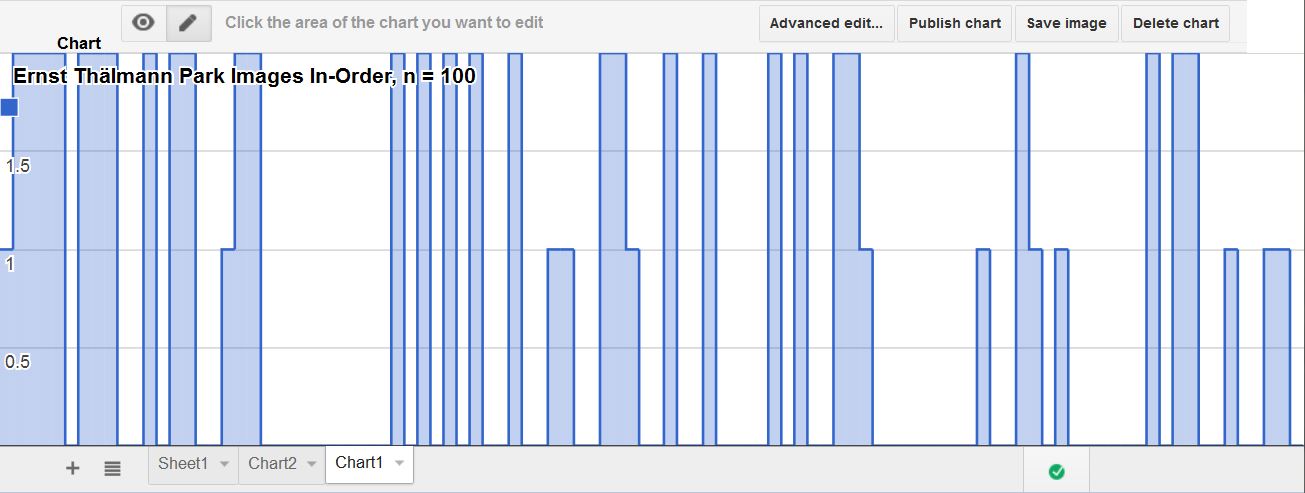
The statue in the Ernst Thälmann Park is the near constant target of graffiti artists. Admittedly, Berlin is no stranger to creative street art, but the statue’s historical legacy with graffiti makes it a pressing concern for the state, especially in maintaining its appearance. By keeping the statue free of graffiti, the state protects its past. Particularly important for Germany, the state must not appear to hide the past, and letting graffiti linger a little too long would constitute objectionable concern by some that state maintenance implies keeping the parks clean. However, the inverse is also important, which is that graffiti constitutes some contemporary context of how the past is viewed in the present, thus, political expression in the form of graffiti ought not to be removed too quickly either for fear of acting as evidence of abundant pride in the past. As a less than scientific, but no less real testament to this idea, we conducted a modest data collection using Google images; we documented the outcome of a search for “Ernst Thälmann Park” and recorded in order whether the image contained the Ernst Thälmann statue and, for those that do, we determined if the statue was depicted with graffiti. Of the first 100 pictures from the search, we learn that the Thälmann statue is not visible in 59 of the 100 pictures (59%); however, when the statue is present in the image, in 29 of the 41 pictures (71%) the statue is depicted with visible graffiti. We also depict our findings in a bar graph where each observation is presented in the order that they appeared in the Google image search. In the chart, zero implies that the image did not contain the statue, one implies that the statue was visible, and two implies that the statue visibly contained graffiti. We observe a trend. If scores are averaged for every ten observations in order, then we that the prevalence of seeing a graffitied Thälmann decreases the deeper one goes into the image search, thus, the earliest images are the most likely to contain graffiti. In 1-10, the average observation is 1.5, a middle-range observation from 51-60 is 0.6, while the late observations from 81-90 is 0.3, hence, the general downward trend. We assume unscientifically that early images in searches such as these are the operant visual identity of the images that appear, thus, the earliest images viewers see of the Thälmann statue is likely to be a graffitied statue.
In Brian Ladd’s 1997 The Ghosts of Berlin: Confronting German History in the Urban Landscape, we learn why the statue persists despite the reality that its contemporary identity hinges largely on its use as a receptacle for urban art. In the late 1980s and early 1990s, a unified Berlin had to determine which monuments to maintain, and, according to Ladd (1997: 201), monuments were to be estimated on their “historical rather than political value.” How to honor the past required consideration of how to also transforms the spaces of their memorialization. For example, proposals during the 1990s included “proposals to plant vegetation in the paved ceremonial spaces around many GDR monuments, or even to grow ivy on the statues,” as a means to “preserve statues, affirm tradition, and at the same time turn politically defined urban spaces into something different” (Ladder 1997: 201). Berlin government officials commissioned an independent group, primarily composed of preservationists, who made compelling claims in their final report to maintain the monuments as part of the “GDR’s interpretation of history,” and in the end “the commission recommended the outright removal of only a few monuments” (primarily related to border guards), although alteration to standing monuments was utilized, in particular, related to the text changes featured in the context of plaques. According to Ladd (1997: 203),
[Ernst] Thälmann [had] … a great deal to do with the image cultivated by the GDR’s leadership. They fashioned a Thälmann who would serve the function that Lenin served for Stalin and his successors: the hero whose prestige and authority they inherited. They suppressed portrayals of Thälmann as a suffering concentration camp inmate in favor of Thälmann as antifascist hero. The combination of historical falsification, authoritarian gesture, and bombastic design understandably made the statue unpopular after 1989.
By 1993, a tone of “universal acceptance” had a toe-hold among preservationists, and
[t]he passage of time worked in their favor: after several years of united Germany, the Thälmann monument was on its way to becoming a historical relic of a past regime, perhaps worth preserving as a document of GDR political ritual. But the strongest argument in favor of keeping the monument, at least provisionally, was its size: no one was willing to pay for its demolition. Meanwhile, the accumulating graffiti around the statue’s base made it clear enough that the heroic Thälmann no longer met with favor. By 1995, three neatly stenciled words higher on the pedestal commented on the fate of the man and his monument: “Imprisoned–murdered–besmeared.” (Ladd 1997: 203)
Now, the most common form of “alteration” to the Thälmann statue appears not in the form of vegetation, but alteration through art; graffiti is added and subtracted, but the monument resists removal, if only through its size, the costliness of its removal, and its life is thusly extended also by benefit of its having been preserved in the first place during the 1990s.

It is official, we are 4 years old. Huzzah!

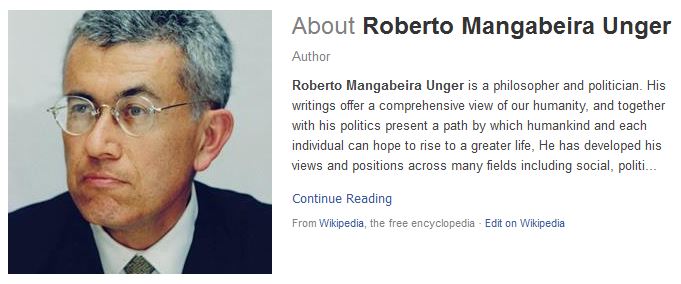
Interview, just one of many, with Roberto Unger, which indicates that sociology — along with all the other social sciences (psychology, economics, law, and perhaps even political science) — is bunk as well as pseudo science.
Back in January, I wrote a post about empathy and technology. I pondered the possibility of technology like Google Glass and Oculus Rift to open up our experiences of the Other through shared perception. In April, Nicholas posted about the all-around failure of Google Glass to be, well, cool. Not particularly revolutionary and kind douchey when push comes to shove. Glassholes were born. Guys on the subway being creepsters. Concerns over the safety of driving while Googled. Most users behaved badly–doing all those things one would expect of tech geeks with 1500 bucks to spend on a computer for their face.
Molly Crabapple on rhizome.org wrote a compelling piece about the corporate and male gaze of Google Glass. We cannot forget the corporate gaze that follows and tracks our movements in the guise of the “smart. ” She writes, “Glass and the sleeker wearables that will follow are the next step down the path started by smartphones: they are private, trackable, monetizable distraction engines that you need never take off.”
Ms. Crabapple sketched and made art while others watched through livestream, but she felt intuitively that they watched only. What made “art art” wasn’t present.
Can we expect that seeing what others see through Glass will give us insight into what they are “really” seeing or experiencing? Will technology allow allow us to see through another’s eyes in a spiritual way, for lack of a better term? Or will Google Glass, and other future and more sophisticated products, be technological navel gazing and vapid self-obsession?
Glass is not the revolution it could have been, certainly, dear readers, but I remain ever hopeful that the future will transform into everything we dreamed of as VHS kiddies. Little Gen Xers dreaming of flying skateboards, TVs for our wrists, and weekend trips to the moon. We did get iPods. I may have to back off on my hopes for empathy and focus on something else.
With this I present another kind of wearable tech: 3D printed fabric. The BB.suit by Dutch designer Borre Akkersdijk is truly wearable, not just carry-able. There is still serious R and D to be done, but fabric of the future could be walking web access, GPS ready, and Bluetooth compatible. Your suit as a walking URL. User experience would differ with every wearer.
Alas, the prototype was quite unattractive. An ill-fitting ecru onesie. But in lieu of my iPod implanted into my arm I’ll take a wearable playlist for floating through urban space.

No hoverboard, but you can get Marty’s shoes. Thanks Nike!
New book series about Recursion from Amsterdam University Press.
 We are proud to announce the launch of a new book series titled Recursions: Theories of Media, Materiality and Cultural Techniques. Placed with Amsterdam University Press, a publisher known for its strong track-record in film and media studies, the series will publish fresh, exciting and important books in media theory. This includes both translations and other volumes that address the core themes outlined below. I am very excited about this project and working with my co-editors Anna Tuschling and Geoffrey Winthrop-Young. We have already some significant projects lined up for 2015 and more forthcoming that we will announce in the coming weeks and months. We are supported by a very strong international advisory board. Get in touch if you want to learn more but first read below for more information!
New Series Announcement
The new book series Recursions: Theories of Media, Materiality, and Cultural Techniques provides a platform for cutting-…
View original post 411 more words

What do you do with unfair or less than constructive criticism of your academic work? Let’s fix peer review!
We all know, some people are jerks, many academics among them, and that some folks use the anonymous system of peer-review in order to act however they like without the responsibility or accountability that goes with face-to-face or self-identifying criticism.
To me, this is just part of the job, or, at least, I tell myself that. However, while it is most certainly just part of the contemporary academic landscape, it still irks me — every time.
It is the worst when your realize that the reviewer simply does not “get” the point. Slightly less bad, but no less forgivable: the reviewer has not looked closely enough at your work, and, as they gloss over the details, you realize from their comments that their “this is unclear” or “this is inappropriate” is really just a sign that they have not read your previous commentary that explains it 8 or 9 lines ago.
Worse than all of this, however, is that editors rarely — at least, in my experience — take this into account when making a judgment on a paper. On rare occasions, a reviewer might be suppressed, but usually the editor just acts like some sort of conduit, relegating all responsibility in the process.
Has such an appeal to the unfairness of a reviewer worked for anybody?
Is this a sign of a deeper problem in higher education?
At any rate, what do you do with unfair criticism?
I’ll be submitting…
This Anthropocene Education project looks interesting. Apps due May 7.

Here is the message, as a session convenor, from EASST leadership; please consider joining us on track D3 at EASST 2014 conference, Track Title: STS and “the state”.
NEW DEADLINE: FRIDAY, MAY 9TH, 2014
Here’s the message:
To all track convenors EASST2014 conference
After the close of call for abstracts last week we have reviewed the level of submissions. We feel that the publicising and timing of the EASST 2014 Conference deadline has led to difficulties for many members of our community in submitting abstracts by the agreed deadline. We are very appreciative of the efforts of those who did manage it. However we have decided to extend the deadline until Friday 9 May to ensure that all of those who wish to present at the conference have the opportunity to submit their abstract.
As a convenor we are asking you to help in encouraging more submissions for your track. We ask you to look at the current submissions … and identify any ‘missing’ individuals’ that you would have hoped to submit and then email them encouraging submission. The goal should be for each convenor to attract one extra abstract. This could deliver on average an extra 3 or 4 abstracts per track.
We hope it was also clear that any papers you wish to present yourselves should also have been submitted within the system.
For guidance about the overall programming, we propose 90 minutes sessions of 4 papers. 24 papers should be the normal maximum in any one track.
You may also wish to advertise this extended deadline through your networks.
Marx-Engels copyright!?
In recent days there has been debate about the copyright of the Marx-Engels collected works. Publishers Lawrence & Wishart have asked that these works are removed from the Marxist Internet Archive (story here); a petition has been started to protest this; Lawrence & Wishart have issued a statement in reply.
I have sympathy with L&W’s position. The idea that knowledge should be freely available is laudable, but this does not mean it is ‘free’. There is a lot of un-compensated or under-compensated labour invested in book production, even for works that are assumed to be out of copyright – editors, translators, proof-readers, production staff, etc.
I do think that unless there is some ability to invest the proceeds of sales back into production, there is a considerable risk that important works will never be translated. And, as they say, there are many more appropriate targets of protest than a…
View original post 16 more words
Stef, reminds me of your drone post

Here is the abstract for my keynote at the Lancaster symposium on Security by remote control next month; it’s a development from my presentation at the AAG in Tampa, and I’ll provide more details as I develop the argument.
The God trick and the administration of military violence
Advocates have made much of the extraordinary ability of the full motion video feeds from Predators and Reapers to provide persistent surveillance (‘the all-seeing eye’), so that they become vectors of the phantasmatic desire to produce a fully transparent battlespace. Critics – myself included – have insisted that vision is more than a biological-instrumental capacity, however, and that it is transformed into a conditional and highly selective visuality through the activation of a distinctively political and cultural technology. Seen thus, these feeds interpellate their distant viewers to create an intimacy with ground troops while ensuring that the actions of others within the…
View original post 218 more words

The answer is here; Anthropologist John Ziker studied “non-random sample of 16 professors at Boise State University and scheduled interviews with them every other day for 14 days. In each interview, they reported how they spent their time the previous day. In total, he collected data for 166 days.”
If I were not going to an EWIS conference in May, I’d want to visit this — SUPERSIZED DECAY is a really cool sensitizing concept.
 I’m excited to be involved in the ‘Big Ruins’ conference, to be held in Manchester later this year. Conference organiser,
Paul Dobraszczyk
, describes the event: “As global capitalism intensifies its hold on the planet, so its ruins are scaling up in size: from vast junkyards of jumbo-jets in Nevada to entire empty cities in China waiting to be inhabited. Meanwhile the urban ruins of the Cold War era continue to resist appropriation, whether because of their toxicity, ideological misplacedness, or as a consequence of intractable ethnic conflicts. Coupled with a recent plethora of (post)apocalyptic visions of ruined cities in cinema and computer games, the links between real and imagined ruination are becoming increasingly blurred. If we are to imagine large-scales sites of decay, how might their possible ruin be represented in a way that helps us adequately respond to that very possibility?
I’m excited to be involved in the ‘Big Ruins’ conference, to be held in Manchester later this year. Conference organiser,
Paul Dobraszczyk
, describes the event: “As global capitalism intensifies its hold on the planet, so its ruins are scaling up in size: from vast junkyards of jumbo-jets in Nevada to entire empty cities in China waiting to be inhabited. Meanwhile the urban ruins of the Cold War era continue to resist appropriation, whether because of their toxicity, ideological misplacedness, or as a consequence of intractable ethnic conflicts. Coupled with a recent plethora of (post)apocalyptic visions of ruined cities in cinema and computer games, the links between real and imagined ruination are becoming increasingly blurred. If we are to imagine large-scales sites of decay, how might their possible ruin be represented in a way that helps us adequately respond to that very possibility?
This conference will address that question by focusing on the wider significance of big ruins…
View original post 203 more words
Waste: A Philosophy of Things — hefty prices, but seems promising (http://www.amazon.com/Waste-Philosophy-Things-William-Viney/dp/1472527577/ref=sr_1_1?ie=UTF8&qid=1398345012&sr=8-1&keywords=viney+waste)
I was just reading THIS POST about abandoned objects by Melbourne artist Julie Shiels, who teaches Art and Public Spce at RMIT.
And it reminded me that I’d forgotten to announce the publication of Waste: A Philosophy of Things, by Will Viney at Durham University, for which I provided a cover endorsement.
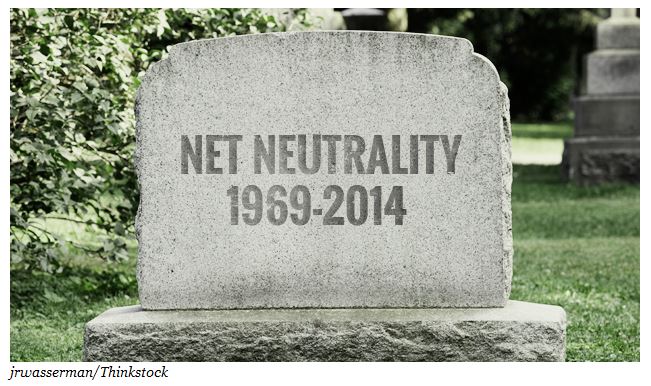
Mother Jones piece announced net neutrality is officially dead. At the ripe old age of 45 years old, legislators have finally taken neutrality behind the proverbial barn.

A disheartening reality-check for the infrastructure boom in Brazil, now reduced to rubble and rust. While we have often discussed infrastructure as a basic economic good, inferior or incomplete infrastructural development may very well have the reverse effect.
These pieces from NYT’s Nadia Sussman, an eery video, and this companion piece from NYT’s Simon Romero (Photographs by Daniel Berehulak), a combination written and visual story, paint a vivid image of a nation striving to build the massive infrastructures similar to those of other nations, but at a time of stagnant and non-existent government budgets, all of which comes on the heels of planning for the World Cup in June, just a couple months away from the time this post goes up. We wrote about the economic impact of similar Olympic stadiums and even a bit on how we might think about their copious infrastructural leftovers.
The article reads:
The growing list of troubled development projects includes a $3.4 billion network of concrete canals in the drought-plagued hinterland of northeast Brazil — which was supposed to be finished in 2010 — as well as dozens of new wind farms idled by a lack of transmission lines and unfinished luxury hotels blighting Rio de Janeiro’s skyline.
Economists surveyed by the nation’s central bank see Brazil’s economy growing just 1.63 percent this year, down from 7.5 percent in 2010, making 2014 the fourth straight year of slow growth. While an economic crisis here still seems like a remote possibility, investors have grown increasingly pessimistic. Standard & Poor’s cut Brazil’s credit rating last month, saying it expected slow growth to persist for several years.
Calls for Papers (special): International Journal of Actor-Network Theory and Technological Innovation (IJANTTI)
Submission Due Date
9/15/2014
Guest Editors
Ivan Tchalakov, University of Plovdiv, Bulgaria
Recommended Topics
Topics to be discussed in this special issue include (but are not limited to) the following:
View original post 205 more words

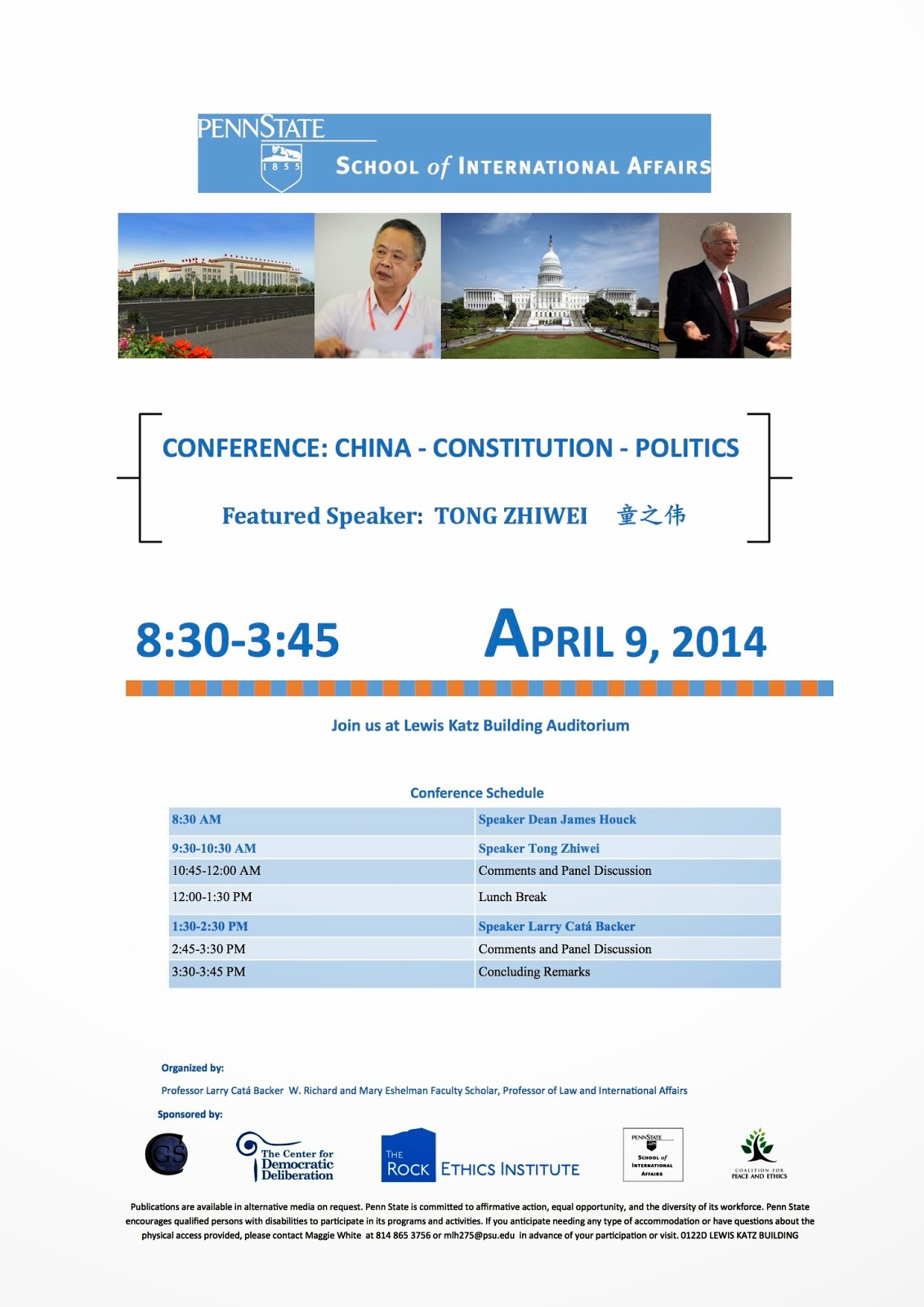
The video recording of the conference, China-Constitution-Politics, is now available for accessing via mediasite. I was involved in the PM discussion; I reviewed Dr. Larry Backer and graduate student Karen Wang‘s paper “THE EMERGING STRUCTURES OF SOCIALIST CONSTITUTIONALISM WITH CHINESE CHARACTERISTICS: EXTRA-JUDICIAL DETENTION (LAOJIAO AND SHUANGGUI) AND THE CHINESE CONSTITUTIONAL ORDER” which is soon coming out in Pacific Rim Law & Policy Journal; the AM session considered Zhiwei Tong (童之伟) and his new work “Two Issues.”
RECORDINGS: Entire Conference HERE: AM Session HERE: PM Session HERE.
The original schedule is here:

I just got this in my e-mail, which is lame-o academic-spam-turned-publishing-hoax. Finally, after getting a number of these, I feel as though academics have finally “made it”; our success is spam-worthy! Custom spam, just for us.
Are you guys getting more and more academic spam too? Why target academics for this sort of thing? Either we are too dumb/desperate to publish in main-line journals(?), or, perhaps, we are finally a market worth getting some serious spam(!). I try to be positive about it; after all, what really comes of getting angry about this sort of thing (besides nothing)?
Now, we hear about journal hoaxes all the time. For example, the recent case of the recent cancer paper that was a joke or Sokal Affair. Some of these cases, for example, the Sokal Affair are, it seems, hard to forget, given that they helped to trigger the “science wars” in STS.
However, what about journal spam? Is anybody actively researching this topic and publishing about it in legitimate journals (there is a post-ironic feel to that sort of work).
A brief review of the literature in STS, and the answer is, apparently, no. So the answer to the question “Are you guys getting academic spam too?” is surely “yes, we are;” however, we do not appear to be studying it.
Continue reading
Gabriel Garcia Marquez, RIP
….the actinobacteria! Another example of modern enchantment, or who says science and modernity killed all the magic?

Via The Crafty Chemist and AsapSCIENCE

A chapter of Michel Foucault’s famous 1977 Discipline and Punish: The Birth of the Prison (1975, Surveiller et Punir: Naissance de la Prison) is titled “The Carceral.” In a few brief notes, I reconsider the chapter in light of contemporary discussions and literature.
As with so much of Foucault’s work, the chapter starts with a rich, seemingly (but not really) unorthodox example, in this case, the official opening of Mettray, a location where “disciplinary form at its most extreme” was born. Utilizing nearly every form of traditional organizational forms — the family, the army, the workshop, the classroom, and juridical ordering techniques — such that those “young delinquents condemned by the courts” (as well as, I will note, boys charged, but acquitted, and yet were imprisoned as an alternative to “parental correction”) were to be overseen by “technicians of behavior; engineers of conduct, orthopaedists of individuality.”
As you can see from the quotes, Foucault’s language holds nicely to this day, even if post-foucauldians in governmentality studies have “cleaned-up” the ideas so much so that now we rattle-off “voluntary self-regulation through myriad disciplinary techniques,” it is worth remembering that, earlier on, we used to have to learn what Foucault meant from writing that did not give way to bullet-point-like writing or textbook-like bold terms sitting like warts in our prose. That said, some of the prose does not really hold over time as well as his language choices. When I first read Foucault, I recall his work being mind-blowing and yet, at some level, impenetrable. My colleagues would say something like “this is not sociology as usual,” and while I agreed with them back then (perhaps out of fear — Foucault readers often loved him dearly and not “getting it” was something you would not normally want to reveal in public, which I think now Foucault would have laughed about), now that I have some distance from my initial readings, it is easy to see why Foucault was not sociology as usual: it is not sociology. I do not mean it does not belong among the sociology canons; I mean that it was never “just” sociology; his work always struck me as historical, political, social, etc. but that it was simply not possible to reduce it to any of them. At any rate, I return to the retrospective.
Of course, the penal systems were famous for meticulous notes; “a body of knowledge was being constantly built up from the everyday behaviour of the inmates,” such that in the toughest of prisons, at the hardest of times, surveillance always implied: “I shall note the slightest irregularity in your conduct.” These two quotes, juxtaposed in the above sentence, give you also a sense of Foucault that I only notice now. I used to think that he was a dynamic writer, for a historian (I used to think of him this way); however, now, having done some professional writing, I see that Foucault is a master of shifting registers. He switches effortlessly between gigantic abstractions that seem to swallow-up the entire carceral world, for example with a quote like, “a body of knowledge was being constantly built up from the everyday behaviour of the inmates”; however, moments later, he reduces his voice to a nearly personal tone, as if whispering to the reader (without breaking eye contact, I imagine in my mind’s eye) shifts registers to tell you, the reader, what an person might have heard, as a prisoner, and in these moments, you are both, for example, “I shall note the slightest irregularity in your conduct.” You get the feeling Foucault might have, upon uttering this line, paused for effect. As a matter of style, I will take this form of writing over the bullet-points and bolded-terms, but the executive summarizing of texts into carefully constructed abstracts and sound blurbs (like those that post-foucauldian governmentality studies scholars have reduced Foucault to) seem to win the day in our times.
While all the discussion of discipline, training, and then self-discipline is positively lovely to read, I was stopped dead in my book at this line: in a discussion of supervision and being supervised, “[a] subtle, graduated carceral net,” Foucault writes, “with compact institutions, but also separate and diffused methods, assumed responsibility for the arbitrary, widespread, badly integrated confinement of the classical age.” I have no recollection of reading that line before; however, reading it now, its like a curio box of how the work has been up-taken into contemporary sociology: the emphasis on “[a] subtle, graduated carceral net” feels like the precursor for discussions of networked stateness; having the net replete “with compact institutions, but also separate and diffused methods” serves to underscore that Foucault was not an anti-institutionalist, but that institutions were “separate” (or distanced both practically and analytically) from the “diffused methods” upon which much (if not most) discipline is rendered; from there, we get a feel for jurisdiction as a key mechanism for control and knowledge production (which, for example, Andy Abbott’s work is a cool off-shoot as well as Tom Gieryn’s) when we read the net of institutions carefully divorced from the methods of everyday discipline, “assumed responsibility for the arbitrary, widespread, badly integrated confinement of the classical age.” The sentence, as it were, and for me only in retrospect, twinkles like a curio box of Foucault’s lasting legacy.
Another matter warranting some re-consideration is how sloppy Foucault is and how this general sloppiness is neatly pasted-over by his vivid word choices. For example, in an incredibly sloppy historical gloss of the origins of the prison, we get a paint-by-numbers tour of yesteryear, seeing “colonies of poor, abandoned vagrant children,” those boarded-up “almshouses for young female offenders” whose mothers exposed them one too many perversities, backbreaking “penal colonies” for young men often acquitted but condemned to reform through labor, “the institutions for abandoned or indigent children” as well as “orphanages,” what was left of the institution of “apprentices,” or those “factory-convents” where young girls would tally-away under circumstances of voluntary confinement, and if all of those beautiful and tragic pictures of yesteryear were not yet enough to bully the reader into agreeing not to disagree with the fine points raised by Foucault, we now get bombarded by “charitable societies, moral improvement associations, organizations that handed out assistance and also practised surveillance,” and now I am too exhausted to continue this German machine-gun of corollaric examples. Still, a point is to be made here, because we have all seen this technique before (some of us, in our own writing), this “exhaust the reader with colorful examples” technique (I am, myself, routinely guilty of this); however, until reviewing Foucault again for my students in social theory today, I had no idea that I was doing this, as if a scholarly mimeograph machine, in the tradition laid-out by Foucault (although, and it would be fitting, perhaps Foucault was copying somebody else that either I don’t know about or whom has been lost in time).
Those are just a few thoughts, having returned to Foucault’s D&P after a number of years.
<image from: http://bordercriminologies.law.ox.ac.uk/wp-content/uploads/2013/07/copy-cropped-dreamstime_WEB_70689362.jpg>

Stef’s piece on “seeing” targets of drone strikes (as well as the metaphorical infrastructure that holds some of those practices together), along with some other posts are about seeing like a military, I cannot resist but to share this piece on google glass failing miserably. Marcus Wohlsome writes about it for WIRED magazine; also, if you recall, Mat Honan wrote a great piece before the end of last year, “I, Glasshole: My Year With Google Glass, which was a fun read too; still, some of you will remember Stef’s post about wearable technology and empathy for the other, if only because of its attention on “Glance,” which is an app for google glass (or smart phones) to observe you having sex with other people while they observe themselves having sex with you.
On the topic of google glass and its public sales: CBS reports that reception from the public was “cool” at best (and not the cool kind of “cool” either); the spin at USA today is that google glass “sold out” (so long as you only count the sales of white rimmed google glass, although there is a nice irony in using “sold out” there); and, of course, chief of overstaters these days (what has happened to this previously decent news source!) CNN reports that this is the dawn of a new age in wearable technology, hallelujah! (although, admittedly, it is on the opinion page … how couldn’t it be.) Still, the CNN piece is more interesting that it might appear at first blush. For example, it reports on a dress that becomes transparent when the “user” is aroused … using this might be a tough reality check for some folks.

A recent art installation is trying to disrupt the dehumanizing effects of drone technology and the metaphor of the “bugsplat” when talking about the “targets” of drone strikes. The images can be found at http://notabugsplat.com/
The installation is a huge picture of child that the drone operator can see and is meant to disrupt the pilot’s ability to dehumanize the victims of the strikes.
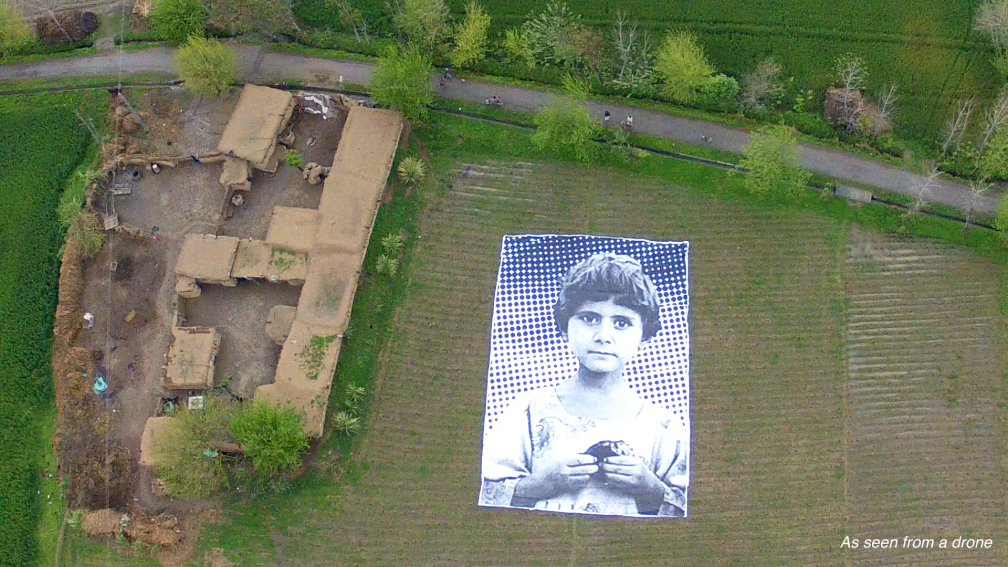
From the blog:
In military slang, Predator drone operators often refer to kills as ‘bug splats’, since viewing the body through a grainy video image gives the sense of an insect being crushed.
To challenge this insensitivity as well as raise awareness of civilian casualties, an artist collective installed a massive portrait facing up in the heavily bombed Khyber Pukhtoonkhwa region of Pakistan, where drone attacks regularly occur. Now, when viewed by a drone camera, what an operator sees on his screen is not an anonymous dot on the landscape, but an innocent child victim’s face.
I have written on a similar subject: the use of medicine and surgical metaphors in warfare. The rhetoric and feeling of this use of language is the same. For example
To [John] Brennan the people of north-west Pakistan are neither insects nor grass: his targets are a ‘cancerous tumour’, the rest of society ‘the tissue around it’”.
To highlight war, metaphor, and their relationship George Lakoff writes that
there is a common metaphor in which military control by the enemy is seen as a cancer that can spread. In this metaphor, military “operations” are seen as hygienic, to “clean out” enemy fortifications. Bombing raids are portrayed as “surgical strikes” to “take out” anything that can serve a military purpose. The metaphor is supported by imagery of shiny metallic instruments of war, especially jets (Lakoff 1991).
In the case of humanitarian intervention, the language used often frames the interventionist actions creating metaphors from the field of medicine. We offer humanitarian “relief, “injections” of foreign aid, and “prescriptions” for ameliorating unrest. These metaphorical frames show that bodies must behave in certain ways, thereby implicitly arguing that certain ideas about healthy bodies and lives must serve as a template for unhealthy ones. Humanitarian intervention is then about healing these “unhealthy” bodies.
In medicine, “germs” are spoken of as “enemies” to good health. We are in “wars” against cancer. New research in AIDS helps us “conquer” the virus. In fact “militaristic language pops up in almost every scientific domain: conservation biology (‘invasive species,’ ‘biosecurity’); global warming (‘global war on global warming’); and biomedicine (‘killer cells,’ ‘hitting multiple targets’)” (Wenner 2007).
How does this language affect how we speak of enemies and opponents? I offer these examples of this from various news sources:
This is from the Guardian’s News Blog, March 21, 2011: “8.13am: Yesterday we heard that supporters of Gaddafi had formed a human shield around his compound in Tripoli, with men, women and children singing songs against the rebel “germs” (Blog 2011).
From the Israeli News website: National Union MK Michael Ben-Ari, while speaking at an SOS Israel conference in Jerusalem is quoted as referring to members of leftist organizations as “traitors who must be persecuted at any cost” (Sofi). He called the leftists “germs” and “enemies of Israel” and added “If we’ll have to enact a law in the Knesset to eradicate this dangerous enemy, that is what we’ll do. Such a germ can destroy Israeli society. This enemy threatens the state’s existence” (Sofi)
In the Sunday Times, Mark Franchetti interviews a soldier who says “The Iraqis are sick people and we are the chemotherapy,” said Corporal Ryan Dupre. “I am starting to hate this country. Wait till I get hold of a friggin’ Iraqi. No, I won’t get hold of one. I’ll just kill him.” (Franchetti 2003).
What does this circulation do? A crucial point is that “[A]nalogies and metaphors are the often hidden devices that serve to rationalize choices of conceptual variants and to render plausible the narrative in which our political concepts are embedded” (Whitehead 2011, 293). In other words, by perceiving war and intervention as a “treatment” for sickness, we are blinded to other responses that may address the situation more effectively. These “hidden devices” can also invite and justify violent responses as shown above. Which metaphorical constructions make this circulation a possibility? What makes all these ways of speaking about intervention, states, and war, so compelling, so facile? How can it be made less facile?
This art installation is an amazing attempt to inject (to use the metaphor against itself) this sterile understanding with ethics and morals. To make these inhuman ways of relating to others less facile.
The victims aren’t bug splats or tumors, but children, men, women, wedding guests, and yes, sometimes even “terrorists,” but targeted killings are an ugly, immoral, and, more often than not, illegal business. It isn’t collateral damage, it’s murder.
It behooves us all to put a human face on civilian deaths. Go to this site and read the names of the dead. Click on the above site and look at their pictures.
Seeing like military and machine
 In a series of posts on photography
Trevor Paglen
provides some ideas that intersect with my own work on Militarized Vision and ‘seeing like a military’. First, riffing off
Paul Virilio
, Trevor develops the idea of photography as a ‘
seeing machine
‘:
In a series of posts on photography
Trevor Paglen
provides some ideas that intersect with my own work on Militarized Vision and ‘seeing like a military’. First, riffing off
Paul Virilio
, Trevor develops the idea of photography as a ‘
seeing machine
‘:
‘Seeing machines is an expansive definition of photography. It is intended to encompass the myriad ways that not only humans use technology to “see” the world, but the ways machines see the world for other machines. Seeing machines includes familiar photographic devices and categories like viewfinder cameras and photosensitive films and papers, but quickly moves far beyond that. It embraces everything from iPhones to airport security backscatter-imaging devices, from electro-optical reconnaissance satellites in low-earth orbit, to QR code readers at supermarket checkouts, from border checkpoint facial-recognition surveillance cameras to privatized networks of Automated License Plate Recognition systems, and from military wide-area-airborne-surveillance systems, to the roving cameras…
View original post 450 more words
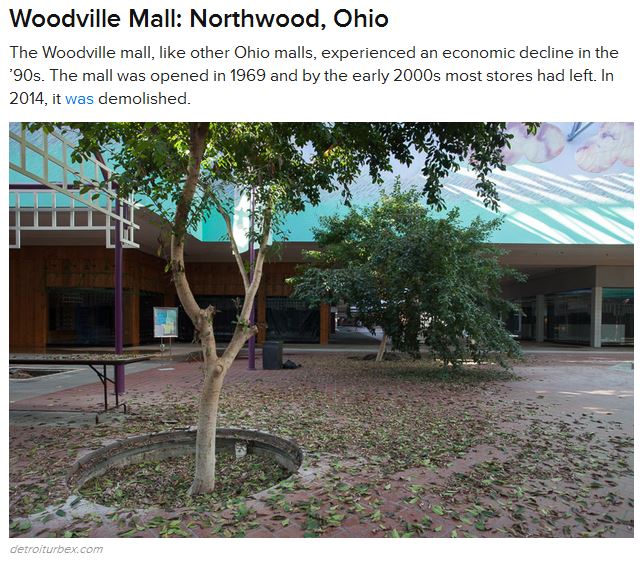
Our practically co-blogger, dmfant, found this today: images of derelict mall infrastructures, just withering away.
Theories of degradation and dereliction; we need them!
Are there 15 ways to be unhappy? Surfing Bruno Latour’s ‘An Inquiry into Modes of Existence’
 I have had Bruno Latour’s An Inquiry in Modes of Existence (AIME) kicking around my desk since last summer, thinking it’s the sort of book one should probably read in case it turns out to be mind-blowingly important. I finally got round to reading it, in a certain manner, recently, encouraged by the setting up of a reading group by the NAMBIO research group in the Geography here at Exeter, which I have actually not been able to attend until this week. I might not be able to go to the next one meeting either, so in the spirit of stretched-out, online thinking that this book is meant to exemplify, I thought I’d try to articulate some of the thoughts that it has provoked in me. (The book is just one element of a more ambitious ‘digital humanities’ project – a website, basically…
View original post 4,379 more words
Foucault vs. Chomsky … be ready.
This DVD is available at a more reasonable price from Fons Elders’ site than from Icarus films.
In 1971, a Dutch initiative called the International Philosophers Project brought together the leading thinkers of the day for a series of one-on-one debates. The participants included intellectual superstars Alfred Ayer and Arne Naess, Karl Popper and John Eccles, Leszek Kolakowski and Henri Lefèbvre, and – most notably, in a now justifiably famous exchange – Noam Chomsky and Michel Foucault.
This two-disc set collects all four remarkable conversations, along with introductions and commentary by Dutch philosopher and writer Fons Elders. Elders moderated the original debates – hand-picking each of the participants after spending…
View original post 297 more words
Odd, but interesting.
On the Soc Job Rumor Board, there was a discussion of the non-replicability of ethnography. I think this is mistaken. Ethnography is easily replicable, it’s just that ethnographers don’t want to do it. For example, ethnographers could:
Of course, no single study can strive for replication in the same way and some folks do a good job addressing these issues. But still, the anti-positivist framing of much ethnography probably prevents ethnographers from developing intuitive and sensible things to create standards that would move the field away from the solo practitioner model of unique and non-replicable studies.
50+ chapters of grad…
View original post 11 more words
 Fascinating preview of a piece by Gastón Gordillo on ‘
The Oceanic Void
‘ which is forthcoming in an edited book on Deleuze and space, and also part of his planned book on the theory of terrain. Among other things it engages with the work of Philip Steinberg, John Protevi and Levi Bryant.
Fascinating preview of a piece by Gastón Gordillo on ‘
The Oceanic Void
‘ which is forthcoming in an edited book on Deleuze and space, and also part of his planned book on the theory of terrain. Among other things it engages with the work of Philip Steinberg, John Protevi and Levi Bryant.
My interview with Gastón for Society and Space is almost complete, and his responses are very interesting. The interview mainly discusses his forthcoming book Rubble: The Afterlife of Destruction, but also his earlier book Landscape of Devils, the terrain project and his blog. I’ll post a link here as soon as it’s published.
Ethnography work on software in Vietnam; interesting updates from the field.
 Lilly U. Nguyen
Editor’s Note: Lilly U. Nguyen (@deuxlits) tells us how in her own work on the ethnography of software in Vietnam, she both studies and embodies “diaspora” – and she shares the insights that diaspora has given her. She is a postdoctoral scholar at the ISTC-Social at UC Irvine. She studies race, labor politics, and information technology in Vietnam and among the Vietnamese diaspora.
Lilly’s post continues the March-April edition focusing on ethnographies of makers, hackers, and engineers.
In my work, ethnography takes on diasporic dimensions.
These qualities touch on several of the questions raised in previous posts in this blog series, such as the distinction between self and other and the Cartesian coordinates of studying up and down in Nick Seaver’s post and the disciplinary shifts as described in Austin Toomb’s post. For those of us who study decidedly contemporary phenomena like algorithms, hackers…
View original post 1,114 more words
The Internet is Here!
The term ‘social’ in ‘social media’ is embedded in positive connotations regarding community spirit and participation and is moreover rhetorically used as a given. Within the popular discourse social media are often portrayed as important tools for generating and preserving social interaction within the community, which would supposedly lead to a more engaged and involved society. But to what extent are these media actually social as opposed to commercial when we consider how ‘the social’ is being recreated and exploited for commercial success. By working around the utopian discourse we will further explore this phenomena within this session in order to define the ‘social’ in social media.
networkcultures.org/wpmu/unlikeus/
https://twitter.com/glovink
I just returned from the International Studies Association annual conference. It’s a large professional conference–a 250 page book of panels, a plurality of approaches to the study of international relations, and hundreds of academics presenting and discussing their research. This means it takes a lot of space: two hotels for the conference itself and then 2-3 additional hotels for participants. And this doesn’t include all the people that venture farther out for hotels in non-conference space.
I started going to ISA in 2008 during my third year of graduate school. It was in San Francisco that year and I remember being overwhelmed by the amount of panels and the amount of people. I am not sure what my insight for this post is, but it seems worthwhile to think through how we organize ourselves in relation to space and place during that once-a-year conference. Most disciplines have them, right? And it seems that these conferences do discipline us in many ways. This is not a rant about how terrible conferences can be–in fact, far from it. I am intrigued that they seem to work so well for so many things. Seeing old friends, hashing out the finer points of theory with like-minded geeks, placing your body in various vectors for various reasons: potential employment connections, publication deals, professional contacts, new ideas.
There is also the politics of which city is chosen over another and how this affects the conference. In New York, fewer panels were accepted due to less room at the conference hotel. The first year ISA went to NOLA, there was a heated debate about the state’s stance on gay marriage and LGBTQ rights. Many called for a boycott of the conference and others countered that the economic boon of a big conference would be welcome in a post-Katrina economy. San Diego, in an informal bad social science poll done by yours truly, was a favorite. Lots of space to stand and talk, a decent and roomy bar in the main hotel, and a Starbuck’s right near the center. All these things are necessary as most people are jet lagged and exhausted from writing their paper on the way to the conference. New York was abysmal–nowhere to stand, the elevators were slow and terrifying, and there was nowhere grab a quick bite in Times Square. I discovered this year in Toronto that the best place to people watch and wait for friends/contacts/people you should meet to advance your career is at the top of an escalator that leads to the meeting rooms. Future ISAs for me will be deemed a success if they have a well placed escalator or two.
Finally, ISA is profoundly un-international in its choice of conference venues. The most international US ISA members have to get is to cross the border to Canada. It might have been in Brazil one year, but that was way before my time and I may be remembering incorrectly. Maybe we just talked about wishing it were somewhere other than US. This gives the US and Canadian members a distinct advantage. I watch Aussie, European and UK friends stumble around jet lagged for days and feel better just in time to board a plane for home. This choice of North American space only seems quite strange. Why is the International Studies Association not international?
Unfortunately, I was not able to attend the 4S conference this year, but it was in San Diego, and maybe even in the same hotel as the ISA awarded with the best venue award (at least in my opinion). Anyone want to chime in on what the space of the conference does for their discipline?
Seeing like a military
I’m putting together my presentation on ‘Seeing like a military‘ for the AAG Conference in Tampa next week, but – prompted in part by my interest in forensic architecture (see also here and here) – I’ve also been thinking about other ways of seeing (perhaps ‘re-viewing’ would be better) military violence.
 So I’ve been interested to read a report over at rhizome on Forensis, an exhibition and installation curated by Anselm Franke and Eyal Weizman at the Haus der Kulteren der Welt in Berlin, on ‘Constructions of Truth in a Drone Age’:
Any act of looking or being looked at is mediated by technology. This is true of any scientific process too, where each tool or method of looking is developed with a purpose in mind which influences the data that it produces. This is precisely what forensic investigation reveals: not only the reality of an event…
View original post 204 more words
 2014 DASTS Conference on RUC
Call for papers: Enacting Futures – extended deadline for abstracts is April 4
This year’s DASTS conference wants to highlight and display the political, conceptual and practical consequences of the ontological turn. Rather than continuing with the Modern belief in grand narratives and a singular ontology, researchers within the field of STS outline an alternative history with several modes of existence and thus a plurality of truth conditions. But what are the implications of multiple modes of existence? How are diplomatic encounters and politics performed across modes? And what does the plurality of truth conditions mean for the institution of Academia? How can we envision new forms of posthumanities in socio-technical worlds? With these questions, the theme of the conference will be enactments of futures.
At the location of Roskilde University this theme is particularly fitting. Since its origin in 1972 Roskilde University has been propagating action research and problem-based group-work to not only criticize but also engage in practices for example through participatory design and research processes. When DASTS is for the first time held at Roskilde University, we find it appropriate to reflect upon a new utopian agenda for researchers. Also, as STS is growing and moves beyond its original fields of science and technology studies, contributions are invited to consider different fields of research as different modes of existence, considering the spreading of STS across disciplines as a transdisciplinary approach. Last but not least, the theme of the conference is inspired by the AIME project: An Inquiry into Modes of Existence, which contributors could reflect upon concerning its theoretical foundation and its online platform.
To address the theme of enacting futures, contributions could focus on identifying characteristics of specific modes of existence, addressing connections between different domains, comparing domains, and/or discussing diplomacy, negotiations over values, and the (re-)invention of subjectivities/posthumanities and institutions. In doing so, contributors could turn attention to research methods and practices, looking at connections to politics, private companies, and/or artistic approaches. DASTS also invite artistic contributions that can be set on display and/or shown at the conference. It is also a possibility to couple traditional conference paper presentations in dialogue with an artistic oeuvre.
—
The call for papers is meant as inspirational. More than inviting papers relating to the announced theme, we also welcome papers and oeuvres discussing and/or performing other STS subject matters. The DASTS annual conference is open for all and the committee welcomes entries from all areas of science and technology studies. Especially junior researchers wanting to present and discuss their research are invited to present their work. The main purpose of the conference is to fertilize STS research broadly by providing an occasion for researchers working with STS in Denmark to exchange their current works and thoughts, and of course to stimulate networking across STS-inspired environments. For this latter reason the conference fee also includes conference dinner. The main language is Danish, but presentations in English are welcome, and a few sessions as well as the key note presentations will be held in English. The conference aims to be a friendly and encouraging scientific environment in which not only well-established scholars, but also Ph.D. and master students should feel confident to present and discuss their work with colleagues.
Keynotes at DASTS 2014: Adrian MacKenzie and Kristoffer Ørum.
Registration is now open: http://ruconf.ruc.dk/index.php/DASTS2014/DASTS2014
Practical information
Dates: June 12 – 13, 2014
Place: Roskilde University, Universitetsvej 1, DK-4000 Roskilde
Deadline for submission of abstracts (max app. 300 words): April 4, 2014 (extended).
Please state in your abstract your preferred language of presentation, and if English is a possibility for you.
Abstracts should be submitted to dasts@ruc.dk.
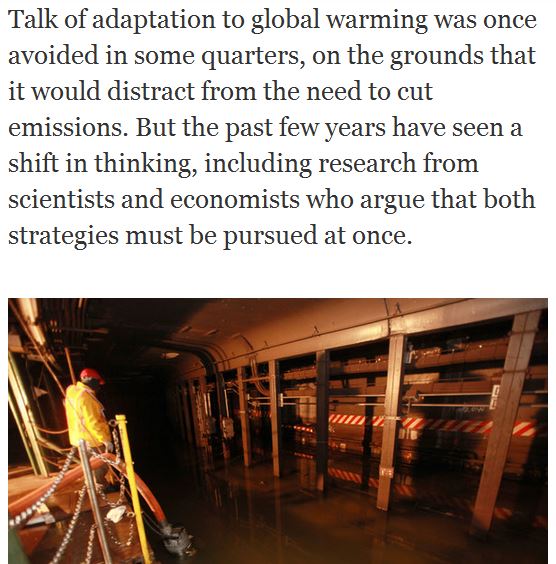
Sometimes things juxtapose themselves. Dmfant wrote a reply about a terrific piece now available on-line, free, as an mp3. Backdoor Broadcasting Company’s academic broadcasts currently host access to the file, which is from:
The Political Life of Things: A One Day Workshop at The Imperial War Museum, London, UK; Nick Vaughan-Williams (Warwick) & Tom Lundborg (Swedish Institute of International Affairs): There’s More to Life than Biopolitics: Critical Infrastructure, Resilience Planning, and Molecular Security
The piece is about critical, self-healing infrastructure, and, of course, require this discussion requires significant use of the “human/non-human” distinction, if only to dash them to bits. Well, while this piece is years old, Dmfant just posted it in response to a previous post about an upcoming event.
There is a piece in the New York Times today about the third time that world scientists united in order to provide a broad response to the public about the realities of climate change. How these two pieces appear to be linked together so nicely is a claim made Tom LUndborg about how the linguistic turn in political philosophy has distracted us, on the whole, from the “social” concern over materiality and a full-fledged research base of studies on infrastructure. Tom goes further, though, claiming that the linguistic turn has made it much more difficult to be fully critical as theorists or, conceivably, as government agencies or even public citizens to take the next step … although, that is where the radio show ends.

Proofs are back for an upcoming book review of Bogost’s work; check it out here (some corrections may be made, but the review is pretty stabilized now).
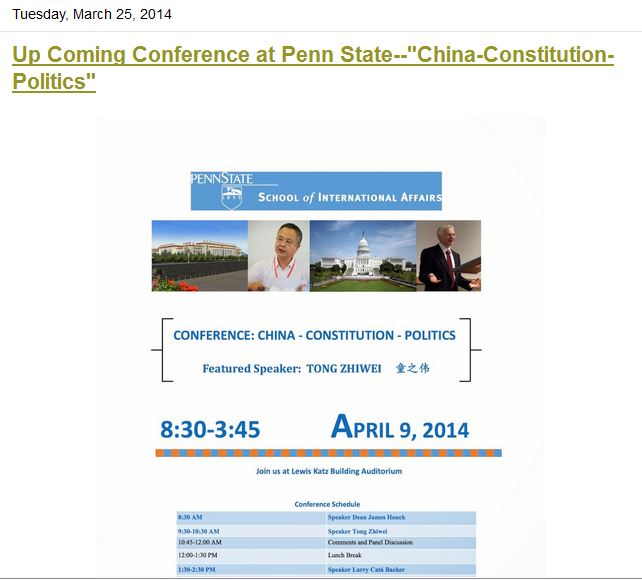
Great event in a couple weeks at Penn State; details at Larry Backer‘s “Law at the End of the Day” blog. Hoping to attend myself.
Geographical Imagination … interesting blog if you don’t know them (I didn’t until a colleague mentioned them to me today). Check it out.
Many readers will know the remarkable work that’s been done to reconstruct the US bombing of Cambodia during the ‘Vietnam’ War: I’m thinking of Taylor Owenand Ben Kiernan‘s ‘Bombs over Cambodia’ which appeared in The Walrus in 2006: available here and here.
The still-incomplete database (it has several “dark” periods) reveals that from October 4, 1965, to August 15, 1973, the United States dropped far more ordnance on Cambodia than was previously believed: 2,756,941 tons’ worth, dropped in 230,516 sorties on 113,716 sites. Just over 10 percent of this bombing was indiscriminate, with 3,580 of the sites listed as having “unknown” targets and another 8,238 sites having no target listed at all. The database also shows that the bombing began four years earlier than is widely believed—not under Nixon, but under Lyndon Johnson. The impact of this bombing, the subject of much debate for the past three…
View original post 546 more words
Open Standards?
Open Standards in the Digital Age: History, Ideology, and Networks
via http://newbooksintechnology.com: We tend to take for granted that much of the innovation in the technology that we use today, in particular the communication technology, is made possible because of standards. In his book Open Standards and the Digital Age: History, Ideology, and Networks (Cambridge University Press, 2014), Dr. Andrew L. Russell examines standards and the standardization process in technology with an emphasis on standards in information networks. In particular, Russell examines the interdisciplinary historical foundations of openness and open standards by exploring the movement toward standardization in engineering, as well as the communication industry. Paying careful attention to the politics of standardization, Russell’s book considers the ideological foundations of openness, as well as the rhetoric surrounding this ideology. Notable also is the consideration of standardization as a critique of previous ideology and a rejection of centralized control.

The Social Thought Program and the student reading group are happy to announce the dates of the 2014 Penn State Social Thought Conference: April 4th-5th on the University Park Campus. The keynote address will take place Friday afternoon, and the main conference on Saturday. All events are free and open, with lunch served on Saturday.
Call for Papers
Knowledge: Power and Production
What is knowledge? Who defines it? Who and what determines the ownership of knowledge? What is the relationship between the production and dissemination of knowledge? What are the power dynamics of knowledge in contemporary society? How does the constriction and control of knowledge influence politics? How is our conceptualization of knowledge changing with technology?
We would like to facilitate a discussion of the changing conceptualization and commodification of knowledge in a world in which a library can occupy both a multi-story building and a computer’s hard drive. Perspectives…
View original post 142 more words
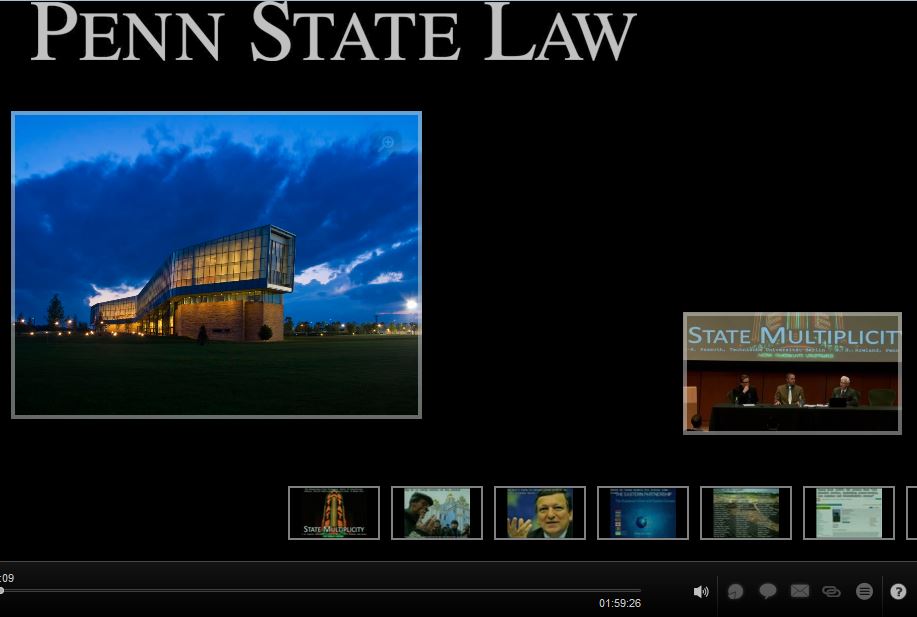
Jan and I recently gave a talk at the School for International Affairs in the Law School at The Pennsylvania State University, which is available HERE.
The presentation, “The Possibilities and Contours of State Multiplicity: Preliminary Findings”, featured Jan-Hendrik Passoth (Technische Universität Berlin), Nicholas Rowland (Penn State University) presenting their latest research work on state theory, and Larry Catá Backer (Penn State) as discussant. The conference was recorded and all are welcome to watch and comment, engage.
Description of the talk:
For at least 100 years, scholars in law, political science, philosophy, international relations, and various branches of sociology have asked: What is the state? And, for at least as long, answers to that question have commonly taken the form of a petty and seemingly endless game of conceptual one-upsmanship. An alternative direction exists from the small world of science and technology studies. State multiplicity. The shift toward seeing “the state” as multiple implies that we understand the state to be, convincingly, both one thing and many things simultaneously. In this talk we draw on more than 100 years of research on the state to document the possibility state multiplicity and then we hazard a few tentative and counter-intuitive conclusions based on our preliminary findings.
The Passoth-Rowland Presentation and Roundtable may be viewed HERE (via mediasite) or on Penn State Law’s Multimedia Page. It may also be accessed through the Coalition for Peace & Ethics Website: HERE.
Henri Lefebvre on city infrastructure
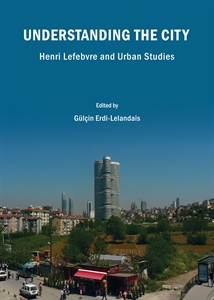
Henri Lefebvre is undoubtedly one of the most influential thinkers in the field of urban space and its organization; his theories offer reflections still valid for analyzing social relations in urban areas affected by the crisis of the neoliberal economic system. Lefebvre’s ideal of the “right to the city” is now more widely accepted given today’s current cultural and social situation. Most current research on Henri Lefebvre refers solely to his ideas and their theoretical discussion, without focusing on the empirical transcription of the philosopher. This book fills this gap, and proposes examples about the empirical use of Henri Lefebvre’s sociology from the perspective of different cities and researchers in order to understand the city and its evolutions in the context of neoliberal globalization. The book’s main purpose is to revisit Lefebvre’s still-relevant key…
View original post 97 more words
Both this post and the post it references are fascinating for seeing an interesting intersection of “practical politics” and “academic models” … if you go to the original post on “Monkey Cage” you’ll notice that survey responses to question 3 are about state entitivity.

The well-known Political Science blog The Monkey Cage, now owned by the Washington Post (now owned by Jeff Bezos; we all work for Amazon now) posted earlier today a concise 3 graph summary of what our De Facto State Research Survey reveals about likely attitudes amongst different ethnic groups in South Ossetia, Abkhazia and Transnistria (we left out our research results from Nagorny Karabakh since it is not directly supported by the Russian Federation and has its own unique features). We want to thank The Washington Post and particularly Erik Voeten of Georgetown for his assistance in swinging open the door of the Monkey Cage sufficiently to let two Irish political geographers propel some hopefully useful place-based knowledge into the maelstrom of debate that engulfs us post-Crimea. It is painful to summarize years of research into a few paragraphs but at least we didn’t have to write…
View original post 6 more words
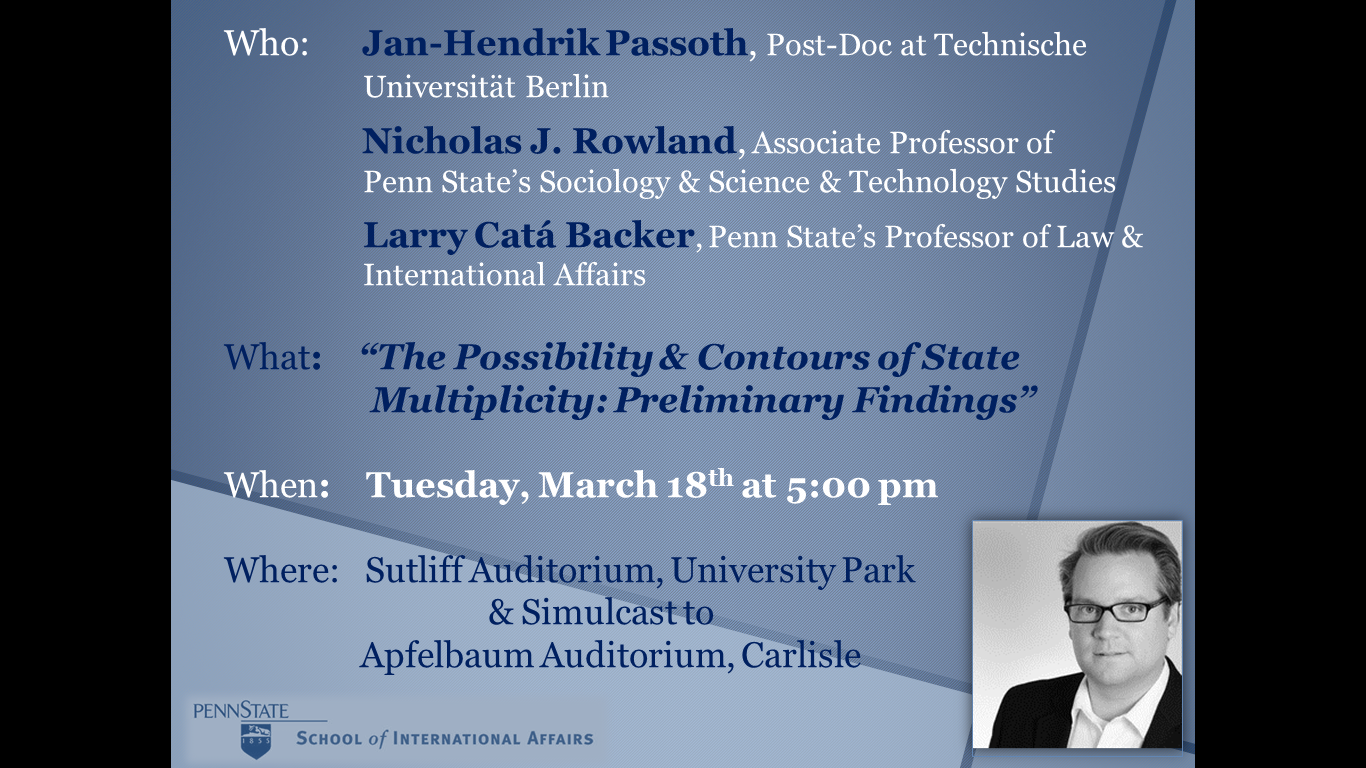
We’ll post the content of the talk (and a maybe a video, if we can manage it) on Wednesday.
Notice: Only Jan is pictured; no Nicholas 😦

Teaching ANT to students at the undergraduate level can be a difficult endeavor; however, I have come across a viable solution.
Coffee.
But not to keep students awake during boring lectures about Bruno so much as a case study. The rise of gourmet-style coffee in the United States via the mass producer and distributor Starbucks.
The lecture is here; if you’ll use it, drop me a line (njr12 <at> psu.edu).


 Installing (Social) Order

You must be logged in to post a comment.