A new Crystal Palace?

Charlotte Mathieson's avatarDr Charlotte Mathieson

It’s a couple of months now since the first press release announcing plans to rebuild the Crystal Palace. My initial response was amazement that it may be possible in coming years to see the rebuilding of one of the most important buildings of the nineteenth century; but as further details unfurl I, like many others, am increasingly ambivalent about the project, which would see a £500 million investment by a private Chinese corporation into the building and surrounding parkland. While the regeneration of the park seems long-overdue and supported by the local community, the corporation currently have an exclusivity agreement with the local council that prevents other proposals for the site’s development to be submitted until February 2015; during this time there is a call for the community to express their feedback on the scheme but it seems this has come rather late in discussions and from what I’ve read of…

View original post 1,250 more words

FBI vs. Orwell vs. Foucault

Jeremy's avatarOpen Geography

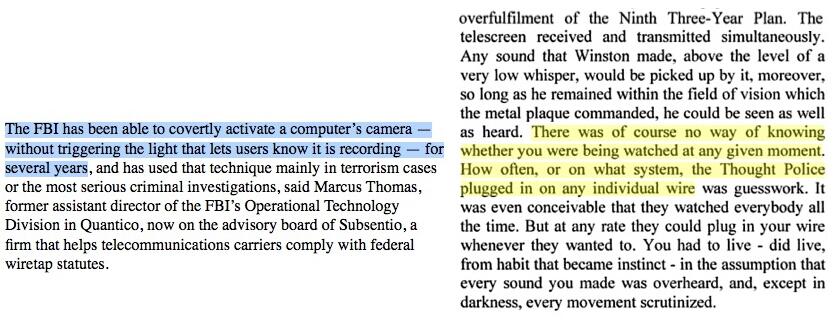
This image attracted a lot of attention around the web today:

The text on the left is from a story in the Washington Post which discusses the FBI’s ability to exploit laptop cameras without enabling the indicator light.  The text on the right is from Orwell’s novel Nineteen Eighty-Four discussing the dystopian state’s capability to view any given citizen unknowingly through their telescreen. (The comparison was tweeted out by @tinyrevolution.)

To which we can add:

Foucault DP

Michel Foucault, Discipline and Punish, page 201.

This was originally published (in French) in 1975, well after Orwell’s book. So Orwell was first with the idea? Not so fast! Foucault is discussing the ideas of the social reformer Jeremy Bentham, who proposed the idea of the “panopticon” (all-seeing) in the late 18th century. According to one history, there are at least 300 prisons worldwide built on panoptic principles. You can see a classic illustration

View original post 138 more words

Door to Hell, 42 Years Later

The_Door_to_Hell

Proverbial “Door to Hell”, Derweze, Turkmenistan: Check out a video here.

The Door to Hell is a natural gas field in Derweze (also spelled Darvaza, meaning “gate”), Ahal Province, Turkmenistan. The Door to Hell is noted for its natural gas fire which has been burning continuously since it was lit by Soviet petrochemical scientists in 1971, fed by the rich natural gas deposits in the area. The pungent smell of burning sulfur pervades the area for some distance (Wiki).

Not the first time we talked about disasters on the blog. For example, about how Google worked in Japan post-Fukushima disaster to use Google-cars to help find missing persons. About how the intersection of infrastructure studies and disaster studies will likely grow in future years. More recently, we featured “Philip Mirowski’s Never Let a Serious Crisis Go to Waste … an important and distinctive contribution to debates around the politics and economics of the economic crisis”.

A Review of Infrapolitics: The Social Life of Water in Mumbai

Infratheory today and now infrapolitics!

Max Liboiron's avatarDiscard Studies

Dissertation Reviews is a site that  features overviews of recently defended, unpublished doctoral dissertations in a wide variety of disciplines across the Humanities and Social Sciences. Their goal is to offer readers a glimpse of each discipline’s immediate present by focusing on the window of time between dissertation defense and first book publication. This review of Nikhil Anand’s dissertation, Infrapolitics: The Social Life of Water in Mumbai, written by Tarini Bedi, will be of interest to discard studies scholars because of the methodological approach and how it highlights the politics of infrastructure:

Nikhil Anand’s dissertation is a nuanced, theoretically ambitious, and timely contribution to political ecology, to the anthropology of the state, and to the emergent field of the anthropology of infrastructure. Anand’s methodological approach, where the city, the “urban,” is the site through which to study the state is provocative for scholars of urban studies. The work is…

View original post 284 more words

Book Review Symposium – Philip Mirowski’s ‘Never Let a Serious Crisis Go to Waste: How Neoliberalism Survived the Financial Meltdown’

Some interesting ideas for the intersection of infrastructure and disaster

Antipode Editorial Office's avatarAntipodeFoundation.org

Guest editor: Brett Christophers, Uppsala University

Philip Mirowski’s Never Let a Serious Crisis Go to Waste is an important and distinctive contribution to debates around the politics and economics of the economic crisis which began in 2007-8 and, as such, is well-deserving of the symposium convened here at Antipode.

Never Let...For one thing, the book is different. As Mirowski remarks in his response to our four reviews, the last five years have seen a veritable “torrent of crisis books”; so why single out this one for particular scrutiny? Because it does not profess, like so many other crisis books tend to do, to identify broad causes and consequences of the crisis. Instead, its specific agenda is to offer an “intellectual history of the crisis and its aftermath” (p.11). That is to say, while it tentatively “explores the economic crisis as a social disaster”, it explores the crisis much more…

View original post 973 more words

Acting in IR?

Capture

Recently, Jan and I completed a new paper about how the material infrastructure on states (and our actor-network state idea) might figure into contemporary theorizing about international relations. In particular, we are in the process of contributing to a book about the “human element” in IR, and the resulting paper now can be read, but it is only in draft form.

Check out the paper here or here; we do some of our earliest work on “state multiplicity,” play with decentering the human in IR, and we also dabble with non-scholarly state theorizing.

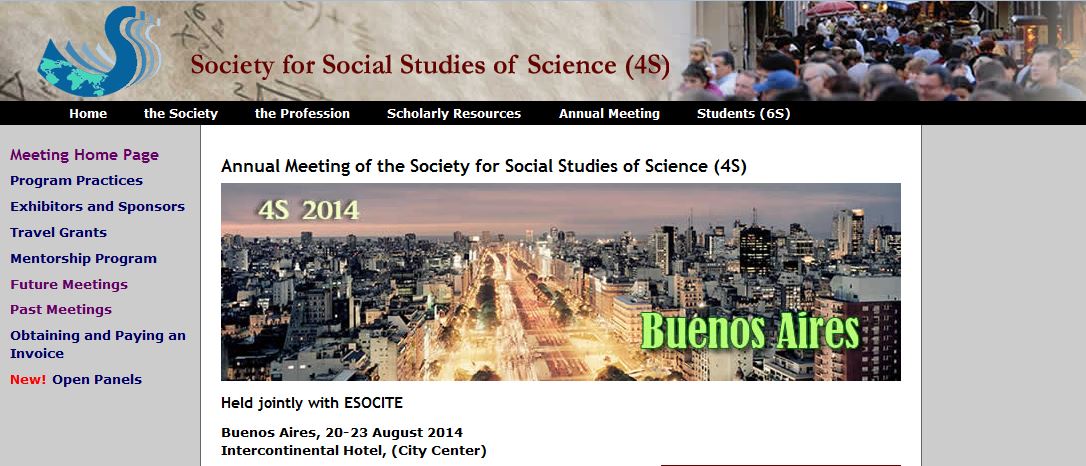
4S deadline was last Friday; we submitted

Capture

Here is our session proposals for 4S in Argentina next year; hopefully we see you there. I think leadership at 4S will select the sessions it wishes to host in about two or so weeks.

********************************************************************************************************

First name: Nicholas J.
Last name: Rowland
Co-authors: Jan-Hendrik Passoth
Session Title: STS and “the state”
Session Description:

Consistent with the general theme of the conference, “Science in context(s): Souths and Norths”, we encourage 4S and ESOCITE scholars researching the emerging intersection of STS and “the state” to submit their work. This jointly-held meeting affords us the unique opportunity to balance South/North perspectives on both “the state” and STS, which is a rare opportunity indeed, and will be the source of a rich discussion among participants.

We anticipate hosting a series of papers in a series of “Open Panels.” In particular, we are hoping to find papers that give rise to new dialogues and exchanges on the following four topics:

1. Empirical cases of “the state” as manifest in infrastructure or in everyday life: New and exciting work in infrastructural developments offer fresh perspectives and cases to reconsider dated theoretical approaches to understanding what the state is and what they state is becoming. Likewise, a new line of research in “the state in everyday life” offers a perspective no less fresh that gets at mundane experiences and routine activities that either bring us closer to the state or fend us off from it. How these differ in the North/South divide are of prime concern.

2. Empirical cases of “the state” as manifest in material or in environmental arrangements: State formation has been a perennial question in state theory. However, as scholarship develops, the old theories of the state, which emphasize war-making and international treaties, have given way to new research on the practical aspects of state formation, as in, how do you form a state. Chief concerns in this area are material activities associated with state formation and, crucially, environmental concerns related to forming states in the first place and sustaining them in the long run. Again, how these differ in the North/South divide are of prime concern.

3. Where is the state and where is not the state? State absense/state presence: This topic emerged organically from the last 4S meeting in San Diego, and while it is new to us and is far more experimental than the above themes, we consider it of vast potential. One way to re-think the state is to ask where it is and where it is not. Are there new boarders emerging between states? Are there areas inside of the traditional territorial zones that bound states where the state simply does not appear to be present? Is it possible that the state is present even in its absence, under certain conditions? We don’t know the answers to these questions; it is the most “open” of the open panels.

4. Theoretical approaches to the state and state theory: No doubt, state theory has odd and deep roots in the Northern tradition of scholarship. Ideas that need to be challenged. We anticipate this coming from two directions if we are sensitive to STS and the state. First, in the North, fresh perspectives on the state are emerging through the lens of STS. Second, in the South, fresh perspectives on the state already exist as alternatives to traditional Northern scholarship on the state (and, of course, STS shapes these discourses too).

Please consider sending your abstracts to our set of open panels. The multiple panel format ensures a sustained audience and prolongs the discussion of our work far beyond a single paper or a single panel.

Christine Hine on virtual ethnography’s E3 Internet

Hine, ethnographer-extraordinaire.

Heather Ford's avatarEthnography Matters

christine_hine_thumbnailChristine Hine is an early pioneer of virtual ethnography and has been at the forefront of movements towards redefining ethnography for the digital age. She is currently a Reader at the University of Surrey’s Sociology Department.

Editor’s note: In this post for our Being a student ethnographer series, I talked to Christine Hine about her forthcoming book, ‘Ethnography for the Internet: Embedded, Embodied and Everyday’ due out next year. In this interview, Christine talks about the current phase in virtual ethnographic practice, about what are her latest research interests, and about a framework that she believes can help ethnographers understand how to adapt their practice to suit multi-modal communication environments. 

HF: What do you think are the key challenges that ethnographers face in trying to study the Internet today?

CH: Robinson and Schulz, in their 2009 paper, describe evolving forms of ethnographic practice in response to the Internet…

View original post 1,087 more words

Fixing Peer Review

broken_window

This post is about fixing peer review. dmfant, who some of you might know from synthetic_zero, commented on a recent post on the state of STS scholarship, asking:

have you been following: http://www.cplong.org/2013/11/the-peer-review-coordinator-and-the-collegiality-index/ ?

Which is a discussion about making reviewers and reviews public (rather than granting reviewers anonymity). The idea is that we could improve reviewing scholarly work through a process of making it public and creating, in the process, a “reviewer score” for reviewers that would be known, esteemed, and productive. My response was so long, I will post it here for further consideration.

My response was (also, I write as a faculty member and about faculty issues, so it is a bit myopic in that way):

I’ve been critical of peer review for a long time, probably ever since I was “subjected” to it early on in my career. This new approach is not nearly as much of a solution as I think it is being presented as:

First, one of the few things that I like about PR is exactly that it is NOT a game of hierarchy. You might get a reputation with an editor, but that editor will be replaced eventually, so the influence of “being a good researcher” over “being a good reviewer” was primary.

Second, my guess is that this is just something that will further hurt in-coming scholars, meaning, it is precisely newer scholars that will need to be deemed “good reviewers” and it is senior scholars with tenure who are the most free to not care about being deemed a “good reviewer.”

Third, another problem will be: is this yet another thing I have to do in order to get tenure? Again, the young scholar is held to a higher standard than the senior scholars that will oversee their tenure file, and, again, the senior scholar hold the younger scholar to a higher standard for tenure than they themselves were held to. That, however, depends a lot on how university administrators see such activities: will young scholars be expected to be “good reviewers” as a part of the tenure decision OR will young scholars be rewarded directly for being deemed “good reviewers” in the form of larger raises? I would imagine that rather than being directly awarded for this hard work, it will be just another expectation for young scholars; it will be, in effect, just something that can held against a scholar (i.e., being deemed “bad reviewer”) than something rewarded (i.e., we expect our faculty to be “good reviewers”).

Fourth, the predictable counter-argument would look like this: “oh, silly Nicholas, don’t be so cynical, if we can “fix” the peer review process, then you’ll be able to publish even more research and publish it through a process that is more fair.” We all know that the publication process is unfair. It is a reality. We all come to grips with it one way or another. When I consider the work of my peers, I am able to keep this in mind. However, if we “fix” it, it will still be unfair (i.e., instead of a tyranny of advanced/high-prestige researchers having a strong voice in the review process, we will trade one tyrant for another, the good reviewer, and soon we will be forced to publish what they will accept) and there is no reason to think that “good reviewers” are going to be more fair, promote innovation, or let the author’s voice come through. We will just trade one set of intrenched values for a new set of values that will be intrenched later on.

Fifth, all of this would not work even if, by some magical coincidence it did align university officials, faculty members, and folks that populate promotion and tenure committees … its called “the internet.” Of course, whenever I get a paper, I could determine the author with stunning frequency by just looking-up the title of the paper, which was likely presented in some professional society’s annual meeting that I probably attended, moreover, most of the papers I get to review these days, I know them as soon as I see them because, if you’re an expert in a small area, you know all the main players already. If you want to promote their work, then you can. If you want to thwart their work, then you can. There is no reason to think that a new system should change this. We already know whose papers they are; anonymity for the author seems long dead among specialists. Then comes reviewers: “There seems to be widespread skepticism that peer review without anonymity can be both rigorous and fair” to quote the blog. The idea that anonymity allows one to be “fair” (i.e., fair being defined primarily in terms of being able to say difficult comments plainly) is just BS. There is no reason to believe that in the professional game of science that I (or any other reviewer) cannot be fully honest in a review. Some folks use it to be a jerk. I understand that. I am fine with that. The reason is that some people are jerks. They are jerks in the classroom. They are jerks in their correspondence. I guess I am open to the range of personalities and am not entirely sure that erasing this variation or marginalizing folks that don’t quite have strongly developed social skills or promoting reviewers with glycerine tongues (by rewarding them with higher education’s favorite currency, status) makes much sense. People fail. Editors fail scholars by not taking this into account. This is a human enterprise and because it is I think we need to embrace a level of uncertainty, improve the processes that we have instead of upending a tradition.

In the end, if you want to fix one thing, I would say that we need NOT better reviewers (after all, reviews are just what they are, reviews), but better EDITORS. Show me an editor with a real vision, one capable of making tough decisions, one that is not a total tool of the reviews, an editor that is not constantly looking for ways to reduce their workload and simply embraces the huge responsibility of selecting one paper over another or encouraging the work of a young scholar to develop or reject the sloppy work of a senior scholar whose work is popular among reviews.

NOTE: the picture is from http://kennyjonesradio.com/wp-content/uploads/2009/08/broken_window.jpg

Is STS a bordello or cabinet of wonders?

Capture

This is based on some ruminations over the last year, which I’ve mentioned a while back casually and which our now full-time blogger Stef Fishel discussed more recently.

Here goes: Is STS a bordello or cabinet of wonders? (I write in the plural because Jan-H. and I were writing this together)

In STS:

… we recognize the unorthodox and outlandish agency of “nonhumans” like scallops, microbes, Portuguese sea-going vessels, and British military aircrafts. In fact, the way we just listed those example case studies into the minutiae of STS scholarship is more telling than it might immediately appear. You see, STS is populated by intriguing micro case studies, and, from a far, STS appears to outsiders like a “cabinet of curiosities.” Because our research is punctualized into individual case studies, and these case studies were so routinely juxtaposed with one another during the era of great edited volumes of the 1980s, a look back through history of STS research is akin to opening the door to a cabinet whose contents were filled with every manner of wonderful and ornamental trinkets that somehow capture the grandeur of other worlds even in their miniature size. Also, because this cabinet was populated  during the Science Wars, its contents are all the more precious, and, in retrospect, to this day provide a sense of nostalgia to the scholars who filled it, marking the discoveries they had made, as they passed it down both as a gift and a challenge to the students they trained.

Also, in STS, however:

Before we are accused of fickle sentimentality for our academic home, our cabinet of curiosities might just as well appear as a “bar à hôtesses” to some insiders sickened by the excesses of postmodernity, or the bitter, personality-driven, concept-oriented turf wars over aurthorial copyright that have come to typify STS <FOOTNOTE: At feverpitch in the early 1990s, … collins yearly / latour callon etc.> and, to this day, distract the field from sharing any semblance of unity with regarding agreed-upon phenomenon to study as a group, all of which might spell the end of STS in years to come. Thus, calling our cabinet a bordello might be warranted in certain company.

*This post was largely inspired by Fabio’s early characterization of STS as a “cabinet of curiosities,” which has, since I first heard it, stayed with me. As he put it, STS is:

very anti-normal science. You end up with a cabinet of curiosities than a deep and precise knowledge of a specific issue.

**The picture is from: http://www.google.com/url?sa=i&rct=j&q=&esrc=s&source=images&cd=&cad=rja&docid=7p2FFa9Eveh4JM&tbnid=oxupV4E35lZsLM:&ved=0CAQQjB0&url=http%3A%2F%2Fparismarket.blogspot.com%2F2011%2F09%2Fcabinets-of-curiosities-and-pretties.html&ei=pFuFUoT6NPHC4APa3ICABg&bvm=bv.56343320,d.dmg&psig=AFQjCNFDvgagsuepOr4mm7V0rPzbL4qZCQ&ust=1384557853106096

Research at Cornell

DSC07160

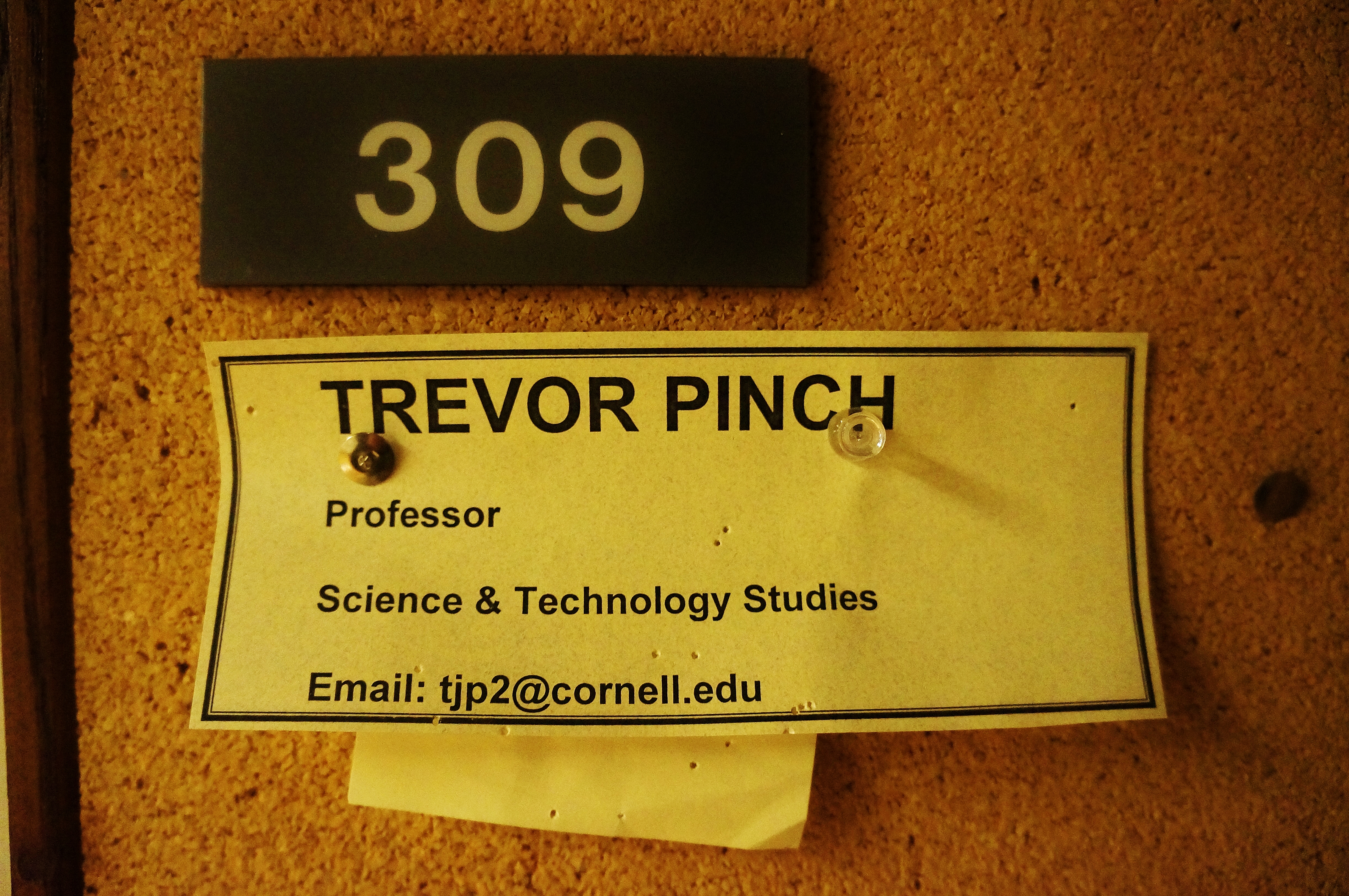
Just last week, I visited Cornell University to visit Trever Pinch, a well-known STSers from the early days. Trever has been an active member of the two most important professional association in STS, the Society for the Social Studies of Science and the European Association for the Study of Science and Technology.

With outstanding luck for me, turns out Trever is something of a pack-rat too, and has original conference proceedings for every single event in the history of both organizations. I’m in the process of using them to chart how different topics have been used in the history of the organizations. After my initial run, they will be donated to their respective professional organization.

While studies of 4S seem relatively rare, there was a recent (and interesting) project reviewing EASST, which is here: EASST_conf_summary. Still, a couple of older 4S programs are available on-line. In what appears to be Sal Restivo’s personal program from the first meeting at Cornell University in 1976, available here: 1976 4S at Cornell, we can see into STS’s past.

During the 1976 meeting, Bruno LaTour (sic!), for example, was still a member of the Salk Laboratories presenting on citation analysis, which would later be the groundwork for Laboratory Life (which, in the 1986 edition, as a great postscript). S. W. Woolgar was present to, at the time hailing from Brunel University, discussing sociological analyses of scientific accounts. H. M. Collins attended, speaking about replication in science, which, as many of you know, would be the work that Woolgar, along with his student Malcolm Ashmore, would later bring Collins to task on in Ashmore’s incredible (and incredibly playful) The Reflexivity Thesis (read the preface for a hilarious letter from Woolgar to the editor). R. K. Merton gave the lunch talk. Karen Knorr gave two talks and John Law gave one on Anomie(? Anybody know what happened to that paper? Maybe it’s sitting in an edited book nobody reads anymore…).

At any rate, as these are completed by my assistant, I’ll occasionally a comment or two.

Immanence Blog and “Querying Natural Religion: Immanence, Gaia, and the Parliament of Lively Things.”

Found some great notes on a recent conference on Latour in Baltimore, MD.
Ivakhiv: Latour’s Gifford Lectures and the Broader Context
Morton: Secret Agents ov Gaia
Taylor: Bruno Latour and the Seductions of Gaian Animism
Connolly: The Anthropocene, Spirituality, and Bruno Latour
Deudney: Reflections on Gaian Planetary Civic Religion

Enjoy!

http://blog.uvm.edu/aivakhiv/2013/11/24/querying-natural-religion-responses-to-latour/

Is that really what is “wrong” with STS? Is there anything wrong?

Toolbox

Yesterday Nicholas posted a comment from org-theory that tries to grasp what might be wrong with STS. And although the discussion below that post is fascinating and thought-provocing, I am not so sure in more than two ways if the diagnosis is correct. First I do not agree that the focus on “authorial” concepts (the A->x structure) is really the way STS ticks. That “Latour -> actant” or “Callon -> Agencement” or “Mol -> Multiplicity” schema might work for attribution from the outside, but I am pretty sure Bruno, Michel and Annemarie do not really care. In fact: most prominent concepts have their “one-hit” appearance…for example “hybrids” in WHNBM, the “nonhuman” in the book on Pasteur. What is really at stake is the phenomena these terms try to capture: we have more than one concept to capture heterogeneity, more than one to capture instability, more than one to capture arrangements, more than one to capture translation.

And second I really do not agree that outside of STS the so called “Mertonian Model” is the model we find in practice of, lets say, organizational theory. One should take a deeper look – maybe an STS project on practice in org theory – to really make that point, but the latest prominence of “fields” -> Fligstein/McAdam, “networks” -> White or the classic ones like “garbage can” -> CMO, “embeddedness” -> Granovetter look pretty much like the A->x structure to me. That is no critique, but I doubt that the distinction between two modes (two cultures …hahaha) of scholarly practice really makes sense. I would prefer asking what role both modes (and maybe a few more) play in the production of science and technology and how one shifts from one to the other in practice.

Another take on the issue would play the old tune of reflexivity: As we are scientifically looking at science we cannot simply hammer variables down (as this is, as we have seen, not really what other scientists are doing anyway); nor can we just play the post-modern relativist (as this is disrespects the craft of science on so many levels). So what should we do? One way is to build up our own labs, our own inventory of used and not used inscription devices, some highly tinkered, some dusty, some in the center of the lab, some in the garage. Misunderstanding “concepts” (like agencement, actant, inscription device, lab, etc.) or styles (like the fictional observer in Lab Life or the “Voice of Aramis”) either as mertonian or as authorial is like treating a chromatograph as a scientific paper. They are devices, tools, workbenches to produce reflexive phenomena. Like the wonderful machines in biotech labs our devices might look strange to those not used to working with them on a day to day basis. Ours are cheap, at last…that is why we can dump them so easily and come up with another.

What’s wrong with STS?

Capture

Here is what’s wrong with STS. For a better STS, consider the following:

hmmm … My sense is that what’s “wrong” with STS is what’s “wrong” with a lot of organizational theory. There are no well-characterized phenomena to study (case studies are not phenomena, although they can lead to their discovery). Instead what you see is a proliferation of schematic “concepts.” In science, “progressive” cosmopolitan collectives build on phenomena and are pragmatic towards concepts and models (the one that provides a more satisfactory account of the phenomenon wins); “oppositional” enclave-based scientific movements deplore phenomena and focus on “authorial” concepts. Authorial concepts are those that are inherently associated with an author, who thus “owns it” (e.g. Latour –> actant). Because oppositional enclaves tend to be organized around “groups” and authorial charisma scientists do not compete to offer the best explanation of an explicitly recognized phenomenon (as in the Mertonian ideal type) but instead the incentive structure is biased for leaders of different subtribes to provide their own authorial concept. The reason is that without your “own” concept, you don’t have a reputation.

Thus, conceptual proliferation in oppositional enclaves is simply the outcome of a more basic underlying socio-structural logic. This contrast to the Mertonian ideal-type collective (which actually attaches names of authors to effects not concepts), which favors the proliferation of different explanations of the same (small) set of (clearly characterized) phenomena. Because authorial concepts, like all concepts, have the general structure (A as X) where X is the concept and A is some empirical setting, “progress” in oppositional collectives follows a “turf-war” model as you extend your concept to cover other realms, in particular realms that were previously covered by your rival’s own authorial concept (e.g. B as X and not Y, C as X and not Y, etc.)

This is not to say that well-characterized phenomena are absent from STS. Obviously one interesting phenomenon to emerge out of the STS enclave is what has become known as performativity (although Ezra might disagree as to whether this phenomenon is well-characterized), and not surprisingly, this is where STS has been the most influential outside of the enclaves. If you prefer the Mertonian model of science (and I’m going out on a limb here and presume that Ezra–who is a boy–prefers this model) then the good thing about phenomena (as opposed to let’s say “concepts”) is that they don’t carry authorial copyright, so that anybody can take a “shot” at (accounting for) them. Phenomena-centered science thus leads to cosmopolitan, interdisciplinary endeavors that follow more closely the “progressive” line traditionally associated with normal science. Given a phenomenon as a reference point, we can make a pretty good estimate of where we stand in relation to the immediate past.

Take for instance the phenomenon of “boom and bust” in industries (or organizational imprinting). You’d be crazy (or just uniformed) if you didn’t realize that we are in a better explanatory position in relation to these phenomena than we were let’s say a three decades ago. However, given a “concept” (let’s say “social structure”) no such “progressive estimate can be given, instead it seems as if we are stuck in second gear. Authorial concepts-centered science instead leads to either Spenglerian “coming crises” types of analyses or cynical, “nothing matters, there’s never progress, everything goes in cycles”(e.g. Abbott in Chaos of Disciplines) types of takes regarding the health of a given field.

It is obvious that STS is a “concept-based” enclave and the “system of thought” that governs most STSers is based on this make-a-”contribution”-by-offering-a-new-concept model. A typical example is Callon, who in a recent paper (2007: 140) argues that “Relying upon the anthropology of science and technology, we can define economic markets as socio-technical arrangements or agencements (STA) whose functioning is based on a set of framings concerning not only goods and agencies but also price-setting mechanisms(1).” Then if you have the patience to go to footnote one we get the definition of agencement:

An agencement is a combination of material and technical devices, texts, algorithms, rules, and human beings with their various instruments and prostheses. I discuss elsewhere the reasons why I prefer the French term agencement (which unfortunately has no equivalent in English) to assemblage or arrangement (Callon, 2007). Agencements denote socio-technical assemblages when they are considered from the point of view of their capacity to act and to give meaning to action. By defining markets as STAs we emphasize the fact that they are simultaneously malleable and capable of actions.

At this point, of course Ezra has already thrown the paper in the trash. Callon’s strategy here follows the template offered above (markets as agencement) But the main point is that throughout this paper, you will not find the usual Mertonian goodies; e.g. a characterization of a phenomenon, a specification of our ignorance regarding the mechanisms that generate it and the proposal of a new model of these mechanisms that does a better job of accounting for the phenomenon than other competitors, but simply more definitions, and stylized descriptions of sites that could be thought of as “agencements.” This is the style of thought characteristic of STS.

We can go hoarse trying to evaluate whether this is or is not a good strategy, but for now I’ll simply play the good anthropologist and say that it is “different” (I have been known to play both sides of this field) but in addition (and now putting on my more specific Mary Douglas hat) it should be noted that it is also exquisitely attuned to the social context within which it makes sense (enclaves where charismatic authority based on authorial concepts is the most natural reputational currency). Since, the main issue after reading this paper is that you come out with the impression that: agencement –> Callon so that you have to cite Callon (2007) if you want to use the concept (the same of course goes for agora, actor-network or what have you).

Please note: This is not my post; it is a recycled comment from orgtheory.net by Omar, a comment to a post that Fabio wrote about some eerily similar territorial scuffles I experienced as a guest blogger there.

Latour’s honor being protested (update)

Capture

Latour’s honor being protested … annually?

So, I just spoke with Dr. Ann Rudinow Sætnan (Department of Sociology and Political Science, Norwegian University of Science and Technology) who wrote that article about how Latour’s recent Ludvig Holberg International Memorial Prize and how Latour’s honor has been protested.

Here is the update on the Latourian protester. I asked “Has the redux fizzled out on a new-ish science wars or have there been any notable developments?”

She responded:

As for what happened to the Science  War flare-up … yes, it fizzled. I just googled the theme to check whether anything new had been published in the debate since the pieces I cited. There was one more. This one was not so much a critique of Latour as a critique of giving prizes in general as a means of gaining public recognition for (social) science. The author of this last piece claims that giving away large sums of money to already famous social scientists doesn’t do much to advance the reputation of the social sciences, as evidenced by the small number of people who have even heard of the prize. He writes that the prize is almost most famous for Jon Elster’s annual protests of it and that if Elster had not existed then someone would have had to invent him in order to publicize the prize. … and there the whole debate seems to have ended. At least until next year when Elster protests whoever wins in 2014

If you are interested in the piece (and have a reading-knowledge of Norwegian), check it out here. The title translated (thanks, Ann) is “What price the Holberg prize?”

Here is the old post:

In an interesting essay from our friends at EASST (European Association for the Study of Science and Technology), documents a possible resurgence of the ‘science wars’ of yesteryear … at sitting in the cross-hairs is good old Bruno Latour, protested recipient of this year’s (2013′s) The Ludvig Holberg International Memorial Prize, or as some of you might know it, just the Holberg Prize. Check out the article; its free and interesting.

Follow-up on Goldiblox

Capture

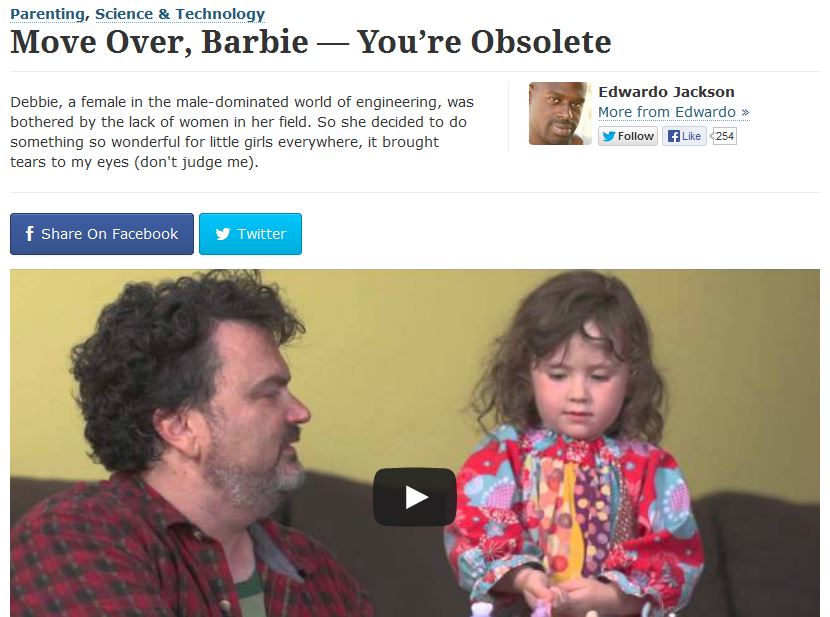
Just saw this; more on actually doing something about gender in STEM, especially, engineering:

Fewer than 3 in 10 graduates in science, technology, engineering, and mathematics are women. And barely 1 in 10 actual engineers are women. Early in a girl’s life, the toys marketed to her are usually things that don’t encourage her to enter those fields. GoldieBlox intends to change that by teaching them while they are young that these fields can be fun — and apparently epic, by the looks of this super-genius 2-minute video. Watch and learn.

Check out the video on upworthy here. Also, a previous post about it here.

Latour’s book scoffed

Capture

Clever public reviews of products on Amazon has become something of a pass-time for more individuals that I would have thought. For example, reviews of this banana slicer, for which there are 4,530 reviews, are quite entertaining, or for this excellent book How to avoid huge ships we find terrific (and humorous) reviews by members of the public. On How to avoid huge ships, for example, we see this review titled “Reads like a whodunnit“:

I bought How to Avoid Huge Ships as a companion to Captain Trimmer’s other excellent titles: How to Avoid a Train, and How to Avoid the Empire State Building. These books are fast paced, well written and the hard won knowledge found in them is as inspirational as it is informational. After reading them I haven’t been hit by anything bigger than a diesel bus. Thanks captain!

Or, this classic:

it didn’t work for me. i still got hit by a huge ship. i can’t recommend this book at all.

While these are entertaining … what about this one about Latour?

Capture

One reviewer of Latour’s We have never been modern raised a point that I had not heard before that the book was “a postmodern joke”:

Anglophone readers probably don’t realise that Latour meant this book as a tongue-in-cheek exercise to capture the postmodern social theory market in his own country by using a postmodern style to show what an illusion postmodernism has always been. But, as fate would have it, when someone sneezes in Paris, an Anglophone is felled with pneumonia. It’s hard to believe that anyone with a firm grasp of the history of the last 250 years of Western culture would find this book anything more than a diversion worthy of maybe a couple of arguments in the pub. It’s telling that historians of science, who are really the people who are in a position to hold Latour accountable to anything he says here, have given the book a chilly reception. Classify this one under ‘Pseud’s Corner’.

Does anyone know if that is true, that WHNBM was just a semi-clever joke?

The EASST meeting in Torun, Poland, is now accepting session tracks

Capture

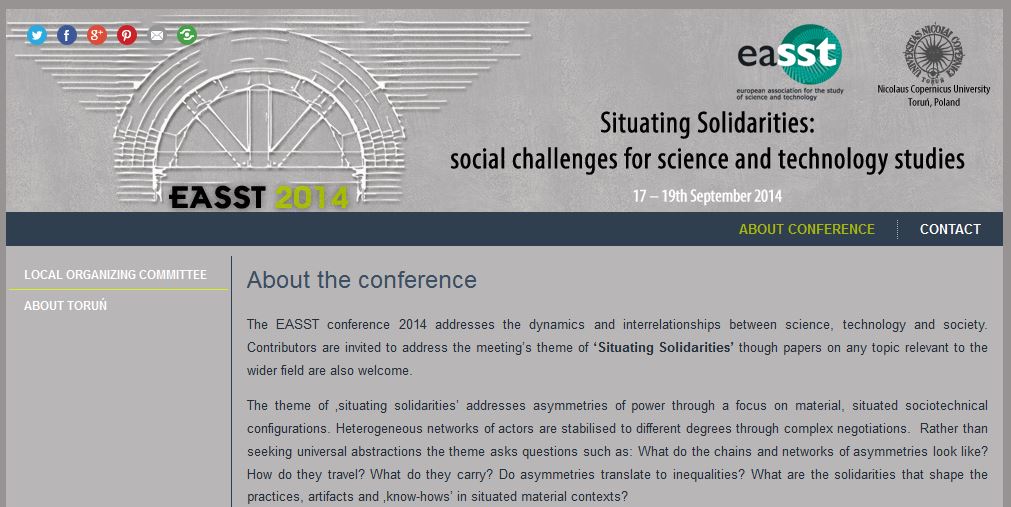
The EASST meeting in Torun, Poland, is now accepting session tracks for those who would like to propose some productive sessions (or unproductive ones too, I suppose).

Link to the call for sessions is here, and December 16 is the deadline.

IMPORTANT DATES AND DEADLINES:
December 16: Proposal for convenors and thematic tracks deadline
January 2014:Communication to the convenors of acceptance of
tracks
January 31 2014: Call for submission of abstracts with the final track list included
March 28 2014: Deadline for abstracts submission
May 16 2014: Communication of acceptance/rejection of abstracts to authors and opening of online registrations

Surely, I will try to attend this meeting so friends in state theory and related issues of infrastructures, please do let me know if you’ll be there/submit!

About the conference

The EASST conference 2014 addresses the dynamics and interrelationships between science, technology and society. Contributors are invited to address the meeting’s theme of ‘Situating Solidarities’ though papers on any topic relevant to the wider field are also welcome.

The theme of ‚situating solidarities’ addresses asymmetries of power through a focus on material, situated sociotechnical configurations. Heterogeneous networks of actors are stabilised to different degrees through complex negotiations.  Rather than seeking universal abstractions the theme asks questions such as: What do the chains and networks of asymmetries look like? How do they travel? What do they carry? Do asymmetries translate to inequalities? What are the solidarities that shape the practices, artifacts and ‚know-hows’ in situated material contexts?

Political and ethical engagement is a central concern for a view of science as changes in collective practice, rather than as individual contemplation. How should STS observe or influence the raising and erasing of social and technical asymmetries in everyday life? What do the ‚situated solidarities’ of dealing with asymmetries and inequalities look like? Can STS contribute to the work of solidarising to connect asymmetric agents, places, moves and networks to weaken inequalities and change hegemonic relations?

A more detailed call for tracks will be available on the EASST website and circulated on Eurograd shortly.

The city of Torun is located on the banks of the River Vistula.  It has an extensive medieval town centre which is designated as a UNESCO World Heritage Site. The university and the city provide a great location for the EASST 2014 conference.

Interdisciplinarity, crisis, and the future of academic institutions

Since the 2008 financial “crisis” (and it’s hard to keep calling something a crisis when it continues for 5 years), tenure track jobs have fallen by about 40%.  Many with PhDs are jobless, on welfare, working in tenuous positions, trying to find work in different sectors, or moving from one job to another—be it an adjunct position or more steady multiple year teaching contracts. Admittedly, the job market has been constricting since the 1980s, but now, there are fewer  jobs elsewhere to mitigate the effects of fewer academic positions.

I have been relatively lucky in this market compared to some.  I have had two positions since earning my PhD that have treated me with respect, decent wages, and health insurance.  These were harbors in the storm that many of my friends and cohort have not been lucky enough to find.  That said, I have racked up hundreds of dollars in fees to my dossier service and spent countless hours over the last three years preparing job letters and sending dossiers to potential employers. This has netted me two campus interviews and one phone interview.  In the meantime, I teach introductory courses to bright-eyed freshmen, take care of my family, research and write in whatever time I have left.

The personal financial troubles of visiting professors and adjuncts are compounded by the larger constriction of university funds. The 2008 crisis devalued endowments and investments for many universities.  While used to fighting for funds and support, humanities, social science, and interdisciplinary departments found themselves fighting for survival within their universities.  Funding was cut to many programs, and in some cases, entire departments were suspended. Technologies like MOOCs and machine graded essays moved in to fill in the gaps between fewer professors and tuition income pulled in by larger classes.  In some cases, both visiting and tenure track professors create online classes that threaten to replace them in subsequent semesters.

The important question for me—as the vagaries and cruelties of this new post-employment academic market have been addressed in nearly all ways elsewhere— is how this affects junior scholars who are attempting to craft an interdisciplinary research career in this tenuous and competitive market.  I have spoken of cabinet of curiosities in earlier posts as a way to imagine IR, but how does this measure up when hiring departments want people doing “real” IR?  What does this mean more broadly for projects that cross or question disciplines?  Research projects that grapple with the interconnected, global, rhizomatic, and immanent world filled with hybrid forms, spaces of flows, and networks are more crucial than ever. Does this new environment suffocate these important research plans?

So, perhaps getting jobs is harder in this market, but what about the future of the university with fewer tenured professors and (perhaps) fewer interdisciplinary humanities and social science projects? Traditionally, the university has been a space for intellectuals to speak subversively without fear or reprisal—especially important is job protection.  An adjunct or visiting professor will likely not even have the time to be a public intellectual.  There is no research leave or course buy out with grant money.  In fact, we are here to teach the classes for tenure track and tenured professors while they pursue their research careers.  They loan us their offices and we fight for time and space to do our own work while teaching, and, more often than not advising and serving the institution that offers visiting professors multiple one-year contracts. But this seems to me as part and parcel of the bigger problem looming over academia as an institution: neoliberal business practices imported to the university uncritically and whole-heartedly by a burgeoning administrative class. The safe space of the university is disappearing and it is unclear what will follow. In theory, I might be okay with a long term teaching contract with little to no research requirements, but what about the public intellectual who should be engaging with civil society and sharing publicly funded research?

The students certainly suffer under this new system, but this may not seem apparent to the students at first.  This is not to say that visiting and adjunct professors are “easy,” in fact, this seems to work in the opposite.  Visiting professors bring new research, disciplinary rigor, and generally plan their classes with the goals of the department and the university in mind.  Young undergraduate scholars may not have the opportunity to create long-term mentoring relationships with their professors, or even more simply, cannot choose them as their department advisors.  Long term, will they be able to request letters of recommendation from their overworked tenured advisor who teaches classes of 250 or from a visiting prof that now works at a different institution? Maybe two or three different places?

The open questions with which I would like to end: What will the university as an institution look like in the next decade or two?  Will tenure still be an option?  What departments will ascend in this neoliberal future?

Glorious Backfires in Digital Ethnography: Becoming an Urban Explorer

Derelict places in sociology

Heather Ford's avatarEthnography Matters

Screen shot 2013-11-11 at 12.53.11 PMFor four years, Bradley Garrett (@Goblinmerchant) explored abandoned hospitals, railways, tunnels and rooftops as part of his PhD ethnography studying an elite group of urban explorers. 

Brad has in many ways had it all: a book deal from Verso just after finishing his PhD, a position at Oxford University to continue his research, and numerous requests for media appearances and license deals. But he has also just had one of the hardest years of his life, struggling with a backlash from some members of the urban explorer community as well as attempts by authorities to stop the publication of his book. Last month, Brad gave a talk to the newly-established Oxford Digital Ethnography Group (@OxDEG) about some of the perils of doing public ethnography. His story is a counterpoint to the uncritical enthusiasm usually espoused about this form of engagement. Public ethnography, we soon learn, can…

View original post 423 more words

Latour’s Gifford lectures – text now available as pdf

Latour, pinned down.

stuartelden's avatarProgressive Geographies

Update 2019: These links seem to be dead, but the pdf of the lectures can be found here; and the videos here. The lectures are now available as a book – details here.

Bruno Latour has made the text of his Gifford lectures available as a pdf on his site –Facing Gaia: Six lectures on the political theology of nature. Thanks to Owain Jones for the link (it seems this may have been available for a while; but news to me). The lectures were all video-recorded and I linked to them a while back – the links are all at the Edinburgh site.

View original post

Goldiblocks: Gender and engineering meet

Capture

Anybody interested in gender, engineering, or infrastructure, especially, meta-issues, like training students in the sciences and engineering and all the related gender issues:

Check out this promotional video.

Golidblocks! This is a smart idea. There is a ton of literature about how women select out of the sciences and engineering, some of which is good work and some of which borders on the sexism it supposedly only describes; however, this angle, related to children’s toys and parenting strategies … just might be one of the smartest thing “done” in that line of thinking/concern.

If you’re teaching STS and you cover gender issues, a discussion of this might be useful.

It also reminded me, hauntingly, of this: when Barbi used to say “Math class is tough” … ugh.

Teaching STS: Controversies

Capture

This is an extension of a previous post about teaching STS. So, teaching controversies is a mainstay of STS; if you need a good film to show, check out “Judgment Day: Intelligent Design on Trial” replete with Steve Fuller weighing-in on intelligent design … and their are courtroom re-enactments and even a decent biology lesson for students that don’t have a strong background in basic genetics and/or evolution.

Of great interest for us is this: the film underscores the utility of theory in face of lame counter-factuals (which uninformed students tend to accept or privilege during discussion). Additionally, there is an incredible discussion, especially for high school or undergraduate students, about the difference between science and non-science. But, better than all of that, there is an implicit display of “truth” in three different forms — which makes for excellent discussion post-film — between “law truth,” “science truth,” and “religious truth,” which is great to show how truth is context-specific and what constitutes truth in law, science, and religion is only rarely overlapping.

Also, I have a handout already made to help students to navigate the documentary. Write me if you you’d like a copy or if you’ve used this clip for your own courses (send to: njr12 at psu.edu).

Lastly, if you’re already teaching Sismondo’s Introduction to Science and Technology Studies, the chapter on “Controversies” can be used with the film because midway through the chapter, Sismondo describes a set of 5 circumstances under which controversies can be “closed up” and those map onto the film wonderfully, making the bridge between in-class reading and an out-of-class film easy.

Foucault reduced to Leftovers

Capture

If Foucault were more a materialist, how might he have thought about this crash-site-turned-memorial? (featured above — full background story here)

In the past, we have written about an infrastructural model of the state as composed of leftovers, specifically, when we wrote about derelict Olympic stadiums in Athens and London, residual separation of city infrastructures found in Berlin, and whether or not the durability of state projects (and the resulting leftovers they proffer) is such a good thing (as so much STS on stabilization might very well imply). What’s the infrastructure link to the state? Its simple. Foucault and especially his followers suggested that there was no such thing as the state; instead there was another thing and this other thing was called “stateness,” which is thought roughly to be captured in this form of argument: the state is not a thing; the state is, at best, at effect. Sure, sure, some governmentality scholars have discussed “institutions” and “political regimes,” but, at the highest level of abstraction, Foucault was reacting to Hobbes-like actor-models of the state and responded by rejecting those models in favor of seeing the state not as the cause but as the effect of micro-physical, bio-political techniques for self-discipline and other forms of coercion. In effect, Foucault is saying the state is the residual after effect. Put another way, the state is leftover; it is to be found amongst the leftovers. Of course, we, as material-semiotic mongrels, would see the state as a residual material after effect, but that’s another argument entirely.

Residual material after effects take all manner of forms, and today I happened upon one, which was both, in and of itself, interesting, but also a compelling case of “leaving behind” that might be relevant to developing a “leftover” perspective regarding infrastructure. This is of double interest to our infrastructure gurus because the infrastructure of the memorial is also memorializing the infrastructure that is the plane (that crashed) so they make leftovers of the leftovers.

The full story is here and here, but a quick summary is: UTA Flight 772 routinely flew from Brazzaville (now in DRC) to Paris CDG airport, when, on Tuesday, 19 September 1989, a bomb exploded aboard the plane causing it to crash in Niger about an hour after take-off. 18 years later, family and friends of the victims aboard the plane returned to the crash site and because of its outstanding remoteness, many of the pieces of the plane were still there, only slightly covered in sand. Funded by a grant from Libya, the remains were transformed into a memorial, further extending the site into the future.

Surely, there is a good deal of literature on memorialization in anthropology and geography along with the practical literature in the arts and architecture on the topic. However, our interest is more into what these “remnants” and their extension into the future means for theories of the state sensitive to infrastructure. While this case is only tertiarily related, there is something elegant about extending ruins; making them more durable through memorialization.

Image from: <http://cdn.viralnova.com/wp-content/uploads/2013/11/34-iQoqN4P.jpg&gt;

IS LATOUR A CLOSET LARUELLIAN?: non-modern philosophy as non-philosophy

Is Latour in the closet?

terenceblake's avatarAGENT SWARM

Latour has famously claimed that we have never been modern, and has unsparingly criticised the postmoderns for their practice of critique, showing that he actively embraces both paradox and performative contradiction. His own name for his style of thinking is “non-modern”. Given his desire to get away from all philosophy based on the dualist principles generated by the “bifurcation of nature” and to create a new type of thinking that he calls “empirical philosophy”, one may wonder if Latour is practicing, knowingly or not, a form of “non-philosophy” in the sense that François Laruelle has given that term. His declarations that he is in no way attached to a particular theoretical vocabulary or set of references, but considers his metalanguage “disposable”, go in the same sense.

Latour’s theoretical formulations show a huge degree of liberty when it comes to locating the basic conceptual matrix of his work. Different versions of…

View original post 566 more words

Lowercasing “sts” and “ant” – What comes next?

On various occasions during the last few months I noticed that we in STS (and we as ANTers especially) have a tendency to talk small when talking big. Some examples needed? Small ones of course? Here they are:

  1. not a theory, not a method”: A classic! Despite its beginnings – does someone still remember the Sociology of Translation or the great methodological subtitle of Science in Action? – nearly every account given of the status of ANT “today” resonates on the “oh, it is not a theory” (starting in 1999 with Latour’s “Recalling ANT”) and the “oh, it is not a method” theme. And while this looks like a withdrawl from “big debates” on theory and method and as a way of saying “we have nothing to offer if you are looking for that”, the answer of what it is, if not a theory and not a method, is: an approach, an attitude. That sounds modest, but has, when takken seriously, massive effects.
  2. “Thin concepts, modest methods, weak explanations”: Now if that is not at the center of the approach…in theory, methods and even in respect to what really is at stake we love to be modest — although we of course are not. Thin concepts are regarded as the strongest possible for thick narratives, modest methods are in fact really demanding and hard to “use” and weak explanations of local, situated and limited phenomena are valuated as far more solid than those with bigger pretense.
  3. “don’t try to get it right!”: ok, we (Nicholas and I) are to blame for that… but reflexivity in STS demands that whenever we studiy epistemic processes and knowledge creation we should not try to know better as our voice is just one more that adds to controversities we study. That was easy when studying technoscience – knowing better than someone working in particle physics or biotech is just too hard. But once we study ourselves or our relatives in economics, population science or political theory it is tempting to know better…but it is better not to try.

It is not just a matter of style: we actually like our concepts, our cases and our methodological rigor to be tiny and gigantic at the very same time. That has a lot of reasons, of course, the history of science studies, the science wars and our, well, not so great experiences with Bruno’s (and Michel’s and John’s) big gestures in the mid 90s being just the least important. After lowercasing science we are lowercasing ourselves. And then? What will follow? Will we stop there? Thoughts?

Latour’s honor being protested

Capture

(from: http://www.holbergprisen.no/en/holberg-international-memorial-prize/holberg-prize-symposium-2013.html)

In an interesting essay from our friends at EASST (European Association for the Study of Science and Technology), documents a possible resurgence of the ‘science wars’ of yesteryear … at sitting in the cross-hairs is good old Bruno Latour, protested recipient of this year’s (2013’s) The Ludvig Holberg International Memorial Prize, or as some of you might know it, just the Holberg Prize. Check out the article; its free and interesting.

Latour Invites Contributions to his AIME Project

I am stuck, it seems – that thing is terrific…am I correct to feel old missing the printed edition?

dmf's avatarANTHEM

Dear AIME platform users,
Since last week all of the functionalities that we had planned to have fully functioning, function and in particular, the last column on the right ‘C’ for contributions. This column allows readers to become co-inquirers and gives meaning to the
whole Inquiry.
To accompany you in your role as a co-inquirer we have assembled a group of mediators who will edit, modify and expand upon and publish your contributions. Please click here to learn more about the members of the mediator team. 
Below, you will find the information that you need if you wish to contribute. Clicking on this link will take you to a tutorial that will guide you through the most common difficulties co-inquirers face when starting out.
 Having resolved most of the technical issues (of which a few remain but nothing too terrible) we can now get back to the
heart of our…

View original post 377 more words

Biotech for the Academy

My research mainly involves trying to think us out of the conundrum of state-based violence using re-figurations of the body politic.  Actual, structural (since all violence stems from actual violence on actual bodies—the threat of hurt and harm), gendered, normalized, terroristic.

If not out of violence per se, as I suspect it is constitutive of the human experience, into a form of knowledge/power that strives to care for the most vulnerable and nurture the multiple forms of being and becoming that emerge and will emerge…a form of political subjectivity that “judges not as the judge judges,” but, as Whitman wrote in the preface to Leaves of Grass “as the sun falling around a helpless thing.”

A tall order, perhaps but one that is crucial to any political project. How do we, as humans, citizens, neighbors, mammals, etc, tend to our world? How is dialogical space made to open creative re-thinking, -figuring, -imagining about how local, state, and global politics function?

More broadly, what I am wrestling with is life.  How is life included in politics? In our institutions, discourses, or urban planning projects? How do state politics understand life, or to ask the more traditional philosophical question: What is a life worth living? How do we create the conditions needed for realizing the good life? Turns out that life is really complex and messy.  It eludes definition and control.

In earlier posts, I have shown how I chose microbiotic communities and co-evolved parasites in the human gut. Walt Whitman was a sometime poetic counsel for these Uexküllian forays in the worlds of animals and humans.  Technology can also be a part of making choices that privilege certain social configurations over others. In this post, I want to talk about art, biotechnology, and critique. Art is another way to imagine different political configurations and futures.  (Detournement can work, too.)

On Monday night at Hobart William Smith, I attended a lecture by Dr. Steve Kurtz, a professor at SUNY-Buffalo and founding member of the Critical Art Ensemble. Since the late 1990’s CAE’s founding concern shifted from the digital revolution to the biotech revolution. As Kurtz explained, the digital revolution was a difference in degree rather than kind–it increased the level of intensity of communication, but was more a revolution of scale that intensified the bombardment of the sign rather than internalizing that sign.  The biotech revolution, Kurtz argued, was more than a revolution.  Previous to this, the body was sacred and humans could always find some relative freedom inside their body, if no where else.  Biotechnology, on the other hand, is coding the body from the inside out. Life and potentiality is understood through the genetic code.

The posthuman, the cyborg, became a reality in a different way than it had been previous to this biotech revolution.  This could be a utopian future or a nightmare.  What, argued Kurtz, was needed to nudge it toward the utopian?

biotech for the people

People must participate and know the political stakes of biotechnology or it will not be democratic, but controlled by policy makers or corporate interests.  The role of the CAE, and of artists more broadly, is to deliver messages, show the stakes, and the possibilities of these revolutions.

image

This, as I see it, is the same project as critical social and cultural theory in academia.  Academics also show the stakes of the policies and norms that are, more than likely, controlled by the elite, the corporate, and the tyranny of the minority in the US Congress.

To return to Kurtz’s talk and its resonances with the research I have presented on this blog, what does it mean that the body can be understood, manipulated, enhanced, improved, with technology as an extension of the actual body?

Aimee Mullins, Photo Credit: Howard Schatz

Aimee Mullins

These shifted understandings of the body must deliver emancipatory messages, show the political stakes involved, and bare the possibilities the biotech body for reinvigorating democracy and other forms of participatory governance. Importantly for academic disciplines, as Nicholas and Jan highlight in the “When in doubt, de-Center humans” post, how does this shift affect our disciplines?

Welcoming back Stef Fishel

Our guest blogger emeritus Stef Fishel is joining us now as a full-time site blogger. Join us welcoming her back to the blog!

558857_10152198590663502_790410204_n

Stefanie Fishel received her doctorate in Political Science from Johns Hopkins University and a Master’s degree in International Relations from the University of Victoria. Dr. Fishel approaches International Relations using techniques and inspirations from Science, Technology, and Society (STS) studies, the philosophy of science, and biology. She is currently at Hobart William Smith Colleges in the Department of Political Science.

I met Stefanie at the 2012 Millennium Conference at the London School of Economics during a post-conference workshop about how actor-network theory and international relations might fit together (if at all). During her stint as a guest blogger in April, she wrote us some interesting and unusual posts about microbial roommate, homeopathy and Walt Whitman, the bodies politic, materialist directions in international relations, and technologies of sharing and caring.

Welcome back and welcome aboard!

When in doubt, de-center humans

Capture

The challenge of de-centering humans — especially in the traditional home of human-centricity like sociology or anthropology but also in the humanities — has been gaining attention for years; however, a few ongoing developments are worth considering.

First, in human and cultural geography, our fellow bloggers at THE ANTHROPO.SCENE have recently posted (thanks, dmfant) a video “Decentering the human in human geography“, which is a lecture about ontological, epistemological, and even moral issues related to “human exceptional-ism” in our social sciences. The talk is by Kay Anderson, University of Western Sydney. At 45 or so minutes long, the talk defies simple summary; however, one might hazard this synopsis: humans have been deemed irreducible to nature, but their very ‘humanness’ is precisely predicated on their transcendence of mere beasts; the specialness of humans (and this is no news to long-time readers of ANT), thus, distracts us from material forces of significance; our presenter then historicizes, thus rendering vulnerable, human exceptionalism, treating the concept like an artifact of time rather than one of truth; hence, the lesson is that de-centering humans through historicizing the processes of centering humans, in the first place, and by appreciating humanism’s materiality and smashing the boundary between humans and nature, can we finally get a de-centered view of humans in geography. Of course, there are many more voices in this discussion that have been overlooked (by me, of course).

What makes Anderson’s talk so interesting is that by historicizing the concept of human exceptionalism we can take the concept to be an empirical matter rather than a presupposition for starting analysis (we tried to do this move with reflexivity). But this requires a careful tour of early biological sciences (e.g., Linneaus) and especially naturalists and anatomic crainiology, but in so doing, we realize that the claims toward human exceptionalism, under the bright light of empiricism, were often unstable and frequently revised in substantial ways. While I fully realize that post-humanism has been around for decades (although Haraway’s cyborg seems so odd now, so 90s), Anderson’s shift of perspective is a welcome development, and one, I contend, could be replicated in other areas. Here is the only room for criticism, though: in biological sciences (and perhaps I am raising the boundaries I would just as well smash, but …) there is not such a clear or direct link to the social sciences wrought with human exceptionalism; I agree that Anderson is uncovering the roots of this plague (i.e., human exceptionalism), but once it leaves the proper confines of biological sciences and then it taken-up as a presupposition or justification for “doing anthropology”, for example, the concept has been transported and, to some extent, changed as a condition of transport. Thus, surely, human exceptionalism has historically meant something different in anthropology as compared to sociology, each of which could be uncovered in a future analysis, or, consider, a comparison to international relations, which brings me to my second point … ir.
Capture

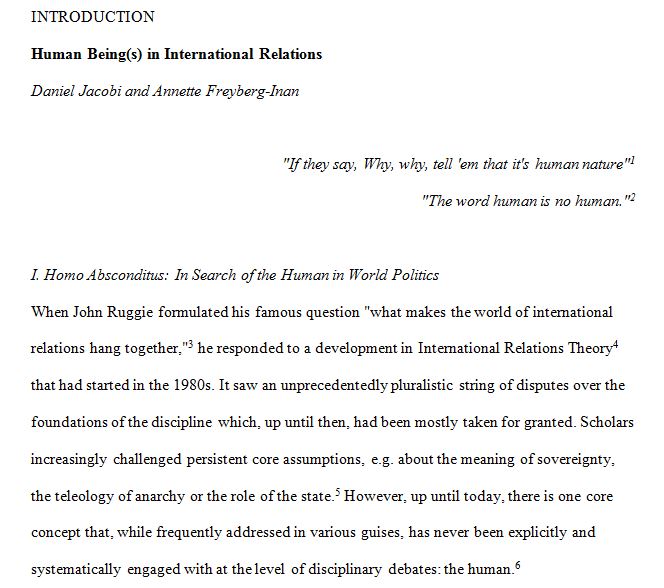
Second, in international relations, a book is underway that considers ‘the human’ from a post-anthropological perspective. Some of us contributing to the book are using this opportunity to de-center humans too, only this time, it is an experiment to see how far one can de-center humans and still have viable theories for international relations, in our case, theories of the state. The opening lines of the to-be book are above in the image and give one a sense of the tone for the book.

An upcoming event is going to be held at Goethe-Universität Frankfurt am Main4th Global International Studies Conference 2014” (Aug 6-9), which I would love to attend, will no doubt also deal with issues related to de-centering humans. This would be a great opportunity to blend some of the thinking in geography, anthropology, and international relations precisely because the book, which is related to this conference. is considering a “post-anthropological international relations” …

The conference details are:

Our goal is to provide an interaction space in which International Relations research expertise can be shared on an international level and thus contribute to the expansion of a truly global professional network. For this purpose, IR scholars from around the world will meet in Frankfurt and present their research to a broad audience made up of scholars and experts in all fields of international studies. The overarching theme of the conference is „Justice, Peace and Stability: Risks and Opportunities for Governance and Development“. In addition to classical issues in diplomacy, security and development studies, panels and roundtables will pay special attention to novel issues in global politics, including emerging actors in international relations and new forms of south-south cooperation.

Our paper that will be part of the book, opens like this;

Acting in international relations? Political agency in post-humanist state theory


Jan-H. Passoth, Department of Sociology, Technische Universität Berlin

Nicholas J. Rowland, Department of Sociology, Pennsylvania State University


This edited volume sensitizes readers to a budding divide in International Relations (IR); a shift away from crafting overly-anthropological accounts to describe the practice of international relations (ir) and toward what our editors are calling post-anthropological scholarship.[1] The chief difference hinges on the position of the human element in IR; front and center, in the former, peripheral and de-centered, in the latter. The upshot for patient readers is insight into what the consequences of this shift will mean for IR and ir.


Our chapter constitutes an experiment to test the outer limits of this shift. We ask: how far can we, as scholars, decenter the human element before our models of international relations implode? To this end, we selected ‘the state’ as our test case. By only analyzing models of the state, we were finally able to dis-inhabit the state of the human element entirely, but, in the process, we were challenged to re-conceptualize many our otherwise taken-for-granted, anthropological assumptions about political agency. No doubt, some readers will be dissatisfied or un-persuaded by our experiment in post-anthropology; admittedly, we had no choice but to scour many, occasionally incompatible literatures to trace-out a fully uninhabited state in the course of our analysis. That being said, we generally believe that our analysis identifies and explores some of the outer limits of what it might mean to legitimately de-center the human element in IR. This test in post-anthropology also has an important implication for the relationship that binds IR to ir. One of the enduring quests in IR and beyond is to determine a universal, ontologically sound definition of the state once and for all. However, we now take this as a fruitless, if not reckless, endeavor. One viable alternative direction for future IR research would be to formulate and, ultimately, implement a model of the state that is more consistent with models of the state that are used in ir (i.e., out there in practice). Put another way, in IR, we need models of the state that capture the complexity of how models of the state are actually used in ir. This shift requires not a theory, but an approach to theories – a model of models – and we develop this line of inquiry forthwith.


[1] Regarding merely the label ‘post-anthropology’; we are fully aware that this term could quite easily be misinterpreted if taken too far from its orienting context in this edited volume, or if it is taken to be a literal description of our scholarship here. It is important to note that the post-anthropological turn in IR scholarship has nothing at all to do with the long tradition of Anthropology as a discipline, and, coming from the small world of Science and Technology Studies, it is significant for us to be clear that post-anthropology in IR is not a direct challenge to the anthropology of science, which our area of study has done so much to cultivate. From this point forward in the chapter, when we use the terms ‘anthropology’ and ‘post-anthropology’ it will be in the same spirit that our editors layout in their orienting introductory chapter, to wit, our title contains the term ‘post-humanist’, which we see as consistent with this distinction.

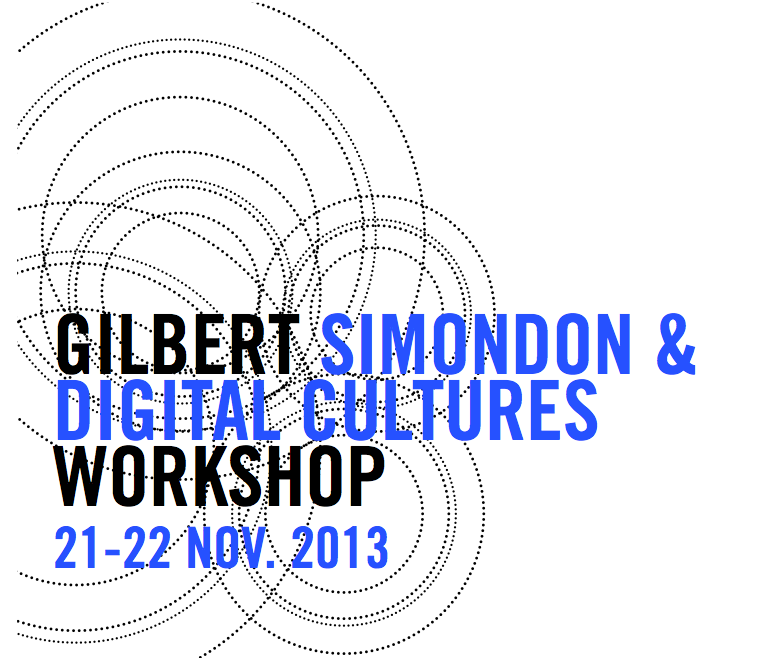
Workshop: Simondon and Digital Cultures, 21-22 November, 2013

Capture-d’écran-2013-10-04-à-14.59.25

Workshop: Simondon and Digital Cultures, 21-22 November, 2013

Centre for Digital Cultures, Leuphana University Lüneburg

Organizers: Yuk Hui (Leuphana Universität), Erich Hörl(Ruhr-Universität Bochum), Jeremy Gilbert(University of East London/New Formations)

Confirmed Speakers: Jean-Hugues Barthélémy (FR), Anne Sauvagnargues(FR), Ludovic Duhem(FR), Erich Hörl(DE), Yuk Hui (DE), Michael Cuntz (DE),Jeremy Gilbert (UK), Andy Goffey(UK), Luciana Parisi (UK), Christoph Brunner(CH),

This workshop is dedicated to Gilbert Simondon: our contemporary. It will explore and delineate the significance of his work for the analysis of our contemporary techno-medial condition. Therefore it focuses on the question of the digital, and aims to put forward a critical agenda for research into digital cultures, informed by  Simondon’s thought.

In Du Mode d’Existence des Objets Techniques(1958), Simondon showed us a new approach to the understanding of ‘technical objects’, and rethought the relation between humans and machines, cultures and technologies. Today we are witnessing  the proliferation of types of object – digital objects in particular – while the very notions of object and objectivity are being transformed by digitizing processes.

This has inevitable implications for experiences and concepts of subjectivity, and Simondon’s work on individuation – in particular in L’individuation: à la lumière des notions de forme et d’information (2005) – remains one of the most original and complete, yet one of the most neglected, explorations of this topic in the history of Western philosophy. This work remains particularly invaluable for its  compatibility with his work on technical systems and technological culture.

What do terms such as ‘object’ and ‘subject’ mean today? If they are undergoing a displacement in the era of digital cultures, then this issue was perhaps most obviously pre-figured by Felix Guattari’s anticipation of a ‘post-media’ age when we wrote:  “one can hope, from there that operates a revision of power of mass media which crashes the contemporary subjectivity and a new entry toward a post-media age consisting of an individual-collective re-appropriation and an interactive usage of machines of information, communication, intelligence, art and of culture”.

While the adventures of post-humanism and cyber-feminism have explored this territory for several decades already, we contend that Simondon’s work – like Guattari’s – remains a crucially under-exploited resource for understanding the ‘post-media’ age, its consequences for subjectivity, the politics of networks, the nature of digital objects, and the role of imaginations, innovation and participation in the information society  (L’invention dans les Techniques, 2005; Imagination et Invention, 2008 ) ( Communication et Information, 2010). While Simondon’s work is known indirectly by readers of Stiegler, Hansen ,and Massumi, very little has been done to develop his ideas for the analysis of contemporary digital culture and its political implications, despite its obvious relevance. We propose this workshop as a first step towards rectifying this situation.