GoldieBlox stirkes again

https://www.youtube.com/watch?v=mHXbQ4PeNLI#t=12

Last night in the states, the NFL hosted the Super Bowl, a night when the game is watched nearly as closely by Americans as are the commercials. Surprising, to me, was that GoldieBlox, which we blogged about before and before that, was featured. It seems that that toy is really making headway and this probably marks the “beginning” for this concept.

Here’s to finally making some pro-engineering gender normativity — finally, “doing” STS out in the broader public (for example, perhaps about as much as these esteemed folks at MIT).

*PS: I finally learned to spell GoldieBlox correctly; thanks to all the viewers that let me know that I misspelled it incorrectly every time in the past entries. Mia culpa!

Pipeline Nearly Approved

Capture

In the New York Times today, reports that the Keystone XL Pipeline — designed to divert oil from Canadian sources through the US to be refined by Gulf Coast refineries — is one step closer to being approved. The article opens:

The State Department released a report on Friday concluding that the Keystone XL pipeline would not substantially worsen carbon pollution, leaving an opening for President Obama to approve the politically divisive project.

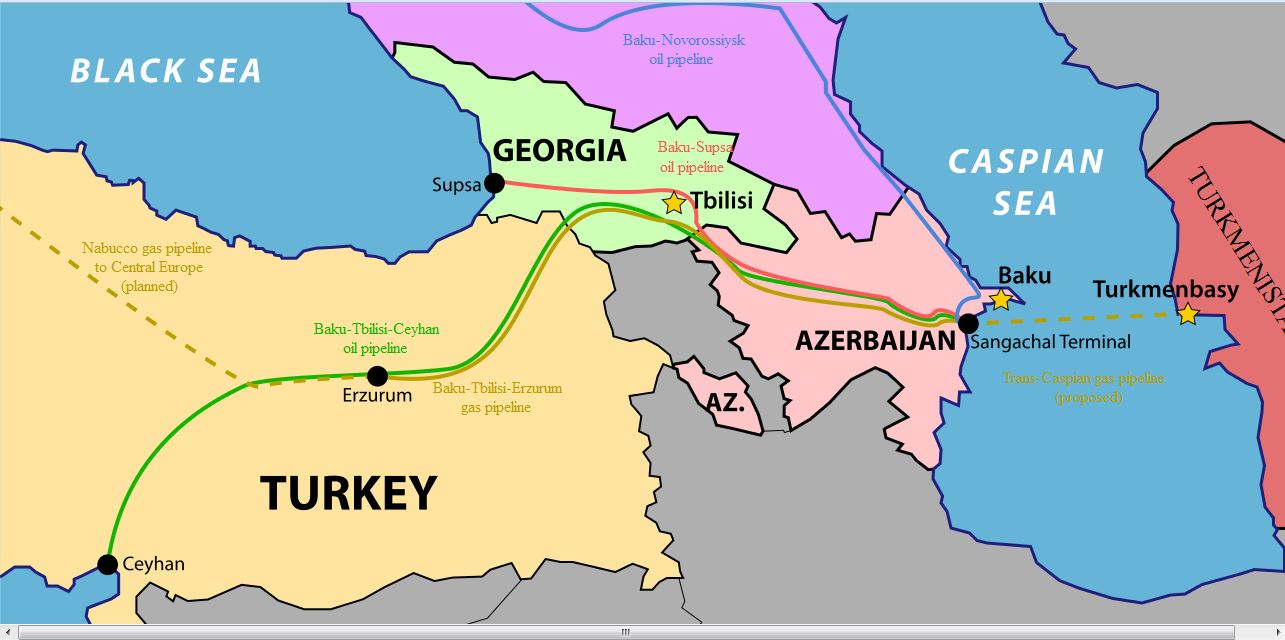
The article goes onto mention that the environmental impact research report will soon be available … and I cannot shake the feeling that I’m re-reading Barry’s new book only this time it’s set in the US. Fittingly, I guess, if you look at the picture in this post, you’ll see the upper left says “POLITICS” … but I’m thinking Andrew would prefer “MATERIAL POLITICS.”

Idyllic bomb site

Capture

Often referred to as the world’s most idyllic bomb site, the Marieta Islands were used as bomb practice by the Mexican government in the early 1900s. But after an uproar from the community, the government cease their bombing and declared the island a natural park. Over the years, tides have brought sand and water in to fill these holes, creating breathtaking beaches hidden from the outside world.” (from here)

Andrew Barry and the Function of Transparency

Capture

A lesson in the function of transparency: In Andrew Barry’s masterful new book Material Politics: Disputes Along the Pipeline he goes to great lengths to consider how “transparency” is employed, in this case, the voluntary pursuit of transparency as a means to rationally improve the experience of oil companies as they pursue transnational oil pipelines (for Barry, it is the BTC).

The basic rationale is simple. Instead of dealing with complaints, usually about environmental concerns (i.e., endangered species, etc.) or issue of public interest (i.e., land rights, etc.), the firm could offset those concerns, thus, front-loading as a means of obviating them completely from the process if only they could be transparent enough and maximize front-end accountability. As he writes, his expectation, which was consistent with the expectations of oil company elites at BP, was that:

transparency might … foster informed and rational debate while limiting the scope and intensity of controversy (182)

The manifest function of transparency appears to be an outward attempt to improve the public appearance of accountability and to intentionally limit or reduce the controversy downstream. This seems fully logical: transparency is a means to reduce controversy; to rationalize a process to the point that it appears that everyone is consenting after the fact. Such a logic is, for nearly anybody under the thumb of transparency, assessment, and accountability measures and measurements, something to concern yourself with; that transparency of assessment suffocates the hard discussions rather than engaging or enlivening them.

However, transparency has a latent function too; a function that is cause for hope. Barry warns us:

while limiting the scope and intensity of controversy [is anticipated], this does not occur as anticipated. For as the case of BTC demonstrates, the production of information — in the form of the evolving archive [the host for all matters transparent at BP regard the BTC] — had the effect of multiplying the surfaces on which disagreements can incubate and flourish (182).

Now, there are host of other arguments of vast utility in this wonderful book, but this one sticks out because of recent discussions about assessment, accountability, and transparency in higher education. What Barry makes nakedly plain is that transparency is really a process of deciding what to make present (i.e.,public and transparent) and what to make absent (i.e., not public or transparent, but not identified as meaningful un-present). Thus, transparency is not a thing; it is a (strategic) process of showing and telling as well as hiding and obscuring. However, the hope that shines through — and I am hopeful about this — is that the real solution is right there, in front of us, if know how to look for it. The key is to see assessment and transparency as processes and engage them so that you see them as a whole because only when taken-together will the absences be apparent, and it is with these absences that we might multiple the much needed discussion and discourse surrounding the transparency, accountability, and assessment that so often impose themselves on our contemporary work lives.

Endre Dányi and EASST

matters

Our long-time friend on the blog, Endre Dányi, was featured on the EASST website for his collaborative work on “Mattering Press: New forms of care for STS books.” A terrific piece and happy to hear that Endre is keeping busy and out of trouble.

Long time bloggers, you may recall that Endre was a guest blogger for us doing a great, great series on Parliaments (6 parts in all, count them, one, two, three, four, five, and six!). Looking back, the six posts make a nice collection.

Also, in case you don’t already know it: mattering press.

Dawn of (neo)Augustine world?

Capture

In this post, guest blogger Andrzej Nowak considers recent developments in the Ukraine and what they might be telling us about social order. –Nicholas

Events in Ukraine, especially streets fights between government forces and multitude of protesters, are still “fresh” — in statu nascendi, the time for  analysis is before us. I would like to risk a hypothesis that the Ukraine could be treated as a picture of near future. Nearly twenty years ago Wallerstein, in his apocalyptic vision, says that:

Much as I think that the next 25-50 years will be terrible ones in terms of human social relations the period of disintegration of our existing historical social system and of transition towards an uncertain alternative I also think that the next 25-50 years will be exceptionally exciting ones in the world of knowledge. The systemic crisis will force social reflection. I see the possibility of definitively ending the divorce between science and philosophy, and as I have told you I see social science as the inevitable ground of a reunited world of knowledge. We cannot know what that will produce. But I can only think, as did Wordsworth about the French Revolution in The Preludes: “Bliss was it in that dawn to be alive. But to be young was very Heaven!”

When we look closer for is happening on (Euro)Maidan (in Kiev), we can risk, that this is a glimpse of the future.

unnamed

This future will be apocalyptic (neo)Agustinine  world – time of cities in siege, empty spaces between them. It will be a time of neo-feudalism and return of medieval imagination. I hope Ukraine is not on path which leads to Syrian “Augustine world”, but I am quite pessimistic.

We are at the dawn of a new epoch that may well be as chaotic as that one and that may come upon us more quickly because of the way the electronic and communications revolutions, combined with a population boom, have compressed history.

Bu go back to Ukraine, I am Latourian, I suppose to show some evidence. Being an empirical metaphysist, I will give a voice to actors themselves.

First, take a look at this picture: http://news.yahoo.com/ukrainian-protesters-occupy-government-buildings-075337566.html

Or this catapult (trebuchet) used by protesters:

And at the end, look at this picture: http://i.imgur.com/xPvHEWh.jpg

Foucault’s Boomerang: the New Military Urbanism (2013)

Foucault’s Boomerang: the New Military Urbanism (2013) — interesting stuff

Clare O'Farrell's avatarFoucault News

Stephen Graham, Foucault’s Boomerang: the New Military Urbanism
OpenDemocracy, 14 February 2013.

According to Stephen Graham, a new set of ‘Foucauldian boomerang effects’ are shaping how states apply ‘tactics of control’ over everyday urban life. Today, he traces the emergence of what he calls a new military urbanism, which applies to cities both in the Global North and South.

On 4 February 1976, Michel Foucault, the eminent French social theorist, stepped gingerly down to the podium in a packed lecture at the Collège de France in the Latin Quarter on Paris’s South Bank. Delivering the fifth in a series of 11 lectures under the title ‘Il faut défendre la société’ (‘Society must be defended’), for once Foucault focused his attention on the relationships between western societies and those elsewhere in the world. Moving beyond his legendary re-theorisations of how knowledge, power, technology and geographical space were combined to underpin…

View original post 184 more words

Actually doing something with sociology

Capture

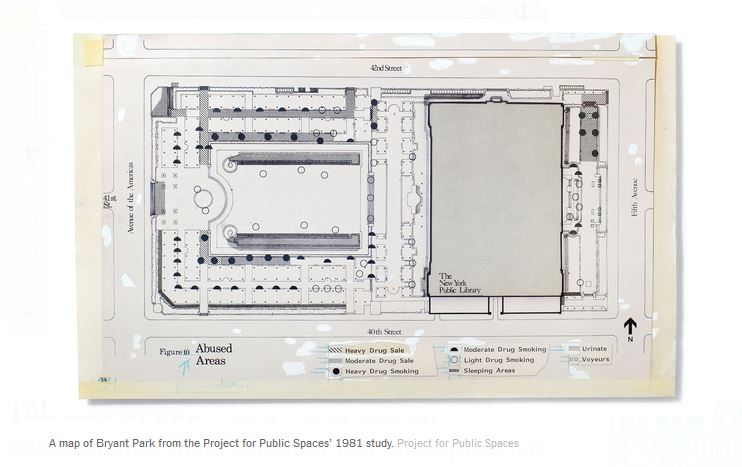
Making New York a better place through sociology? Apparently, it can be done. In 1975, Fred Kent (a former student of the wonderful W. Whyte) created Project for Public Spaces. His job? Take time-lapse films of public urban spaces with an eye to improve them. Better than any theory would be massive amounts of data. After all, rather than over-generalize Putnam’s “bowling alone” or agree too hastily with Turkle’s “alone together” thesis, he might be able to just study a spot and improve it with data and experimentation.

Kent challenges Turkle, in particular, stating that her sometimes casual observations about connection are simply no replacement for time-stamped, time-lapse data on human interaction. What’s missing, he says, is historical perspective. To avoid nostalgia for the past and the inevitable retrospective bias and attribution errors as we “remember” the past, we just need data and rigor.

Kent found some of Whyte’s old footage with an eye to recreate the research to achieve a time-place-specific reproduction for sake of comparison. Here is what he found:

… mobile-phone use, which Hampton defined to include texting and using apps, was much lower than he expected. On the steps of the Met, only 3 percent of adults captured in all the samples were on their phones.

People may decry human disconnect, but, according to Kent, 3% does not make sense as a rough count for the social armageddon that we are supposedly heading toward thanks to too much texting. Instead, he research reveals that people are more public, that is, they hang-out in public more than they did during the previously captured time period that Whyte recorded. Kent also noticed one big change: more women, many more of them. As he (nicely) puts it:

Across the board, Hampton found that the story of public spaces in the last 30 years has not been aloneness, or digital distraction, but gender equity. “I mean, who would’ve thought that, in America, 30 years ago, women were not in public the same way they are now?” Hampton said. “We don’t think about that.”

See NYT story about all this here.

Politics of the naked body vs. the Body Politic

Capture

In this fascinating post, Andrzej Nowak, our friend and guest blogger for Installing Order, tackles a fascinating case of last resort for marginalized populations — the nakedness of their own bodies as a form of personal suffering and political protest. –Nicholas

Western feminism, especially connected liberal view is often quite paternalistic, when is speaking about women from Third World. Africa nations are our best example where colonial and post-colonial myths are still quite strong.

In particular, I would like to propose a short trip to West Africa. I am interest in very particular phenomenon – when naked body can be used as a tool of political action.

This phenomenon is sometimes called Anasyrma with reference to antic Greeks. But for me here more interesting is political use of so called “curse of nakedness”. Exposing of women naked body is, in West Africa, a strong political weapon, which can be used as a way to change course of politics.

It is interesting how body politic can literally be created out of naked bodies. Let’s look a little closer, what is this phenomenon:

We all come into the world through the vagina. By exposing the vagina, the women are saying: ‘We are hereby taking back the life we gave you,'” Turner says. “It’s about bringing forth life and denying life through social ostracism, which is a kind of social execution. Men who are exposed are viewed as dead. No one will cook for them, marry them, enter into any kind of contract with them or buy anything from them.

Very traditional cultural custom “Curse of nakedness” is often used as a  tool for political and economic  emancipation.

One of the best know example is a mobilization of women against Charles Taylor dictator of Nigeria. More details about this, You can find in this movie:

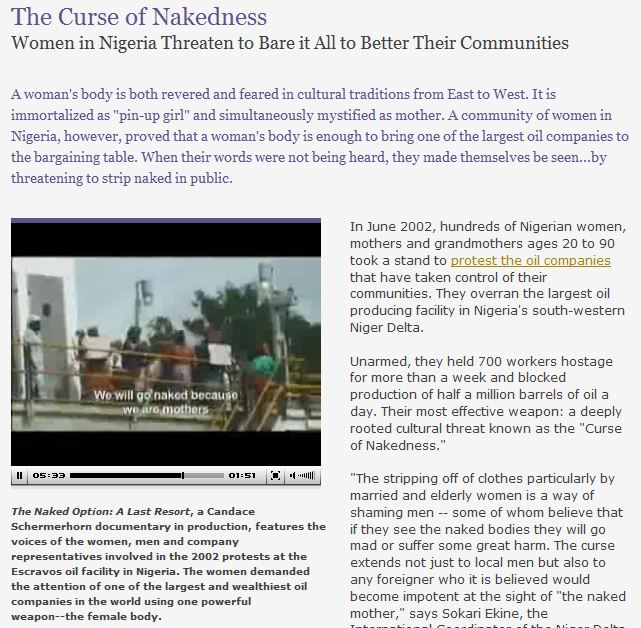
Other example is protest of Nigerian women against petrol companies in delta of Niger: 

And another example from Ivory Coast, when political women bodies meet body politic with deadly result:

“Abandoned Cruise Ship Full of Starving Rats Headed For Land”

Image

The Lyubov Orlova, a Soviet cruise ship, is packed-full of starving rats, who appear to be sailing for shore.

A ghost ship filled with cannibal rats is floating somewhere off the coast of Scotland, ready to crash ashore and unleash its disease-ridden cargo of starving rodents. And it’s all because Canadian authorities let the Soviet-era nightmare liner loose in the North Atlantic, satisfied that it was no longer a threat to Canada.

The “hundreds” of rats aboard the abandoned cruise ship have surely begun eating each other by now, officials say. It has been nearly a year since the vessel was intentionally lost at sea by Canadian authorities who were happy to let the “biohazard” become another country’s problem.

This gruesome gift from Canada is now expected to crash ashore in Ireland or the United Kingdom, dumping the plague ship’s living cargo of cannibal rats onto the land.

More on this story here and here and here.

Empathy for the Other through wearable tech?

My last post in December was a reflection on technology and politics.  How can we understand the connections between technology and politics, especially given that technology is generally understood as a tool of humans—either neutral as a mirror to our desires and interests, or as evil and uncontrollable progeny of humans as Creator? Think of the Cylons, Skynet, or Arnie as the Terminator. If politics and technology become entangled and rife with ethical issues and ontological angst at multiple levels what about bodies and technology?  What I think of as the “materiality of technology” is another topic that is buzzing through the webs this month….

Two things caught my attention along these lines: Oculus Rift and Google Glass.  Of course, neither of these wearable VR and computer platform, respectively, are new this month, but there has been some heavy rotation on the interwebs.  I guess I could add that I suspect the new Spike Jonze film “Her” has brought quite a few of the underlying issues about technology and our relations with technology to the surface.  Sexuality and intimacy and how they are enhanced or stymied by our tech are always top concerns.  Rightly so, of course, as more often than not plain old low (or old) technology comes along with them: misogyny, racism, sexism, criminality, etc. More broadly, the discussion in the case of “Her” has centered on our need to sexualize technology, to “weirdly” sexualize: is it “homage to form” when we assign inanimate objects gender stereotypes–as Isha Aran points out in her Jezebel essay–or a more disturbing and continuing desire to objectify and create subservient subjectivity for women?

Somewhat counterintuitively, I think that the two products above incorporate a need to both remove material barriers to our technology while creating new ways to materialize, or sexualize, this technology.  Ultimately, it may be more about sensualizing our experiences with technology, not necessarily sexualizing them.  They seem to represent a deep desire to remove “things” from between our bodies and our computers and information (mouse control, monitors, keyboards—ways of externally interacting with computers) with intuitive body controls. Think Robert Downey Jr. in Ironman (watch this) or Tom Cruise in Minority Report (2002). The drive is to interact with our information in radical new ways–in ways that mimic how we manipulate “things” in the world.

minority-report

Minority Report (2002) 20th Century Fox/Dreamworks Pictures (Remember how this movie blew our minds?  Especially when we found out that this was all kinda old tech?  And now we don’t need those silly gloves.)

This is added to an anxiety that technology is altering or complicating or potentially harming our relationships with others and ourselves.  While we want technology to operate seamlessly, we are wary of its possible pernicious effects.  This is not necessarily unfounded from a bodily point of view.  We are mammals; we need contact with other mammals to mature correctly and to be happy and healthy. Babies need skin-to-skin contact and the elderly who live with a partner, or dogs and cats, tend to live longer than those who live alone. This is not necessarily reductionist thinking, just a biological understanding of limbic connections. Ultimately, we are pack animals. Playing WoW all night and day might be unhealthy for lots of reasons—many of which aren’t necessarily the fault of technology.  Isolationist behavior in any form tends to be damaging if taken to an extreme.  This brings up the other reason I chose these two examples: another impulse that wants to use this wearable tech and less interface to share and swap experiences with others for greater understanding of perspectives other than our own.  To be able to see into the pot and past the steam, as Wittgenstein wrote, of another’s mysterious inner world.

More specifically, I want to discuss two applications of Google Glass and Oculus Rift, and in one case, a hack of these two pieces of technology. Let’s return to firstly to Google Glass.  These are wearable google interfaces to simplify your interaction with information and devices; they are wearable smartphones.  They allow a user to move away from a screen and use the technology without breaking contact with the “real” world.

google-glass-hands-on-stock5_2040_large_verge_medium_landscape

Sex with Google Glass is a recent app created that allows the wearer to watch and record sex from various angles.The wearer can also sync the glasses with lighting, music and to the Kama Sutra for “ideas”, for example.  It is private and all recordings are deleted after five hours.  Although Google has a strict anti-porn standing, this isn’t exactly watching porn–it’s sharing in its creation, perhaps? Sex with Glass can also allow couples to trade places and see what the other is experiencing.

This brings us  to Oculus Rift.  These are virtual reality goggles, originally funded through Kickstarter, and just out with the “Crystal Cove” prototype.  This prototype is the latest in immersive gaming and virtual experiences.

OculusRift1

BeAnother Lab is using the Rift to allow users to experience what it’s like to swap gendersto investigate embodiment, and issues like “Gender Identity, Queer Theory, feminist technoscience, Intimacy and Mutual Respect.” This is part of the The Machine to Be Another Project.  From the website:

More than individuals, we are part of a social collective called humanity. As members of this collective, the perception of our own identity is based on our relation with other people and our social environment: how people see us, how we do act and interact with them, and what self image we project to this society and to ourselves. As part of this collective society, it is clear the importance of understanding the ‘Other’ and ‘Each Other’ to better understand ourselves. This artistic investigation plans to use the recent neuroscience approach of ‘embodiment’ and apply it to investigate the perception and comprehension about the Self based on the comprehension of the “Other”.

While I am not enough of a tech follower to have an educated opinion on the specs and lifespan of these platforms,  what I find most intriguing are these examples of the application of these products.  They seem to be highlighting the desire to be able to experience what another sees and feels; to see through their eyes.  This is an interesting empathic impulse for tech and one that bears further watching and investigation.  If technology is never neutral, as I argued, in the last post, what are the opportunities we have for freedom and ethics within this medium?  If the medium is the message, how do these applications transform the material world?

For those thinking about “ding politik”…next time… the Internet of Things. A future where everything will have an IP.

Holy Crap: Infrastructure Jokes?

Capture

Apparently, there are infrastructure jokes. We have written about fun in infrastructure studies, humorous infrastructure hoaxes, Onion reports, and even have a tag for “infrastructure humor.” Still, the way that San Francisco used humor to draw attention to and improve its sewer infrastructure is pretty remarkable. Here is the back story:

On a Monday evening back last May, at the intersection of 2nd Avenue and Lake Street in San Francisco’s Richmond district, the earth opened up. A giant sinkhole–about 20 feet across and nearly 10 feet deep–suddenly gaped in the middle of the road. But the culprit wasn’t an earthquake or a creature from the deep. It was just an ancient sewer line, finally giving way after more than a century of decay.

A few months later, some odd advertisements began popping up. A set of unusual slogans suddenly plastered the backs of buses, Facebook and Twitter timelines, and in newspapers across the city, making residents double-take on their morning commutes. The ads read things like No One Deals With More Crap Than I Do and Your #2 Is My #1

This is a great idea; simply wonderful. It underscores the significance of the problem and does it with a lighthearted approach. A truly fresh idea to a serious problem. According to the FactCompany write-up,

The real punch-line, however, was that these ads came not from a newly minted, investor-backed fertilizer startup, but from the San Francisco Public Utilities Commission (SFPUC), a government agency with a tight budget and an unattractive but vital job to do.

There are more infrastructure jokes, although none so useful as San Fran’s, like this predictable one about government spending, this one that is a bit sexist about a bridge to Hawaii, or this one about IT servers. However, when you search for “infrastructure joke” you will also find these blogs indicating that crumbling and failing infrastructure is, in fact, no joke, a cruel joke, or … <choke> “snow joke” in times of in-climate weather.

three visiting fellowships on innovation at the Technische Universitat in Berlin – due Feb. 15, 2014

Capture

three visiting fellowships on innovation at the Technische Universitat in Berlin – due Feb. 15, 2014

katherinechen's avatarorgtheory.net

One of our orgtheory readers, Jan-Peter Ferdinand, forwarded a flier about a fellowship opportunity at the Technische Universität in Berlin, Germany.   This sounds like a great opportunity for grad students and prospective post-docs who are studying innovation.

Here’s an overview:

The DFG graduate school “Innovation society today” at the Technische Universität Berlin, Germany, is pleased to advertise 3 visiting fellowships. The fellowships are available for a period of three months, either from April to June 2014 or October to December 2014.
The graduate school addresses the following key questions: How is novelty created reflexively; in which areas do we find reflexive innovation; and which actors are involved? Practices, orientations, and processes of innovations are studied in and between various fields, such as (a) science and technology, (b) the industrial and service sectors, (c) arts and culture, and (d) political governance, social planning of urban and regional spaces. More information…

View original post 104 more words

Latour´s Cosmocolosse. A project of Gaia Global Circus

I am just listening to the german translation of the radio version of Latour´s first play “Cosmocolosse. A project of Gaia Global Circus (written with Frédérique Ait-Touati & Chloé Latour) that was just released in December. I remember that Paul Edwards told me about this being work in progress last summer – and it seems there is no english translation that you can listen to. But the text is available…and reading (to cite Niklas Luhmann´s comment on why he had no TV set) is much faster than listening or watching.

Not Durk/Tarde, but Saint-Simon/Comte!

Capture

It is practically lore now that Latour is right that if only sociology had listened to Gabe Tarde instead of old Émile Durkheim, we could have obviated a seriously bad detour in the history of sociological analysis. Admittedly, that’s a super-glossy gloss, but that is basically what Latour argued in Reassembling the Social.

Now that I’m teaching social theory again, I am not so sure Latour was right, or, put another way, I think we made another even bigger mistake in sociology, but it was before the likes of Durkheim and Tarde ever went at it — before either were born. The break to be worried about, given our recent discussions about the austerity-infrastructure relationship, is one the divided Saint-Simon and Auguste Comte. Without going into the full details, Saint-Simon was a social thinker that kept infrastructure closely in mind; in fact, to him, a “socialist” (note: not socialist, as in the modern political moniker, but socialist in the form of a socially organized rather than religiously organized society) was somebody that supported pro-social endeavors, for example, projects that result in something meaningfully useful to “all” of us (hence, the social part of socialist). For example, his early plans were to develop canals indicating that nothing was more social than infrastructural developments (he even anticipated and offered a design for what would eventually be called the Seuz Canal). His best student, however, Auguste Comte, did not have such a practical mind. Instead, Comte gave us terms like “sociology” and “society” and devoted himself to arm-chair theorizing. This break, between “the social” connoting shared infrastructure and “the social” being more of the world of ideas if only they could be properly rendered from the comfort of an office chair, is the break we should be worried about.

The austerity-infrastructure relationship

Capture

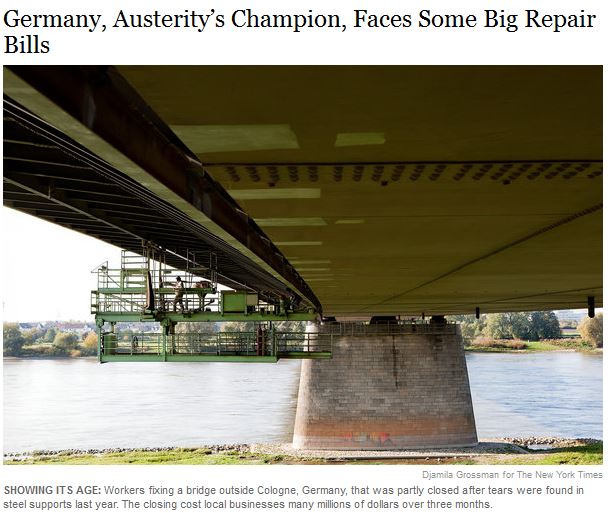
Infrastructure research might get a “shot in the arm” over the next decade, but perhaps only because of the deleterious effects of political/economic austerity measures. Perhaps we need to start developing more concepts around the topics of decay and decay-remediation over the next few years.

Suzanne Daley and Alison Small report that austerity in Germany has weakened its infrastructure, one of its most important public investments:

Germany was once known for its superfast autobahns, efficient industry and ability to rally public resources for big projects, like integration with the former East Germany. But more recently, it has been forced to confront a somewhat uncharacteristic problem: Its infrastructure — roads, bridges, train tracks, waterways and the like — is aging in a way that experts say could undermine its economic growth for years to come.

In the years to come, as austerity measures reach a fever pitch (in both popularity and critique), we should expect to hear more about the deleterious effects of austerity on infrastructure. Those of you in the “know” already have seen the wave of such discussion. For a merely a smattering of such discussion, consider American Dave Johnson’s blog, Colin Turner’s work on seeing austerity as a “pro-growth” model of governing infrastructure investments, or Mark Gongloff’s Huffington Post piece linking a bridge collapse with austerity measures, though there is much, much, much, more to say.

This should be a recurrent theme in scholarship in STS, although the topic seems only modestly addressed in our professional literature (with a few notable exceptions).

Easing Sociology into the Non-Modern World?

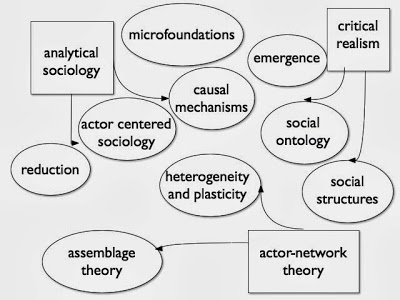
In a recent post on “Understanding Society”, Daniel Little discussed some recent development in the philosophy of social science: Analytic Sociology, Critical Realism and Actor-Network Theory. Here is how it goes:

Understanding Society: How do the poles of current PSS interact?

Start with a few resonances between ANT and CR. Both are grounded in a philosophical system (Deleuze, Kant), and they both make use of philosophical arguments to arrive at substantive conclusions. (…) But a point of contrast is pervasive: CR is realist, and ANT is constructionist.

(…) The anti-philosophical bent of AS makes it difficult for AS scholars to read and benefit from the writings of ANT scholars (witness, for example, Hedstrom’s dismissal of Bourdieu). The model of explanation that is presupposed by AS — demonstration of how higher-level entities are given their properties by the intentional actions of individuals — is explicitly rejected by ANT. (…)

Finally, what about the relation between AS and CR? On the issue of causation there is a degree of separation — AS favors causal mechanisms, preferably grounded in the level of individuals, whereas CR favors causal powers at all levels. (…) But here there is perhaps room for a degree of accommodation, if CR scholars can be persuaded of the idea of relative explanatory autonomy advocated elsewhere here.

via Understanding Society: How do the poles of current PSS interact?.

Somehow I felt a bit like I was suddenly in an academic version of an episode of Doctor Who, jumping back in time, stranded in 1992. In a paper that came out in parallel to the well know “Chicken Debate” (Collins/Yearly 1992; Latour/Callon 1992), but that was burried in a edited volume (McMullin 1992), Latour moved ANT explicitly away from what until then was called the “Social Studies of Science” and towards a framework to deal with the moderns. He wrote:

“A radical is someone who claims that scientific knowledge is entirely constructed ‘out of’ social relations; a progressist is someone who would say that it is ‘partially’ constructed out of social relations but that nature somehow ‘leaks in’ at the end. (…) a reactionary is someone who would claim science becomes really scientific only when it finally sheds any trace of social construction; while a conservative would say that although science escapes from society there are still factors from society that ‘leak in’ and influence its developmentIn the middle, would be the marsh of wishy-washy scholars who add a little bit of nature to a little bit of society and shun the two extremes.(…)” (Latour 1992: 277)

And then concludes:

“If one goes from left to right then one has to be a social constructivist; if, on the contrary, one goes from right to left, then one has to be a closet realist.  (…) It is fun to play but after twenty years of it we might shift to other games (…)”

Hmmm. Maybe it is not Doctor Who, maybe it is Groundhog Day and we are just waking up again at 6:00 to the voices of Sonny and Cher. Do we really have to have the same debate again, now not in the philosophy of science but the philosophy of social science? Maybe there is a reason to do that – after all, Phil Connors has to repeat his morning routine over and over again until he starts making himself a better man and finally finds a way to love and happiness. After all, Little does indeed think it is important to add “ANT to the menu for the philosophy of social science, at least as a condiment if not the main course” and there are others in that field today that share his opinion. Maybe if we don´t discuss those issues again and try to work diplomatically with the moderns (in this case: AS and CR…) on what they value most, we are selfish and grumpy fools – like the character that Bill Murray played so beautifully. But it is not tempting to know that the sound of “I got you babe” will be with us for a while. Is there a way out? A shortcut? A “shift to other games”?

Limn (4) on Food Infrastructures

Limn (“Limn is somewhere between a scholarly journal and an art magazine”), edited by Stephen J. Collier, Christoffer M. Kelty and Andrew Lakoff, just published its fourth issue on food infrastructures. Here is the opener, check it out:

Issue Number Four: Food Infrastructures

edited by Mikko Jauho, David Schleifer, Bart Penders and Xaq Frohlich
This issue of Limn analyzes food infrastructures and addresses scale in food production, provision, and consumption. We go beyond the tendency towards simple producer “push” or consumer “pull” accounts of the food system, focusing instead on the work that connects producers to consumers. By describing and analyzing food infrastructures, our contributors examine the reciprocal relationships among consumer choice, personal use, and the socio-material arrangements that enable, channel, and constrain our everyday food options.

With articles by Christopher Otter, Franck Cochoy, Sophie Dubuissson-Quellier,  Susanne Freidberg, Heather Paxson, Emily Yates-Doerr, Mikko Jauho, Kim Hendrickx, Bart Penders and Steven Flipse, Xaq Frohlich, David Schleifer and Alison Fairbrother, Javier Lezaun, Michael G. Powell, Makalé Faber-Cullen and Anna Lappé!

via Issue Number Four: Food Infrastructures | Limn.

4S and EASST invitation, 2014

Screenshot 2014-01-10 12.07.42

Open letter to readers:

This is Nicholas Rowland and Jan-Hendrik Passoth. This year we’re chairing sessions at the annual meeting of the Society for the Social Studies of Science (4S) (20-23 August 2014, Buenos Aires, Argentina) as well as the annual of the European Association for the Study of Science and Technology (EASST) (17-19 September 2014,Toruń, Poland). Consistent with years past, we have proposed a session with multiple panels, all organized around the broad and basic topic of STS and “the state.”

We invite you to submit your work to the sessions. Over the past half-decade or so, we have done our best to host papers on a variety of topics related to the state in some way (state and state infrastructure projects, policies, and practices, and anything related to state theory itself).

Also, consistent with the last few years, 4S and EASST leadership have required us to be a little more formal when it comes to submitting papers. So, if you do decide to submit your work (and we hope you do), please submit the paper abstracts individually through the formal 4S and EASST on-line paper submission process.

For 4S, the deadline for submissions is March 17th. Here is the website for the conference. You can submit here; they want 250 words and a title. We are track 74.

For EASST, the deadline for submission is March 28th. Here is the website for the conference. The submission site is not yet up (the deadline for session proposals was only 08 Jan 2014; they will likely want 250 words too and a title. We will update this as soon as the system goes live.

We look forward to expanding and extending in new ways the discussions we started in Cleveland in 2011, Copenhagen in 2012, and San Diego in 2013.

our very best,

Nicholas Rowland

Jan Passoth

p.s., our track to 4S is here and our track sent to EASST is so similar we don’t need to share it again.

Foucault’s Lectures on the Punitive Society IV.i

Next installment of Foucault …

Barry Stocker's avatarStockerblog

Lecture of twenty-fourth January, 1973

As my notes and comments on this expanded beyond the length of what I posted for previous lectures, I posting on this lecture in two parts.

Foucault sets up this lecture in such as way as to emphasise the political context of debates around criminality. Though some of this can be found in his book of 1975 Discipline and Punish, much of it is more taken up in the lectures of 1975 to 1976, Society Must be Defended, and the lectures of 1976 to 1977, Security, Territory, Population. Here he suggests that look at attitudes to towards criminality and the penal code in the context of the upheavals and debates regarding sovereignty, institutions, and the use of violence to change or preserve these things, which make up the French Revolution.

In the debates of 1791, Maximilien Robespierre opposed the idea that the…

View original post 639 more words

A new natural history of destruction?

Derek Gregory's avatargeographical imaginations

Security by remote control conference

My work on drones has been invigorated by reading an outstandingly creative essay by Lucy Suchman on ‘Situational Awareness: deadly bioconvergence at the boundaries of bodies and machines’, forthcoming at the ever-interesting Mediatropes.  It’s sparked both an e-mail conversation and an invitation to speak at a symposium on Security by remote control: automation and autonomy in robot weapon systems at Lancaster University, 22-23 May.  Here is the call for papers:

Remotely operated and robotic systems are central to contemporary military operations. Robotic weapons can select targets and deliver lethal force with varying degrees of human control, and technologies for fully autonomous weapon systems are currently in development. Alongside military reconnaissance and the prospective configuration of ‘killer- robots,’ drone technologies are being deployed for ostensibly peaceful purposes, most notably surveillance of public space, private property and national borders. More generally, the frame offered by contemporary security discourses has redrawn…

View original post 726 more words

Information as a Structure, Structure as Information

DSC07030 - Copy

In this rather long post, Andrzej W. Nowak, now a guest blogger at Installing Order, asks whether or not we can collapse the boundary between information and structure. No doubt, given that these two terms mean so many different things depending on the tradition they are embedded within, this is bound to be a difficult task, which is why Andrzej is so careful to specify the unique traditions from which he hopes to, once and for all, decimate the boundary between information and structure. — Nicholas

Information as a Structure, Structure as Information. Power relation and dynamics of networks

I want to examine here, a problem of relation between the notion of ‘information’ and the notion of ‘structure’. My main thesis will be that the very distinction between these two notions can be abolished; in the perspective I want to adopt they can be understood as synonyms.

To describe this perspective I will use a term ‘network ontology’. I propose that we can combine two traditions where the notion of network is used: Actor Network Theory (represented by Bruno Latour and others) and “new science of network” (represented by Duncan Watts and Laszlo-Albert Barabasi). I am absolutely aware that such a comparison might be perceived as controversial, mainly because these two traditions are very different. I know exactly that Bruno Latour himself reject such comparison. But I am bold enough not to be Latourian, but to go my own way.

I am also aware that, at first glance, in these two theories the very term “network” refers to completely different phenomena and, in fact, cannot be used interchangeably. This is reason I would like to ask, about possibility of comparison and mutual translation of these two ways of understanding of the notion “network”. Could such experiment help us in expanding our  view of network ontology? Material and ontological character of ANT gives us opportunity to show how information is structured and embodied in concrete world of things, objects, artifacts etc. “New Science of network” gives us rare opportunity to show dynamic process of self-organization (Novotny) and its consequences, also it is a  useful tool for analysis of power relation.

Information as a Structure. The notion of ‘Network’ in ANT

When we try to explicate the notion of ‘network’ in Actor–Network Theory we should remember that Latour himself is very skeptical about this notion. In “Actor Network and After”, he declared that there are four things wrong with actor-network theory: “actor”, “network”, “theory” and the hyphen. On the other hand, in Reassembling the Social: An Introduction to Actor-Network-Theory), he changes his opinion and accepts the wide use of the term . What worries Latour about the term ‘network’ is its common understanding that associates it with World Wide Web. In his opinion this association is misleading because it suggests that the actor (or information) is moving unchanged on the network. To avoid this misunderstanding, as we well know, he refers to a Deleuzian term ‘rhizome’. He follows McLuhan’s statement that “medium is a message” and claims that every single operation (all forms of communication, sending information, creating knowledge) is always a ontological operation. New network, new information is always connected with work which has to be done. There is no single bit of information which can be send without hidden work.

The terms ‘collectivity’, ‘network’ and ‘actant’ are in ANT all synonymous of complexity. I claim, that there is a set of particularly important problems that in fact haven’t been fully scrutinized in ANT. They include the problem of structure of the complex collectivity and its dynamics and also the question of the rule of affiliation and association of new elements. I want to suggest that despite all his declarations and promises Latour doesn’t fully recognize the significance of these problems.

At this point I think we should examine the second part of the title structure as information:

To analyze this we should consider holistic presumption which we often accept when we think about complex systems and with some controversy when we think about Latour’s assemblage. This is the most basic Aristotelian presumption that complex system is something more than just a sum of its parts. Accepting this we have to acknowledge a phenomenon of emergence. I want to claim that the phenomenon of emergence causes some theoretical problems to ANT and that it complicates its “flat” ontology.

In ANT new networks emerge out of the already existing ones. Networks are growing and expanding and are stabilized. But in my opinion, while Latour rightly emphasizes the role of humans and nonhumans as parts of collectivity, he also neglects the laws of collectivity. The result is that the problem of internal dynamics of the complex network system remains unresolved. Latour shows us clearly how actors/actants are or become networks. But he does not put the same emphasis on explaining how networks are or become independent actors. If actants and networks together create a whole, a collectivity, which is a complex system, then there should be new emergent laws which rule this collectivity. At first sight it could seem destructive to “flat” ontology and “ocasionallism” of ANT. However, I think it is possible to save this ontology if we decide to treat the emergent laws of collectivity and the laws of affiliation as actants.

We can understand functioning of these actants when we move to Network Science

Structure as Information. 

There are many theories which deal with the problems of emergence and complex systems. I will refer here to ‘new’ Science of Network. It is a set of theories associated with works of Steven Strogatz, Duncan J. Watts and Albert-Laszlo Barabasi.

Social physicians (among them Watts and Barabasi) recognize the problem of nonhuman in commonsense way. Because they concentrate on social network their analysis overlooks very complicated relations between the realm of ‘the social’ and the realm of “objects”. But in my opinion this shortcoming can be overcome with the help of ANT understanding of materiality. Social physicians are more like scientists than sociologists. In their research they draw on mathematics and theoretical physics. However, I want to claim that their traditional, naïve vision of the relation between humans and non humans can be transformed in accordance with Actor Network Theory without significant changes in the core of their approach. There are some elements of Watts and Barabasi theories that support my claim – for example when they use the same mathematical tools to describe processes of synchronization in case of clapping hands or crickets chirping.

At first sight Barabasi and Watts are using the term social in a traditional way, but when we look closer at it we can discover that they have much more in common with ANT. Watts and Barabsi concentrate on a type of linking, connecting and assembling things. They try to explain this in a traditional language of “hidden” social force. But I suggest that in the very core of their approach they can be treated as a Tardian sociologist.

However, in my opinion if we want to reconcile Barabasi and Watts network science with ANT we have to deal with one more problem. It is a relation between an actor and a network. Barabasi and Watts are widely recognized as scientists whose research field is World Wide Web. As we remember Latour strongly opposes associating his notion of ‘network’ with the internet and WWW. But the theories of Strogatz, Watts and Barabasi on one hand and ANT on the other reveal many similarities when we look at them a little closer. Watts, Granovetter and Barabasi seem to differentiate between actor and network. But the analysis of synchronization of clapping hands or crickets chirping made by Watts shows clearly that there is no single traditional actor, like a single clapping person. Instead, it might be the laws that organize complicated networks that we may identify as actors. It turns out that one of the implications shared by both the network science and Actor Network Theory is that the agency is not only a consequence of network laws, but it is a network itself.

Now I want to show in what way ANT could benefit from the insights developed in network science.

First advantage is connected with the idea of ‘small world theory’ (Watts). When we analyze the hubs and connecteions  we can discover some other network laws governing power distribution within the network. Important hubs have tendency to become bigger and bigger and internal structure of the whole network is based on the existence of these hubs. But it means that the distribution of power within the network is very “unequal’ or “aristocratic”. It is desribed as a ‘power laws’ or – if we refer to Barabasi – by the term ‘free–scale networks’. (The phenomenon of ‘free-scale networks’ is often known as an 80/20 Pareto rule, or a Saint Mathew effect, etc.) 

The highest-degree ‘nodes’ called ‘hubs’ play a significant role in the whole network. The most important and valuable insight of the network science is that the condition of having control over or influence on the network is the knowledge of the network’s structure. This knowledge must include the localization of clusters, cliques and – most of all – the position of ‘hubs’. It is only this knowledge that opens possibility to influence the network as a whole. In this context we can conclude that the structure itself is the information.

Conclusion

I wanted to show that incorporating ideas from network science into Actor Network Theory research program may seem to destroy simple and elegant “flat” ontology of ANT. I also wanted to show that if we want to compare the two network approaches (ANT and network science) we have to take up the problem of a growth of the network and of creation new macro actors. By referring to the ‘small world’ theory I wanted to show that the possible influence the actors may have on the network as a whole depends not only on their size but mainly on their localization in this network. As I mentioned before it is the hubs that concentrate the power in the network.

I wanted to show that apart from “black boxing” practice there is another way of creating macro actors. Macro actors can be also created by the internal laws of complex network system. This kind of macro actors, like the laws of complex network systems, should be treated as independent nonhuman actants. In Latour’s theory the collectivity of humans and nonhuman actants also include such actants as the laws of complex collectivity.

Network science and Actor Network Theory try to blur or invalidate the distinction between natural and social science, although they do this form opposite directions. I am strongly convinced that these two tradition should draw extensively from each other.

I would like to discus here, in public draft, some ideas which I get some time ago. I presented this ideas first time, in a paper at Wittgenstein Symposium (here).  Now I am working on a article about this topic (still in progres). Feel free to give me feedback and suggestions.

/Andrzej W. Nowak/

Integrate the social sciences and humanities?

Picture1

One of the Horizon 2020 grand challenges for research and innovation is precisely that: Integrate the social science and humanities.

The value and benefits of integrating Social Sciences and Humanities
European Social Sciences and Humanities are world class, especially considering their diversity. They are indispensible in generating knowledge about the dynamic changes in human values, identities and citizenship that transform our societies. They are engaged in research, design and transfer of practical solutions for a better and sustainable functioning of democracy. Their integration into Horizon 2020 offers a unique opportunity to broaden our understanding of innovation, realigning science with ongoing changes in the ways in which society operates.


1. Innovation is a matter of change in organisations and institutions as well as technologies. It is driven not only by technological advances, but also by societal expectations, values and demands. Making use of the wide range of knowledge, capabilities, skills and experiences readily available in SSH will enable innovation to become embedded in society and is necessary to realise the policy aims predefined in the “Societal Challenges”

2. Fostering the reflective capacity of society is crucial for sustaining a vital democracy. This can be achieved through innovative participatory approaches, empowering European citizens in diverse arenas, be it through participation as consumers in the marketplace, as producers of culture, as agents in endangered environments, and/or as voters in European democracies.

3. Policy-making and research policy have much to gain from SSH knowledge and methodologies. The latter lead to new perspectives on identifying and tackling societal problems. SSH can be instrumental in bringing societal values and scientific evaluation into closer convergence.

4. Drawing on Europe’s most precious cultural assets, SSH play a vital role in redefining Europe in a globalising world and enhancing its attractiveness.

5. Pluralistic SSH thinking is a precious resource for all of Europe’s future research and innovation trajectories, if it can be genuinely integrated. H2020 offers this opportunity for the first time.


Conditions for the successful integration of Social Sciences and Humanities into Horizon 2020

7. Recognising knowledge diversity: Solving the most pressing societal challenges requires the appropriate inclusion of SSH. This can only succeed on a basis of mutual intellectual and professional respect and in genuine partnership. Efficient integration will require novel ways of defining research problems, aligned with an appropriate array of interdisciplinary methods and theoretical approaches. SSH approaches continue to foster practical applications that enhance the effectiveness of technical solutions.

8. Collaborating effectively: The working conditions of all research partners must be carefully considered from the beginning and appropriately aligned to set up efficient collaboration across different disciplines and research fields. This includes adequate organisational and infrastructural arrangements, as well as ties to other stakeholders in civil society and business. Budgetary provisions must be appropriate to achieve this goal.

9. Fostering interdisciplinary training and research: Integrating SSH with the natural and technical sciences must begin with fitting approaches in post-graduate education and training. Innovative curricula foster a deepened understanding of the value of different disciplinary approaches, and how they relate to real world problems.

10. Connecting social values and research evaluation: Policy-makers rightly insist that the impact of publicly funded research and its benefits for society and the economy should be assessed. Accurate research evaluation that values the breadth of disciplinary and interdisciplinary approaches is required to tackle the most pressing societal challenges.

Abandoned Places

power

Abandoned places. Stunning visuals.

I am of the mind that abandoned places have something, analytically, to contribute to infrastructure studies. Once you click the link, you’ll see that the producers of this compilation (not sure how many pictures are truly “there’s”) suggest with the opening lines that this is something about what the entire world would like without people, which is sort of a pseudo-apocalyptic comment on global warming, the end of days, and curiosity about “a world without people” (anymore — or this documentary about life after people). The first lines read:

These real life ruins offer an eerie glimpse into a world without humans. Their dark walls inspire a sense of wonder like I’ve never felt before.

This should surprise no one. Perhaps the thought experiment is a good one for students, but generally thoughtful people don’t have to let their minds wander/wonder too far to know what a world without people would look like as our infrastructures remain slowly giving way to the elements.

What else might infrastructural relics like these tell us? Surely, it is fair to say that they would teach us something new every time we returned to them. However, one of the points that these might tell us, which archeologists and anthropologists have claimed for more than a century (and quite longer, I would guess), is that infrastructural remains indicate more than just “people” were here. Many of these remains (pictured above) are not ancient, either, so we don’t need to impose meanings on where these structures came from or how they were used in antiquity. These are contemporary ruins that sit precariously alongside “life as we know it” now. The point? Some, but not all, are state projects, meaning, of course, real people on the ground ultimately produced the structures that “remain,” but the attributional source of the work is a non-human entity called “the state” … these are pieces of evidence that the state exists somewhere, somehow. How to harness that insight for state theory would be a great bridge to infrastructure studies (and infrastructural relics might also be a nice play on literature for infrastructure studies that would sort of be like the relationship between STS and disaster studies, although, there is something really nice about a slow decay as compared to a momentary boom found in most disaster studies — exceptions, of course, exist).

Andrzej Nowak joining as Guest Blogger

image001

Our colleague and friend Andrzej W. Nowak from Adam Mickiewicz University (Uniwersytet im. Adama Mickiewicza w Poznaniu) in Poznań, Poland, is joining the blog as a Guest Blogger.

Please welcome him.

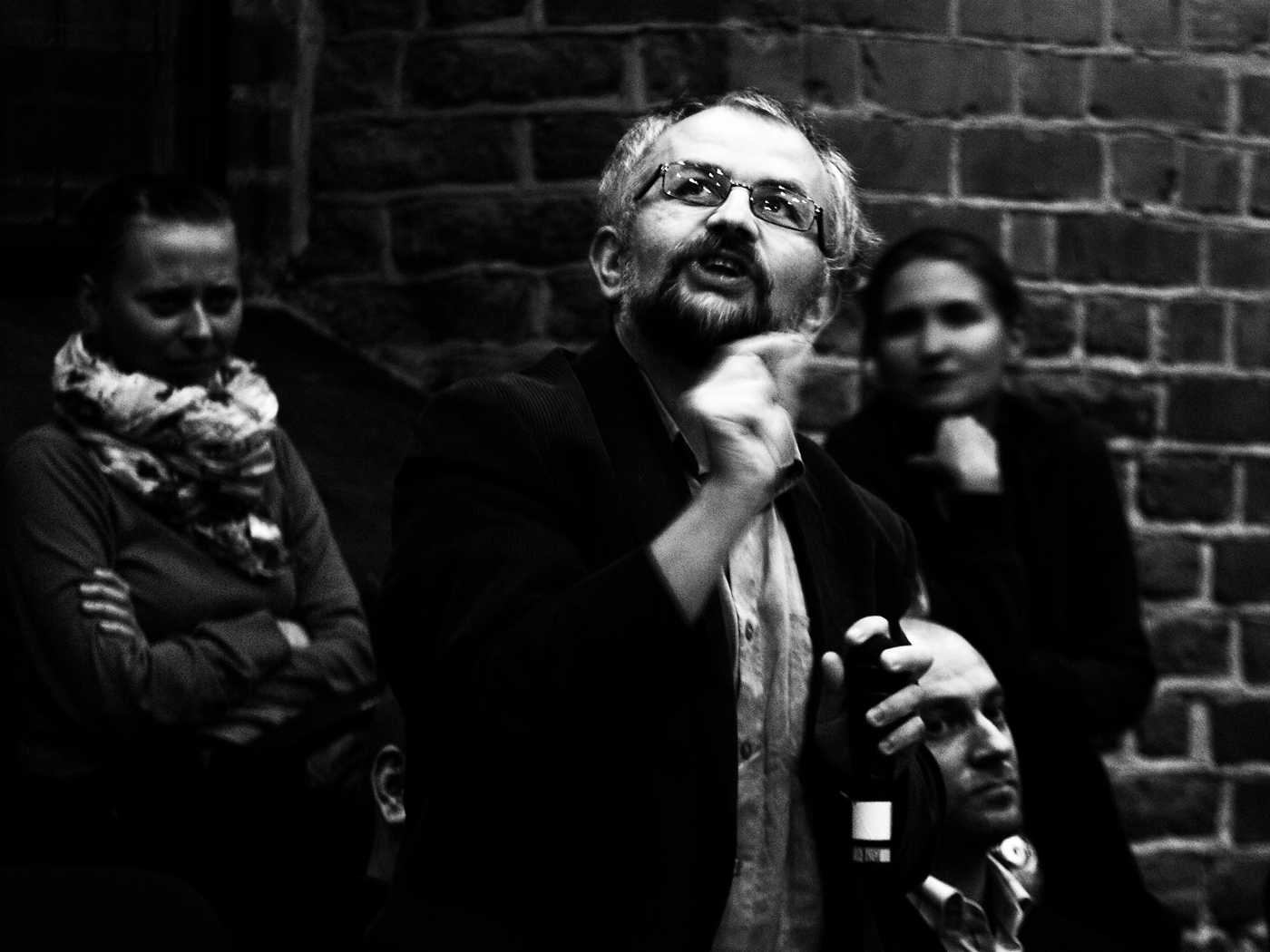
I’ll introduce him through a bit of information that he sent me recently. He shared with me this 3-min film, which briefly shows the police’s violence at the Economic University in Poznan, PL. The police attacked a small group of people peacefully protesting against a pseudo-‘scientific’ lecture (“gender as a destruction of the human and the family”) delivered by a priest (& lecturer from theology dept at Adam Mickiewicz University).

The event took place on 5th Dec. Unfortunately, Andrzej couldn’t find any news in English.

Andrzej is falsely accused in Polish right wing blogs as well as a few newspaper as a hooligan; someone who was main provocateur of this event. Just the right sort of company for us on the blog!

WELCOME ANDRZEJ!

*And the photo above was taken at the event by one of Andrzej’s friends.

P.s., when I first asked Andrzej to join the blog he wrote back: “I don’t have time to make science when I really did STS and State exercise (batons, shield, electroshocks)” (!)

Happy Holidays! See you all next year

This has been an interesting year for all of us at installingorder.org. We had a number of good topics this year and we are very happy that the blog is now way more interactive than it was before. We have been a little quite over the summer, sorry for that, but we are back since 4S 2013 in San Diego which was a great conference and a fantastic meeting for all who study societies sociotechnical nerves.

Stefanie Fishel joined us, first as a guest blogger, then as full time author. Thanks for the great input, Stef! Next year will see guest bloggers again, starting with Andrzej W. Nowak from the  Adam Mickiewicz University in Poznań, Poland. (See his TedXPoznan talk on youtube, sad that I don´t speak polish). We are looking forward to that! And there will be more! Expect 2014 to be as interesting as the last.

For the rest of the year we will, as most of you will too, take a little break and rest over the holidays. Have yourself a merry Christmas, if you want to have it, or happy Hanukkah, if that is yours, or a great flying spaghetti monster gathering. However you spend your days, think about Santa´s little elves at Amazon, FedEx or DHL and about the massive infrastructural work necessary to let you have some Eggnog, Chestnuts or that box of Breaking Bad episodes that you need for the upcoming festivities. See you all next year!

Jeremy Crampton on my ‘the political is always technical’ comment

Is “the political always technical” or is “the technical always political”? An interesting interpretation of discussions we’ve had here: https://installingorder.org/2013/12/18/infrastructure-is-politics-by-other-means/

stuartelden's avatarProgressive Geographies

Jeremy Crampton has responded in a very interesting way to my comment that ‘the political is always technical’. I made that comment in my remarks to the ArcticNet conference last week – a summary and the audio recording are here. Here’s the key paragraph he is responding to:

One of the previous presenters had made the claim that there was nothing political about some of the techniques. While I made the comment that we could say that there is always a politics to the technical, I was most interested in turning his claim around, rather than disagreeing with it: suggesting that the political is always technical. I’ve made this claim before in relation to territory as a political technology, as dependent on all sorts of techniques for measuring land and controlling terrain.

Jeremy’s post is interesting on several levels. The first is that he sees this response as a…

View original post 413 more words

Call for Papers – Spontaneous Generations

32 - Pasteur

Call for Papers – *Spontaneous Generations: A Journal for the History and Philosophy of Science*
http://spontaneousgenerations.library.utoronto.ca

Submissions for the eighth issue should be sent no later than *March 14, 2014. *

**Science and Social Inequality:*Science and technology reflect and perpetuate social inequalities, but also serve as crucial sites of contestation, intervention, and hope. Over the past several decades scholars, particularly those engaged with feminist and critical theories, have questioned the ways in which inequalities among the producers of knowledge affect the kinds of knowledge produced. At the same time, investigations into the social engagement with science have pointed to the ways in which science can, and has, benefitted from the inclusion of marginalized groups. This focused discussion aims to encourage scholars in the history and philosophy of science or science and technology studies to consider inequalities within scientific practice, professions, and knowledge production. We will feature work that explores the causes and
consequences of—or resistances to—these inequalities and how they shape the experiences and knowledge claims of historically marginalized individuals.
We seek scholarship that pushes STS and HPS to re-engage with questions surrounding science as a professional “field” and, in particular, as one that has been—and remains—stratified in practice by inequalities of race, gender, and social class.

We welcome research that interrogates the various and intersecting forms of inequality, and resistance to inequalities, that shape power structures in science and technology at any time or place. We seek research comparing various areas of scientific practice. Submissions can focus on a variety of institutional and national contexts, can use both historical and contemporary cases, and can draw on a variety of critical and methodological perspectives. The questions below may help guide potential submissions:

1. What perspectives on inequalities within scientific practice
can we draw from critical theories, such as feminist and critical race
theories?

2. How has diversity and inequality affected inter/multi/trans-disciplinary scientific collaboration and “Team Science”
(inclusive of academic and non-academic science teams)?

3. What has been the role of gender, race/ethnicity, and
socioeconomic status in scientific education and training across the
educational spectrum?

4. What is the normative and instrumental value of diversity in
science, given science’s orientation as “value-free,” objective, and
universal? Why is scientific diversity a good thing? Have diverse
scientific teams produced better science?

5. What has been the role of the “invisible worker” in science
and technology at different times and places? What light can historical and transnational studies shed on the changing position of the “invisible worker”?

6. How have inequalities of race/ethnicity, gender/sexuality,
class, and ability permeated the ranks of knowledge production and affected the kinds of knowledges that are produced?

7. How have science and technology been (re)configured to alter
the course of social inequalities?

The eighth issue of Spontaneous Generations will appear in September 2014.

Submissions for the eighth issue should be sent no later than *March 14, 2014. * For more details, please visit the journal homepage at
http://spontaneousgenerations.library.utoronto.ca

*Spontaneous Generations* is an open, online, peer-reviewed academic journal published by graduate students at the Institute for the History and Philosophy of Science and Technology, University of Toronto. It has published seven issues and is a well-respected journal in the history and philosophy of science and science and technology studies. We invite interested scholars to submit papers for our eighth issue.

We welcome submissions from scholars in all disciplines, including but not limited to HPS, STS, History, Philosophy, Women’s Studies, Sociology, Anthropology, and Religious Studies. Papers examining any time period are welcome.

The journal consists of four sections:

– A focused discussion section consisting of short peer-reviewed and
invited articles devoted to a particular theme. The theme for our eighth issue is “Science and Social Inequality”* (see a brief description
below).
Recommended length for submissions: 1000-3000 words.
– A peer-reviewed section of research papers on various topics in the field of HPS. Recommended length for submissions: 5000-8000 words.
– A book review section for books published in the last 5 years.
Recommended length for submissions: up to 1000 words.
– An opinions section that may include a commentary on or a response to current concerns, trends, and issues in HPS. Recommended length for submissions: up to 500 words.

Teaching STS: Teaching that time does not exist

istockphoto_3153865-stop-watch-scaled500

Times does not exist. At least, we think time does not exist.

According to Ferenc Krausz at the Max Planck Institute of Quantum Optics in Garching, Germany, time is unlikely real.

Efforts to understand time below the Planck scale have led to an exceedingly strange juncture in physics. The problem, in brief, is that time may not exist at the most fundamental level of physical reality.

Check out the original Discovery reading here. It is an easy read and would do well if presented students in-class to read on-the-spot and then immediately discuss it. It has worked well for me to get at issues of “reality” in a surprisingly concrete way. Admittedly, this might seem like a no-brainer for long-time friends of social constructivism. Still, time is generally a great concept for an STS class, especially issues of “standards” and so on. We’ve discussed it once before on the blog here.

One of the comments is particularly nice for students to chew on:

This article was written in 2007, and I am responding to it and commenting on it in 2013. Why? Because “time” doesnt exist.

Also, of interest: notice that you have to raise time as real to tear it down as not real, signifying the significance of real-time for understanding the un-realness of time.

Infrastructure is politics by other means

Capture

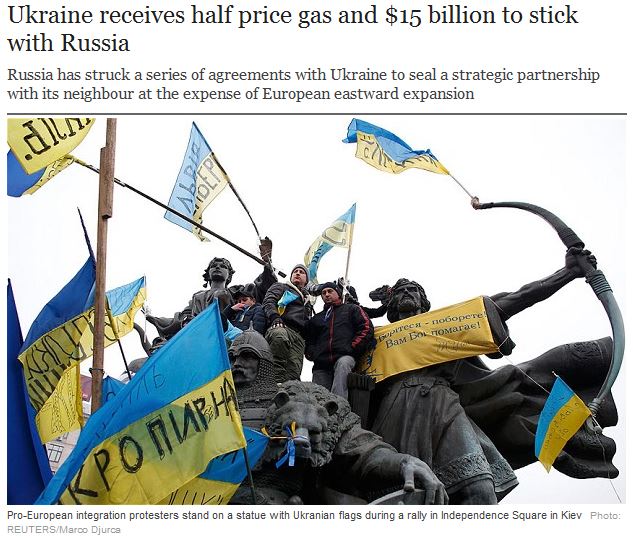
Spent the morning reading Petrostate by Marshall Goldman, and look what I find in my news feed: “Ukraine receives half price gas and $15 billion to stick with Russia.” Reminds us all that infrastructure (and control over infrastructure) is politics by other means. As Goldman mentions in the book (I’m paraphrasing): Who wants/needs nuclear weapons, when there is no mutually-assured destruction to curb the use of petroleum and natural gas!?

Stef wrote something about this recently too, but not about pipelines. Along these lines, I’m in the middle of reviewing Andrew Barry’s new book (about pipeline infrastructure and politics from a geography angle) for Science Technology ans Society (the EASST journal).

American cover-up of Icelandic revolution?

Capture

According to Rebecca Savastio of Liberty Voice, there is good reason to believe that American news sources are purposefully not covering the political transformations of Iceland over the last five or so years:

Socialist and Marxist blogs here in the U.S. say that there’s been a massive U.S. news conspiracy and cover up about the revolution in Iceland because the U.S. media is controlled by corporations, including banks, and the “powers that be” don’t want U.S. citizens getting any ideas to stage a revolution of their own. Some conservative Icelandic bloggers claim that while there was, indeed, a revolution, it did not lead to a successful or widely accepted new constitution. They say the situation in Iceland is worse than ever, and that international news reports of an effective democratic uprising leading to a better government are simply myths. Social media commenters are scratching their heads over why they were robbed of the story of Iceland’s pots and pans revolution.

There is also a video (in the pic above) documenting this “pots and pans” revolution that is available here, which is quite good.

Andrzej W. Nowak on “Ontological Imagination”

zylo_9272314

Our colleague and friend Andrzej W. Nowak (see him on academia.edu) from Adam Mickiewicz University (Uniwersytet im. Adama Mickiewicza w Poznaniu) in Poznań, Poland, just put a new paper on-line and it deserves some attention.

His new paper “Ontological imagination: Transcending methodological solipsism and the promise of interdisciplinary studies” is available free here. This let’s the cat out of the bag, so to say, but here goes:

To conclude, without phronetic politics, ontological analyses are only an esoteric game, whereas politics and critical reflection are blind without a posthumanist, historical ontology.

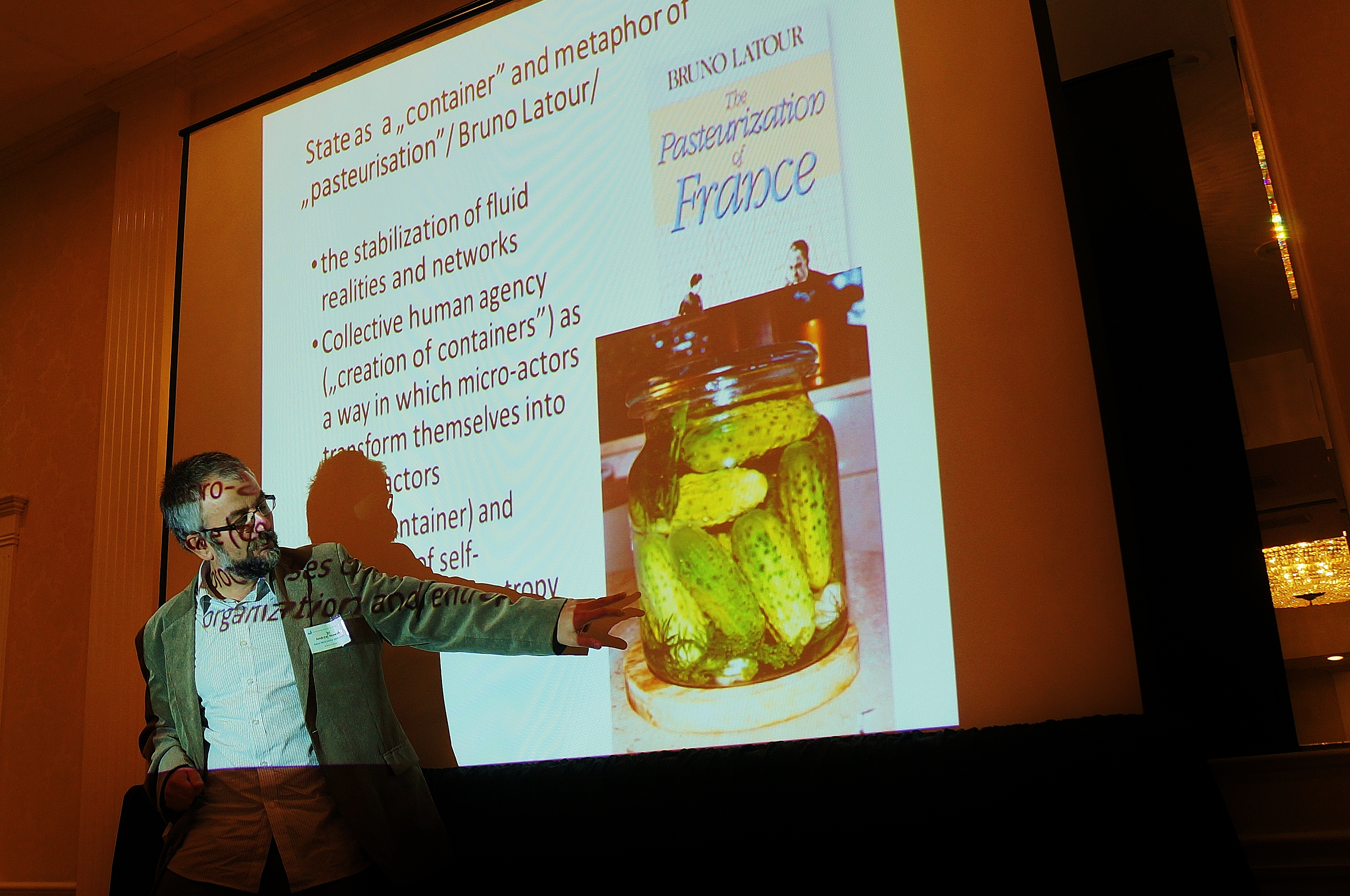
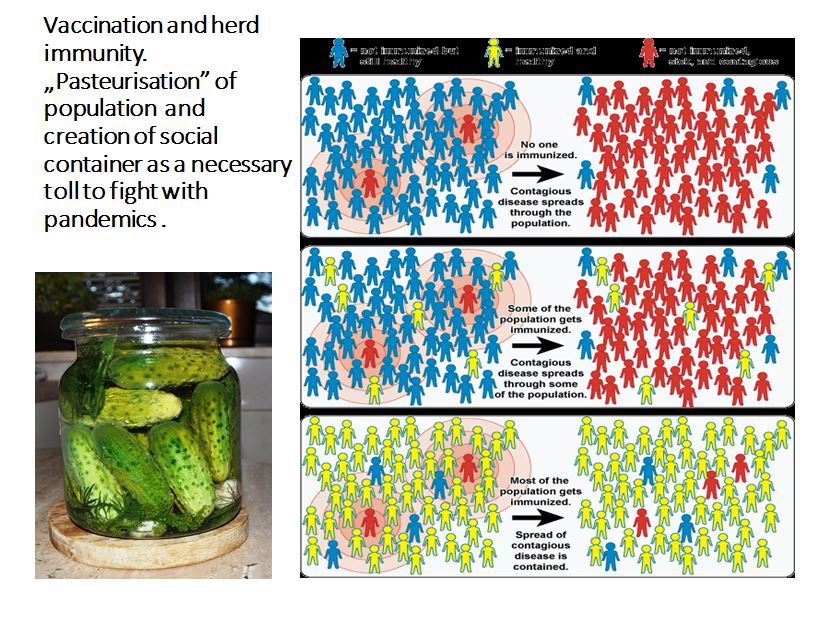
Nice, no? If you don’t know Nowak or his work, we have mentioned him on the blog before with regard to our annual 4S meetings. This year, his talk at 4S with the long title “The fragile life of the state and its ambivalence: from the vaccination commando to the anti-vaccination movement. Merging Actor-Network Theory with World-system Analysis” was outstanding. At one point, the crowd was audibly gasping when Nowak discussed the state as akin to a jar of pickles — see the original slide below and then a follow-up slide where he makes the claim (in person) even more forcibly:

Capture

DSC07030 - Copy

At any rate, I will post about presentation as part of a series starting in the new year. So, his new paper. Here is his provocative abstract:

This text is a presentation of the notion of ontological imagination. It constitutes an attempt to merge two traditions: critical sociology and science and technology studies – STS (together with the Actor-Network Theory – ANT). By contrasting these two intellectual traditions, I attempt to bring together: a humanist ethical-political sensitivity and a posthumanist ontological insight. My starting point is the premise that contemporary world needs new social ontology and new critical theory based on it in order to overcome the unconsciously adapted, “slice-based” modernist vision of social ontology. I am convinced that we need new ontological frameworks of the social combined with a research disposition which I refer to as ontological imagination.

Andrzej wants nothing more than to slam together, with so much rhetorical force that they fuse, the likes of C. Wright Mills and Bruno ANT Latour. Do accomplish this, he follows the lead of Flyvberg, stating:

My starting assumption is that one of the problems plaguing the contemporary humanities and social sciences is their isolation from social problems (Flyvbjerg 2001: 166). … Today we know that these fictively-traced boundaries of modernity
cannot be upheld (cf. Beck 1992, Feenberg 2010: 181). The ozone hole, anti-vaccination movements, energy security, terrorism and religious revival do not fit simple modernist frames (cf. Latour 2011).

It initially reminded me of Latour’s Politics of Nature (which I reviewed), but as I read on, I am not so sure. In fact, I am now thinking that perhaps Nowak got it better than Latour did.  In the end, Nowak’s “ontological imagination” amounts to this:

The notion of ontological imagination is conceived as multi-faceted, and if one follows Mills and draws and analogy to sociological imagination, at least three main aspects thereof can be listed: methodological, sociological-historical, and moral-political. Let us characterise each of them. The methodological aspect of ontological imagination is, above all, the abandonment of the ideal of science as theory and letting go of the illusions related to humanistic fundamentalism (Abriszewski 2010: 143-157). Using ontological imagination requires noticing the complex network of actors that construct our collective, in accordance with the principle of symmetry, raised by Bruno Latour (Latour 2011). The second aspect consists in the response to the challenge posed by the so-called reflexive modernity and to the fears evoked by technoscience (Nowak 2012). It is the hope that disseminating such sensitivity and cognitive disposition will help to empower groups and individuals in the world of technoscience.

Check out the conclusion for the real push: to be ontologically imaginative will also require us to engage real social problems and perhaps engage in the social change we supposedly only study…

To be, for a moment, critical: The term “ontological imagination” (though sociological in form and function in Andrzej’s use) is not an original term; in fact, this idea has been used elsewhere, for example, in literature, on blogs, in books, and even lectures, often featuring pragmatist thinker William James who, it seems, is not featured in Nowak’s work.

New Journal coming: Big Data & Society

Our friend Evelyn Ruppert at Goldsmiths is editor and founding editor of a new open access peer reviewed journal that is in the making. We have met Evelyn the last time at 4S in San Diego where she contributed to our “State Multiplicity, Performativity and Materiality: Current STS Research on State and Stateness” sessions with a great talk on “Peopling Europe”. She is also known to many for her co-lead on the Social Life of Methods theme at CRESC.

Big Data & Society (BD&S) is an open access peer-reviewed scholarly journal that publishes interdisciplinary work principally in the social sciences, humanities and computing and their intersections with the arts and natural sciences about the implications of Big Data for societies.


The Journal´s key purpose is to provide a space for connecting debates about the emerging field of Big Data practices and how they are reconfiguring academic, social, industry, business and government relations, expertise, methods, concepts and knowledge.


BD&S moves beyond usual notions of Big Data and treats it as an emerging field of practices that is not defined by but generative of (sometimes) novel data qualities such as high volume and granularity and complex analytics such as data linking and mining. It thus attends to digital content generated through online and offline practices in social, commercial, scientific, and government domains. This includes, for instance, content generated on the Internet through social media and search engines but also that which is generated in closed networks (commercial or government transactions) and open networks such as digital archives, open government and crowdsourced data.  Critically, rather than settling on a definition the Journal makes this an object of interdisciplinary inquiries and debates explored through studies of a variety of topics and themes.


BD&S seeks contributions that analyse Big Data practices and/or involve empirical engagements and experiments with innovative methods while also reflecting on the consequences for how societies are represented (epistemologies), realised (ontologies) and governed (politics).

viaBig Data & Society: About the Journal.

Technology is politics by other means

Technology—our use of and reliance on it—is a fraught topic in the modern world. Perhaps it is appropriate to begin this blog by noting that I sat down to make preliminary thoughts at the table with a pen and paper. I took these notes and keyed them into my word processing program later.  I skipped the typewriter, but I think Heidegger’s concern about “proper writing” and technology is still worthwhile to reflect upon. Does my keying these words into my laptop separate me from myself, from my ideas in a dangerous way—in a way that is different from the technology of the pencil or pen? To add to this, I chatted with a friend on Facetime about the topic and will later post a link to this blog on Facebook. Maybe someone will tweet this blog. The technology behind this blog on technology….

More seriously, how do these electronically mediated encounters affect my relation with the world? Broadly, we can ask how do the mediums (pencils, laptops, internet) affect our writing and creativity, and even more importantly, how do different technologies enable particular ways of understanding the world and acting in it?  While I very much believe that the pencil can be as fascist as the Mac, and that the pen is a tool like a mouse is a tool, the larger question regarding technology remains unanswerable at this time. These technological changes in communicating information over the last two centuries, showed above by the switch from pen to word processing, may be just a difference in degree. On the other hand, especially with the ongoing work on AI; robotics; chatbots; the Internet of Things; and iBeacon and Bluetooth LE, they may be a difference in kind. Will the singularity, or advanced information technologies, allow us to “transcend our biological limitations,” as Kurzweil contends?

Even without the possibility of uploading our consciousness into a server, many are concerned with the effects of technology on our personal relationships.  Multiple studies are undertaken to understand how digital closeness may in fact make us more distant from our family and friends. How many Facebook friends are counterproductive to relationships made and nurtured in IRL? Do online dating site algorithms know you better than yourself? What is it about the cold intimacy of the online space that generates such love stories—both torrid and commonplace?  Big data may change many things, including dating.

This doesn’t begin to address the relationship between particular institutions and technology. Every semester, I teach freshman about technology and violence. We cover the ongoing Revolution in Military Affairs, and more broadly, how technology is impacting how people fight and die in modern warfare.  Surveillance and weaponized drones stand to change the face of war in the 21st century. Robots are increasingly used in conflict situations: IED detection units and so-called battlefield “killer robots” that take humans out of the loop in the future making autonomous decisions on targeting, to name but two.

DARPA has spent millions researching and developing micro air vehicles like the RoboBee.  Spend some time on the DARPA site, look at Global Defense Technology publications, or peruse the archives of Wired Magazine’s Danger Room for countless more examples. Fiction becomes reality with exoskeletons reminiscent of Ironman:

and “smart weapons,” like the self-aiming rifle, that turn “novices into experts.”

A side note that is worth mentioning concerns Amazon.com’s stunt with drone delivery systems unveiled this Cyber Monday: drones or not, Amazon will likely control the entire infrastructure of package delivery in the future. Amazon Fresh, their next day grocery delivery service, will deliver all the goods with trucks (or perhaps drones in the future) owned by Amazon.  They’ve already cut a deal with USPS to deliver packages on Sunday.

While these advances in technology bring up a host of ethical questions that often cannot be addressed with our current legal frameworks and institutions, this military technology goes hand in hand with increased executive power, increased lobbying power of defense contractors like Lockheed-Martin or Boeing, and increasingly militarized domestic policing techniques. In the US, drone strikes are decided by executive order with no oversight from democratically accountable committees or military command. New executive power in the National Defense Authorization Act of 2012 (among other provisions, it allows for indefinite detention of US citizens without trial and was signed into law by President Obama in December 2012), and an older increase in executive power through the War Powers Resolution of 1973, or the War Powers Act (allows the president to commit armed forces without a declaration of war or Congressional approval for 60 days). Also worth noting is the US military’s Joint Vision 2020, a document outlining the combined vision of the various military branches, especially focused on “full spectrum dominance” of all threats, both military and natural. A main focus of this document is Information Technology and robotics used to clear the “fog of war.”

There is also the disturbing general trend toward the militarization of the police in the US.  Counterinsurgency techniques are adopted in urban areas, and some programs—like Massachusetts’s C3, or Counter Criminal Continuum, policing—explicitly draw on counterinsurgency techniques. Based on the Avghani Model, born from US experiences in Vietnam and Iraq, it adapts COIN and Green Beret techniques to target gangs and drug dealers in high crimes areas. The website explains, “This is accomplished by, with, and through the local population. C3 Policing creates multiple pressure points on criminal elements and establishes a robust intelligence cycle that drives law enforcement operations. As a result of these efforts, violent gangs and drug dealers are denied operational freedom to maneuver and one by one their networks are attacked systematically.” Along with the disturbing trend toward counterinsurgency techniques used on US soil there is a concomitant attack on civil liberties that intensified with the PATRIOT Act after 9/11. This militarization of police and the concentration of power to suppress the constitutionally protected right to assemble were well demonstrated by the coordinated attacks that forcibly suppressed the Occupy movement in multiple states by the police and the FBI. Last year, Naomi Wolf, writing in the Guardian, told of the findings of The Partnership For Civil Justice Fund.  The FBI, the Department of Homeland Security, local police, and local mayors combined efforts to break up Occupy camps across the US. Not only were the attacks on Occupy camps coordinated, they often used illegal crowd control technologies like the LRAD Sound Cannon (and here), tasers, flash bombs, wooden dowels and stingball grenades.

Technology and civil liberties are definitely an area that needs more attention.  As of late, another chapter has been added.  In part through information provided by whistleblower Edward Snowden, the NSA was found to be surveilling and gathering copious amounts of information on “terrorists” while “accidentally” saving emails, phone conversations, etc from the average American internet and phone user.  Apple, Google, Microsoft, Facebook, Yahoo, LinkedIn, Twitter and AOL have recently decried this bulk collection of data in an open letter to President Obama. As reported byThe Guardian, the big 8 will back radical reforms to protect individual freedoms over increased state power.  Of course, much of the motivation behind this letter includes the fact that consumers will not purchase what they do not trust and that the NSA surveillance has “shaken the trust of our users,” according to Yahoo CEO, Mayer. In this letter, the above companies put forward five principles that should be put into action.  Governments should limit their authority to collect data, have oversight committees when collecting or compelling data, support self transparency, respect the free flow of information, and improve frameworks to avoid conflict among governments through mutual legal assistance treaties (MLATS).

But keep in mind, these are the same companies (and corporations like them) that are behind the Trans-Pacific Partnership free trade negotiations, or TPP.  While wanting the government and state power limited, corporations are quite happy to support radical new political powers granted, in secret, non-transparent, democratically unaccountable meetings, to corporations. Details of the TPP, recently made public by Wikileaks, reveal it to be the largest economic treaty ever negotiated, and it will eventually cover 60% of the world’s GDP.  According to Wikileaks, the treaty negotiations have been so secret that even US Congress members have been unable to view most of the treaty while 600 “trade advisors” from corporations like Chevron, Haliburton, and Walmart, and Monsanto have been privy to most of the text of the treaty. In this treaty, supranational litigation tribunals will replace sovereign courts in enforcing far-reaching laws covering prescription drugs, intellectual property, patents, copyrights, and trademarks. Further, hearings can be conducted with secret evidence.

At first glance, this increase in corporate power and executive power may seem coincidental, but there is a resonance that bears further investigation.  In the US, the entanglement of corporate money and politics (dark money) and the legal status of corporations through Citizens United have been a hotly debated topic, as well as foremost in the concerns of the Occupy movement. Remember, the full title of this resistance was Occupy Wall Street and the first camp was in Zuccotti Park, only blocks from Wall Street itself, and and an emphasis of Occupy DC. It is also not coincidental that additional support for the suppression of Occupy came through “private sector activity”:  namely, the Federal Reserve, “Bank Security Groups,” and a “Bank Fraud Working Group.” As Naomi Wolf points out, this merger of the private sector, DHS, and the FBI puts tracking dissent into the hands of the banks.  This could have disastrous results for freedom of expression for the average individual.

To conclude, I want to return to how technology relates to politics in the context of this short investigation. For the undergrads in my class, I always pair excerpts from Clausewitz’s On War with Foucault’s lectures Society Must Defended to show the intimate relation of politics and war. Foucault inverts Clausewitz’s famous dictum “War is the continuation of politics by other means” to “Politics is the continuation of war by other means.”  In this inversion we can see the institutionalization of violence into society and culture. War never ends with the peace agreement; it is subsumed into state politics. Technology is often offered as a solution to problems we see around us. Wars will be easier to fight with “smart bombs,” but what about when these smart weapons continue to kill civilians, as was the case in both the Iraq wars? It will likely become apparent to those affected by these bombs that the launchers might be aiming for them, or perhaps even more likely, that the victims matter little to those aiming the bombs. What if, as Peter W. Singer asks, a robot malfunctions and kills civilians? Is this a programming error or a war crime? Robotic and smart technology do not answer the ethical and moral problems of civilian death–in fact, it defers it to a supposedly neutral realm devoid of careful reflection on the limits of that technology.  This is technological solutionism at its most frightening. This isn’t just about the irony saving the world with a click on your smartphone built with REEs causing that bloody conflict you just watched a video about, but rather the obfuscation of multiple levels of undemocratic processes, corporate and government corruption, and unethical, immoral, and deadly political practices. Technology is not neutral, nor is always able to offer solutions to the complex world we live in.