Disaster art?

DSC07403

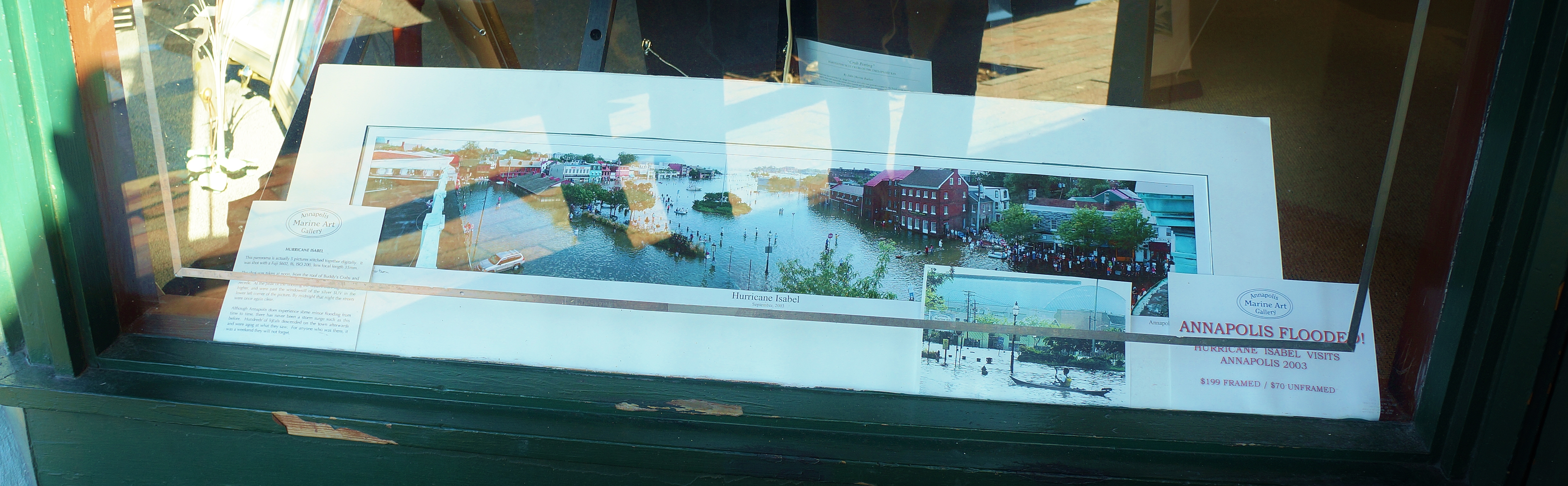
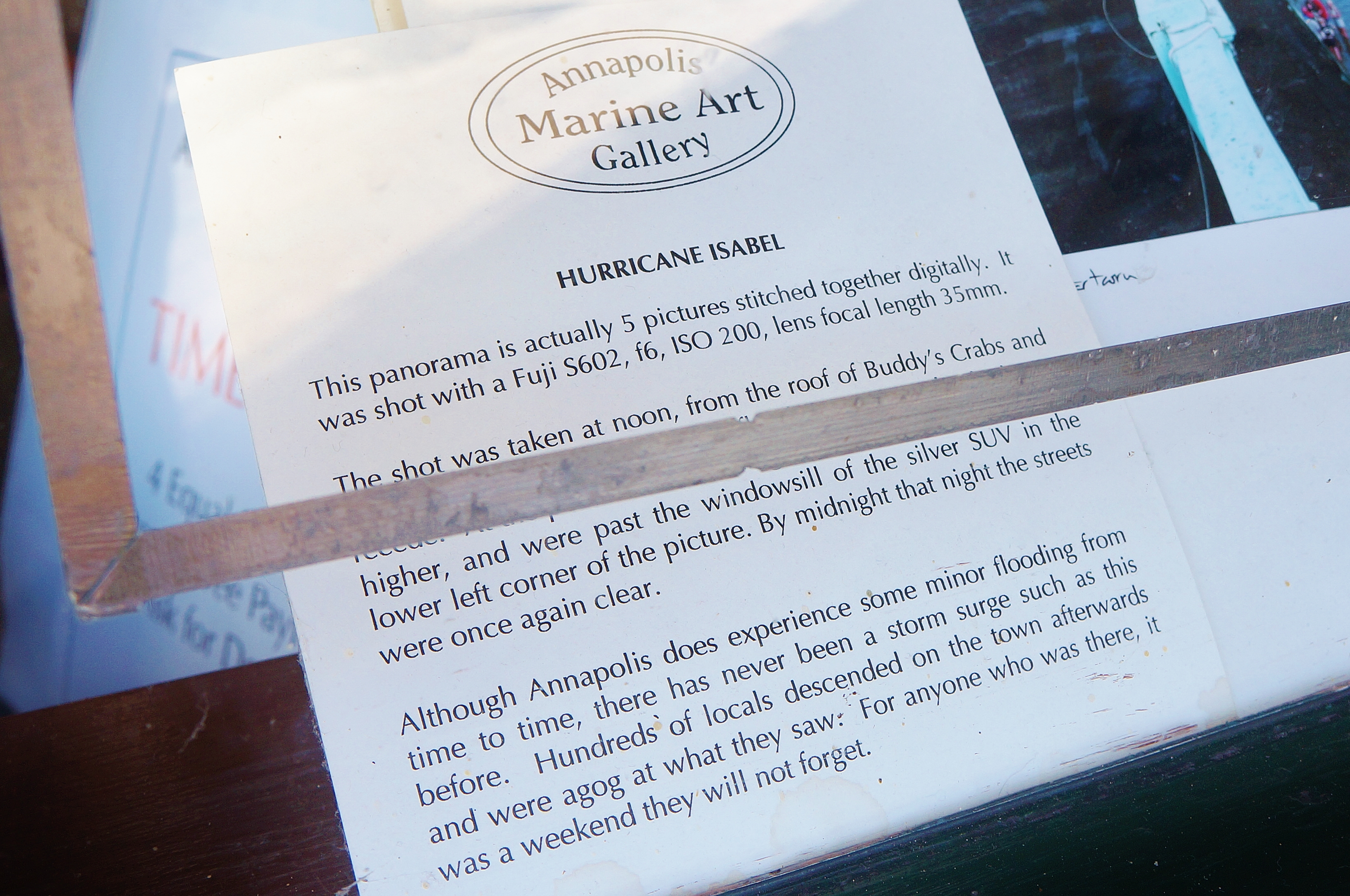
I was in Anapolis, MD, last weekend and saw something that I thought was a bit odd (above): disaster art. At first, I was stunned; how could a place celebrate (but potentially profit) from local disasters? How would that appeal to tourists? In this case, of course, its an image of flooding after a hurricane where the infrastructure of the harbor is damaged and, in may cases, submerged.

DSC07402

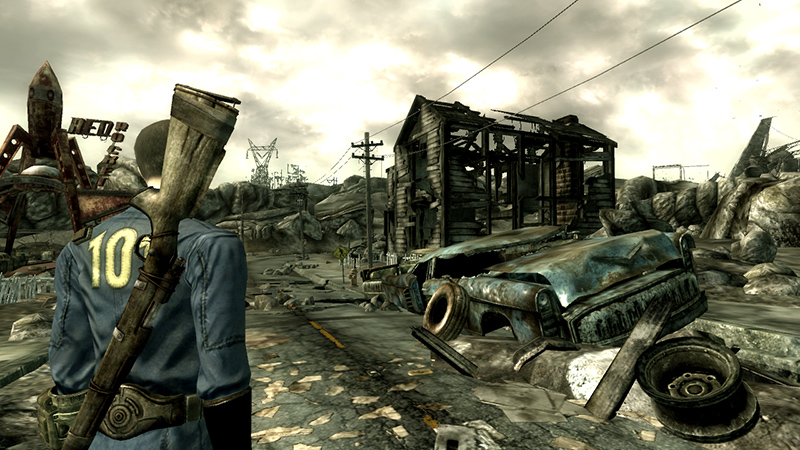
“Why would folks want pictures of broken infrastructure?” I thought. And that’s when my art history training came in and I had a “duh” moment. Disaster art — fictional and non-fictional — has been common for centuries. See, for example, this blog post about sunken ships or this one featuring a number of examples of fictional disaster art.This pintrest board sums it up nicely, saying disaster begets creativity, and includes a number of other obvious pieces of this puzzle like disaster memorials and post-disaster reassembly work like art from tsunami rubble in Japan. I’d also be remiss not to include the massive amount of disaster art in video games, for example, post-apocalyptic games like the Fallout (below), Gears of War, or Halo series.

Capture

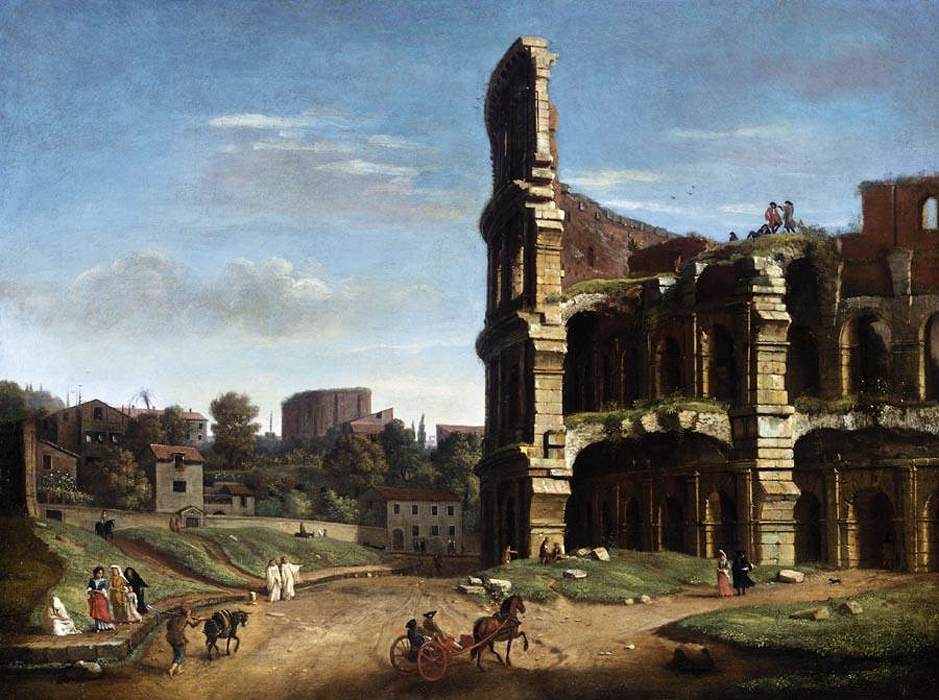
Still, people’s love for depicting ruins is far older than all that. I’m thinking, in particular, of the many depictions — often with a romantic feel — of derelict Greek temples or statues like this image (contemporary, lame, background wallpaper) or this painting of the Colosseum (from the second half of 17th century).

Capture

Seems we love our ruins, after all.


Using search engines to teach reading

Capture

Interesting development in Alabama:

HUNTSVILLE, Ala. (Feb. 27, 2014) – An Internet search engine developed specifically for schools by two University of Alabama in Huntsville professors is being tested as a way to increase reading abilities in challenged students and help motivate intellectual development in gifted students, while saving schools money on textbooks.

Check out the full story here.

The long shot heard round the world

Capture

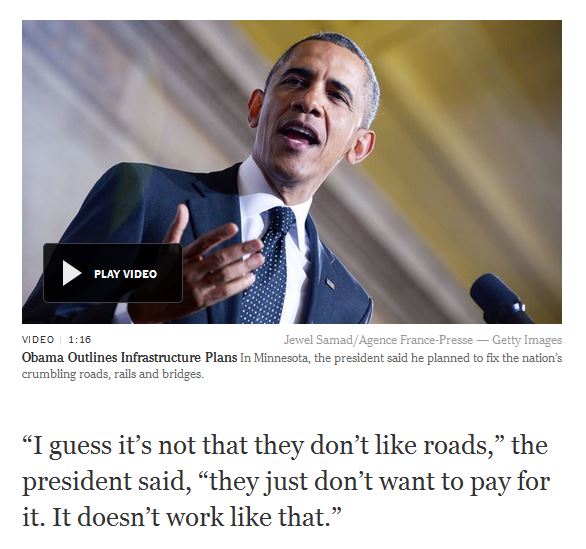
Well, not exactly around the world. President Obama asks for a tax increase on gasoline to improve American infrastructure … only, it is not a gas tax, it is just another corporate tax, according to a NYT report. Obama appears to be using commonsense; if you like to use roads, then we need to pay to upkeep them … only that is what scares me because commonsense on the hill seems to have left the building a decade (or more) ago.

Crowdsourcing light pollution data: A means of infrastructure awareness?

Crowdsourcing infrastructure data/awareness?

Max Liboiron's avatarDiscard Studies

The Globe at Night project  is an international citizen-science campaign to measure the impact of light pollution. It invites citizen-scientists (aka: you) to measure their night sky brightness and  submit their observations  from a computer or smart phone. Light pollution is often left out of discussions about waste and discards, possibly because of its un-material, non-toxic status. Yet, if waste is broadly defined as the externalities of social-technical systems, then light that exceeds its use or that effects areas outside of designed intentions certainly qualifies as waste. Light pollution is usually defined as “excessive, misdirected, or obtrusive artificial” (usually outdoor) light. Too much light pollution has consequences: it washes out starlight in the night sky, interferes with astronomical research, disrupts ecosystems )particularly nocturnal animals), has adverse health effects (particularly circadian rhythms) and wastes energy. There is even something called “ light trespass ,” where light shone onto a property prevents the owner from…

View original post 625 more words

The Anthropocene, Cabinet of Curiosities Slam, Nov. 8-10, 2014, Call for Submissions

FYI–great looking conference coming up! It seems that NIck and I return to this cabinet of curiosities quite often…

The Anthropocene, Cabinet of Curiosities Slam

Nov. 8-10, 2014 University of Wisconsin, Madison

Call for Submissions

We are in the midst of a great reawakening to questions of time—across the
spans of geological, ecological, evolutionary, and human history.  It is a
reawakening precipitated, not by a nostalgia for the past, but by a sense
of urgency about the future.  The Anthropocene, coined in 2000 by
ecologist Eugene Stoermer and popularized by Nobel Prize-winning
atmospheric chemist, Paul Crutzen, is one of the most resonant examples of
how the urgency of the future has prompted scientists, artists, humanities
scholars, and social scientists to engage creatively with the emerging
legacy of our geomorphic and biomorphic powers. The advent of this new
scientific object—the Anthropocene—is altering how we conceptualize,
imagine, and inhabit time.  The Anthropocene encourages us to reenvisage
(in Nigel Clark’s phrase) future and past relations between “earthly
volatility and bodily vulnerability.”  What images and stories can we
create that speak with conceptual richness and emotional energy to our
rapidly changing visions of future possibilities?  For in a world deluged
with data, arresting stories and images matter immeasurably, and play a
critical role in the making of environmental publics and in shaping
environmental policy.

The Anthropocene is just one among many moments in time when new
scientific objects have altered humanity’s relationship to the past,
present, and future.  The coming-into-being of scientific objects such as
fossils, radioactivity, genetic mutations, toxic pesticides, and ice
cores, to name a few, have precipitated different narratives and
imaginings of the human past and the human future.  What might a cabinet
of curiosities for the age of the Anthropocene look like?  What objects
might jolt us into reimagining environmental time across diverse scales,
from the recent past to deep history?  How might certain kinds of objects
make visible the differential impacts—past, present, and future—that have
come to shape the relationships among human and non-human beings, living
in an era of extreme hydrocarbon extraction, extreme weather events, and
extreme economic disparity?

The Nelson Institute’s Center for Culture, History, and Environment (CHE)
and the Center for German and European Studies (CGES) at the University of
Wisconsin-Madison are pleased to be partnering with the Rachel Carson
Center for Environment and Society (RCC) in Munich and the KTH
Environmental Humanities Laboratory (EHL) in Stockholm to host an
international workshop that invites artists and writers, scientists and
humanists, scholars and activists, to participate in “The Anthropocene,
Cabinet of Curiosities Slam.”  The workshop will take place in Madison,
Wisconsin from Nov. 8-10, 2014.  In the spirit of poetry/spoken word
slams, contributors will be asked to pitch in a public fishbowl setting an
object for the Anthropocene that asks us to rethink humanity’s
relationship to time, place, and the agency of things that shape planetary
change.  How is the appearance and impact of homo sapiens as a geomorphic
force registered in the sediments of history, the objects around us, and
the things yet to be?  What emotionally layered Anthropocene objects can
surprise, disturb, startle, or delight us into new ways of thinking and
feeling?  What objects speak to resilience or adaptation, to vanishing
biota or emerging morphologies?  Based on the audience response at the
slam, contributors will be invited to participate in the design of an
Anthropocene cabinet of curiosities as part of a larger exhibit on the
Anthropocene being planned by the Deutsches Museum in Munich.
Presentations will also form the basis of a collected series of short
essays to be published as part of the CHE, RCC, EHL collaborative project
on Environmental Futures.

To apply, please submit a 200-word abstract of your proposed object and
its importance in opening up questions of time, agency, and/or
intergenerational equity in the Anthropocene, along with a visual
rendering of the object.  Please also include a CV or artist profile.
Materials should be submitted to Garrett Dash Nelson, ggnelson@wisc.edu
by Friday, April 11th.  A limited amount of funding is available to cover
the travel costs of participants.

For more information, please visit
http://che.nelson.wisc.edu/activities/environmentalfutures/

And another thing…

In case you missed it—and you might have if you aren’t in US academia—Nicholas Kristof wrote a NYT blog about the alleged disengagement of America’s professors, especially those in Political Science and International Relations.  Since then, there have been multiple replies and responses to his opinion about the state of the professoriate in the US. I wasn’t going to respond until I read Kristoff’s reply to the replies and realized this dialogue should continue. In the spirit of his call to action, as Claire Potter wrote in her letter to Kristof, I will add my two cents from the frontline in the brave new world of neoliberal postsecondary education.  I have blogged on many of the issues before so I won’t rehash what I’ve gone on record saying previously or spend too much time on what others have written already.

To sum up, Kristof writes in “Dear Professors, We Need You” that most professors are smart, but are irrelevant, arcane, willfully unintelligible, and disdainful of  non-academic audiences. In short, we hide behind our walls when we could be doing SO MUCH MORE.

To begin, I want to say, “I hear you, man.” I appreciate your sincerity and belief in the academic’s role in society.  You are right in your concern that there is a recurring sentiment of anti-intellectual feelings in politics.  Progressive intellectuals should be more active, yes. You are right that jargon sucks and willfully obscuring ideas through pretentious language is counter-productive.

But let me add to the story here. Accessibility of university research to the “average” American is not just blocked by vagueness, jargon, and an increasingly quantitative focus (by this I assume you mean a continued support of positivist approaches), but also by mega publishing companies that firewall and charge exorbitant amounts of money for the regular reader to access our work. Often this is research funded by public money and yet is inaccessible to the public through no fault of the professor. The publishing companies are profiting from the charges, not the authors and, to add insult to injury, we are required to publish in these journals by this “publish or perish tenure process” you call out. Or, in my case, I publish to even have a shot at permanent employment. I am part of a group–Occupy IR Theory–that is fighting this constriction of our scholarly output.  We want our word to be accessed by wider audiences and to have debates in the public sphere, but we are blocked by for profit publishing companies who own our work.  We are forced to “sell” our work to keep our jobs or get jobs in academia.  To chime in with Mr. Vouten: We are right here, Mr. Kristoff.   Many academics are forging ahead with Internet publishing and alternative presses in order for our voices to be heard. While I am first to line to echo your frustration on willful jargon in Political Science, it is a piece of a larger problem that you identify solely with individual academics not pulling their weight in the public arena.

There is also the matter of punching your weight in the public arena.  You don’t acknowledge the plight of many recent PhDs.  Jobs are down by 40%, there’s no work in the private sector either, and many are in tenuous and exploited positions.  I can’t believe you haven’t read these statistics. This elephant in the room is the reality of finding and keeping employment in academia. Most young scholars are spending their time applying for food stamps, working in horrible conditions for low pay, and spending hours and hours applying for jobs that we don’t get. Doesn’t leave much room for engagement, but many of us do anyway. It’s a labor of love. Adjunct, visiting, tenure track, tenured professors all know that it is not uncommon to spend 60-80 hours a week teaching, doing service to our university, advising students, researching, and writing. We work more than full-time jobs. In some cases for those in adjunct positions, as Miya Tokumitsu writes in the Jacobin, they provide high-skilled labor for low wages because the “do what you love” ideology is so embedded in academia. Tokumitsu also stresses that this helps to explain why (and this will resonate with you, Mr. Kristof) the tenured and “proudly left leaning faculty remain oddly silent about the working conditions of their peers. Because academic research should be done out of pure love, the actual conditions of and compensation for this labor become afterthoughts.”

This leads to another conclusion: Quite frankly, some academics are better placed to engage and support public engagement than others. Perhaps you, and others who are well placed, can secure a place for others to speak? This means using your privilege and then stepping back to let those marginalized by the system have a go. In short, yes, academics often marginalize ourselves, but some of us have more help in our disenfranchisement from public intellectuality than others. Some aren’t “cloistered like monks,” but exploited like peasants, to use your metaphor.

Okay, so what is this public intellectual anyway? You write that “over all, there are, I think, fewer public intellectuals on American university campuses today than a generation ago.” This brings me to another point. Unless employed at an R-1 university, professors are also teachers. Is this not public engagement? To be honest, I spend most of my time teaching, grading, and responding to the students in my classes and not writing my jargon-y, esoteric, and specialized research.  I am also active in my community. I organize for primary and secondary education reform and organize talks and films that are open to the public.

You also assume that it is a good idea for professors to be involved in policy. This sometimes goes badly.  I am hoping to see another blog about the role of academics in justifying slavery, colonialism, and in economic departments, wanton destruction of national and international economies by spreading belief in factually incorrect and harmful ideologies like free market capitalism, austerity, and trickle-down economics. These professor/consultants earn fortunes hocking weak theory and bad public policy. This doesn’t even address the revolving door in politics.  Who is allowed to speak to policy makers? Corporations, ex-CEOs, and lobbyists, that’s who.  Maybe that problem should be debated, too. Dear Corporations, we don’t need you.

Just some food for thought.  I think any of these academics below (and there are many more listed in Corey’s response), warrant a guest blog in the NYT to address these issues with you in more depth.  What do you say? Maybe Anne-Marie Slaughter or the Brookings Institute can find some space for adjuncts who would like to be heard?

The responses have been varied and productive.  I will list some of the links here:

Nick Voeten’s reply from the Washington Post  “Dear Nicholas Kristof: We are right here.”

Corey Robin reply “Look Who Nick Kristoff’s Saving Now”

Claire Potter on the Tenure Radical “A Letter From a Public Intellectual”

Mischiefs of Faction “Nicolas Kristof still doesn’t get it”
 

Legos Shutting-Down Gender Criticism?

1779091_678509118859183_356860788_n

Girls, Blox, Bricks, and “Childhood Engineering”: We’ve written about the new craze for Goldiblox a bunch of times recently (here, here, and here), now that that young engineer from Stanford has formally “launched” the product. Legos appear to be joining the battle-cry … or they also might have started it (well, they seem to claim as much).

Here is some recent text I’ve been seeing all-over discussions about gender and, let’s say, “childhood engineering” (its a WYSK EXCLUSIVE — but seems to be difficult to load the stuff right now … not sure why). Here is the text, and above is the original picture:

“In 1981,” explains Giordano, “LEGOs were ‘Universal Building Sets’ and that’s exactly what they were…for boys and girls. Toys are supposed to foster creativity. But nowadays, it seems that a lot more toys already have messages built into them before a child even opens the pink or blue package. In 1981, LEGOs were simple and gender-neutral, and the creativity of the child produced the message. In 2014, it’s the reverse: the toy delivers a message to the child, and this message is weirdly about gender.”

Not sure if Legos has seized this little tid-bit trying to shut it down, and that explains why it is down, or perhaps the traffic to it is too high (though that seems unlikely, at best). Here is the piece, at least as I can see it from my facebook:

Capture

If you can find it, check out the commentary. You could save this and write a modest piece in STS or even have students analyze the responses in an activity about gender and engineering…


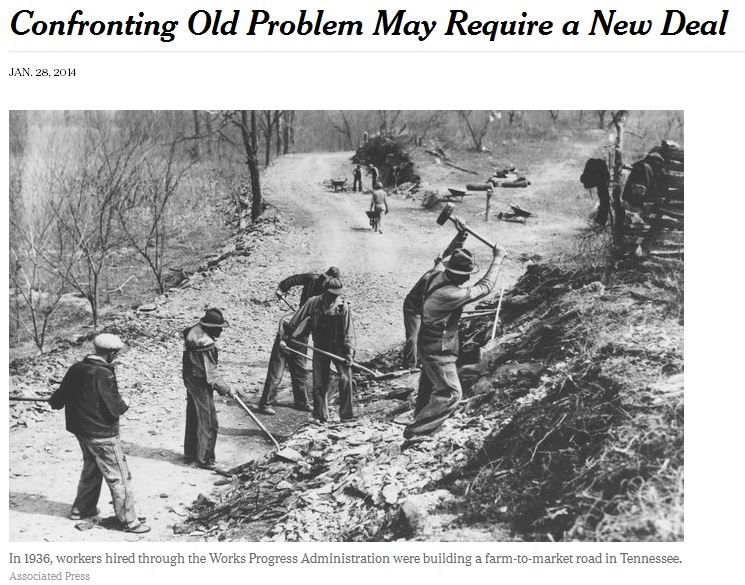
Infrastructure: The New New Deal

Capture

Following government discussion of whether or not investment in infrastructure will or will not improve the economy and boost job growth seems like a no-brainer for the STS crowd (i.e., as a rich topic for discussion); however, to the best of my knowledge, this is relatively rare to find in the pages of our journals (even if the insights we could glean may very well have helped such dire governmental circumstances).

Eduardo Porter, writer for the New York Times “Economic Scene” section, recently wrote a piece on infrastructure. The piece, “Confronting Old Problem May Require a New Deal,” provides readers with the predictable ‘public’ perspective on the relationship between employment and infrastructural development painting the all-too-familiar picture that more of the former requires more (investment) in the latter. This is hardly  new. During times of economic strife, low investment in (even crumbling infrastructure) further diminishes job growth on a grand scale (which we’ve discussed with regard to Germany, the US, and the austerity-infrastructure relationship).

Porter takes us on a tour of political and economic history, showing readers that this relationship may not be so clear-cut. For example, Keynes predicted — thanks to technological efficiencies, improvements in management, and so on — a persistent level of unemployment is inevitable. A solution is investment in infrastructure, and such discussion, Porter reports, go a ways back:

In “Freedom From Fear,” his history of the United States through the Great Depression and World War II, David Kennedy notes that fears that what Keynes called “technological unemployment” might become a permanent feature of the labor market, especially among the less skilled and the elderly, date back to the administration of President Herbert Hoover.

The inability or complete failure of the American government to produce enough consensus regarding new programming as aggressive as those of FDR’s era has lead to concerns and fear that we are on a path toward permanent employment stagnation.

However, at this moment in history, it may not be possible, even if the political will did exist, to invest in enough infrastructure to get us out of this mess. In the 1970s,  a failed job stimulus plan (similar to Obama’s failed plan) showed Americans that, and we’ll go to a Harvard specialist for this:

“It works best if you hire people that would not otherwise be hired, to do something productive that is not already being done by somebody else,” said Lawrence Katz of Harvard, formerly chief labor economist in the Clinton administration.

Katz goes on:

“Long overdue infrastructure investments would be a good place to start, coupled with funding for positions cleaning parks and the like, which could help disadvantaged workers like the long-term unemployed.”

And then Porter intercedes:

Not every unemployed worker may be qualified to build infrastructure. But many might. Today, there are 1.5 million fewer jobs in construction than there were before the financial crisis six years ago. Plenty of unemployed workers out there know how to build things.

Only, we don’t need house-builders, we need re-construction, de-construction, and renovation. Perhaps that is not so unlikely to be fulfilled; after all, the cost of borrowing money is low and the amounts of money needed for such massive projects is available, but it simply will not — no matter how many libertarians tell me so — be done if not by the government. My intuition is that large firms in the US that use such infrastructure with regularity would only step-in after it all far too late … we are getting closer by the day, after all. The last serious investment in nation-scale infrastructure might very will be during the Great Depression.


Bibliography of work on Foucault and education

Foucauldians … this one is for you: a useful bibliography.

Clare O'Farrell's avatarFoucault News

I have just finished (more or less) compiling a list of English language works on Foucault and education for my M.Ed (Master of Education) students. I thought this might also be of use to others so I have set up a permanent page for it here at Foucault News.

Large as it is, the bibliography is by no means comprehensive, and you are invited to post any missing items, corrections or other additions in the comments section on the page for the bibliography for inclusion in the main document. As such, the bibliography will remain a work in progress.

With thanks to Megan Kimber for assistance in finding many of the journal articles.

View original post

Questions arising from discards and ‘An Inquiry into Modes of Existence’

This is interesting; Learning from Discarding.

guestauth0r's avatarDiscard Studies

By Josh Lepawsky
Reblogged from Reassembling Rubbish

What happens to the narrative of modernity – what do we learn – when we make an inquiry into what centres of modernism (science, technology, law, urbanism, religion, politics) discard from themselves? Clearly, this question is nothing more than a restatement of Latour’s in this video. In asking this question I don’t necessarily want to just attach my interests to Latour’s work in general or to his project in An Inquiry into Modes of Existence (AIME) (Latour 2013) specifically. However, my hypothesis – very tentative – is that perhaps asking this question actually illuminates something(s) passed over or missed in the AIME project.My hypothesis is triggered by remembering Harman’s claim that Latour has an ‘industrial model of truth’:

Truth is best described not by the optical or pictorial metaphor of copying a true state of affairs in our mind, but by…

View original post 2,061 more words

Song as a emotional and political attractor

In this interesting post, Andrzej talks about singing, and the political significance of breaking-out into song and the state infrastructures of em0tion.–Nicholas

Tunisia already signed a new, more democratic constitution. It is a small step toward rebuilding the state after the Arab Spring.

Using this example, I would like to discuss something different — the role of emotions in the making of politics. Such a statement is, today, quite obvious. We discuss the role of emotion in politics since at least Machiavelli. This subject takes Martha C. Nussbaum in her latest book Political Emotions Why Love Matters for Justice. But as an STS scholar, I think that we should be more specific and empirical.

What is interesting for me is looking for concrete emotional machines, emotional attractors, which are creating a political force. I am thinking about particular songs, which bring people together (remember Tarde’a law of imitation); I would like to threat such songs a attractors which starts, condense processes of self-organization.

Let me follow one of such songs, let begin form Tunisian version, by Emel Mathlouthi:

and other version of this song form Tunisia:

This song is a Arabic version of Catalan song “L’Estaca” written by Lluís Llach against dictatorship of Franco.

And it was very popular under title “Mury” as anticommunist song in Poland during Communist regime:

Maybe, if we care about “the State,” democratic politics and social emancipation, we should sing more? But remember that song is only a attractor — an empty container — which can be filled by different thing. This ambiguity is quite nice shown by Zizek analysis of Beethoven “Ode to Joy” in his last movie “Pervert guide to ideology”.

Israel Bayer and Street Roots: A Snowstorm, a tent city….

Here in US we have been struggling through the coldest winter in a lifetime. What is invisible to most of us while we scrape our cars, pay outrageous heat bills, and hope for summer is a that snow day for the school kids means potential deaths for those on the streets.
This is a pointed institutional analysis of the battle in downtown Portland around compassion, “livability” and the “rejuvenation” of downtown areas.

Check out his latest blog:

http://news.streetroots.org/2014/02/07/snowstorm-tent-city-and-portland-police-chief-mike-reese

New Journal!

A group of stellar and amazing scholars in International Relations have hatched a new journal entitled “Journal of Narrative Politics”.  Keep your eye out for the first issue–it’s going to be a great addition to the complex and reflective scholarship we would all like to see more of in the social sciences.

From the website:

Journal of Narrative Politics is an interdisciplinary journal rooted in the study of global politics that explores narrative voice in academic research, writing, and pedagogy, and in the diverse expressions of non-academic communities and social formations. Normatively committed to human dignity, fairness, and peace, Journal of Narrative Politics aims to imagine futures free from colonial, racial, gendered, and economic violences. As a result, Journal of Narrative Politics also commits to forging deep linkages with communities seeking or practicing alternative modes of sociality and governance, and it seeks to challenge the varying tropes of hegemony and oppression in the academy and elsewhere. The journal foregrounds the embeddedness of authors and storytellers in their craft and it aims to publish a diverse range of expressions from this engagement.

While concerned with aesthetics, Journal of Narrative Politics is not a literary journal, but is instead committed to exploring the overlaps between aesthetics, politics, theory, and ethics. However, unlike other scholarly social science journals devoted to narrative, Journal of Narrative Politics is less concerned with the academic analysis of narrative, and more with the expression of narrative itself as a mode of knowing. The journal therefore aims to operate in the overlap between the languages of science and literature with the goal of showing how theory becomes practice and practice theory. It commits to diverse ways of storytelling as knowledge appropriate to the academy, rather than as merely the objects of scholarly inquiry.

Here’s a link to the page. 

http://journalofnarrativepolitics.com/


Teaching the Public Understanding of Science with Ancient Aliens

819jpokH4AL._SL1500_

I have had unprecedented success with a new lesson in STS and I thought I’d share it with you all on the blog. NOTE: I’ve also got a sheet that can be used for students to follow along and it provides some questions to orient discussion after viewing (if you’d like it, it is like some others I’ve shared, for example, related to the “King of Kong” as an easy way to teach students about the scientific community and philosophy of science or a handout used to teach students about controversies in science through a documentary on intelligent design). So, every semester, the chapters on the “public understanding of science” in Sismondo’s introductory text end-up being sort of boring to students.

However, working with a student over the last year, we found another way to “get at” the information. Instead of dealing directly with some of the issues associated with the public and science through the typical lens of “understanding,” we look for the public and science through another lens, that of “misunderstanding,” in this case about what is and is not science.

Enter: Ancient Alien Theorists!

91ehsF3LplL._SL1500_

Ancient Aliens” is a series on the History Channel, self-described as:

Ancient Aliens explores the controversial theory that extraterrestrials have visited Earth for millions of years. From the age of the dinosaurs to ancient Egypt, from early cave drawings to continued mass sightings in the US, each episode in this hit H2 series gives historic depth to the questions, speculations, provocative controversies, first-hand accounts and grounded theories surrounding this age old debate.

In class, we just watch one episode, and it has been an incredible source of discussion ever since. During Season One, the fourth episode (which is just perfect for this lesson) is called “The Visitors.” Here is the summary:

If ancient aliens visited Earth, who were they, and where did they come from? Possible historic evidence and beliefs are examined around the world. The Dogon people possess knowledge of a galaxy they claim was given to them by a star god named Amma. The Hopi and Zuni people celebrate Kachinas, gods from the sky, whose headdresses and costumes appear to resemble modern helmets and protective clothing. Halfway around the world, Chinese legends tell of the Han leader, Huangdi, arriving on Earth on a flying, yellow dragon. Was this dragon more likely a spacecraft? Ancient astronaut theorists believe that these are far from chance encounters and that extraterrestrials not only interacted with us, but changed the course of human history.

The key is to ask questions after viewing like:

1. How do these “theorists” use the tools, rhetoric, and, thus, credibility of science to launch their claims?

2. What statements might be made or what portrayals do you see that link ancient aliens to the scientific enterprise? 

After we watched this, understanding how the presentation of scientific ideas (in this case, non-science), the students have literally no trouble dealing with Sismondo’s chapter, which features the deficit model of public understanding and the presentation of science and the scientific enterprise by journalists. The real joy, though, comes when Sismondo starts to discuss how some scientists short-cut the journalism process and go to the public directly — often, out of desperation (enter, again: Ancient Alien Theorists!)

Again, write me if you’d like a copy of the sheet or to discuss the teaching idea.

Images from: http://www.amazon.com/Ancient-Aliens-Season-One/dp/B0038M2AWI

A new direction in political sociology?

Capture

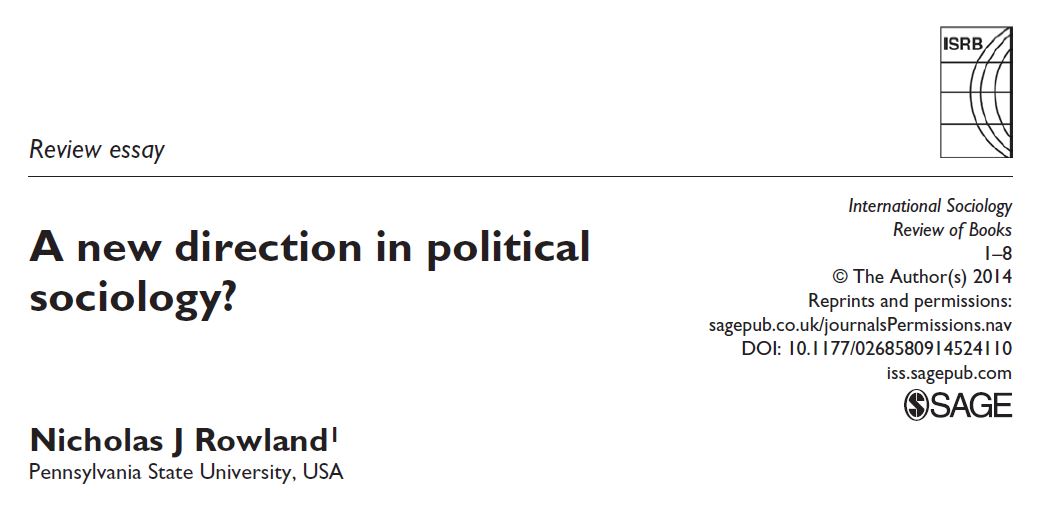
These are the proofs for a new paper/article that I’m working on. The piece is based-off of a few new books in political sociology, which I review, tie-together, and then admittedly and self-servingly I use them to suggest that a little STS would help matters out in political sociology. It is a bit academic in places, somewhat nit-picky, but I tried to keep the tone at least a little playful.

The Productive Body by Didier Deleule and François Guéry

Making an old book new again … by translating it into English.

stuartelden's avatarProgressive Geographies

An important 1972 book, mentioned by Foucault in Discipline and Punish, is finally coming out in English translation in March 2014, with an excellent introduction by the translators.

Productive BodyThe Productive Body asks how the human body and its labor have been expropriated and re-engineered through successive stages of capitalism; and how capitalism’s transformation of the body is related to the rise of scientific psychology and social science disciplines complicit with modern regimes of control. In Discipline and Punish, Foucault cited Guéry and Deleule in order to link Marx’s diagnosis of capitalism with his own critique of power/knowledge. The Productive Body brings together Marxism and theories of the body-machine for the goal of political revolution.

  • Very interesting analysis… The technological mutations of the apparatus of production, the division of labour and the elaboration of the disciplinary techniques sustained an ensemble of very close relations (cf. Marx, Capital,  vol. i, chapter XIII and…

View original post 24 more words

GoldieBlox stirkes again

Last night in the states, the NFL hosted the Super Bowl, a night when the game is watched nearly as closely by Americans as are the commercials. Surprising, to me, was that GoldieBlox, which we blogged about before and before that, was featured. It seems that that toy is really making headway and this probably marks the “beginning” for this concept.

Here’s to finally making some pro-engineering gender normativity — finally, “doing” STS out in the broader public (for example, perhaps about as much as these esteemed folks at MIT).

*PS: I finally learned to spell GoldieBlox correctly; thanks to all the viewers that let me know that I misspelled it incorrectly every time in the past entries. Mia culpa!

Pipeline Nearly Approved

Capture

In the New York Times today, reports that the Keystone XL Pipeline — designed to divert oil from Canadian sources through the US to be refined by Gulf Coast refineries — is one step closer to being approved. The article opens:

The State Department released a report on Friday concluding that the Keystone XL pipeline would not substantially worsen carbon pollution, leaving an opening for President Obama to approve the politically divisive project.

The article goes onto mention that the environmental impact research report will soon be available … and I cannot shake the feeling that I’m re-reading Barry’s new book only this time it’s set in the US. Fittingly, I guess, if you look at the picture in this post, you’ll see the upper left says “POLITICS” … but I’m thinking Andrew would prefer “MATERIAL POLITICS.”