Unknown's avatar

About Nicholas

Professor of Sociology, Environmental Studies, and Science and Technology Studies at Penn State, Nicholas writes about scientific study of states and the future.

ON-LINE FIRST: Infrastructure and the state in science and technology studies

Capture

Our new article in Social Studies of Science about infrastructure and the state in contemporary STS books. It is ON-LINE FIRST so it is free to one and all (at least, for now). It is a relatively short piece, but the introduction and conclusion captures some of our emerging ideas.

As a review article/essay, we review a series of books (rather than one), which include:

1. Andrew Barry, Material Politics: Disputes along the Pipeline (Oxford: Wiley-Blackwell, 2013) xiv+ 244 pp., £60.00/€70,60/$89.95 (hbk), £24.99/€31,30/$39.95 (pbk). ISBN 1118529111 (hbk), 111852912X (pbk).

2. Jo Guldi, Roads to Power: Britain Invents the Infrastructure State (Cambridge, MA: Harvard University Press, 2012), 297 pp., £31.95/€32.87/$37.80 (hbk). ISBN 0674057597 (hbk).

3. Allan Mazur, Energy and Electricity in Industrial Nations: The Sociology and Technology of Energy (London: Routledge, 2013) xvii + 227 pp., £90.00/€114,05/$155.00 (hbk), £28.99/€37.96/$48.96 (pbk). ISBN 0415634415 (hbk), ISBN 0415634423 (pbk).

4. Sara B Pritchard, Confluence: The Nature of Technology and the Remaking of the Rhône (Cambridge, MA: Harvard University Press, 2011) xvii + 371 pp., £38.95/€40.62/$47.25 (hbk). ISBN 0674049659 (hbk).

New Book: Worlds of Sciencecraft

419jDEIOGTL

I just got a first-run copy of the new book “Worlds of Sciencecraft” which is written and edited by Sal Restivo, Sabrina M. Weiss, and Alexander I. Stingl.

In a series of posts coming-up I’ll review the book chapter-by-chapter and comment on matters of style and tone, content and controversy, and so on.

Upon even opening the book and casually reading the first few pages, I can already tell that the book will read something like a roller-coaster, which, in the academic realm, means that the book takes an unapologetic tone — in this case, both with the reader as well as between the authors, which is quite peculiar to my mind — and will challenge a few basic ideas most of us have (inherited) about the sciences. For starters, the book’s title, which implicates “Sciencecraft” is a play on “Warcraft,” as in, “World of Warcraft” the massive on-line role playing game … and so starts the roller-coaster!

913FM6RtXTL._SL1500_

Bravo, Sal and Co.!

Those curious for a blurb, here is the dust jacket:

A response to complex problems spanning disciplinary boundaries, Worlds of ScienceCraft offers bold new ways of conceptualizing ideas of science, sociology, and philosophy. Beginning with the historical foundations of civilization and progress, assumptions about the categories we use to talk about minds, identities, and bodies are challenged through case studies from mathematics, social cognition, and medical ethics. Offering innovative approaches to these issues, such as an integrated social brain-mind-body model and a critique of divisions between the natural and technological, this book provides novel conceptions of self, society and an emerging ‘cyborg’ generation. From the micro level of brains and expanding all the way out to biopolitical civics, disciplinary boundaries are made permeable, emphasizing the increased need for interdisciplinary scholarship. By rejecting outdated and restrictive categories and classifications, new horizons in studies of science, technology, and medicine can be explored through the incorporation of feminist, international, and postmodern perspectives. A truly interdisciplinary examination of science and technology as cultural phenomena, Worlds of ScienceCraft will appeal to scholars and students of science and technology studies, as well as philosophers, historians, and sociologists of science, technology, and medicine.

An Open Letter to Comcast / Xfinity

StacieHuckeba's avatarRamblings

Hello,

My name is Stacie Huckeba I have been a customer of Comcast for over eight years.

I realize that it’s a dirty little secret and you don’t like to talk about it, but c’mon, between just you and me, you can admit it. Basically you have a monopoly on internet service, at least in terms of speed. It’s ok, I like money too. Nobody is happier than me when I deposit big fat checks. Sadly, I’m not quite as “connected” as you guys.

I’m a photographer and I think I’m really good, unfortunately, I live in a town with a plethora of talented photographers so I can’t just sit back and be lazy. I’ve sent emails to the Mayor, and Governor and even my Senators and Congressmen asking that they put in regulations to make sure I am the only photographer who can use professional and top of the…

View original post 1,765 more words

Please Show You’re Working

On-line publishing, paper, and detritus

William Viney's avatarWaste Effects

This is an unedited version of my review for The Times Literary Supplement. The typos are, for that reason, entirely my own.

Cover: The Work of Revision, from Harvard University Press

James Joyce would often write to his patron and unofficial archivist Harriet Shaw Weaver, adding “a little waste paper to get it out of the way.” He was sending her preparatory material, work in progress, which would later become part of the British Library collection. Of the estimated 25,000 pages of drafts and sketches, less than half of these words would be printed in his ‘final’ text, Finnegans Wake. Clearly, the presence of discarded drafts and proofs, and the economies they support, provide a range of opportunities for authors, literary executors, archivists, libraries and scholars. For the latter, establishing points of provenance, compositional order, and textual transmission of these wasted notebook drafts, ‘scripts, and page proofs, along with demonstrating a technical competence necessary to marshal difficult…

View original post 1,693 more words

check out rodney benson’s challenge to ‘new descriptivism’

Recent Critique of Latour: Know Your Enemy!

andrewperrin's avatarscatterplot

In case you missed it, Rodney Benson has an excellent piece here, delivered as a response on a panel at the Qualitative Political Communication preconference. It’s well worth the read, in part because the case he makes deserves to be considered and incorporated in many areas of sociology well beyond communication research. It’s also refreshing to see substantive, synthetic, and critical points raised in a panel response — #ASA14 discussants, read, consider, and emulate!

View original post 184 more words

New Book: the Multispecies Salon

Multispecies fieldwork … Coming to a library near you!

Jeremy Schmidt's avatarJeremy J Schmidt

978-0-8223-5625-7_prInteresting new title from Duke University Press. Here is the description:

A new approach to writing culture has arrived: multispecies ethnography. Plants, animals, fungi, and microbes appear alongside humans in this singular book about natural and cultural history. Anthropologists have collaborated with artists and biological scientists to illuminate how diverse organisms are entangled in political, economic, and cultural systems. Contributions from influential writers and scholars, such as Dorion Sagan, Karen Barad, Donna Haraway, and Anna Tsing, are featured along with essays by emergent artists and cultural anthropologists.

Delectable mushrooms flourishing in the aftermath of ecological disaster, microbial cultures enlivening the politics and value of food, and emergent life forms running wild in the age of biotechnology all figure in to this curated collection of essays and artefacts. Recipes provide instructions on how to cook acorn mush, make cheese out of human milk, and enliven forests after they have been…

View original post 64 more words

why the hurricane study is not a referendum on whether “sexism kills”

Some interesting thoughts about interpretation of nonhuman
Entities, especially gender attributions

jeremy's avatarscatterplot

The hurricane study caught people’s imagination precisely because we had never thought about it before and, once we hear it, the basic idea sounds at least plausible. Unfortunately, the “hurricane name study” is a doomed research design for credibly testing what is actually a clever and even potentially useful public health hypothesis. I suggested why it was doomed from the start in my earlier post, and may elaborate more on that later.

What I want to take up here, however, is the pervasive hindsight bias that comes along with surprising findings like this. We’d never thought about the consequences of giving men’s and women’s names to hurricanes before, but, now that somebody has offered a finding that claims naming hurricanes after women actually kills people, it’s easy to get into our head this is always and naturally the direction we would have anticipated it to go.

Various stories about…

View original post 608 more words

On Taking Notes By Hand

Capture

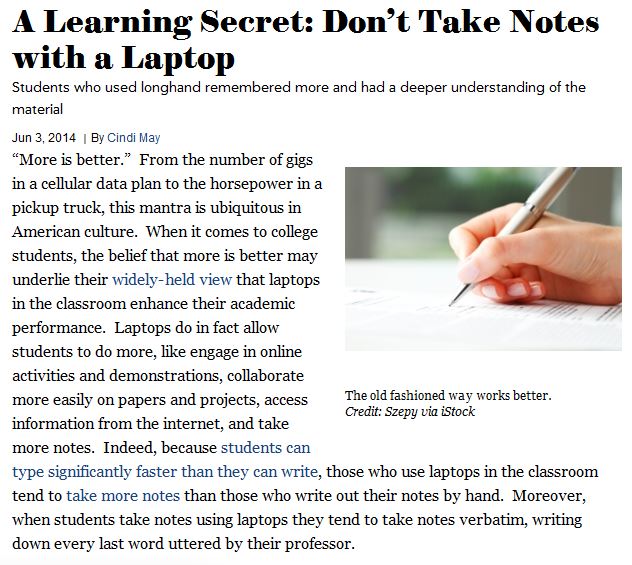
Evidence that writing notes by hand on paper results in greater learning (as compared to taking notes by laptop keyboard). Check out “The Pen is Mightier Than the Keyboard” by Mueller and Oppenheimer in Psychological Science.

CLAIM: In effect, quickly typing copious lecture notes by computer fails to (at least in the experiment) generate the sorts of conceptualization techniques that promote learning (the way that slow handwriting requires students to think about what to selectively write).

Obviously, as any educator will tell you, based on his/her experience, this is an imperfect explanation. Seeing this, the authors also conducted a content analysis, which shows that students writing longhand have to summarize in their own words and draw on conceptual mapping to digest the information.

PROBLEMS: Interestingly, nothing about in-class discussion is mentioned and very little is said about on-line learning. I am reluctant to draw too many conclusions just yet about what this means for practice. There is a powerful irony when I hear a student say “its hard enough to just write this down let alone understand it” … as if notes were really designed for “learning later what you’re learning now.” The active classroom full of discussion — even if some or much of it distracts from the topic at hand — seems relevant. Also, on-line learning wherein notes are often ready-made for the bill-paying student seems like a relevant consideration too in this regard. Also, very little is said about writing assignments: I have been using a technique where students write their first draft totally by hand and then only type it up after I give comments; the quality is outstandingly better, in my experience (using this in a high-level social theory course where conceptualization in significantly important to success on writing assignments).

STUDY: Back to the original study: Evidence comes from experimental research. Mueller and Oppenheimer used the following set-up:

Half of the students were instructed to take notes with a laptop, and the other half were instructed to write the notes out by hand.  As in other studies, students who used laptops took more notes.  In each study, however, those who wrote out their notes by hand had a stronger conceptual understanding and were more successful in applying and integrating the material than those who used took notes with their laptops.

Much of the argument is hinged on a sort-of-fair assumption that college students perceive having laptops in the classroom creates an advantage for the student; typing is faster than writing and this means that students are able to collect a more complete set of notes (as compared to handwriting notes). They write:

When it comes to college students, the belief that more is better may underlie their widely-held view that laptops in the classroom enhance their academic performance.  Laptops do in fact allow students to do more, like engage in online activities and demonstrations, collaborate more easily on papers and projects, access information from the internet, and take more notes.  Indeed, because students can type significantly faster than they can write, those who use laptops in the classroom tend to take more notes than those who write out their notes by hand.  Moreover, when students take notes using laptops they tend to take notes verbatim, writing down every last word uttered by their professor.

Time to start telling student to ditch the laptop for the fountain pen? I did years ago.

Steve Fuller on ‘Dark Ecology’ by Philip Conway

Intuitive appeal of actor-network theory?

dmf's avatarANTHEM

via: http://circlingsquares.blogspot.co.uk/2014/05/steve-fuller-on-dark-ecology.html

At the slowlorisblog there’s an interesting guest post from Steve Fuller. It’s a good read but I have a quibble with one of his comments:

To understand OOO and dark ecology (I take the latter as a specific extension of the former), one needs to understand the intuitive appeal of actor-network theory, which is that you’re better placed to understand the full range of agency in the world if you yourself are not an agent, but simply a mouthpiece for agency.

I really like the essay but that’s false. There are plenty of human actors and agents in ANT. The central tenet of ANT is that every node in a chain of translations transforms what it carries, conducts, transmits. Therefore, humans can’t be written off as mouthpieces; or, equally, even mouthpieces translate what they mouth.

The problem with ANT is that it’s a method that got…

View original post 170 more words

notes on molecularisation of control

Molecularisation of control — Baudrillard, back again

Arran Crawford's avatarsynthetic zerØ

The psychotropic body is a body modeled “from the inside,” no longer passing through the per-spectival space of representation, of the mirror, and of discourse. A silent, mental, already molecular (and no longer specular) body, a body metabolized directly, without the mediation of the act or the gaze, an immanent body, without alterity without a mise en scéne, without transcendence, a body consecrated to the implosive metabolism of cerebral, endocrinal flows, a sensory, but not sensible, body because it is connected only to its internal terminals, and not to objects of perception (the reason why one can enclose it in a “white,” blank sensoriality – disconnecting it from its own sensorial extremities, without touching the world that surrounds it, suffices), a body already homogeneous, at this stage of plastic tactility, of mental malleability, of psychotropism at every level, already close to nuclear and genetic manipulation, that is to say to…

View original post 2,175 more words

‘Books constitute capital’

Harvey on the end of capitalism (again)

Derek Gregory's avatargeographical imaginations

HARVEY Seventeen contradictions Introducing his interview with David Harvey at the Chronicle of Higher Education earlier this week, Scott Carlson notes that

‘The American stage has recently been set for questioning capitalism, with the U.S. tour of academe’s rock star of the moment, Thomas Piketty. The French economist’s Capital in the Twenty-First Century has highlighted capitalism’s drift toward inequality and criticized economists’ focus on pure theory.’

The interview was prompted by the publication of David’s latest book, Seventeen contradictions and the end of capitalism: see also this interview with Jonathan Derbyshirehere.  En route, David has good things to say about Piketty’s project – its empirical detail, its humanistic flourishes (see also Paul Krugmanhere) – but he is evidently dissatisfied with its analytical and, in consequence, its political reach.

Since he spoke to the Chronicle, David has fleshed out his critique of Piketty here.

The book…

View original post 481 more words

USB typewriter — really?

Capture
Yep. Meet the USB Typewriter. You might think those typewriters are obsolete or antique, but seeing these USB typewriters forces one to remember: we will not pass down those iPhones to future generations. A little steampunk goes a long way.

Of all the hacks I’ve seen lately, this one takes the bag. While I will be the last to say that “life hacks” are useless, this one is a possibly both the oddest and most appealing. While you can buy one pre-made, you can also convert your own. Here’s how it works:

Capture

So, apart from applying a ‘spacebar’ key detector and a ‘shift’ key detector, the rest of the letters and number can be harvested from a ‘keypress’ detertor pad on the underbelly of the typewriter which monitor key swings, but from below. Add a control panel on the side and you’re USB-ready.

There is a simplified home conversion kit, as well as more DIY version that requires a bit of soldering.

Some of the videos are admittedly cheesy (the background music … ouch), but this idea is actually pretty solid. It appeals to me on a number of levels, but none more than the idea that is developed in the second video. The idea that one day the batteries will be gone and our electronic technology will be utterly useless; what’s more, they mention how today’s high technology will not last, meaning, today’s technology is incapable of becoming an antique because so much support goes into it and once batteries are not widely available, they’re useless (beyond a paperweight, assuming we have paper).

Retro-hacks like these have been featured in a number of venues, but the interviews on NPR are probably the coolest.

Workshop: Governing through ‘Post-​’: Post-​Disaster, Post-​Conflict, Post-​Crisis? – Warwick, 18th June 2014

POST-Posts at an upcoming conference

stuartelden's avatarProgressive Geographies

Full details here

9e4426b9c0ff4249c5b272d552ac943eWhat is the sig­ni­fic­ance of ‘post’ in post-​disaster, post-​conflict and post-​crisis, and how might we ana­lyze the sim­il­ar­ities in the gov­ern­mental re­sponses to eco­nomic, in­fra­struc­tural and so­ci­etal dis­rup­tion? We con­tend that, des­pite dis­cip­linary bound­aries which sep­arate the study of war, eco­nomy and dis­aster, im­portant in­sights can be gained through an in­ter­dis­cip­linary ex­plor­a­tion of the way that events are bounded by con­cep­tions of tem­por­ality and re­spons­ib­ility. Events are con­sti­tuted through both an­ti­cip­a­tion and re­mem­brance. The bound­aries of ‘be­fore’ and ‘after’ help to for­mu­late events as ‘mo­ments’ of dis­rup­tion which punc­tuate equi­lib­rium and ne­ces­sitate cor­rective gov­ernance. This is often un­der­taken with scant re­gard for the struc­tures that amp­lify and gen­erate their im­pact, or their on­going ef­fects. Slow-​burning crises are par­tic­u­larly sus­cept­ible to being-​made-​silent within this frame.

The re­si­li­ence dis­course, which has tra­versed studies and policies of eco­nomy, con­flict pre­ven­tion and dis­aster man­age­ment, is paradig­matic with re­gard to con­tem­porary event-​thinking. Resilience…

View original post 226 more words

The failures of constructivist language

This is an excerpt from a paper that we will present in Izmir, Turkey, next week as part of the European Workshops in International Studies; we are in the social theory section (big surprise) organized by Benjamin Herborth, University of Groningen, and Kai Koddenbrock, University of Duisburg-Essen.

photo v 00005

(left-over Nazi bell from the ’36 Summer Olympics)

On the failures of constructivist language for our purposes.

In each case, the materiality of the object contributed to its fate. There were clear economic, cultural, and logistic costs and considerations associated with our objects under study being de-constructed, re-constructed, or, for lack of a better term, un-de-constructed, or, put simply, left. Upon even modest reflection, the available constructivist vocabulary seems to fail us in these moments; primarily developed for understanding how things are to be built, we find it difficult to utilize such language for encapsulating and illuminating the processes associated with the allowable decay resistant materials and the slow unintended or unattended-to wasting-away of durable objects.

The only apparent option is to capture attempts at (re)framing — discursively, symbolically, but not practically — the (re)appropriation of monuments in official and unofficial accounts of history. People “make sense” of these ruins, so the classic constructivist interpretation goes. And as soon as they stop or do not care any more there is nothing left to say. That is exactly what Foucault bemoaned when he complained about a historiography that turns monuments into documents. One can easily see that his complaint does not only hold for historical accounts, but for social sciences looking at contemporary issues as well: if we cannot find someone who makes sense of something, then that something simply does not count. But as our cases show: that does not make these massive pieces of concrete, bronze, and iron go away; it does not even leave them untouched. Even when people do not care, forget, or even ignore: the stuff left-over by former state projects stays and shapes what can and cannot be done with it.

9957559

(Soviet War Memorial)

As we view the cases, those Soviet War Memorials constitute a kind of classic form of international relations, one held together by international treatise and inter-governmental agreements regarding the conditions of maintenance for the sites. Based on agreements, the materiality of the sites are not to be marred. The formerly-Nazi Olympic bell constitutes another form of international relations that is de facto, meaning, the bell’s unearthing and repositioning outside the Olympic stadium is not the outcome of treaties with another nation or the result of any linger agreement from former German governments. The bell’s durable material hardly needs to be willfully maintained; however, to remove it would require a considerable quantity of will, both economic and cultural. As the international stage observes how Germany will learn to deal with its past, the irremovable bell lingers-on in public view with only modest material transformation, which recognizes without celebrating the past. How Germany relates to the material residues of past governments becomes a form of international relations.

Capture

(perpetually graffitied Ernst Thälmann Park memorial bust)

The Thälmann bust appears to us as an example of international relations unquestionably shaped by materiality, or, put another way, as a standing example of material international relations. The costliness of its decommissioning outweighed so greatly the will and coffers of the Berlin city commission that, despite being selected for removal on the basis of historical value, the monument endures (Ladd,1997: 201). Unlike the Soviet War Memorials, the the Thälmann bust is not vigorously maintained; however, it has also not been disabled like the Berlin Olympic bell. The operant or public identity of the memorial in Ernst Thälmann Park is one of a graffitied material behemoth. Creative urban artists embellish the statue and only occasionally and without ceremony is hulk washed of the ongoing alterations that it is subjected to from the public.

In sum, the Soviet War Memorials endure for classical reasons of international relations; the Olympic bell endures, irremovable but intentionally altered so that it no longer bears the inscription of a past government and it is incapable of expressing its material purpose to ring; though its removal was approved by a commission whose sole purpose for convening was to determine how the Berlin cityscape would be selectively altered, through its hulking materiality the Thälmann bust endures in a state of semi-permanent but allowable vandalization.

As we reflect on the monuments to a former age, we think of commentary on the repurposing of the Berlin Olympic stadium. Walter’s (2006: xiii) reflects in an extended passage from a perhaps little-read preface:

“Whereas other Nazi edifices such as the rally grounds at Nuremberg are rightly abandoned, this is a building still very much in use – even playing host to the 2006 World Cup final. Although some argue that a structure so closely associated with the Nazi period should not be used, it would seem churlish (and uneconomical) to abandon so handsome and vast a building. In 1936 it may well have been regarded as an architectural embodiment of the waxing power of the new German Reich, but in 2006, the seventieth anniversary of the Nazi’s Olympics, it stands as a symbol that Germany has the ability to come to terms with its past. Why should it not be used? What harm does it do? The shape of the Olympic Stadium does not register as a symbol of evil in the same way as the infamous entrance to Auschwitz, with its railway lines converging to pass under its all-seeing watchtower. The stadium may well not be free from guilt, but like many associated with the Nazi regime, it does not necessarily deserve the death penalty.”

The language used in the passage above to execute an old stadium produces a clear image in the mind; however, do not mistake it as a heartfelt call from the inner-circles of STS to adopt a relational materialist approach to the symmetrical depiction of humans and nonhumans. Still, there is a kernel of insight worth coaxing into germination.

Sentencing a stadium to death would not only be deemed mean-spirited and irrational by Walters, the implication is that one way to deal with international relations (even with old dead states, like the Nazi state) is through the material relations — what Barry calls “material politics” — of monumental spaces such as architect Werner March’s, on Hitler’s orders, grand Olympiastadion staged in the Reichssportfeld (which was built on the foundation of the previous Olympiastadion from the aborted 1916 Games in Berlin). By material politics, Barry conceptualizes processes by which the material world gets drawn into a dynamic relationship with politics; the material world, as it happens, is an important resource for the practical conduct of politics. In STS, Barry’s approach can be contra-positioned with the old adage that “artefacts have politics,” by which Winner (1986) means that technologies have politics as a quintessential part of their design or contextual situatedness.

Returning to our main line of discussion, Barry’s project is explicitly about dealing with a project under construction, in his case, laying a rather large oil pipeline, while our is about dealing with a project long-since constructed. Barry’s case is emergent; our cases are left-over. For us, this sometimes means intervention or decommission and other times it means preservation or transformation, either way, the state must relate to these residues of past states. While the constructivist language common to STS accounts serves Barry well, we find it wanting and search for alternatives more suitable for conceptualizing and describing decay amid durability and the state of being left behind.

It is in contemplating the impossible that one distinguishes advancing from declining societies.

Capture

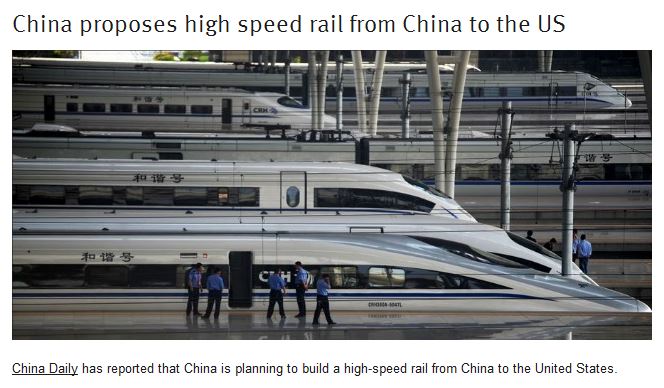
China Daily has reported that China is planning to build a high-speed rail from China to the United States.

A tunnel from the Bering Straits to Alaska under the Pacific Ocean is the proposal.

If the Channel Tunnel is a “Chunnel” (the 50.5-kilometre rail tunnel linking the United Kingdom, with Coquelles, Pas-de-Calais, near Calais in northern France, beneath the English Channel), then is this is this Ocean Tunnel … an “Oceannel” of maybe Oceaunnel”?

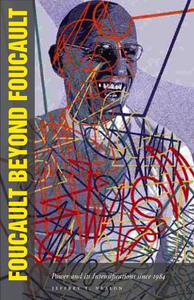
‘This is not a cover image’ – bad covers of books on Foucault

Bad Foucault Book Covers

stuartelden's avatarProgressive Geographies

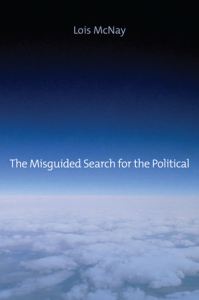
tumblr_inline_n59vvohFao1r1ogyf A set of images of covers of books on Foucault … and their problems. I actually like the Lois McNay cover, but there are some hideous ones here…

Something to bear in mind for Foucault’s Last Decade, though I continue to like the cover image for the book Jeremy Crampton and I edited on Foucault – one of only two times in my publishing career where my/our suggestion for the cover was enthusiastically welcomed by the press (the other was The Birth of Territory). All my book covers are here.

View original post

Malcolm Ashmore on Sociology of Science as a Weak Discipline

SSS is weak stuff, Ashmore claims

dmf's avatarANTHEM

“The sociology of science in 15 minutes!”
Can the comparatively weak discipline of the sociology of science produce anything as credible (knowledge, facts, truths) as those comparatively “strong” disciplines it investigates? Indeed, why should we trust it at all?
In recent years, together with his partner, Olga Restrepo, Malcolm has been examining several of the “mundane technologies of distrust” prevalent in Colombian society, including the cédula, extravagant home “security” devices, and the functions of the notaría system.

View original post

Meta, a postmodern curse word

Capture

Interesting discussion, albeit using the NBC TV series Community to make its point, on Diet Soap podcast and blog An Emphatic Umph about “meta”, how it is used inappropriately, and whether or not is something of a curse word now.

We have encountered much of this discussion in STS, a lot. It is part of a broader discussion about reflexivity, which we wrote about in a Qualitative Sociology article (expensive here, free here). Our claims are more about making accounts, but the basic premise prevails.

At An Emphatic Umph, they raise the classic work on Bergman’s Persona citing Mubi: “It embraces its own artificiality as a medium that has its sole function in representing human impressions and/or emotions. Thus, embracing the postmodernist vein of self-reflexivity, Bergman includes various metacinematic scenes in the film.” Super ugh, self-reflexivity! Painful to read now with a bit of distance from the super-mind-blowing-ness of it all.

Summarizing things nicely, we read “This is to say, the postmodern considers not just the content but the terms and means of content production“, to which we must emphatically agree; however, consistent with the tone of the AEU piece, some folks have this a little too far, or, worse, have left us in a super-lame self-referential circle as we claim to have discovered this fact over and over and over again.

And yet … “And yet there is a certain smug self-congratulation. Rather than meta disrupting our knowing, it brings us into the know, as if we’re in on the whole gag” (re: the fall of the fourth wall in cinematic art). Whew! Again, agreement on all fronts; the part that is difficult for me to swallow (for it is a bitter, bitter pill) is that we gain anything from doing so (i.e., being overtly meta or tickling the fourth wall), which is a point made wonderfully by Mike Lynch who argues that, well, all human communication is already reflexive, thus rendering any attempts to gain ground in an academic or even moral sense by being meta/self-reflexive is beyond pointless (in the best paper about reflexivity ever, but this contest does not include book chapters, for it is Latour that get’s that one, with the dissertation victory going to our friend Malcom Ashmore).

If nothing it to be gained from meta/self-reflexivity (and we generally find Lynch correct in his account), then, Latour concludes, we need to be reflexive in non-self-congratulatory ways, in this case, that means to be infra-reflexive, which implies that we need to overcome the dead-end of any attempt to get an edge on others through the overt use of reflexivity as well as find ways to be reflexive without being too clever about it and just using it when needed (which is all the time) without asking for so much in return (like being congratulated for taking a picture of a picture or something like that).

New book: the misguided search for the political

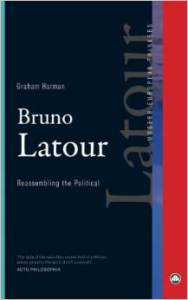
The misguided search for the political … reassembling the political?

Jeremy Schmidt's avatarJeremy J Schmidt

McNaysketch2.indd This book looks quite interesting , here is the description from the publisher’s website.

There has been a lively debate amongst political theorists about whether certain liberal concepts of democracy are so idealized that they lack relevance to ‘real’ politics. Echoing these debates, Lois McNay examines in this book some theories of radical democracy and argues that they too tend to rely on troubling abstractions – or what she terms ‘socially weightless’ thinking. They often propose ideas of the political that are so far removed from the logic of everyday practice that, ultimately, their supposed emancipatory potential is thrown into question.

Radical democrats frequently maintain that what distinguishes their ideas of the political from others is the fundamental concern with unmasking and challenging unrecognized forms of inequality and domination that distort everyday life. But this supposed attentiveness to power is undermined by the invocation of rarefied models of political action…

View original post 130 more words

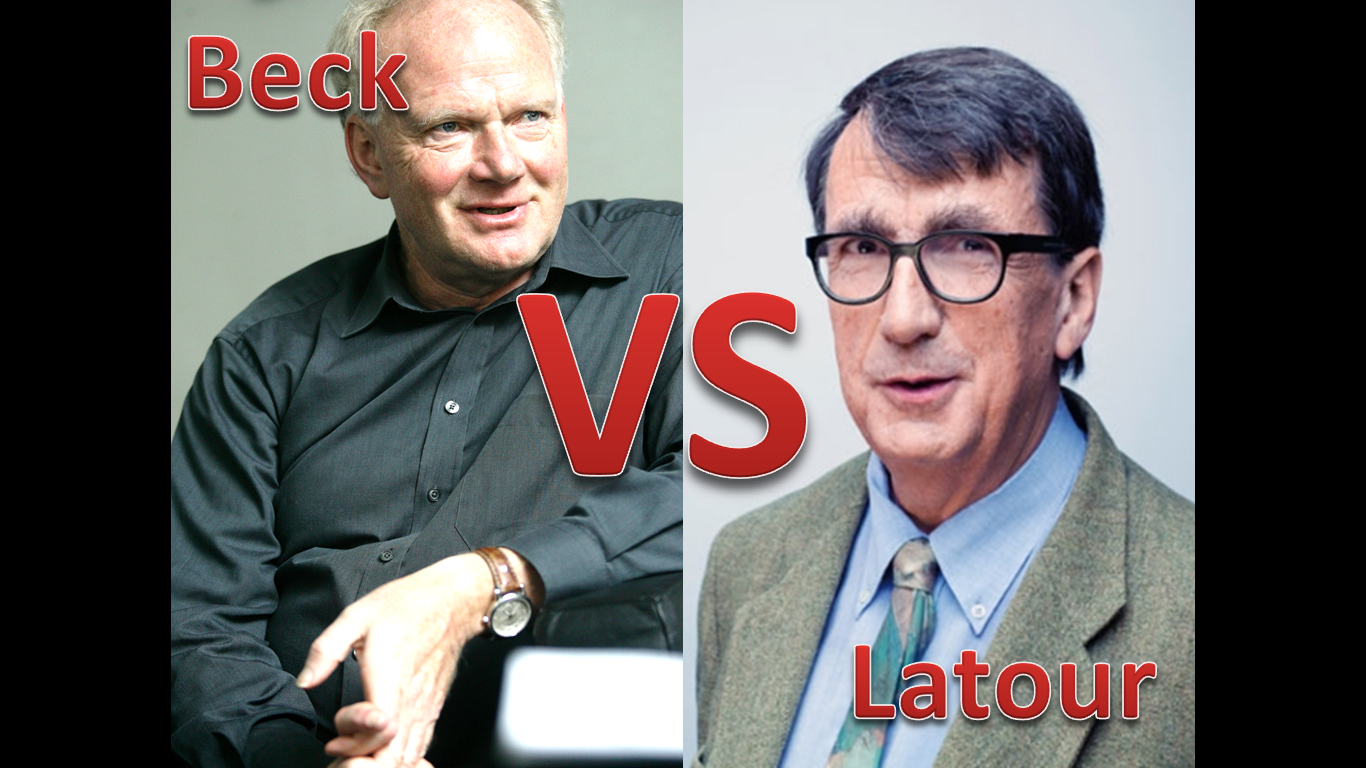
Ulrich Beck vs. Bruno Latour

Screenshot 2014-05-07 10.59.47

A decade ago, Latour and Beck went at it in the pages of Duke University Press’s journal Common Knowledge, writing, arguably, some of the most read material in the modest journal’s history. The topic in question was about peace at a time of advancing cosmopolitanism. After reading the debate, I wonder why it never really “grabbed” STSers the way, for example, that the papers from Collins/Yearly vs. Callon/Latour are seen as a kind of classic “battle royale”?

At any rate, check them out for yourself (in this order):

Beck 2004 “THE TRUTH OF OTHERS: A Cosmopolitan Approach”: (doi: 10.1215/0961754X-10-3-430)

Latour 2005 “WHOSE COSMOS, WHICH COSMOPOLITICS?: Comments on the Peace Terms of Ulrich Beck”: (doi:10.1215/0961754X-10-3-450, the most cited article in Common Knowledge’s history by January 2014)

Beck 2005 “NEITHER ORDER NOR PEACE: A Response to Bruno Latour”: (doi:10.1215/0961754X-11-1-1 )


Ernst Thälmann Statue; Durability as Material Resistance

Capture

Been doing some research on the Ernst Thälmann statue (a gigantic bust) situated off of Greifswalder Straße in Berlin; mainly writing about how this large material bust persists despite being the near constant target of graffiti artists. Some early preservationists in the recently united Berlin of the 1990s attempted to keep statues like these but alter them subtly in the process; examples included proposals to grow ivy on the statues; however, as you can see, this form of “alteration” did not take, and instead Berliners took alteration into their own hands.

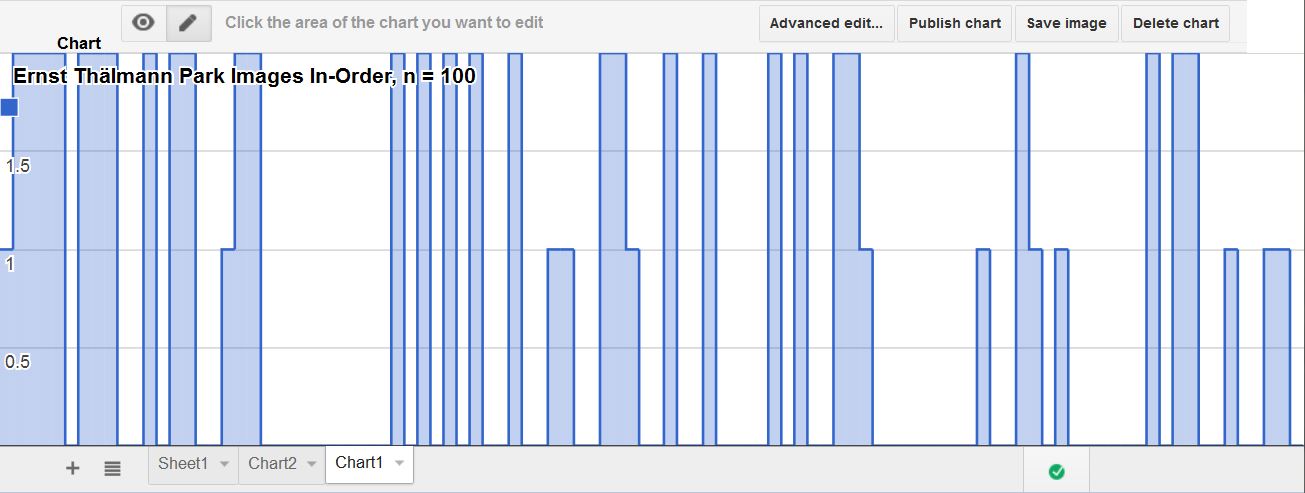
The statue in the Ernst Thälmann Park is the near constant target of graffiti artists. Admittedly, Berlin is no stranger to creative street art, but the statue’s historical legacy with graffiti makes it a pressing concern for the state, especially in maintaining its appearance. By keeping the statue free of graffiti, the state protects its past. Particularly important for Germany, the state must not appear to hide the past, and letting graffiti linger a little too long would constitute objectionable concern by some that state maintenance implies keeping the parks clean. However, the inverse is also important, which is that graffiti constitutes some contemporary context of how the past is viewed in the present, thus, political expression in the form of graffiti ought not to be removed too quickly either for fear of acting as evidence of abundant pride in the past. As a less than scientific, but no less real testament to this idea, we conducted a modest data collection using Google images; we documented the outcome of a search for “Ernst Thälmann Park” and recorded in order whether the image contained the Ernst Thälmann statue and, for those that do, we determined if the statue was depicted with graffiti. Of the first 100 pictures from the search, we learn that the Thälmann statue is not visible in 59 of the 100 pictures (59%); however, when the statue is present in the image, in 29 of the 41 pictures (71%) the statue is depicted with visible graffiti. We also depict our findings in a bar graph where each observation is presented in the order that they appeared in the Google image search. In the chart, zero implies that the image did not contain the statue, one implies that the statue was visible, and two implies that the statue visibly contained graffiti. We observe a trend. If scores are averaged for every ten observations in order, then we that the prevalence of seeing a graffitied Thälmann decreases the deeper one goes into the image search, thus, the earliest images are the most likely to contain graffiti. In 1-10, the average observation is 1.5, a middle-range observation from 51-60 is 0.6, while the late observations from 81-90 is 0.3, hence, the general downward trend. We assume unscientifically that early images in searches such as these are the operant visual identity of the images that appear, thus, the earliest images viewers see of the Thälmann statue is likely to be a graffitied statue.

Capture

In Brian Ladd’s 1997 The Ghosts of Berlin: Confronting German History in the Urban Landscape, we learn why the statue persists despite the reality that its contemporary identity hinges largely on its use as a receptacle for urban art. In the late 1980s and early 1990s, a unified Berlin had to determine which monuments to maintain, and, according to Ladd (1997: 201), monuments were to be estimated on their “historical rather than political value.” How to honor the past required consideration of how to also transforms the spaces of their memorialization. For example, proposals during the 1990s included “proposals to plant vegetation in the paved ceremonial spaces around many GDR monuments, or even to grow ivy on the statues,” as a means to “preserve statues, affirm tradition, and at the same time turn politically defined urban spaces into something different” (Ladder 1997: 201). Berlin government officials commissioned an independent group, primarily composed of preservationists, who made compelling claims in their final report to maintain the monuments as part of the “GDR’s interpretation of history,” and in the end “the commission recommended the outright removal of only a few monuments” (primarily related to border guards), although alteration to standing monuments was utilized, in particular, related to the text changes featured in the context of plaques. According to Ladd (1997: 203),

[Ernst] Thälmann [had] … a great deal to do with the image cultivated by the GDR’s leadership. They fashioned a Thälmann who would serve the function that Lenin served for Stalin and his successors: the hero whose prestige and authority they inherited. They suppressed portrayals of Thälmann as a suffering concentration camp inmate in favor of Thälmann as antifascist hero. The combination of historical falsification, authoritarian gesture, and bombastic design understandably made the statue unpopular after 1989.

By 1993, a tone of “universal acceptance” had a toe-hold among preservationists, and

[t]he passage of time worked in their favor: after several years of united Germany, the Thälmann monument was on its way to becoming a historical relic of a past regime, perhaps worth preserving as a document of GDR political ritual. But the strongest argument in favor of keeping the monument, at least provisionally, was its size: no one was willing to pay for its demolition. Meanwhile, the accumulating graffiti around the statue’s base made it clear enough that the heroic Thälmann no longer met with favor. By 1995, three neatly stenciled words higher on the pedestal commented on the fate of the man and his monument: “Imprisoned–murdered–besmeared.” (Ladd 1997: 203)

Now, the most common form of “alteration” to the Thälmann statue appears not in the form of vegetation, but alteration through art; graffiti is added and subtracted, but the monument resists removal, if only through its size, the costliness of its removal, and its life is thusly extended also by benefit of its having been preserved in the first place during the 1990s.

Pay me for my big data

Capture

“In a world of digital dignity, each individual will be the commercial owner of any data that can be measured from that person’s state or behavior,” writes Jaron Lanier in his relatively recent book Who Owns the Future (Simon & Schuster, 2013).
Companies like Google — and we’ve discussed them to death over the last months: here, here, and here, but mostly about wearable technology — are getting rich off of our personal data. I call search terms personal because, frankly, we are often more honest with our browser search engines that we are with our spouse (maybe even ourselves, or perhaps including ourselves).
The simplicity of the idea — to get paid, in effect, to allow one’s self to be spied-on — is what I like most about it. The typical “oh, but when we spy on you we can give you better search outcomes” or “we can customize searching for you in exchange for your data” is just not enough. Google is making cash-money with my data, so, like with my credit cards, I want 1% back!
Lanier’s ideas don’t just describe the present, they may very well become blueprints for the future, thus, while they are not currently true, I think they will become true over time.

Recursions: a new book series in media & cultural theory

New book series about Recursion from Amsterdam University Press.

jussiparikka's avatarMachinology

recursions logoWe are proud to announce the launch of a new book series titled Recursions: Theories of Media, Materiality and Cultural Techniques. Placed with Amsterdam University Press, a publisher known for its strong track-record in film and media studies, the series will publish fresh, exciting and important books in media theory. This includes both translations and other volumes that address the core themes outlined below. I am very excited about this project and working with my co-editors Anna Tuschling and Geoffrey Winthrop-Young. We have already some significant projects lined up for 2015 and more forthcoming that we will announce in the coming weeks and months. We are supported by a very strong international advisory board. Get in touch if you want to learn more but first read below for more information!

New Series Announcement

The new book series Recursions: Theories of Media, Materiality, and Cultural Techniques provides a platform for cutting-…

View original post 411 more words

What are you supposed do with unfair criticism?

jerk

What do you do with unfair or less than constructive criticism of your academic work? Let’s fix peer review!

We all know, some people are jerks, many academics among them, and that some folks use the anonymous system of peer-review in order to act however they like without the responsibility or accountability that goes with face-to-face or self-identifying criticism.

To me, this is just part of the job, or, at least, I tell myself that. However, while it is most certainly just part of the contemporary academic landscape, it still irks me — every time.

It is the worst when your realize that the reviewer simply does not “get” the point. Slightly less bad, but no less forgivable: the reviewer has not looked closely enough at your work, and, as they gloss over the details, you realize from their comments that their “this is unclear” or “this is inappropriate” is really just a sign that they have not read your previous commentary that explains it 8 or 9 lines ago.

Worse than all of this, however, is that editors rarely — at least, in my experience — take this into account when making a judgment on a paper. On rare occasions, a reviewer might be suppressed, but usually the editor just acts like some sort of conduit, relegating all responsibility in the process.

Has such an appeal to the unfairness of a reviewer worked for anybody?

Is this a sign of a deeper problem in higher education?

At any rate, what do you do with unfair criticism?

Just in: EASST deadline extended for Poland

Capture

Here is the message, as a session convenor, from EASST leadership; please consider joining us on track D3 at EASST 2014 conference, Track Title: STS and “the state”.

NEW DEADLINE: FRIDAY, MAY 9TH, 2014

Here’s the message:

To all track convenors EASST2014 conference

After the close of call for abstracts last week we have reviewed the level of submissions.  We feel that the publicising and timing of the EASST 2014 Conference deadline has led to difficulties for many members of our community in submitting abstracts by the agreed deadline.  We are very appreciative of the efforts of those who did manage it.  However we have decided to extend the deadline until Friday 9 May to ensure that all of those who wish to present at the conference have the opportunity to submit their abstract.

As a convenor we are asking you to help in encouraging more submissions for your track.  We ask you to look at the current submissions … and identify any ‘missing’ individuals’ that you would have hoped to submit and then email them encouraging submission.  The goal should be for each convenor to attract one extra abstract. This could deliver on average an extra 3 or 4 abstracts per track.

We hope it was also clear that any papers you wish to present yourselves should also have been submitted within the system.

For guidance about the overall programming, we propose 90 minutes sessions of 4 papers.  24 papers should be the normal maximum in any one track.

You may also wish to advertise this extended deadline through your networks.


Lawrence & Wishart and the copyright of the Marx-Engels collected works

Marx-Engels copyright!?

stuartelden's avatarProgressive Geographies

In recent days there has been debate about the copyright of the Marx-Engels collected works. Publishers Lawrence & Wishart have asked that these works are removed from the Marxist Internet Archive (story here); a petition has been started to protest this; Lawrence & Wishart have issued a statement in reply.

I have sympathy with L&W’s position. The idea that knowledge should be freely available is laudable, but this does not mean it is ‘free’. There is a lot of un-compensated or under-compensated labour invested in book production, even for works that are assumed to be out of copyright – editors, translators, proof-readers, production staff, etc.

I do think that unless there is some ability to invest the proceeds of sales back into production, there is a considerable risk that important works will never be translated. And, as they say, there are many more appropriate targets of protest than a…

View original post 16 more words

The God trick and the administration of military violence

Stef, reminds me of your drone post

Derek Gregory's avatargeographical imaginations

JOC staring at screen 24afghan-600

Here is the abstract for my keynote at the Lancaster symposium on Security by remote control next month; it’s a development from my presentation at the AAG in Tampa, and I’ll provide more details as I develop the argument.

The God trick and the administration of military violence

Advocates have made much of the extraordinary ability of the full motion video feeds from Predators and Reapers to provide persistent surveillance (‘the all-seeing eye’), so that they become vectors of the phantasmatic desire to produce a fully transparent battlespace.  Critics – myself included – have insisted that vision is more than a biological-instrumental capacity, however, and that it is transformed into a conditional and highly selective visuality through the activation of a distinctively political and cultural technology.  Seen thus, these feeds interpellate their distant viewers to create an intimacy with ground troops while ensuring that the actions of others within the…

View original post 218 more words

Big Ruins: The Aesthetics and Politics of Supersized Decay – Manchester, Wednesday, 14 May 2014

If I were not going to an EWIS conference in May, I’d want to visit this — SUPERSIZED DECAY is a really cool sensitizing concept.

William Viney's avatarWaste Effects

I’m excited to be involved in the ‘Big Ruins’ conference, to be held in Manchester later this year. Conference organiser, Paul Dobraszczyk , describes the event: “As global capitalism intensifies its hold on the planet, so its ruins are scaling up in size: from vast junkyards of jumbo-jets in Nevada to entire empty cities in China waiting to be inhabited. Meanwhile the urban ruins of the Cold War era continue to resist appropriation, whether because of their toxicity, ideological misplacedness, or as a consequence of intractable ethnic conflicts. Coupled with a recent plethora of (post)apocalyptic visions of ruined cities in cinema and computer games, the links between real and imagined ruination are becoming increasingly blurred. If we are to imagine large-scales sites of decay, how might their possible ruin be represented in a way that helps us adequately respond to that very possibility?

This conference will address that question by focusing on the wider significance of big ruins…

View original post 203 more words

waste objects

doctorzamalek's avatarObject-Oriented Philosophy

I was just reading THIS POST about abandoned objects by Melbourne artist Julie Shiels, who teaches Art and Public Spce at RMIT.

And it reminded me that I’d forgotten to announce the publication of Waste: A Philosophy of Things, by Will Viney at Durham University, for which I provided a cover endorsement.

View original post

Brazilian infrastructure: Boom to nothing

Capture

A disheartening reality-check for the infrastructure boom in Brazil, now reduced to rubble and rust. While we have often discussed infrastructure as a basic economic good, inferior or incomplete infrastructural development may very well have the reverse effect.

These pieces from NYT’s Nadia Sussman, an eery video, and this companion piece from NYT’s Simon Romero (Photographs by Daniel Berehulak), a combination written and visual story, paint a vivid image of a nation striving to build the massive infrastructures similar to those of other nations, but at a time of stagnant and non-existent government budgets, all of which comes on the heels of planning for the World Cup in June, just a couple months away from the time this post goes up. We wrote about the economic impact of similar Olympic stadiums and even a bit on how we might think about their copious infrastructural leftovers.

The article reads:

The growing list of troubled development projects includes a $3.4 billion network of concrete canals in the drought-plagued hinterland of northeast Brazil — which was supposed to be finished in 2010 — as well as dozens of new wind farms idled by a lack of transmission lines and unfinished luxury hotels blighting Rio de Janeiro’s skyline.

Economists surveyed by the nation’s central bank see Brazil’s economy growing just 1.63 percent this year, down from 7.5 percent in 2010, making 2014 the fourth straight year of slow growth. While an economic crisis here still seems like a remote possibility, investors have grown increasingly pessimistic. Standard & Poor’s cut Brazil’s credit rating last month, saying it expected slow growth to persist for several years.

CfP: IJANTTI special issue on 3D Printing, Space Entrepreneurship and Advanced Battery Technology as Challenges to ANT

Calls for Papers (special): International Journal of Actor-Network Theory and Technological Innovation (IJANTTI)

PE's avatarANTHEM

Calls for Papers (special): International Journal of Actor-Network Theory and Technological Innovation (IJANTTI)

Special Issue On: The Breakthroughs in Additive manufacturing (3D Printing), Space Entrepreneurship and Advanced Battery Technology as Challenges to Actor-Network Theory

Submission Due Date
9/15/2014

Guest Editors
Ivan Tchalakov, University of Plovdiv, Bulgaria

Recommended Topics
Topics to be discussed in this special issue include (but are not limited to) the following:

  • ANT (and related approaches) based case studies of additive (3D) manufacturing: key innovations and their actor-networks – the complex web between 3D computer aided design (3D scanning), 3D printing equipment and production of appropriate material to be used by the equipment; of emerging consumer oriented business models; 3D printing and biotechnologies – new perspectives in implant and replacement organs manufacturing and related legal, ethical, psychological and other issues.
  • ANT (and related approaches) based case studies of space entrepreneurs, their companies and technologies they developed, and the…

View original post 205 more words

Chinese Constitutional Politics

640px-Flag_of_the_People's_Republic_of_China.svg

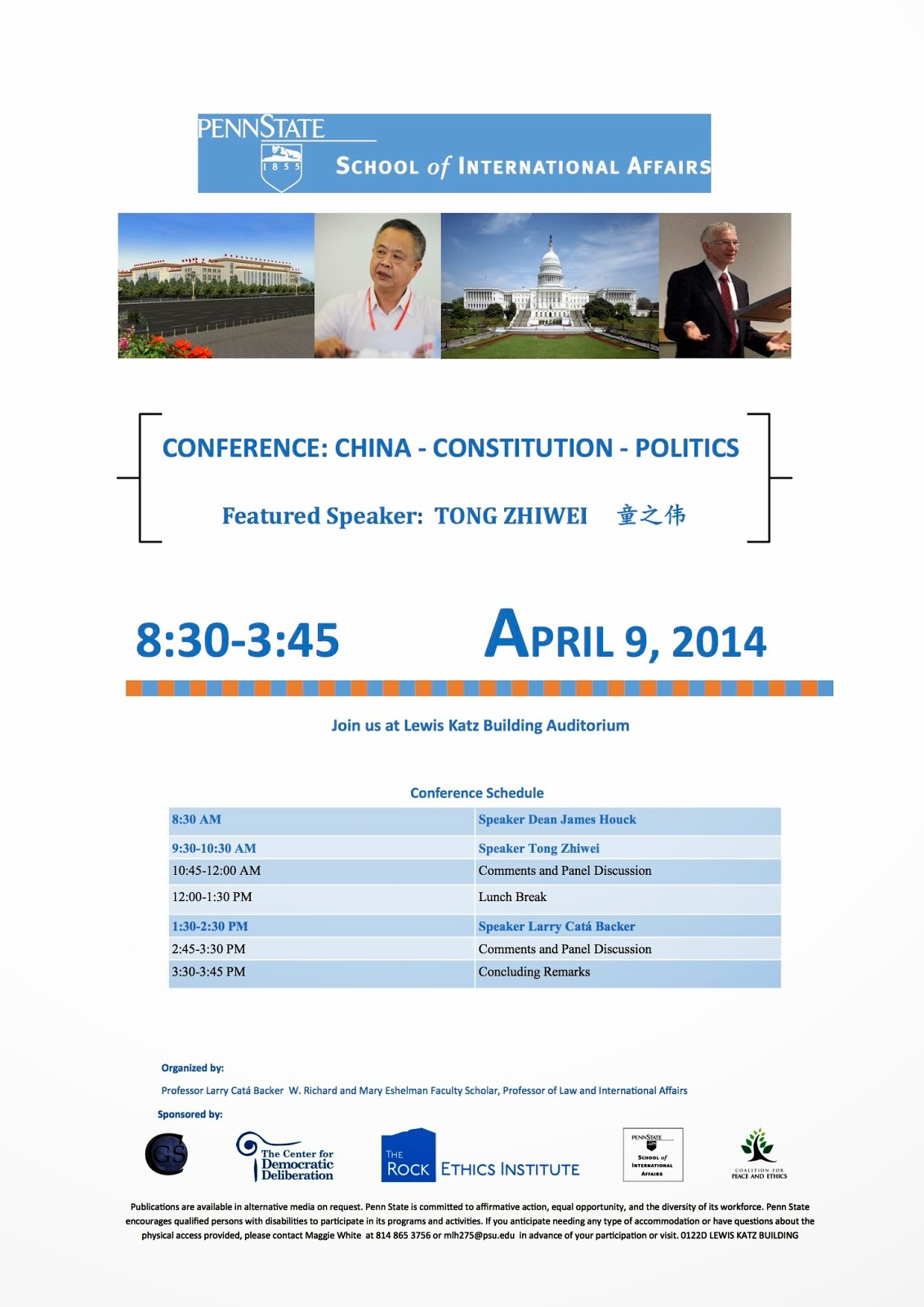
The video recording of the conference, China-Constitution-Politics, is now available for accessing via mediasite. I was involved in the PM discussion; I reviewed Dr. Larry Backer and graduate student Karen Wang‘s paper “THE EMERGING STRUCTURES OF SOCIALIST CONSTITUTIONALISM WITH CHINESE CHARACTERISTICS: EXTRA-JUDICIAL DETENTION (LAOJIAO AND SHUANGGUI) AND THE CHINESE CONSTITUTIONAL ORDER” which is soon coming out in Pacific Rim Law & Policy Journal; the AM session considered Zhiwei Tong (童之伟) and his new work “Two Issues.”

RECORDINGS: Entire Conference HERE: AM Session HERE: PM Session HERE.

The original schedule is here:

A

Are you guys getting academic spam too?

spam

I just got this in my e-mail, which is lame-o academic-spam-turned-publishing-hoax. Finally, after getting a number of these, I feel as though academics have finally “made it”; our success is spam-worthy! Custom spam, just for us.

Are you guys getting more and more academic spam too? Why target academics for this sort of thing? Either we are too dumb/desperate to publish in main-line journals(?), or, perhaps, we are finally a market worth getting some serious spam(!). I try to be positive about it; after all, what really comes of getting angry about this sort of thing (besides nothing)?

Now, we hear about journal hoaxes all the time. For example, the recent case of the recent cancer paper that was a joke or Sokal Affair. Some of these cases, for example, the Sokal Affair are, it seems, hard to forget, given that they helped to trigger the “science wars” in STS.

However, what about journal spam? Is anybody actively researching this topic and publishing about it in legitimate journals (there is a post-ironic feel to that sort of work).

A brief review of the literature in STS, and the answer is, apparently, no. So the answer to the question “Are you guys getting academic spam too?” is surely “yes, we are;” however, we do not appear to be studying it.
Continue reading

Retrospective on “The Carceral”

A

A chapter of Michel Foucault’s famous 1977 Discipline and Punish: The Birth of the Prison (1975, Surveiller et Punir: Naissance de la Prison) is titled “The Carceral.” In a few brief notes, I reconsider the chapter in light of contemporary discussions and literature.

As with so much of Foucault’s work, the chapter starts with a rich, seemingly (but not really) unorthodox example, in this case, the official opening of Mettray, a location where “disciplinary form at its most extreme” was born. Utilizing nearly every form of traditional organizational forms — the family, the army, the workshop, the classroom, and juridical ordering techniques —  such that those “young delinquents condemned by the courts” (as well as, I will note, boys charged, but acquitted, and yet were imprisoned as an alternative to “parental correction”) were to be overseen by “technicians of behavior; engineers of conduct, orthopaedists of individuality.”

As you can see from the quotes, Foucault’s language holds nicely to this day, even if post-foucauldians in governmentality studies have “cleaned-up” the ideas so much so that now we rattle-off “voluntary self-regulation through myriad disciplinary techniques,” it is worth remembering that, earlier on, we used to have to learn what Foucault meant from writing that did not give way to bullet-point-like writing or textbook-like bold terms sitting like warts in our prose. That said, some of the prose does not really hold over time as well as his language choices. When I first read Foucault, I recall his work being mind-blowing and yet, at some level, impenetrable. My colleagues would say something like “this is not sociology as usual,” and while I agreed with them back then (perhaps out of fear — Foucault readers often loved him dearly and not “getting it” was something you would not normally want to reveal in public, which I think now Foucault would have laughed about), now that I have some distance from my initial readings, it is easy to see why Foucault was not sociology as usual: it is not sociology. I do not mean it does not belong among the sociology canons; I mean that it was never “just” sociology; his work always struck me as historical, political, social, etc. but that it was simply not possible to reduce it to any of them. At any rate, I return to the retrospective.

Of course, the penal systems were famous for meticulous notes; “a body of knowledge was being constantly built up from the everyday behaviour of the inmates,” such that in the toughest of prisons, at the hardest of times, surveillance always implied: “I shall note the slightest irregularity in your conduct.” These two quotes, juxtaposed in the above sentence, give you also a sense of Foucault that I only notice now. I used to think that he was a dynamic writer, for a historian (I used to think of him this way); however, now, having done some professional writing, I see that Foucault is a master of shifting registers. He switches effortlessly between gigantic abstractions that seem to swallow-up the entire carceral world, for example with a quote like, “a body of knowledge was being constantly built up from the everyday behaviour of the inmates”; however, moments later, he reduces his voice to a nearly personal tone, as if whispering to the reader (without breaking eye contact, I imagine in my mind’s eye) shifts registers to tell you, the reader, what an person might have heard, as a prisoner, and in these moments, you are both, for example, “I shall note the slightest irregularity in your conduct.” You get the feeling Foucault might have, upon uttering this line, paused for effect. As a matter of style, I will take this form of writing over the bullet-points and bolded-terms, but the executive summarizing of texts into carefully constructed abstracts and sound blurbs (like those that post-foucauldian governmentality studies scholars have reduced Foucault to) seem to win the day in our times.

While all the discussion of discipline, training, and then self-discipline is positively lovely to read, I was stopped dead in my book at this line: in a discussion of supervision and being supervised, “[a] subtle, graduated carceral net,” Foucault writes, “with compact institutions, but also separate and diffused methods, assumed responsibility for the arbitrary, widespread, badly integrated confinement of the classical age.” I have no recollection of reading that line before; however, reading it now, its like a curio box of how the work has been up-taken into contemporary sociology: the emphasis on “[a] subtle, graduated carceral net” feels like the precursor for discussions of networked stateness; having the net replete “with compact institutions, but also separate and diffused methods” serves to underscore that Foucault was not an anti-institutionalist, but that institutions were “separate” (or distanced both practically and analytically) from the “diffused methods” upon which much (if not most) discipline is rendered; from there, we get a feel for jurisdiction as a key mechanism for control and knowledge production (which, for example, Andy Abbott’s work is a cool off-shoot as well as Tom Gieryn’s) when we read the net of institutions carefully divorced from the methods of everyday discipline, “assumed responsibility for the arbitrary, widespread, badly integrated confinement of the classical age.” The sentence, as it were, and for me only in retrospect, twinkles like a curio box of Foucault’s lasting legacy.

Another matter warranting some re-consideration is how sloppy Foucault is and how this general sloppiness is neatly pasted-over by his vivid word choices. For example, in an incredibly sloppy historical gloss of the origins of the prison, we get a paint-by-numbers tour of yesteryear, seeing “colonies of poor, abandoned vagrant children,” those boarded-up “almshouses for young female offenders” whose mothers exposed them one too many perversities, backbreaking “penal colonies” for young men often acquitted but condemned to reform through labor, “the institutions for abandoned or indigent children” as well as “orphanages,” what was left of the institution of “apprentices,” or those “factory-convents” where young girls would tally-away under circumstances of voluntary confinement, and if all of those beautiful and tragic pictures of yesteryear were not yet enough to bully the reader into agreeing not to disagree with the fine points raised by Foucault, we now get bombarded by “charitable societies, moral improvement associations, organizations that handed out assistance and also practised surveillance,” and now I am too exhausted to continue this German machine-gun of corollaric  examples. Still, a point is to be made here, because we have all seen this technique before (some of us, in our own writing), this “exhaust the reader with colorful examples” technique (I am, myself, routinely guilty of this); however, until reviewing Foucault again for my students in social theory today, I had no idea that I was doing this, as if a scholarly mimeograph machine, in the tradition laid-out by Foucault (although, and it would be fitting, perhaps Foucault was copying somebody else that either I don’t know about or whom has been lost in time).

Those are just a few thoughts, having returned to Foucault’s D&P after a number of years.

<image from: http://bordercriminologies.law.ox.ac.uk/wp-content/uploads/2013/07/copy-cropped-dreamstime_WEB_70689362.jpg&gt;


Google Glass Goes Public: Not Exactly A Revolution

Captureg

Stef’s piece on “seeing” targets of drone strikes (as well as the metaphorical infrastructure that holds some of those practices together), along with some other posts are about seeing like a military, I cannot resist but to share this piece on google glass failing miserably. Marcus Wohlsome writes about it for WIRED magazine; also, if you recall, Mat Honan wrote a great piece before the end of last year, “I, Glasshole: My Year With Google Glass, which was a fun read too; still, some of you will remember Stef’s post about wearable technology and empathy for the other, if only because of its attention on “Glance,” which is an app for google glass (or smart phones) to observe you having sex with other people while they observe themselves having sex with you.

On the topic of google glass and its public sales: CBS reports that reception from the public was “cool” at best (and not the cool kind of “cool” either); the spin at USA today is that google glass “sold out” (so long as you only count the sales of white rimmed google glass, although there is a nice irony in using “sold out” there); and, of course, chief of overstaters these days (what has happened to this previously decent news source!) CNN reports that this is the dawn of a new age in wearable technology, hallelujah! (although, admittedly, it is on the opinion page … how couldn’t it be.) Still, the CNN piece is more interesting that it might appear at first blush. For example, it reports on a dress that becomes transparent when the “user” is aroused … using this might be a tough reality check for some folks.

Capture

Seeing Machines

Seeing like military and machine

Derek Gregory's avatargeographical imaginations

VIRILIO Vision machine In a series of posts on photography Trevor Paglen provides some ideas that intersect with my own work on Militarized Vision and ‘seeing like a military’.  First, riffing off Paul Virilio , Trevor develops the idea of photography as a ‘ seeing machine ‘:

‘Seeing machines is an expansive definition of photography. It is intended to encompass the myriad ways that not only humans use technology to “see” the world, but the ways machines see the world for other machines. Seeing machines includes familiar photographic devices and categories like viewfinder cameras and photosensitive films and papers, but quickly moves far beyond that. It embraces everything from iPhones to airport security backscatter-imaging devices, from electro-optical reconnaissance satellites in low-earth orbit, to QR code readers at supermarket checkouts, from border checkpoint facial-recognition surveillance cameras to privatized networks of Automated License Plate Recognition systems, and from military wide-area-airborne-surveillance systems, to the roving cameras…

View original post 450 more words

Are there 15 ways to be unhappy? Surfing Bruno Latour’s ‘An Inquiry into Modes of Existence’

Are there 15 ways to be unhappy? Surfing Bruno Latour’s ‘An Inquiry into Modes of Existence’

Admin's avatarPop Theory

1). Samin’ and changin’

DSCF1034I have had Bruno Latour’s An Inquiry in Modes of Existence (AIME) kicking around my desk since last summer, thinking it’s the sort of book one should probably read in case it turns out to be mind-blowingly important. I finally got round to reading it, in a certain manner, recently, encouraged by the setting up of a reading group by the NAMBIO research group in the Geography here at Exeter, which I have actually not been able to attend until this week. I might not be able to go to the next one meeting either, so in the spirit of stretched-out, online thinking that this book is meant to exemplify, I thought I’d try to articulate some of the thoughts that it has provoked in me. (The book is just one element of a more ambitious ‘digital humanities’ project – a website, basically…

View original post 4,379 more words