It was mentioned during some comments that we initiate a teaching section for the blog. This is a good plan. So here goes.
Category Archives: Uncategorized
"Computational Culture", a new journal. Feels like home…
As I have just read on Lev Manovich´s Blog on Software Studies there is a new journal ready to launch. On its editorial board are such great scholars as Mathew Fuller, Adrian MacKenzie and Olga Goriunova. Seems that the sociology of infrastructure could get a home. The website is still under construction, but the initial statement sounds like it will be a perfect place to look for the topics we discuss here (and elsewhere). Here is the blurb:
Computational Culture, a journal of software studies is an online open-access peer-reviewed journal of inter-disciplinary enquiry into the nature of computational cultural objects, practices, processes and structures.
The journal’s primary aim is to examine the ways in which software undergirds and formulates contemporary life. Computational processes and systems not only enable contemporary forms of work and play and the management of emotional life but also drive the unfolding of new events that constitute political, social and ontological domains. In order to understand digital objects such as corporate software, search engines, medical databases or to enquire into the use of mobile phones, social networks, dating, games, financial systems or political crises, a detailed analysis of software cannot be avoided.
A developing form of literacy is required that matches an understanding of computational processes with those traditionally bound within the arts, humanities, and social sciences but also in more informal or practical modes of knowledge such as hacking and art.
The journal welcomes contributions that address such topics and many others that may derive and mix methodologies from cultural studies, science and technology studies, philosophy of computing, metamathematics, computer science, critical theory, media art, human computer interaction, media theory, design, philosophy.
Computational Culture publishes peer-reviewed articles, special projects, interviews, and reviews of books, projects, events and software. The journal is also involved in developing a series of events and projects to generate special issues.
The Editorial Group
Matthew Fuller, Goldsmiths
Andrew Goffey, Middlesex
Olga Goriunova, London Metropolitan
Graham Harwood, Goldsmith
Adrian Mackenzie, Lancasterhttp://computationalculture.net
For initial enquiries, please contact: m.fullerATgold.ac.uk
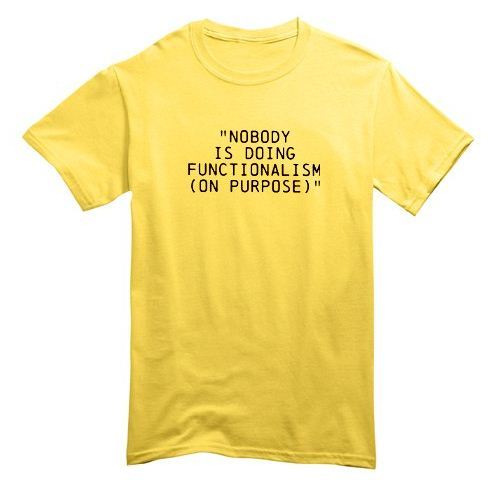
Nobody is doing Functionalism (on purpose)
… a statement available to wear. Now you can “order” your order(.org).

Rousing debate over postmodernism
Occasionally repetitive in response, the question was raised “why include postmodern theory in sociological theory courses anymore?“
The exchange is longer than any I’ve ever seen on a blog, and it made me wonder: In my courses on STS and sociological theory, what would they look like without postmodern theory?
Are the challenging and mind-bending concepts worthy of inclusion, or is the exploration into postmodernity over (such that, unless I was providing a “history of sociological theory” course, it is no longer necessary to include what few scholars appear to explicitly or actively engage in)?
Ending STS?
Although it might be poor career advice to (try to) follow in the footsteps of the great Bruno Latour — who has done so much to cultivate the narrow world of STS — I wonder if we might all benefit from taking a look at his recent playbook.
It has been a good while since Latour did some old fashioned, empirical STS. HIs books are now mainly about political ecology or attacking the “social” parts of sociology. I was reminded of this as I casually glanced at the history of STS on-line today — in particular, the section about history and the origins of STS. As I reviewed the rundown of founding questions, I got the feeling that the work is (in an odd way) done; that we have succeeded in our original aims, those being (in loose historical order):
1. putting scientific controversies in their social context; showing how facts are constructed — DONE.
2. challenging “technological determinism” by studying the spread and history of technology to show that technologies do not spread or shape history of their own volition — DONE.
3. bringing together historians and philosophers of science in recognition of Kuhn’s historic work about paradigm shifts wherein the appreciation that scholars in STS must have a dual-knowledge of both their subject matter and their home discipline — DONE.
4. generate inclusive STS community composed of anthropologists, historians, philosophers, political scientists, sociologists, to a lesser extent psychologists and linguists, etc. with some of those folks being of the “activistic” stripe, for example, those aiming to raise awareness for a particular issue or illness and those aiming for equality according to race, gender, or nationality — DONE? (and if not “done” then this aspirational goal will be ongoing for the foreseeable future).
5. examine science and technology policy and if they can be shaped by the public and to better serve the public — DONE (and if not “done” then this aspirational goal will go on forever as policy seems to forever change).
In STS, it appears that we might be suffering from some mission drift, as we say in organizaitonal studies, meaning that the reason we have STS in the first place have been to some extent “handled” and now our “mission” (if you can call it that) must become sufficiently ambiguous so that we can never know whether or not it has been completed/achieved (like the U.S.-based “March of Dimes”).
The implicaiton might also be, in a Latourian twist, should we end STS? Disperse its insights into other disciplines and try to find out where in the world STS is valuable outside of STS?
Latour as Tarde!
Remake of a Tarde – Durkheim debate!
Check it out: http://www.bruno-latour.fr/expositions/debat_tarde_durkheim.html
Interrelating in extreme situations: the infrastructural angle
Just like Nicholas I am very much interested in disasters, and his earlier post made me wonder some more about the connection to the issue of infrastructures. Some connections are obvious once you talk about technological disasters propers, especially if you approach the topic from a “normal accidents” angle (as Perrow in his treatise on normal accidents utilizes a general notion of networks including humans, technological artefacts, institutions, etc.). But there is also the whole literature about high-reliability organizations (HROs) which Nicholas alluded to in his second post on this topic, in which the focus is more on human behavior in high-risk situations and on “mindful organizing”.
One common denominator between the various types of research and literatures on disasters and near misses is the emphasis given to relational structures and processes: Perrow’s notion of vulnerable systems is basically a conceptualization of networks the elements of which can be loosely or tightly coupled, and HRO authors like Weick characterize mindful behavior as “heedful interrelating”.
Having been concerned with micropatterns of responding to disruptions in my own post-doc research, I am struck by the extent to which such responses are characterized by spontaneous forms of interrelating among participants, for example in emergent groups in communities struck by disasters. Furthermore, organizations coping with disruptions look more like networks than like hierarchies – a condition which HROs almost appear to emulate.
Bottom line is, I think, that an extended infrastructural understanding of understanding disasters, near misses, high-risk situations, and so on, may be elaborated by more systematically discussing the various social and technological aspects of interrelating in extreme situation. Actually, there is a lot of research going on in this area right now since disaster researchers and disaster response practitioners generally tend to be quite aware about the relational aspects of responding to disruptions. Just this week, our local communicating disaster research group met for a workshop on the use of social media in crisis situations, and you may check out the outline here. Apparently, disaster response organizations increasingly ponder possibilities of utilizing people’s technologically augmented abilities of interrelating in real time: if you have people with smartphones present at a disaster site, and they will spontaneously interrelate in immediate disaster responses (like looking for survivors, moving debris etc.) anyway, while you as an outsider start with knowing nothing or very little about where and how to deploy your own helpers and machines, why not use survivors’ smartphones, their GPS and photo capabilities for coordinating disaster responses? The “disaster app” may at some point, perhaps sooner rather than later, become an obligatory smartphone functionality.
Obituary for a unique mind: Harold Garfinkel died last week
Sad, but true: Harold Garfinkel died a week ago at the age of 93. A student of Parsons (and maybe his most creative critic), linking American and European social theory again through the works of Alfred Schuetz, he became well known as the founding father of Ethnomethodology – the study of the orderliness of social life, created in the moment-to-moment work of (not so) ordinary practices.
Instead of praising all his accomplishments and wonderful writings, a short passage of his 1996 paper in Social Psychology Quarterly (59/1, pp. 5.21) will show how much we owe him, and it is not a passage describing Ethnomethodology – but a footnote showing his modesty and humor. The footnote is attached to the claim that the achievements Formal Analysis are “unquestionably demonstrable achievements” (page 6):
If this claim is read as irony, it will be read incorrectly. To read it withou irony, recall the scene in Ionesco´s Rhinoceros. The last man and his girlfriend, Daisy, are looking out into the street below filled with rhinoceroses. Daisy exclaims: ‘Oh look, they´re dancing.” The last man: “You call that dancing!” Daisy: “That´s the way they dance.” (…) EM is not claiming to know any better (than FM, JHP). But neither is EM proposing to institute and carry out EM investigations of ordinary society while being in the midst of organizational things and therein knowing nothing. Rather, we´ ll proceed without having to decide or even know how to proceed while knowing nothing. Instead by [beginning], by [carrying on], by [finding our bearings again], by [completing an investigation], we´ll land ourselves in the midst of things. Procedurally we know something. We´re not agnostic. (…) In the midst of its endless things we´ll study the work of which immortal ordinary society consists. We´ll see.
With that in mind I remembered the statement from Latours “Reassembling the social” (2005: 54-55): “It would be fairly accurate to describe ANT as being half Garfinkel and half Greimas: it has simply combined two of the most interesting intellectual movements on both side of the Atlantic and has found ways to tap the inner reflexivity of both actor’s accounts and of texts.” John Law already claimed that ANT is (or should be) a modest sociology. From Garfinkel, whose thoughts live on in us, we can learn how that is done.
On Temporal Order
A common sense interpretation of what technical infrastructures – for example media technologies like the system of printed books or TV or the Internet – do to our everyday lives, to institutions, organizations and society as a whole is that they condense temporal and spatial reachability. Once you write your thoughts down and publish a book, your readers can pick up our ideas or disagree with tem years, even decades later. Once you can use the phone you can speak with your loved and not so loved ones, no matter where they are on the globe. Infrastructures are time and space packing machines.
But that seem to be an invalid claim, or at least, a totally imprecise one.
The Wisdom of Conferences?
During a rousing visit to Penn State, Fabio Rojas and I were discussing the organization of conferences and he suggested that I take some of my insights and hunches and put them to the test. In particular, we were discussing the idea that a group of attendees might better organize a conference as compared to one organizer or a set of expert organizers; of course, I am not talking about the logistical issues of organizing the venue, dates, etc., but the papers themselves.
In effect, we wondered if you could harness the wisdom of crowds (a la Surowiecki) for the purposes of conference improvement — whether or not you can crowd-source conference sessions/panels?
In an imperfect way, sessions/panels are already crowd-sourced, for example, at 4S, where members of the professional community do the work of organizing sessions for other members of the community. Still, this is not really what Surowiecki was describing, and I am imagining a much more radical Surowieckiian model of paper selection.
Surowiecki’s three major criteria are that the wisdom of crowds can be unlocked, but only if:
(1) a definitive answer exists or will exist such as the eventual winner of the next World Cup or, in one of the famous examples from the book, the unknown position of a sunken subermine (i.e., the Scorpion),
(2) matters of coordination are necessary, for example, where individuals create suitable trading arrangements or determine how to drive safely in heavy traffic, or
(3) matters of cooperation are necessary wherein otherwise self-interested, potentially distrusting individuals must find a way to establish, for example, what suitable compensation might be even with competing interests at play.
Likewise, circumstances must be “right” meaning that the wisdom of crowds operates most effectively under conditions of independence among decision-makers who are also, in some meaningful way, diverse and decentralized (so that they can connect and share information, but not too much as to homogenize decision-making).
Is there a wisdom of conference attendees worth harnessing?
Claus Rerup: Near Failures and Near Successes in the "Gray Zone"
Claus Rerup is an
associate professor of Organizational Behavior
at the Richard Ivey School of Business at the University of Western Ontario and
…his work
explores how coordination, politics, and
heterogeneous information influence the ways in
which employees and managers collectively learn
from (rare) events. In most cases firms
learn from an accident or crisis after the fact,
but many organizations can also learn valuable
lessons from a near disaster.
A couple of notable things:
1. The notion of “near failures” requires a basic update to many of our STS syllabi which contain numerous references to technological disasters. Certainly, my courses on STS primarily designed for engineering students cover engineering disasters at length, but fail to feature or conceptualize “near failures” and “near successes” and what might be learned about them and from them.
2. And I’m thinking explicitly about his paper “The gray zone between mindful and mindless organizing” — the notion of a gray zone between careful, mindful organizing and reckless, mindless organizing is an interesting idea where a lot of “noise” could be captured if properly conceptualized.
Infrastructure and Disasters
As I am generally interested in “technological” disasters and write for an infrastructure blog, I always wonder about infrastructural disasters.
I recently read an interesting and somewhat non-tradition piece for an economics journal (although it does harken to the “Freakonomics” style of inquiry, if only it had a comparison case where the same set of underlying mechanisms operated):
Frey, Bruno S., David A. Savage, and Benno Torgler. 2011. “Behavior under Extreme Conditions: The Titanic Disaster.” Journal of Economic Perspectives, 25(1): 209–22.
The full-text article, which is currently complimentary, reviews how individuals behaved (based mainly on personal characteristics) during one of the “deadliest peacetime maritime disasters.” The abstract reads:
During the night of April 14, 1912, the RMS Titanic collided with an iceberg on her maiden voyage. Two hours and 40 minutes later she sank, resulting in the loss of 1,501 lives—more than two-thirds of her 2,207 passengers and crew. This remains one of the deadliest peacetime maritime disasters in history and by far the most famous. The disaster came as a great shock because the vessel was equipped with the most advanced technology at that time, had an experienced crew, and was thought to be practically “unsinkable” (although the belief that the ship had been widely believed to be truly unsinkable actually arose after the sinking, as explained in Howell, 1999). The Titanic’s fame was enhanced by the considerable number of fifi lms made about it: not including various made-for-television movies and series, the list would include Saved from the Titanic (1912), In Nacht und Eis (1912), Atlantic (1929), Titanic (1943 and 1953), A Night to Remember (1958), Raise the Titanic! (1980), and of course the 1997 Titanic, directed by James Cameron and starring Leonardo DiCaprio and Kate Winslet. In 1985, a joint American–French expedition, led by Jean-Louis Michel and Dr. Robert Ballard, located the wreckage and collected approximately 6,000 artifacts, which were later shown in an exhibition that toured the world.
The results suggest when you compare the quick sink of the Lusitania (under 20 mins) to the show, gradual sink of the Titanic (over a 3 hour period), you learn something about the dynamics of self-interest under certain circumstances.
The comparison between the Titanic and the Lusitania suggests that when time is scarce, individual self-interested flight behavior predominates, while altruism and social norms and power through social status become more important if there is suffificient time for them to evolve.
Better conferences follow-up: How to schedule conferences
Unfortunatly there is not much to report form the world of STS right now: all email-lists are silent, 4S proposals are send out, EASST is missing this year. But time is a scarce resource these days, so I don´t mind.
Since I run from workshop to workshop, from conference to conference these weeks, I wonder how conferences get scheduled. Nicholas comment to the Stengers workshop (“Why not in the summe?”) made me aware that also in here in old Europe most academic gatherings are all taking place exactly when our schedules are already full. Take these weeks: it is the beginning of the summer term here in Germany, and I travel to two different places to meet people each week.
I wonder why? How does the practice of scheduling academic gatherings work? Are there mechanisms, strategies and tactics I don´t get?
Why never to write a paper for a conference theme
Jan-Hendrik and I recently wrote a paper to align with a conference theme and a proposed papers session — what a mistake. Thankfully, we also submitted a sort of “back-up” paper should the first fall on hard times.
The conference is always rather large so perhaps we should have known better than to fall prey to the theme and/or take the theme seriously. Still, when we got the call for papers and read the theme, it is hard to ignore (at least in a way) because it has an feeling of legitimacy, it feels (when you’re actually taking it seriously) as if it just might be meaningful, and if it is, then you just might land a better session spot if you bend your work to the theme.
Again, we were wrong, falling prey to the (awkward) siren song of conference calls.
So, themes: this is a fairly straight forward empirical question — under what circumstances do themes shape conferences?
The answer to a question like this we probabaly all have a “good hunch” but I’d be curious to see data.
Symposium with Isabelle Stengers, CUNY, April 9, 2011
Just came back from a week of travelling – we definitly need to have more people contributing, so feel free to get in contact with us – and found this in my mailbox. Again I wish I would be able to be in NY, now it is CUNY that hosts a great event. I am just reading Stengers Cosmopolitics (a review will follow), I am sure this will be a great event.
COSMOPOLITICS
http://www.wix.com/cunygc/cosmopolitics
April 9, 2011, 1:00 PM – 5:00 PM
9TH FLOOR CONFERENCE ROOMS
CUNY Graduate Center
365 Fifth Avenue, New York CityIsabelle Stengers will be visiting the CUNY Graduate Center on a rare visit to the United States for an International Symposium. Cosmopolitics, a book series by Stengers, explores possible nonhierarchical modes of coexistence. Stengers examines our entanglements—the diverging values and obligations that shape our practices. Cary Wolfe (Rice University), Natasha Myers (York University), Eben Kirksey (The CUNY Graduate Center), Matei Candea (University of Durham), Steven Meyer (Wash. University St. Louis), Lina Dib (Rice University), Joan Richardson (The CUNY Graduate Center), and Dorion Sagan (Sciencewriters) will also give lectures at this Symposium.
Charting the waters between the Scylla of established materialism and the Charybdis of romantic supernaturalism, Cosmopolitics gives us a frame for grappling with what has been created by science while foregrounding the fragile conditions of knowledge production, giving resonance to the unknown and the mysterious beyond. The University of Minnesota Press published Cosmopolitics I, the first book in this series, in 2010. Stengers has given the speakers at this CUNY Graduate Center conference exclusive access to the forthcoming English translation of Cosmopolitics II.
This event is sponsored by the Mellon Committee for Science Studies.
Details about the Cosmopolitics Symposium are on-line:
http://www.wix.com/cunygc/cosmopolitics
To schedule a personal meeting with Isabelle Stengers, contact: Eben Kirksey ekirksey@gc.cuny.edu, 212-817-7094
Exciting new journal.
For those of you hard at work, here is a new venue to submit your hard work: http://www.universalrejection.org/#about
The rejection rate is relatively high, which shows how serious this new journal is.
What is the point of large conferences having organizing "themes"?
As part of my part-time life-mission to figure out how to make better conferences, I pose this question:
*What is the point of large conferences having organizing “themes”?*
As a case to consider, this year’s annual meeting of the American Sociological Association has the organizing theme “Social Conflict: Multiple Dimensions and Arenas” (meeting, without a shred of irony, at Caesar’s Palace in Las Vegas, NV). The theme goes like this:
Social conflict is constantly in the headlines, in the breaking news, but also under the surface of social life. Wherever there is change, struggle, or domination, there is conflict. Social conflict involves many dimensions, including not only economic and power struggles, movement dynamics, and violence, but also forms of inequality and domination latent with conflict, and practices which resolve conflict or which divert attention from it. Sociology is the only social science that takes conflict as a major topic, and the only field that throughout its existence has been crucially centered on class, race, and ethnicity. New fields focused on race, ethnicity, gender, and sexuality are also concerned with conflict, but the intellectual driving force in most of these fields is a sociological perspective. There is a reason why sociologists were heavily involved in the rebellious movements of the 1960s and 70s—sociologists are experts at understanding both power and group mobilization. This has continued to be sociology’s special strength.
Apart from the theme being the clear “pet” of whomever happens to organize such a massive conference, and apart from shaping the plenary talk(s), these themes, in my experience,
(1) fail to shape the broader conference, and
(2) tend to be fairly dated (i.e., so mainstream that they fail to generate much innovation).
So, what is the point of large conferences having organizing “themes”?
Ever wanted to work with Bruno Latour? Here is your chance!
I just read that twice – one time on EASST Eurograd and the second time on Graham Harmans Blog on Object Oriented Philosophy (and I must admit, I was thinking about applying myself until I remembered that my french is not even good enough for ordering coffee). Ever wanted to work with Bruno Latour? Here is your chance!
Bruno Latour, professor at Sciences Po in Paris, has been awarded a European Research Council (ERC) grant for a project called AIME starting the 1er of September 2011 to the end of August 2014. This project (see http://www.bruno-latour.fr/expositions/AIME-short_summary.pdf ) connects philosophy, anthropology of modernism with digital methods in order to organize, on the one hand, an ”augmented publication” using state of the art technology and, on the other, the collective negotiation of its content with interested parties selected and facilitated by a team of mediators. For this endeavor, he is looking for a project manager with financial skills (if possible a knowledge of European accounting processes) and with experience in managing complex projects involving artists, or/and scientists, or/and programmers. Carried most of the time in English, the project manager will have to work closely with the principal investigator, unsuring the smooth running of the financial aspects of the project, the overseeing of the small team of designers and mediators as well as the organization of the various phases of the negotiation to take place in the last phase of the project. The job is based in Paris, it is a full time job for the three years of the project. Please find enclosed the job description.
For inquiry on the suitability of the application, inquire directly to myself or to Biljana Jankovic biljana.jankovic@sciences-po.fr. Tél: +33 (0)1 45 49 50 93.
Application should be sent before the 15th of May 2011. The decision will be made June 30th at the latest.
Bruno Latour
Failure – A Desideratum of Modernity (International Conference, 15.-17. September 2011 at Leibniz Universitaet Hannover)
As I mentioned before, I am currently organizing a conference with three colleagues of mine in September 2011. I promised to post the cfp, too (I thought it would be nicer to post the text and not the document).
Voilà:
Call for Papers and invitation to an international conference
„Failure – a Desideratum of Modernity“
at Leibniz Universitaet Hannover, 15.-17. September 2011
in cooperation with ISInova
Failure is one of the basic everyday life experiences. When performed by the mass media, it even serves as a crowd puller. Failure by itself appears in many kinds of forms: as a loser in competition, deranged and precarious persons, divorce, insolvency, catastrophe, misconduct, as a chance for a comeback and even as an epistemic formula of continuity, namely as corruption. Failure, albeit clandestinely, consists of a certain prominence, in that failure hides behind success. It is the ever present and possible threat of failure that lends success its fascination.
Contrary to the prominence of success, the concept and empirical description of failure in the social sciences suffer from inadequate attention. Only in the field of Sociology of Organization one systematically addresses the issue of failure. Yet even here failure merely serves as a negatively emphasized background for detecting fitting solutions. Obviously the impact of failure can be identified only in connection with the respective definition of success. Keeping in mind that success is naturally preferred by society, conversely the meaning of success can only be specified in conjunction with a reflection of failure. In this respect, it seems to be advisable to transcend a simple opposition of the notions of success and failure. Besides the search for a substantial notion of failure, it is important to develop a differentiated notion of success and to point out the interaction between both concepts. From this perspective, it can be observed that a structural arrangement such as the financial market partially fails and at the same time is nevertheless able to hide its failure (for a short period) behind a rhetoric of success. Reversely the maintenance of routines and the establishment of everyday organization do not count as `success stories` that one could proudly refer to. This distinction unveils a curious paradox; a constellation of success and failure. In this context, one can think of the successful failure and of the failing success (pyrrhic victory).
The promising character of failure reflected in this light is not merely betoken by the prominence of this topic in mass media and by its everyday occurrence. It can also be identified in the complex cross references that arise when questioning conditions of failure and success of individual vita, organizational change and social structure. The potential capacity of a perspective of failure is founded in the possibility to mark the chances of success of planning, of control and of reduction of complexity ex negativo. This is because only by retracing the processes of collapsing structures and failing intentions is it possible to elaborate the conditions of success on different levels of analysis.
Therefore the main aim of the conference is to discuss failure as a context in three aspects: first, it is necessary to define a notion of failure against the background of social change, while simultaneously considering the notion of success as an opposite concept. Secondly, the notion of failure is to be explained in reference to its structural, normative and semantic implications. As a result, one can gain further capabilities of analysing. Finally, the conference aims to pick out various empirical observations of failure.
Key questions of the conference are:
-
What
kinds of notions of failure can be defined and how can success be
understood in contrast to them? What kinds of relationships exist
between those concepts? -
What
capabilities of sociological analysis can be drawn from a
perspective of failure? In this context, a perspective shall be
highlighted that does not focus exclusively on successfully solving
problems and does not turn away from failing aims or collapsing
processes of structure-building. -
How
can one define different constellations of consistent and
inconsistent relations of failure and success theoretically? By
which kind of methods can the plurality of forms be adequately
reconstructed?
The conference trails these questions by plenary meetings and panel sessions.
For the panels, it is kindly requested that speech outlines be sent in by the 15th of June 2011.
Hosts are:
René John (ISInova, Institut für Sozialinnovation).
Jens Bergmann (Leibniz Universitaet Hannover), Antonia Langhof (Universitaet Bielefeld), Gabriele Wagner (Leibniz Universitaet Hannover).
Key note speakers are:
Holger Braun-Thuermann (Universitaet Hamburg), Nils Brunsson (Uppsala Universitet), Giancarlo Corsi (Università degli studi di Modena e Reggio Emilia), Birgit Geissler (Universitaet Bielefeld), Ursula Holtgrewe (FORBA Wien), Matthias Junge (Universitaet Rostock), Morten Knudsen (Copenhagen Business School), Stefan Kuehl (Universitaet Bielefeld), Klaus Schlichte (Universitaet Bremen), Stephan Voswinkel (Institut für Sozialforschung) and Tricia Wachtendorf (University of Delaware, requested).
Conference languages:
German and English
Deadlines:
Registration for the conference: 15th of August 2011
Submission for Call for Papers: 15th of June, 2011
Please send outlines to the following address:
tagung-scheitern@ish.uni-hannover.de
Contact: René John (rene.john@isinova.org)
Conference fee:
85 Euro to be remitted upon confirmation of registration.
Homepage: http://www.ish.uni-hannover.de/tagung-scheitern.html
Harvard University: Science and Technology Studies: The Next 20, April 7-9, 2011
Just stumbled upon this: why do announcements of such event always reach me when it is far too late? To be able to travel overseas – we in Germany at least – need more than four months to apply for funding. Two weeks is definitely not enough. But: there is a Twitter-feed to follow! And the conference will be video-streamed!
This meeting is the product of a year of conversations across several continents and dozens of institutions. It weaves together the hopes, aspirations, and—yes—frustrations of STS scholars from around the world who have committed their careers to studying the central role of science and technology in our social, political, and moral lives.
The meeting is in part a stock-taking. After two decades of increased public funding for STS, what can we say about our achievements as a “thought collective”? What have we learned from speaking the truths of our field to the power of established disciplines? Which areas of work do we recognize as displaying the greatest theoretical depth and creativity? What do we impart to STS scholars-in-the-making, and what can we do to ensure that their ideas are heard more widely and that they find appropriate academic homes? The three-day program addresses these questions: first, STS and the disciplines; second, STS and its theories; third, STS’s institutional challenges and opportunities.
In part, too, the meeting is a provocation: an invitation to reflect on the conditions needed for this field to thrive and grow—in keeping with the importance of its mission. As with any provocation, the questions we hope to explore may have conflicting answers. Ideas will be generated throughout the meeting from both our physical and virtual audiences. This website, managed by a local team of scholars, is part of an effort to make the meeting as inclusive and participatory as possible, both during the event and after it.
Overall, this is a meeting to rethink questions that all STS scholars have grappled with at some point in their intellectual lives. Why do STS? What makes it interesting, distinctive, coherent, relevant, and deserving of stronger institutionalization?
This meeting—diverse enough to be representative, yet small enough to foster conversation—offers a rare opportunity to think together about these issues, in the company of others who share our concerns and our convictions.
via stsnext20.org
By the way: do you think that the lack of involvement of european scholars has a deeper reason that just missing funding for travel?
What is (an) Agenc(y’/ie)s Structure?
This weekend I discovered a nice post on Daniel Little´s Blog UnderstandingSociety dealing with an old (nearly classic) topic of sociology. Daniel reviewed a new book by Peter Martin and Alex Dennis that (2010) that promisses to remodel the old problem of structure and agency – I just ordered it to review it myself. From the TOC it seems to me that the impression I had when I first read the title “HUMAN agency and SOCIAL structure” seems true: There is Habermas, there is Bourdieu, there is Giddens, there is Foucualt. A classic collection of protagonists of the 1990s structure/agency debate (the one about conflations, remember?).
Here is a piece of Daniel Little´s review:
This group of researchers addresses the contrast between agency and structure; but really their goal is to help to dissolve the distinction. They want to show that “structures” do not exist in any strong sense (including the senses associated with critical realism), and that a proper understanding of “agency” involves both subjective and objective features of the individual’s actions, thoughts, and situation. Social relationships are densely intertwined with reasons, emotion, commitments, beliefs, and attitudes — the aspects of consciousness that make up agency and action.
Here is a representative statement about social structures:
The collective concepts (such as family, state, organisation, class and so on) — which have often been seen as fundamental to sociological analysis — have often encouraged ‘the temptation to reify collective aspects of human life’ (Jenkins 2002a:4); that is, to treat them as if they were real entities, independent of the human beings who constiTute them. (7)
Their affirmative theory of agency — now stripped of the notion that it is a polar opposite to structure — has much in common with the traditions of micro-sociology — Goffman, ethnomethodology, symbolic interactionism, and phenomenological sociology. The idea here is to emphasize the very concrete ways in which each of these traditions succeeds in identifying the agent, the social actor, as both subjective and objective. He/she is a subject, in the sense that the agent possesses thoughts, emotions, desires, aversions, allegiances, and the like, which in turn contribute to the actions and lives they live. But the agent is objective, in the sense that he/she is embedded and developed within a concrete set of social relationships and institutions.
Thus each of these approaches develops in its own way the idea that human social life is carried out through processes of interaction among real people in specific situations, and each seeks to avoid the reification of collective concepts — there are no such ‘things’ as social ‘structures,’ ‘classes’, or indeed ‘societies’, yet terms such as these are indispensable, not only for sociologists but for the purposes of everyday communication. (14)
 2002a:4); that is, to treat them as if they were real entities, independent of the human beings who constiTute them. (7)
Social theory in sociology as well as in STS has gone a long way since the 1990s – and it seems to me that the temporary solution of the now 20 year old debates (“make it micro, place structure and agency both into your concept of (human) action”) has been challenged by a diverse set of approaches today. Boltanski and Thevenot, Schatzki, Latour (oh well, and don´t forget their ancestors Dewey and Tarde) all argue (in different ways), that agency is not a quality that (human) actors possess – but an effect of a temporary structuring so that the basic qustion is not: “How do agents structure their relationships and institution?” but “How do different ways of structuring collective relations bring about modes of agency?”
Making better conferences
After proposing my first session at a conference with Jan-Hendrik, and, in particular, after his recent post about a forthcoming conference at LSE and Hendrik’s reflections about this year’s ISA annual meeting, I started to wonder if anyone writes on how to make conferences better?
I wrote in my comment to Jan:
This reminds me of something I have always wanted to know more people’s opinions on: WHAT MAKE A GOOD CONFERENCE GOOD AND WHAT MAKES A BAD CONFERENCE BAD??? Seriously, I have been to so many conferences and sometimes they are outstanding (networking opportunities, good papers, etc.) and sometimes they are terrible (poor attendance, bad food, etc.).
Perhaps you have unlocked one of the first possible answers. You write above: “how can a forum that adopts the “social studies of —” title gather people to talk about finance, crisis and IT without any recognizable input from another “social studies of —” field, namely the “social studies of finance”? “
Perhaps this is one of the characteristics: too many off-topic scholars as a ratio to on-topic scholars (in your case, all social studies of X with out any sociology of financial market folks).
This should be an ongoing blog topic: WHAT MAKE A GOOD CONFERENCE GOOD AND WHAT MAKES A BAD CONFERENCE BAD?
I wonder: What makes a good conference good? What makes a bad conference bad?
*BUT MORE THAN THAT, can you control these characteristics as to improve a conference or conferences as a whole?*
You have to imagine the major funding agencies such as the US-based National Science Foundation or the DEU-based DFG would be interested in knowing whether or not conferences can be improved, and if so, how. Conferences make-up a massive proportion of all scientific communication. Therefore, improving them systematically over time would be an obviously good thing. Perhaps there is something about the size of the conference that matter or perhaps the setting…
So, if I think of conferences over the last year or two that have been really good, here is what I have:
Best conference of the last year, hands down, was EASST (European Association for the Study of Science and Technology) set in Trento, IT, summer 2010. Why?
It was set in Trento amid the Dolomite Mountains. I was “forced” to visit Verona and the greater Veneto (in particular, Valpolicella wine country, home to Bertani, perhaps my favorite winery) after the conference and Milano before the conference. Still, what made this conference so wonderful was the carefully put together sessions — the dual session on health technologies that Jan and I participated in was just great and also where I first met Wouter Mensink and learned about his exciting work on eHealth. The building too was fantastic — the views out the window were great, but not distracting because the infrastructure was fantastic; great projectors, large clear images, good spaces, good seating, etc. Likewise, the sessions on IT put together by my the bright and friendly Gian Marco Compagnola, which featured papers from among others Neil Pollock and Antonios Kaniakakis. Dare I also say that the food, which can be doubly attributed, both to EASST administrators and the the great University of Trento, was unlike anything I have ever seen at a conference — and better than any food I will likely see at any future conference.
What can be learend from this?
A. Good setting — something about how embedding the conference in a particular location or setting influences attendance and expectations.
B. Careful planners — getting good people to organize sessions is no easy task, although there are few incentives to do this really well, unless I am missing something.
C. Excellent food — this is, frankly, something more conferences should think about. I remember saying to Jan, jokingly, the food was so good it actually helped us to think more clearly (although that might have been counteracted by the wine available with lunch). Also, there was day-long excellent Italian coffee available.
D.?
So, what else makes a good conference good? And, dare we discuss: what makes a bad one bad?
ISA conference notes repost (sigh)
I am now reposting this after an unknown error occurred earlier today with the posterous template. So here we go again…
I am taking a day off at International Studies Association Annual Convention in Montr??al today, looking forward to visit the Museum of Fine Arts and see the Terracotta Army (the by now global presence of which might inspire a separate post in the future). To start the day, here are a couple of quick notes and early impressions from the conference.
To begin with, this conference is huge. The total sum of events and panels is 1,094, cramped into four days. This means that panels start as early as 8.15 in the morning, and up to 99 panels are on at the same time – at least that’s the high-score I was getting when browsing throught the conference program which, needless to say, looks somewhat like a phone book. I also got the impression that the organizers assigned panels which they thought would be crowd-pullers preferably to the early slots. Here’s a sample of panel themes which also gives you an idea about the variety of topics discussed here:
– Confronting the Transnational State
– Why Did the U.S. Invade Iraq?
– Intelligence Analysis and Decision
– Religion, Values, and Common Faith as Facilitators of Governance Mechanisms
– Making Offers You Can’t Refuse: The Art of Coercion in International Politics
– Natural Disasters and Political Unrest
– The Chinese Puzzle: Democracy vs. Autocracy
– Using Movies as Teaching Tools
– The Body in International Relation
– Choosing Terrorist Strategies: Outbidders, Specialists, and Two-Level Games
– Human Rights: The Hard Feminist Questions
– Piracy Studies: The Legalization of Contemporary Responses to Piracy
By the way, the general theme of the conference is “Global Governance: Political Authority in Transition”. The variety of panels also reflects the variety of sections within the ISA which range, as I found out just now, from Diplomatic Studies, International Ethics, Peace Studies and Political Demography to Feminist Theory and Gender Studies, Intelligence Studies, and to the “Lesbian, Gay, Bisexual, Transgendered, Queer, & Allies Caucus”.
According to my little theory about the placement of panels within the schedule, the organizers must have considered the panel I was on mildly interesting, since it took place at 10.30 in the morning. As posted here earlier, the panel was on “Numbers in Global Governance”, and I think it went quite well. The papers from which I personally benefitted the most were written by the two organizers, Hans Krause Hansen and Tony Porter who reflected generally on the role of numbers in global governance, and by Lars Th??ger Christensen and George Cheney on the notion of transparency, and on the problems and paradoxes it entails. Overall, the panel was, I think, one of the few not dominated by political scientists who as a profession appear to be very much in control of the ISA. The discussion was generally sympathetic to the understanding shared by the speakers that tracking the circulation and use of numbers, ranking, ratings, performance measurements, and so on, is a critical element in understanding contemporary forms of global governance.
Our panel chair was Mikkel Flyverbom from Copenhangen Business School. I saw him present his paper on internet politics yesterday on another panel, and he might be an interesting colleague to watch with respect to the general interest of this blog. Actually, I asked him whether he would like to contribute to this blog occasionally. Mikkel is applying ANT to analyzing emergent forms of authority in governing the internet, and though he had a hard time to present his case effectively as one paper among six during the 105 minutes of the panel, and to an audience largely innocent of both ANT ire and ANT interest, he surely did leave a mark. He has a book coming out about his understanding of entangled authority that will definitely be worth a look.
Which brings me to pick up on our earlier discussion about good and bad conferences. It is hard but manageable to get four papers discussed in 105 minutes if the discussant is really well prepared and effective in addressing the papers, as Brad Epperly surely was in the case of our panel. Increasing the number of papers further however, as was the case in the “Getting to Grips with Internet Governance” panel that hosted six papers, must leave the audience somewhat disoriented even if the discussant somehow manages to address all of the papers in, say, 15 minutes. If any author on the panel additionally chooses to present an approach that is somewhat incongruous to the other papers (as Mikkel did with arguing along ANT lines rather than presenting another customized IR approach), this is very likely to be somewhat drowned out. So, I was asking myself, if you already have 1,094 panels to deal with in organizing a big convention, would it really hurt to have a couple of double panels to accommodate an effective discussion of all the papers which panel organizers have deemed interesting enough to have included???
There is also something to be said about hosting an event like this in a big corporate style hotel (or, as in this case, in three of them), with panels taking place in “hospitality suites” and conference rooms named after local heroes, politicians, business men, artists, or, most conspicuously, militarists, in an environment littered with all sort of “luxury” fabrics from deep carpets to table cloths which look more like curtains (not to mention that in the corridors of one of the hotels, you suffer from continuous exposure to “easy listening” elevator style music), and with, most annoyingly, having to wear your name badge all the time (since otherwise you are very likely to be asked by one of the very friendly hotel clerks to present them). The premises of McGill and a couple of other local universities are within a short walk of the conference sites, so why lock us away like this? Like he who shall not be named at this point, I would prefer to have outsiders in, and insiders out, at least to some extent. The latter I now happily implement immediately.
Paul Edwards: A Vast Machine – Computer Models, Climate Data, and the Politics of Global Warming (MIT Press, 2010).
Paul Edwards is of course not a “new scholar to watch”, he is a well known scholar of infrastructuration. But he is also a Blogger, in a way at least. His recent book on climate data (which is already on my shelf, a review will follow) has its own blog, his research on cyberinfrastructures for scientific activity together with Geof Bowker, David Ribes, Steve Jackson, Tom Finhol and Chris Borgman also has a blog. And of course there is the old (last post form 2007) “Infrastructuration” blog.
Overview
A Vast Machine is a historical account of climate science as a global knowledge infrastructure. Weather and climate observing systems cover the whole world, making global data. This infrastructure generates information so vast in quantity and so diverse in quality and form that it can be understood only through computer analysis — by making data global. These processes depend on three kinds of computer models: data models, used to combine and adjust measurements from many different sources; simulation models of weather and climate; and reanalysis models, which recreate climate history from historical weather data. A Vast Machine argues that over the years data and models have converged to create a stable, reliable, and trustworthy basis for establishing the reality of global warming.
Summer School on Infrastructure in lovely Sardinia, STS Italia
Just got this, and it is both an event and a place to watch: STS Italia, just founded a year or so ago, organizes a Summer School on Infrastructure. Most might know Attila Bruni from last years EASST and Alessandro Mongili from Sassari is a very friendly and clever scholar who I had the pleasure to go to lunch with at the 2009 4S meeting. Anyway: here is the call:
STS Italia Summer School, 1st edition: “Cities, Infrastructures, Networks”
Alghero, Sardinia (Italy), 28th June – 1st July 2011
STS Italia, the Italian Society for the Study of Science and Technology – in collaboration with the University of Sassari, Faculty of Political Sciences and Faculty of Architecture – invites you to join the Summer School “Cities, Infrastructures, Networks”, to be heldin Alghero, Sardinia (Italy), from 28th of June to 1st of July 2011.
CALL FOR PARTICIPATION, SCHOOL PROGRAMME AND APPLICATION FORM AVAILABLE AT: http://www.stsitalia.org/?p=1
Contact: summerschool@stsitalia.org
Applications deadline: 15th of April 2011.
Thank you for your attention.
Best regards,
The STS Italia Summer School Organizing Committee
Old scholars and professionals to remember: Max Weber
Soon I will speak at St. Francis University about Max Weber. The talk I’m giving is entitled “Sociology to the Max (Weber).”
St. Francis is a good liberal arts school. Their vision:
Saint Francis University is a Catholic university of choice for undergraduate and graduate students, nationally recognized for its Franciscan mission and goals, its academic excellence and its vibrant student life co curriculum. The University places particular emphasis on developing individuals who will lead or serve with character and values in their chosen professions and communities.
…and the talk I’m giving is part of a “sociology week” mainly put on by undergraduate students, which is cool.
As I prepare:
Does anybody know of a concise history of Max Weber’s writings on technology?
I get the feeling that a “what did Max Weber contribute to STS” would be a good book.
Robotic Humanities?
Inspired by Jérôme Denis‘s comments/posts on Latour’s play honoring Michel Callon, I tried to think back to an idea I recently read about out of Australia about robots and art, which might be of interests to STSers and those of us (like me) who have a background and/or interest in art and museums.
So, ever heard of “robotic humanities”? Me neither, at least, not until reading this blog entry on the term’s potential origins with Chris Chesher (Australian Centre for Field Robotics at the University of Sydney).
He writes:
The motivation for mobilising the term ‘Robotic Humanities’ was an invitation to speak at an event ‘Digital Editing, Digital Humanities’, organised by Mark Byron, a colleague in the English Department. Digital Humanities is a relatively new name for an expanded version of quite an old tradition of using digital technologies in literary scholarship. Such work includes literary scholars analysing stylistic patterns algorithmically to discover patterns in the words in a certain author’s work. Others scan in notebooks of great writers, marking up the author’s corrections and annotations to create digital editions. The best of this work finds biographical and creative insights through this process. For example, Margaret Webby presented an analysis of Patrick White’s notebooks to show a direct link between White’s criticisms on seeing Ray Lawler’s play Summer of the Seventeenth Doll (which he describes as banal) and new confronting scenes he wrote for his own play The Ham Funeral.
His slide show also has a few provocative slides, perhaps none more so than the (11th) slide on the “fish-bird” exhibit wherein two robot-wheelchairs “communicate” or “interact” with one another and visitors through controlled movements and the presentation of written materials.
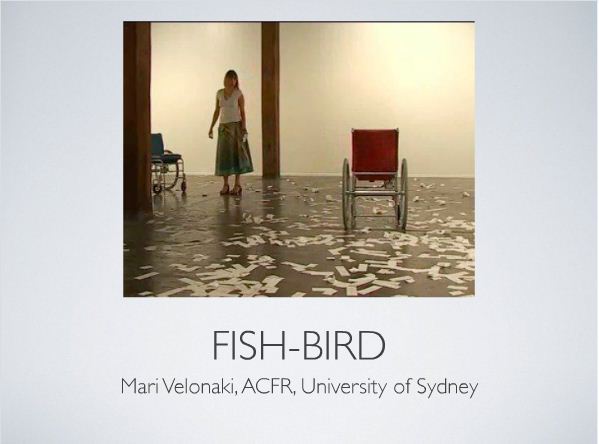
Read about it here in a paper by David Rye, Mari Velonaki, Stefan Williams, and Steven Scheding (all at the ARC Centre of Excellence for Autonomous Systems, Australian Centre for Field Robotics, The University of Sydney). Although the interplay between art and robotics is by no means new, this exhibit struck me.
Anybody know when/where the first art/robotics show took place/showcased? Or, for that matter, good materials on the interplay between art and technology OR art and STS?
Ethics: IRB approval and article reviews
Data collection in the social sciences must typically pass through an institutional review board’s (IRB) human subjects committee (HSC) before being conducted in order to ensure comformity with IRB regulation. This we all know.
I once reviewed an article and while doing so got the sneaking suspicion that the author (whomever s/he was) had not gotten their study passed through the IRB. The reason was that data in the article came in the form of casual conversations and e-mail correspondence. Quotations from data sources identified the speaker/e-mail-writer by name, not pseudonym. There was little written about the length of these conversations, how many there were, where they were conducted, etc. or any mention of the methodological strategy employed or method of analysis. This sort of methodological sloppiness is reprehensibe in its own right, but the idea that this research study might not have passed through the proper research channels started to bothered me.
And then it bothered me a little more.
As I read, article in hand, I increasingly felt like I was holding a soiled garment.
And so, I wrote the editor and, without making any accusations, expressed my “sneaking suspicion” and provided the evidence that encouraged me to think so.
QUESTIONS:
1. Has anyone been asked for proof of IRB approval for articles when social/human subject data used?
2. Has anyone read a paper and wondered if it had passed IRB?
3. What would you do if you read a paper like this during reivew?
A Question of (STS) Style?
Many thanks to Fabio Rojas (whom I met for a sub for lunch in Bloomington back in 2005, but I don´t think he will remember) for letting the readers of orgtheory know about our little blog. We just started, they have tons of experience, so that is great!
The comment to that post made me think about our short discussion about STS, Latour and the uneasyness they seem to induce. Here is why: I always thought that this is due to a double characteristics of ANT (or STS in general) texts. They seem to fall in two basic categories: great conceptual ideas in an insider jargon on the one hand, great case studies that do not really care about theoretical purity on the other (I overemphasize, of course). You have to read both types to appreciate that.
But the comment made me think: wait, it is also a question of style? I could not believe that. But then I tested, the old normal science way: I fired up my reference manager, did a search on “(” in the title field and there it is. Really, nearly only STS papers use the parenthesis type title. These were the only non-STS papers I found:
Dandaneau, S. P. & Dodsworth, R. M. (2006). Being (george ritzer) and nothingness: An interview. The American Sociologist, 37(4), 84-96.
Hughey, M. (2008). Virtual (br)others and (re)sisters: Authentic black fraternity and sorority identity on the internet. Journal of Contemporary Ethnography, 37(5), 528-560.
Jessop, B. (2001). Bringing the state back in (yet again): Reviews, revisions, rejections, and redirections. International Review of Sociology, 11(2), 149-173
Why do we do that? We did it also, yes. Maybe for every single paranthesis we use, we have good reasons. The title of this blog for example is chosen due to the fact that we are not careless about terms, but in general quite carefull. What other sociological term could be more problematic that “social”? And once we start to ask how order in contemporary societies (again, a concept to be careful with) gets installed rather than “just” institutionalized, shouldn´t we be especially careful about calling it social order, then? But in sum it is true: STS texts are written in a certain style, a jargon maybe. Should we try to avoid it?
New articles/idea to watch: Journal of Information Technology & Politics, paper on Wikipedia
Your very own Nicholas Rowland was just added to the Full Editorial Board for the Journal of Information Technology & Politics.
This young journal’s aims is to:
Mission Statement
The Journal of Information Technology & Politics (JITP) seeks high-quality manuscripts on the challenges and opportunities presented by information technology in politics and government. The primary objectives of the journal are to:
- promote a better understanding of how evolving information technologies interact with political and governmental processes and outcomes at many levels
- encourage the development of governmental and political processes that employ IT in novel and interesting ways, and
- foster the development of new information technology tools and theories that can capture, analyze, and report on these developments.
They have also recently published interesting paper about Wikipedia-use and how it variously frames NGOs and now there is a CFP (call for papers) for a forthcoming special issue on the future of computational social science.
Experiment in social networking sites: The monoclization of facebook
This is a serious non-serious post.
Not long ago Hal Niedzvieke wrote Hello, I’m Special: How individuality became the new conformity. As a professor, I teach this book in my introductory sociology courses, or the lesson at least (as they do not read it). I teach the students about how one of the most important preoccupations of our times is to “be one’s self” or to “find one’s self.” This rampant and occasionally pathetic navel-gazing manifests itself around nearly every bend, according to Hal. Even greeting cards, he shows, have messages that encourage anti-conformity — GREETING CARDS ENCOURAGING YOU TO BE A REBEL — and this (among other things) prompts Niedzvieke to suggest that individuality is (somewhat ironically) becoming the new confirmity (as everyone is diligently pursuing individuality).
Now, a good example is tattooing. The content of the tattoo can be highly-individualized (so much so that perhaps only you truly know what it means if anything at all), but the ritual act of getting tattooed and being a tattooed person is where conformity comes in. Likewise, anything like that where the content can be customized and thus appear individualized, but the object or act of purchasing it is so wide spread as to constitute an act of conformity should genuinely fall under what Hal is talking about — and thus how to see individuality amid conformity. Seemingly retro t-shirts on short production schedules, pre-worn seemingly authentic jeans (each is genuinely different and yet eveyone has a pair), these are some examples.
Each year, inevitably, a number of students (some of them critical, some of them so deep in the belly of this new conformity beast that they cannot see what I am trying to tell them) ask to see it in person — it is one thing to show us that we buy pre-worn jeans, it is another thing to show me that we are such suckers for individuality pursuits that we conform in order to get there.
So, over spring break, I developed a social networking experiment. I monocled myself; well, my profile picture, anyways. Then I started to monocle my friends, such as our very own Jan-Hendrik. Then I made a fan page for the “Monocle Project 2011” on facebook (just start searching for “monocle” and you should get there easily) — there is a link on the information tab, but also a link to the webpage I made to easily monocle thyself here. I’d like to see it spread, and from what I can tell it very well might as it has that nice combination of conformity (in monocling) and individuality (as you must use a personal picture of yourself). …we’ll see, I guess.
At the risk of humiliating myself (but it is already too late, I am almost certain), here is an example of the monocled man.

GET YOUR MONOCLE TODAY!
Places to watch: LSE Information Systems and Innovation Group
Probably for most outside the UK this might be a bit late, but I just stumbled upon the SSIT Open Research Forum 7. Seven – I mean: they did that now for six times and I had no idea that a “Social Studies of IT” (with that name) even existed. Wonder why – because I found this announcement via the ANTHEM Blog of which I am a regular reader for more that 3 years now. So I should have seen this or this. The SSIT Forums are hosted by the LSE Information Systems and Innovation Group, definitly a place to watch. But looking at the abstracts of their 7th Forum on IT and the financial crisis I wondered: how can a forum that adopts the “social studies of —” title gather people to talk about finance, crisis and IT without any recognizable input from another “social studies of —” field, namely the “social studies of finance”?
The seventh SSIT Open Research Forum
LSE 29 and 30 March 2011
We are pleased to announce details of the Social Study of IT Open Research Forum (SSIT-ORF7), 29/30 March 2011. This will follow the eleventh SSIT Workshop of the LSE ISI Group. The Open Research Forum will be an opportunity for IS researchers to present their work and discuss a broad range of themes relating to the SSIT in an informal, constructive setting.
Primarily, the Forum provides an ideal opportunity for PhD and junior IS researchers to present their work and raise questions on issues of their concern-substantive, theoretical, methodological or practical. It is also a useful experience for other researchers wishing to understand what SSIT is like, though their research approach may be different – e.g. from an engineering or business perspective.
In previous years the Forum attracted also experienced SSIT researchers, supervisors and PhD programme directors and we had stimulating discussions about the merits and challenges of SSIT research. We expect that this year the Forum will have a similar mix of PhD, experienced and non-SSIT researchers and that it will accommodate challenging discussions on the nature of SSIT.
Another significant feature of the SSIT-ORF is its informality. So, we suggest that presenters avoid PowerPoint presentations or the use of transparencies. There will be a number of short presentations (about 10 minutes) and panel discussions with plenty of time to focus on emerging questions and issues.
Registrations for the SSIT-ORF are currently taking place. Those who are interested in presenting should send a summary (up to 600 words) of their work to SSITORF@lse.ac.uk. Those who are interested in participating without a presentation should apply for attendance at the same email address. As space is limited, places will be allocated on a first come, first served basis.
The closing date for applications is 21 March 2011
Looking forward to meeting you at LSE in March.
SSIT-ORF Committee.
page last updated 19 January, 2011
via lse.ac.uk
Wake-up in the mornin’ feeling like Bruno Latour
orgtheory is a blog written by a number of scholars in organization studies of various sorts, among them is a mentor of mine and all around cool dude, Fabio Rojas.
Omar Lizardo recently posted a thought-provoking post “What it is like to be Bruno Latour” and this made for some interesting comments as well.
As a one-time, now emeritus guest blogger, I took some heat in the name of Latour and ANT, so much so that Fabio joked that Latour ought not be mentioned in certain company.
As this group is generally sympathetic to Latour and Co., what is it about ANT that draws the ire of so many folks?
New scholars and professionals to watch: Cynthia Selin
A few years ago I was sitting on an exercise bike at a gym in Princeton, NJ, reading an article in STHV that used Latour’s much ignored model of diffusion to interpret the mobilization of “the future” in nanotechnology controversies. I remember thinking highly of the article at the time, and upon learning more about the “sociology of the future” realized that it was part of a growing movement in the social sciences, one that was far beyond (from what I understand as previous incantations of this) what Toffler was thinking about in Future Shock or the Third Wave.
The STHV article was written by “Expectations and the Emergence of Nanotechnology” and was published in March of 2007 (vol 32; issue 2). Her abstract reads:
Abstract
Although nanotechnology is often defined as operations on the 10-9 meters, the lack of charisma in the scale-bound definitions has been fortified by remarkable dreams and alluring promises that spark excitement for nanotechnology. The story of the rhetorical development of nanotechnology reveals how speculative claims are powerful constructions that create legitimacy in this emerging technological domain. From its inception, nanotechnology has been more of a dream than reality, more fiction than fact. In recent years, however, the term nanotechnology has been actively drawn toward the present to begin to deliver on the fantastic expectations. This debate over time and timing is loaded with paradox. This work examines how future claims work to define what counts as nanotechnology and reveals dilemmas that accompany temporal disjunctures. Science and politics converge in debates about the future of technology as expectations serve to create and enforce power and legitimacy in the emerging area.
Cynthia now appears to be at Arizona State University’s Center for Nanotechnology in Society where, in addition to her research, she teaches on analyzing the future and even has/had a course of “Justice and the Future.” In addition to being a professor, she is also a “scenario practitioner” (although I’m not entirely sure what that implies) and a strategy consultant.
Studying the future draws a lot of controversy, and I’d like to know more about it. From what I can tell, contemporary research often emphasizes the study of how “visions of the future” are used to mobilize networked-patterns of human behavior that characterize the present, and, therefore, there is no end to the number of applications.
For example,
- How does rhetoric about the future of a software firm shape their present circumstances?
- How does rhetoric about the future of marriage or divorice shape their present circumstances?
- How does rhetoric about the future of a nation-state shape its present circumstances?
…and so on. To reiterate: it seems that there is no end to the number of potential applications. Still, as noted above, there is no absence of criticism to this type of work. I’ve heard it called everything from “non-science” to “poppycock” even during conference presentations about only tangential research regarding the future.
I don’t have a strong opinion other than that the idea that current rhetoric about the future shapes the present is either (a) a hidden-in-plain-sight insight of considerable magnitude or (b) that this insight is hardly an insight at all given how commonsensical it appears to be — or is that just the right mix of the two?
More Governing by Numbers, and more Montr??al
Speaking of governing by numbers, and speaking of Montréal (and speaking of Bettina Heintz), there is the ISA meeting next week, including a panel hosted by Hans Krause Hansen (Copenhagen Business School) and Tony Porter (Hamilton) on “Numbers in Global Governance”. The main convention theme is “Global Governance: Political Authority in Transition”.
Bettina Heintz and myself just finished our conference paper which I will be presenting there next week. The “Numbers in Global Governance” panel is going to take place on Wednesday (March 16, 10.30 a.m., Ramezay), and if anybody reading this can make it to the meeting on such short notice, give it a try.
Hans and Tony will be contributing a paper titled “What Do Numbers Do?”, and there are two other papers on “Numbers of Transparency ??? Transparency of Numbers” by Lars Thøger Christensen (University of Southern Denmark) and George Cheney (Utah), and by Michael H. Allen (Bryn Mawr) on “Incoherent Convergence: Crisis, Power and Normative Discourse in Global Constitutionalism” to be discussed during the session. The paper by Bettina Heintz and myself is titled “Globalizing Comparisons: Performance Measurement and the ‘Numerical Difference’ in Global Governance”.
For those of you unable to make it to Montréal, I’ll write something up afterwards and post it here once I got rid off the jetlag.
In the meantime go here to check out the conference.
Govern by Numbers (AAA), November 16-20. 2011
Back in January when Nicholas and I started thinking about the 4S Session proposal, we also thought about a way to keep the debatte running after 4S. One Idea we came up with was a small series of workshops that could facilitate the discussion on “STS and the State” One of these should focus on how data and data infrastructure is used to shape governance decisions. When searching for a name for this to start applying for a small grant to finance these workshops, we though about “Governing by Data”. We were so happy to have such a nice name for it that we did not notice that we were not the only ones to use a title like that. Bettina Heintz (2008) used “Governance by Numbers” as a title for a paper on science regulation.
And Alison Cool and Jennifer Mack use “Govern by Numbers” for a proposed session for this year´s AAA. We noticed that too late, so now the deadline already passed, but it is good to see likeminded scholars working on similar problems. So if you are planning to go to AAA in Montreal this year, this might interest you
CALL FOR PAPERS: Govern by Numbers: Models, Plans, and the Quantitative in the Welfare State
American Anthropological Association (AAA) Annual Meeting
Montreal, Canada, November 16-20. 2011
Co-organizers: Alison Cool, PhD Candidate, New York University and Jennifer Mack, PhD Candidate, Harvard University
Please send titles and 250 word paper abstracts to alison.cool@nyu.edu and jmack@fas.harvard.edu by March 7, 2011
Statistical and other quantitative techniques form an important means of planning and rationalizing large-scale policy measures in many welfare states. Such “hard facts” are gathered by state-sanctioned actors, such as scientists, urban planners, bureaucrats, and other interested parties, using the data-collecting systems and tools of their trades. Numbers and models produced by such techniques are enlivened through forms of representation and circulated. This panel looks for ethnographic approaches that address questions like: How is the exquisite complexity of everyday life translated into exact figures and “rational” planning methods? What happens when data is represented in graphs, charts, and drawings or embedded within scientific articles, policy reports, and future-oriented blueprints for action? As contexts change and scales shift, what do the numbers mean, and to whom?
While quantitative data is used in tandem with many forms of government, it has been particularly important in the context of welfare states, where the social well being of the citizenry at large may be in tension with concepts of liberty for the autonomous individual. In the welfare state, in other words, the ability to “point to the numbers” has allowed those who govern to provide their publics with empirically-supported reasons for both mundane and radical interventions into everyday life. Yet scientific methods and standardized urban plans work within moral systems of both care and control. Through practices of counting, classifying, and measuring citizens and their spaces, planners, scientists, and bureaucrats act as intermediaries between the welfare state and its citizens in relations that are abstract and intimate at the same time. Actors can also choose not to quantify and call the numbers into question on ethical or methodological grounds. Drawing in part on notions of governmentality, we ask how welfare states make their ideal citizens through measures that are supported by and circulated through such numbers and systems, and how a cult of the quantitative has often become a national project and a topic of everyday discussion for welfare state citizens themselves.
This panel intends to produce an anthropological conversation between built environment and science studies approaches to research in contemporary welfare states. Broadly, we seek ethnographic work focusing on how the planner, scientist, or bureaucrat inhabits his or her official role in practice and how statistics, standardized planning models, and other logics of the state have come to function as truth-making tools, or their foils, in various forms of (welfare) state-making. How do these actors think about (and embody) the relationship between quantitative data and the qualitative opinions and actions of citizens? How do citizens respond to, help to create, and transform the numerical justifications of policy and complicate the mechanisms of the bureaucratic toolbox? We seek papers approaching these topics within the context of any welfare state and focusing on actors working within a number of different fields, including biomedical sciences, demography, urban planning, finance and economics, architecture and housing, engineering, landscape architecture and environmental design, auditing, law and law enforcement, national security, public health, education, and criminal justice.
Proposed categorization scheme for (some of my or some of our) future posts
This is just a thought: hoping to be somewhat generative of future work on the blog, Jan-Hendrik and I were discussing this earlier today (on opposite sides of the Atlantic thanks to google-chat) as one possible framework for moving forward and categorizing some (and probably not most) future posts.
*****************************************************************************************************************
Step One:
Post a summary of one of the following:
- New articles/idea to watch (like STS’s supposedly new “third-wave” mentioned/generated by Pollock and Williams (2008) in their recent book Software and Organisations on the “biography” of contemporary Enterprise Resource Planning (ERP)).
- Old articles/ideas to remember (like a 100 year overdue book review of Weber’s Economy and Society).
-
New scholars and professionals to watch (like Kaniakakis (2006; 2008) and his new-ish agora concept/orientinng framework for doing multi-site, multi-year, multi-scholar STS research projects).
- Old scholars and professionals to remember (like Gabriel Tarde, as mentioned in Latour’s (2005) Reassembling the Social).
- New places to watch (on-line or off-line like orgtheory.net or Copenhagen Business School, the proposed site for the next European Association for the Study of Science and Technology (EASST) annual meeting in 2012).
- Old places to remember (The Pennsylvania State University’s to-be closed STS program).
Step Two:
Within a week or so we all try to post our thoughts, corrections, extensions, and/or tangential comments.
4S Annual Meeting: Society Social Studies of Science, Cleveland, OH November 2-5, 2011
Join Jan-Hendrik Passoth and I (Nicholas J. Rowland) at this year’s annual meeting for Society Social Studies of Science (4S) meeting in Cleveland, OH (USA) from November 2nd until the 5th, 2011.
Submissions and proposals are being accepted. http://www.4sonline.org/ Likewise, we encourage scholars in STS and outside to submit an abstract to a session that Jan and I are proposing. See below:Seeing States and State Theory in STS
Jan-Hendrik Passoth (jan.passoth@uni-bielefeld.de), Bielefeld University, Germany, and Nicholas J. Rowland (njr12@psu.edu), Pennsylvania State University, Altoona, PA, USA Deadline for Abstracts: March 10, 2011 The relationship between science, technology, and governance is a relationship that shapes and is shaped by contemporary states. While this relationship has been influential in STS research on how contemporary modes of governance influence scientific practice and technological innovations, the converse question of the influence of both on governance is relatively underrepresented. This session, therefore, takes-up the task and explores the inter-play between this relationship and its depiction in history and social/political theory. With one eye on “seeing like a state” and the other eye on “state performativity,” we engage and question well-trodden artifacts of historical and social theory such as state entitivity, state materiality, and the much distributed Foucauldian model of stateness. Looking for insights in both directions, what does STS have to offer and learn from these important traditions that have shaped so much previous research? We are also curious about seeing state performances in some historical relief, for example, in establishing reciprocity under neo-liberal circumstances, in shifting ontologies of health care, in massive state projects such as California’s delta, and even in times of ungoverned anarchy set in Southeast Asia. We, therefore, invite papers that explore empirically and conceptually the possibilities of research based on an STS approach to politics, states and stateness, governance and governmentality.
(Session Proposal for the Annual Meeting of the Society for Social Studies of Science (4S), Cleveland, Ohio, November 2-5, 2011)
Informal Work Group ???Installing (Social) Order??? Installed
No doubt that computer science is the formative mode of building the models of contemporary social life. Interactional settings, inter- and transorganizational networks as well as the internal structures of macro-social phenomena like science, politics, economy, art and the media are ‘nerved’ with heterogenous, overlapping and sometimes antidromic tendencies to be formed by extremely distributed but nonetheless large scaled information infrastructure. This tendency of contemporary society not to realize stability and expectability by processes of institutionalizing, but by installing (social) order is the focus of this work group of young researchers from social science and humanities.
This blog is a platform to join efforts and to bring scholars together. Here we collect projects, publications and events, here we will try to widen our debate. Originally formed at the Department of Sociology at the Bielefeld University, it is open for participation. Subscribe to this blog by email or by RSS to follow the debate, contact us if you yourself are working on a project in this area and want to become affiliated.
 Installing (Social) Order