There is a book that I try to read for weeks now. I always read a few pages, then put it back, pick it up again, read, shake my head and put it down again. You would probably not believe it, but this book is Bruno Latour´s “An Inquiry into Modes of Existence. An Anthropology of the Moderns”.
For those who have not touched AIME yet, Latour´s “new” book is not just a book, it is a book + website + collective inquiry, funded by the European Research Council and run by Science Po´s Media Lab. The printed version, the text, is supposed to be mainly a manual, not the report itself. The collective inquiry started somewhere in 2012, being first introduced at Azim Premji University some time before the french publication of the book in September 2012 and the launch of the platform in November 2012. Anglophone readers could join after the publication of Cathrine Porters translation in August 2013, a german translation by Gustav Roßler will be published this July. The project itself, maybe best described in a short piece published in Social Studies of Science, is what could be called a positive version of the, well, negative points made in “We have never been modern”. It is — finally — tackling a problem that accompanied actor-network theory since its beginnings (or at least: since its first movements outside the lab): If everything is made from networks, and “Nothing is, by itself, either reducible or irreducible to anything else”: how to deal with what the moderns have called the differences of regions, spheres, fields, systems like science, law, politics, religion, organization? How can we flatten our approach without loosing our ability to account for the only kind of multiplicity that modernity has accepted, but continuously misunderstood as domains of knowledge? And what do to with what modernity has positioned at the source of knowledge — the self — or its object — matter?
Latour does that — Whitehead, Souriau, James and Tarde in his backpack and ready to dismiss the “Greimas” part of the “ANT is part Garfinkel, part Greimas” definition — by trying to sketch what he calls, borrowing a term from Souriau, “modes of existence”. Like the “regimes of enunciation” that populated earlier writings, especially those on religion and law and that have the same problem as Greimas’ actants, namely that they invoke a textual, discursive, narrative interpretation of what is at stake, modes of existence try to capture what “passes” through the various heterogenous networks that ANT had described. But of course, as in the case of science, the modes are not domains. There is more than passing reference in laboratories and more than politics in parliaments and more than religion in churches. The modes are the multiple forms of being, not essences — or, in Latour´s words, not being-as-being, but being-as-others — that populate the lab, the church, the parliament and that the moderns have crossed specifically and confused with the values they hold dear. The question that runs through the book is: can we find ways to speak with the moderns about what they hold dear without falling back into the traps that the modern constitution has put all over the landscape: the bifurcation of nature, the subject/object distinction, the crossed out god(s)?
As a long time reader of Latour´s work, I find the book both tempting and troubling, making be shift continuously between agreement and the feeling that something is terribly wrong with it. And since the moment I started reading the book, I am trying to find out what it is that produces that oscillation. I first thought it was the tone: the book is written in a very careful and modest, but at the same time educational, sometimes even cavalier style. But the tone, although puzzling at first, surprisingly funny after a few chapters. Then I thought it was the system of 15 modes and I felt the terror of reification and loosing not only the Greimas, but also the Garfinkel side. But no, that is not really the problem, as the inquiry is explicitly provisional. But the feeling that something is wrong remains. My current guess is that it has to do with the both too broad and too narrow definition of “the moderns”: what is said about religion is mostly about catholic christianity; what is said about law is mostly about discretionary adjudication, a very specific form of dealing with legal means in the Conseil D´Etat. The Moderns are at the same time “us”, “rich westerners”, “white moderns” and a species long gong. I guess expect more sensitivity and caution from something that calls itself anthropology. But I am still not sure that is source of my problem reading this book. Have you read it? Are your experiences similar? Thoughts?

















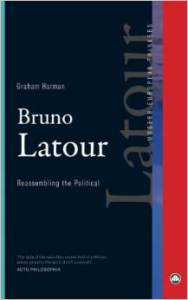 Graham Harman’s new book Bruno Latour: Reassembling the Political is due out in October. Details in the








You must be logged in to post a comment.