The challenge of de-centering humans — especially in the traditional home of human-centricity like sociology or anthropology but also in the humanities — has been gaining attention for years; however, a few ongoing developments are worth considering.
First, in human and cultural geography, our fellow bloggers at THE ANTHROPO.SCENE have recently posted (thanks, dmfant) a video “Decentering the human in human geography“, which is a lecture about ontological, epistemological, and even moral issues related to “human exceptional-ism” in our social sciences. The talk is by Kay Anderson, University of Western Sydney. At 45 or so minutes long, the talk defies simple summary; however, one might hazard this synopsis: humans have been deemed irreducible to nature, but their very ‘humanness’ is precisely predicated on their transcendence of mere beasts; the specialness of humans (and this is no news to long-time readers of ANT), thus, distracts us from material forces of significance; our presenter then historicizes, thus rendering vulnerable, human exceptionalism, treating the concept like an artifact of time rather than one of truth; hence, the lesson is that de-centering humans through historicizing the processes of centering humans, in the first place, and by appreciating humanism’s materiality and smashing the boundary between humans and nature, can we finally get a de-centered view of humans in geography. Of course, there are many more voices in this discussion that have been overlooked (by me, of course).
What makes Anderson’s talk so interesting is that by historicizing the concept of human exceptionalism we can take the concept to be an empirical matter rather than a presupposition for starting analysis (we tried to do this move with reflexivity). But this requires a careful tour of early biological sciences (e.g., Linneaus) and especially naturalists and anatomic crainiology, but in so doing, we realize that the claims toward human exceptionalism, under the bright light of empiricism, were often unstable and frequently revised in substantial ways. While I fully realize that post-humanism has been around for decades (although Haraway’s cyborg seems so odd now, so 90s), Anderson’s shift of perspective is a welcome development, and one, I contend, could be replicated in other areas. Here is the only room for criticism, though: in biological sciences (and perhaps I am raising the boundaries I would just as well smash, but …) there is not such a clear or direct link to the social sciences wrought with human exceptionalism; I agree that Anderson is uncovering the roots of this plague (i.e., human exceptionalism), but once it leaves the proper confines of biological sciences and then it taken-up as a presupposition or justification for “doing anthropology”, for example, the concept has been transported and, to some extent, changed as a condition of transport. Thus, surely, human exceptionalism has historically meant something different in anthropology as compared to sociology, each of which could be uncovered in a future analysis, or, consider, a comparison to international relations, which brings me to my second point … ir.
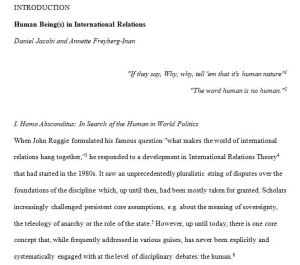
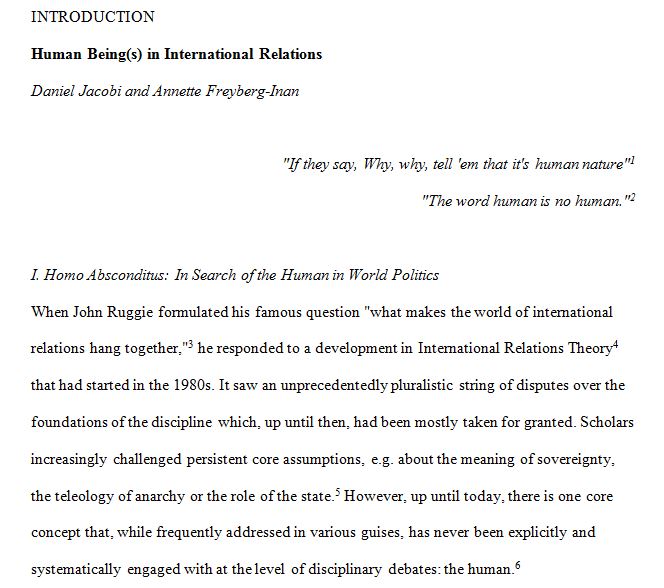
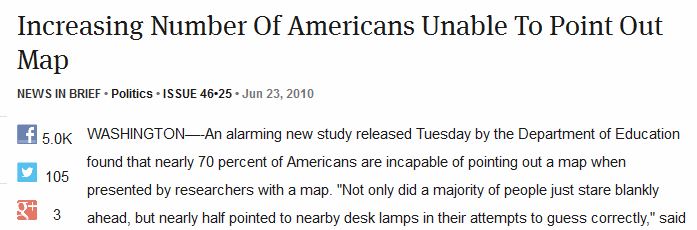
Second, in international relations, a book is underway that considers ‘the human’ from a post-anthropological perspective. Some of us contributing to the book are using this opportunity to de-center humans too, only this time, it is an experiment to see how far one can de-center humans and still have viable theories for international relations, in our case, theories of the state. The opening lines of the to-be book are above in the image and give one a sense of the tone for the book.
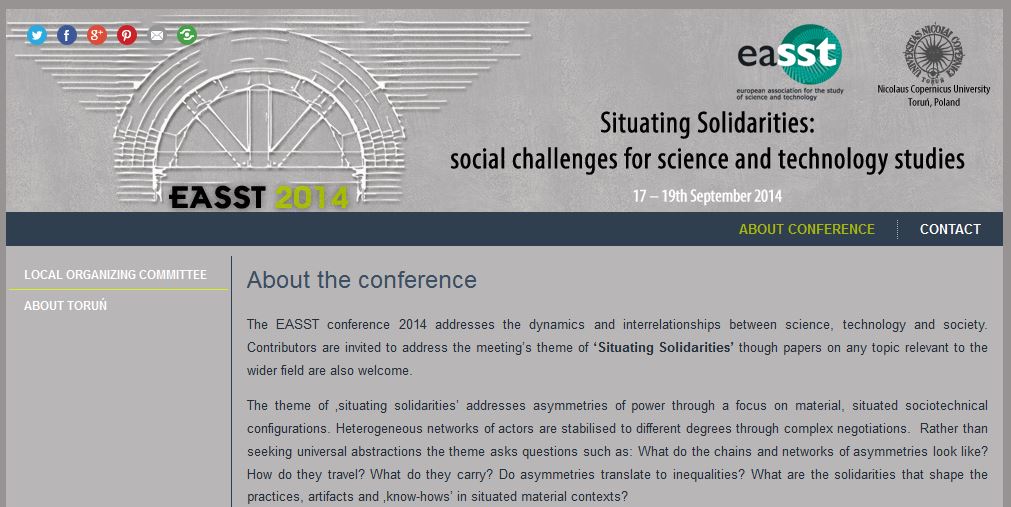
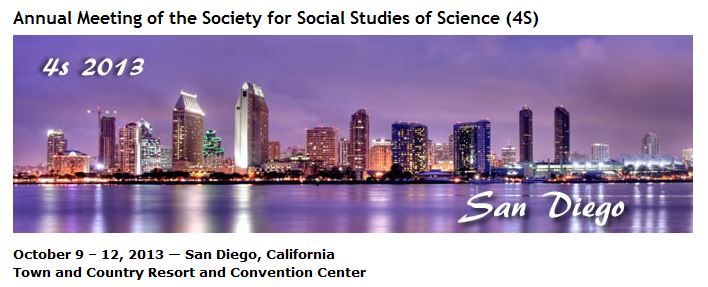
An upcoming event is going to be held at Goethe-Universität Frankfurt am Main “4th Global International Studies Conference 2014” (Aug 6-9), which I would love to attend, will no doubt also deal with issues related to de-centering humans. This would be a great opportunity to blend some of the thinking in geography, anthropology, and international relations precisely because the book, which is related to this conference. is considering a “post-anthropological international relations” …
The conference details are:
Our goal is to provide an interaction space in which International Relations research expertise can be shared on an international level and thus contribute to the expansion of a truly global professional network. For this purpose, IR scholars from around the world will meet in Frankfurt and present their research to a broad audience made up of scholars and experts in all fields of international studies. The overarching theme of the conference is „Justice, Peace and Stability: Risks and Opportunities for Governance and Development“. In addition to classical issues in diplomacy, security and development studies, panels and roundtables will pay special attention to novel issues in global politics, including emerging actors in international relations and new forms of south-south cooperation.
Our paper that will be part of the book, opens like this;
Acting in international relations? Political agency in post-humanist state theory
Jan-H. Passoth, Department of Sociology, Technische Universität Berlin
Nicholas J. Rowland, Department of Sociology, Pennsylvania State University
This edited volume sensitizes readers to a budding divide in International Relations (IR); a shift away from crafting overly-anthropological accounts to describe the practice of international relations (ir) and toward what our editors are calling post-anthropological scholarship.[1] The chief difference hinges on the position of the human element in IR; front and center, in the former, peripheral and de-centered, in the latter. The upshot for patient readers is insight into what the consequences of this shift will mean for IR and ir.
Our chapter constitutes an experiment to test the outer limits of this shift. We ask: how far can we, as scholars, decenter the human element before our models of international relations implode? To this end, we selected ‘the state’ as our test case. By only analyzing models of the state, we were finally able to dis-inhabit the state of the human element entirely, but, in the process, we were challenged to re-conceptualize many our otherwise taken-for-granted, anthropological assumptions about political agency. No doubt, some readers will be dissatisfied or un-persuaded by our experiment in post-anthropology; admittedly, we had no choice but to scour many, occasionally incompatible literatures to trace-out a fully uninhabited state in the course of our analysis. That being said, we generally believe that our analysis identifies and explores some of the outer limits of what it might mean to legitimately de-center the human element in IR. This test in post-anthropology also has an important implication for the relationship that binds IR to ir. One of the enduring quests in IR and beyond is to determine a universal, ontologically sound definition of the state once and for all. However, we now take this as a fruitless, if not reckless, endeavor. One viable alternative direction for future IR research would be to formulate and, ultimately, implement a model of the state that is more consistent with models of the state that are used in ir (i.e., out there in practice). Put another way, in IR, we need models of the state that capture the complexity of how models of the state are actually used in ir. This shift requires not a theory, but an approach to theories – a model of models – and we develop this line of inquiry forthwith.
[1] Regarding merely the label ‘post-anthropology’; we are fully aware that this term could quite easily be misinterpreted if taken too far from its orienting context in this edited volume, or if it is taken to be a literal description of our scholarship here. It is important to note that the post-anthropological turn in IR scholarship has nothing at all to do with the long tradition of Anthropology as a discipline, and, coming from the small world of Science and Technology Studies, it is significant for us to be clear that post-anthropology in IR is not a direct challenge to the anthropology of science, which our area of study has done so much to cultivate. From this point forward in the chapter, when we use the terms ‘anthropology’ and ‘post-anthropology’ it will be in the same spirit that our editors layout in their orienting introductory chapter, to wit, our title contains the term ‘post-humanist’, which we see as consistent with this distinction.


 Christine Hine is an early pioneer of virtual ethnography and has been at the forefront of movements towards redefining ethnography for the digital age. She is currently a Reader at the University of Surrey’s Sociology Department.








 For four years, Bradley Garrett (


















 Installing (Social) Order


You must be logged in to post a comment.