Unknown's avatar

About Nicholas

Professor of Sociology, Environmental Studies, and Science and Technology Studies at Penn State, Nicholas writes about scientific study of states and the future.

Homeopathic Infrastructure: Machiavelli on Infrastructure

Recently, an old dissertation fell into my lap and I’d like to tell you about it. I asked my work study to find basically anything about the state and state theory for Jan and I’s book “The State Multiple,” which we are writing now. Well, the dissertation was from 1988 by Michael Soupios, now a storied professor at Long Island University here in the states, where he’s being teaching for three decades and more. His 1988 dissertation from Fordham *(he has multiple PhDs) is titled “Human Nature and Machiavelli’s Homeopathic Theory of State” wherein he tackles the basic quandary set forth by Machiavelli.

Capture

Quoting the dissertation:

The terms “homopathic” or “homeotherapy” are of medical origin and refer to a form of treatment in which an element similar to the causative agent of a disease is itself used in attempting a cure. It is precisely this approach that we find offered in Machiavelli’s political formula.

The dissertation goes on to explain how Machiavelli’s vision of humans was basically that we are a bunch of decrepit liars and thieves and, thus, deserved to be treated with as much manipulation and self-service as we would impart on others. Call this, let’s say, a Hobbsian antidote to the crisis of the commons and the natural order of man, although Michael Soupios refrains from the comment (good to stay on topic in a dissertation!). We are not to be ruled and governed by a force that helps us to repress our baser instincts and then choose to be together non-violently as a form of supra-self-interest (sort of like a dynamic where we cooperate just long enough to compete, like children playing nearly any game), and, instead, we see Machiavelli’s view that you treat like with like, or his homeopathic view of states. Michael Soupios tackles fear and force, fraud as an instrument of the state, and creative conflict within the state before setting his sights on how this approach could even be instantiated as a model for International Relations.

The dissertation is fascinating and essentially well-written. Now, this view of politics is politics by political means, if you will. Since this writing, STS has entered the discussion of the state, perhaps foremost by my friend and ally in state theory, Patrick Carroll, who, in his many written works, shows how the state, as we know it (i.e., as an actor, a macro entity capable of action, etc.) is a falsehood of sorts and instead the state is made-up of all things stately such as people, bogs, trees, and all the measurement techniques used to make the state’s ‘self’ register in formal documents of statehood and statecraft. For Patrick, the state is constructed and environmental rather than iconic and abstract; material rather than conceptual.

So, with enough force, could Michael Soupios and Patrick Carroll be collided with enough force to make the argument: if one model for the state is homeopathic (i.e., Mach’s), and if one model for the state is material, then could we have a hybrid theory, a homeopathic-material theory of the state?

If that is the case: what would the infrastructural equivalent of homeopathic statecraft look like? I don’t yet know, as I’ve only just completed the dissertation read, but it seems like a viable option forward if one wants to engage the cocktail of normative and empirical claims-making that is contemporary political theory.

Another Turn After ANT: An Interview with Bruno Latour:

Is a Post-Post-ANT Era about to begin (again)?

dmf's avatarANTHEM

Another Turn After ANT: An Interview with Bruno Latour:

Latour Interviewed About His New Book

by Adam Robbert

Another Turn After ANT: An Interview with Bruno Latour: ”This is a review, or preview, in the form of an interview, of Bruno Latour’s forthcoming book, An Inquiry into Modes of Existence. We discuss his intellectual trajectory leading up to actor–network theory and the pluralistic philosophy underlying his new, ‘positive’ anthropology of modernity.”

View original post

Abstracts are in for 4S 2013 San Diego!!!

Capture

Submissions in! Jan and I (Nicholas) proposed an open session for this year’s Society for the Social Studies of Science meeting in San Diego this fall. We already have 18 submissions for the one session, which — at least I think — is the highest level of interest we’ve had in the state/stateness area of STS in the last few years of organizing these panels/sessions. Obviously, this is very cool, and we are stoked. If you sent us an abstract, thank you; they look great. Looks like we’ve got a month to put the abstracts into order. We are being allotted 15 total spots to spread over 3 sessions, which will also be the biggest set of sessions we’ve been allowed to host.

Timing: According to the webpage about the conference, by 12 May 2013 abstract submitters should learn of their acceptance notification and the placement of their respective papers (the day afterward, early registration starts, coincidentally).

Capture

Also, for those unfamiliar with the sessions we promote: We called the proposed session “State Multiplicity, Performativity and Materiality: Current STS Research on State and Stateness,” and our brief description reads:

Annual Meeting of the Society for Social Studies of Science (4S), October 9 – 12, 2013 — San Diego, California


Open Session 43. State Multiplicity, Performativity and Materiality: Current STS Research on State and Stateness


Organizers: Jan-Hendrik Passoth; Nicholas J. Rowland


Currently, science and technology studies is rich with opportunity to conceptualize the state and comment on its consequences for global living. While long under the conceptual jurisdiction of traditional political science, political sociology, and political history, scholars in science and technology studies have, with their own concepts and style, taken to rethinking the state and, with renewed nuance, capture its many and multiple influences in our (decidedly) material world. Similar to the move made by scholars in the social studies of finance, when they showed us how to rethink economic sociology, recent work on the machinery and infrastructure of governing is growing in significance. We see large empirical studies of water infrastructure in India, Columbia, and US states such as California, research on public transportation systems and global logistics, work about census creation and population data gathering as well as growing and genuine theoretical contributions to state theory and theories of stateness have all been published in recent years.

The upshot: Conceptual lens such as multiplicity, performativity, and materiality, which are central to contemporary science and technology studies, provide one such direction toward an explicitly science and technology studies perspective on the state. We believe that this line of thinking, if properly developed in-house by science and technology studies scholars, has the potential to produce discourse-changing research even among our friends in traditional political science, sociology, and history. This open panel will consist of two or three sessions. We invite empirical and theoretical contributions on a wide variety of topics, regions, and theoretical approaches. We encourage work-in-progress as well as more mature projects to the session. We especially invite papers on the multiple ontologies of political entities such as states, the performativity of social and political theory, and the materialities of governing modern states and their environs.

STS Program at Penn State

As a member of the University Faculty Senate serving on the Faculty Affairs Committee here at Penn State during the 2011-2012 academic year, I got a first-row seat to witness the de-commissioning of the University’s STS program, which closed, formally, on July 01, 2012. This was a challenging thing to observe, given my commitments teaching STS courses to our engineering students; however, it seemed that no faculty push-back could reverse what was ultimately deemed an administrative dis-continuation of the program (which had considerable academic implications even if relatively little consultation with non-administrative faculty took place). A commonly heard comment was that Penn State was ending STS at the precise moment that Harvard initiated their program.

Be that as it may, I have often pondered why STS was de-institutionalized at Penn State … and so, when this landed on my desk, from a colleague and reformed STSer, Gary Weisel, I think I found a significant part of the story that I simply did not fully realize prior to reading it.

Image

So, Lehigh University published a curricular newsletter for their STS program. This is the cover of this issue I am referring to, which documents (like a miniature case study) the history of the STS program at Penn State. Interestingly enough, the program was “low church”, and I think this contributed to its failure to fully embed in the University. Long time STSers, no doubt, you recognize that high-church/low-church distinction. For new comers, this harkens back to old discussion from 1992 by Juan Ilerbaig, which could be summarized nicely as the following:

… [programs] with a problem-centered, social activist bent (e.g., Penn State) and ones with a discipline-centered, scholarly bent [constitute] … as a Low Church-High Church distinction (see June 1992 Science Technology and Society Curriculum Newsletter “The Two STS Subcultures and the Sociological Revolution” pgs. 1-6)

Thus,

The issue here reminds one of the contrast between high church (Roman Catholic) views of the religious life as a profession of it own versus the low church (Protestant) rejection of such religious specialization in the name of taking religion to the world, into all secular professions (see above image for source).

Somewhat unsurprisingly, the origins of the STS program at Penn State come from the fall of 1969 in the wake of student protest. The program has had, ever since, an enduring character of rebellion and resistance. At first, the program was going to have three components, a graduate minor, undergraduate course offerings, and “research and continuing education components” (see above). As it happens, then-President Walker granted only the course offerings to undergraduates, which constitutes the first step on a path toward the low church, or, put more plainly, a step toward advancing undergraduates and non-advanced degree seeking students and a step away from a department that produces top-quality research. During the 1978-1979 academic year, the program was evaluated and concluded that funding was too low, faculty typically volunteered to contribute the courses (and were not standing faculty), and that teaching and research were not well integrated (which, I assume, meant that the teaching mission took priority over the research mission of the program). However, Rustum Roy, who headed-up the program, pushed forward gaining some external funding (NSF) for the program and its educational initiatives. For Roy, the STS program was foremost about “technological literacy” which he saw as:

… a [1] good dose of science education, approach from the perspective of practical problems and technology, and some [2] critical awareness of the social interface.

This is somewhat perplexing for the university because the program aligned with pro-science and pro-engineering faculty, but also aligned with those faculty critical of science and engineering, which ultimately made of an uneasy relationship among faculty who generally taught STS voluntarily or as an overload. The STS newsletter called his program “bi-polar”, and loosely indicate that these unsettling relations did not bode well for the STS program in the historical context of the science wars. The program grew under Roy’s leadership, but, in 1989, when Roy retired, the STS program shifted its administrative home to the College of Engineering under the new direction of Carl Mitcham. External support for STS-oriented science education floundered (and this detail is unclear; either Mitcham did not pursue external funding, failed when he did pursue it, or whether or not the NSF grew tired of supporting STS educational endeavors.). Mitcham consolidated the program, and, upon external evaluation, the same set of concerns appears to have endured. The mission was:

… to broaden scientific and technological literacy outside the scientific and technical community, and … to deepen ethical, political, and social sensitivity within the scientific and technical community.

During the early 1990s, the program taught about 800 students per year, but “resisted creating an undergraduate major or graduate program.” At this time, the shift toward enhancing interdisciplinarity on many campuses across the U.S. was brewing, but interdiscipinarity and the joint-appointments they create for faculty did not embed well in the university setting (perhaps because of old entrenched reasons).

The entire analysis reminds me of Fabio Rojas‘s book about how black studies departments were similarly born of 1960s social/political protest. The programs that have sustained themselves over the years tended to be, to use the language we used above to describe STS programs, high church (i.e., academically-oriented research departments) rather than low church (i.e., student-oriented or community-oriented teaching departments).

The bottom-line: it appears that if you want to embed a department/program within the context of a large, research university, then even those departments born of radical social/political protest much make accommodations with the university in question by joining the research mission of the college. Whether or not universities are unresponsive to education-only or community-oriented programs is less clear to me, but in the case of STS, the programs that last may very well be the programs that publish.

Fabio writes for orgtheory.net, a great blog about organizational studies. Also, on black studies, one of my top undergraduate students looked into the historical roots of the Black Studies program here at Penn State and recently presented his findings at the Eastern Psychological Association’s annual meeting. He pretty much found the same things described above; if research is not the first priority of the department, then it seems that the department is destined to struggle over the long run, even if it satisfies important demands from the student body (like enhanced course offerings in black history, for example).

Guest Blogger for April: Stefanie Fishel

Stefanie Fishel received her doctorate in Political Science from Johns Hopkins University and a Master’s degree in International Relations from the University of Victoria. Dr. Fishel approaches International Relations using techniques and inspirations from Science, Technology, and Society (STS) studies, the philosophy of science, and biology. She is currently at Colgate University in their Peace and Conflict Studies area.

I met Stefanie at the 2012 Millennium Conference at the London School of Economics during a post-conference workshop about how actor-network theory and international relations might fit together (if at all). Andrew Barry was the keynote speaker. In all, it was great.

In her LSE talk, “Lively Vessels and Contaminated States: Biological Metaphor and Global Politics” Stephanie described … well, I’ll let her fill you in over the next month.

Join us in welcoming Stefanie to the blog!

Postdoctoral Fellow in Infrastructure Studies, University of Michigan

Postdoctoral Fellow in Infrastructure Studies, University of Michigan

The University of Michigan announces an eleven-month postdoctoral fellowship position. The position will start September 1, 2013.

Salary: $50-60,000 per year (depending on negotiated duties), plus a competitive benefits package, $5,000 in discretionary funding, and the opportunity to appoint and supervise one or more paid undergraduate research assistants to work on projects of your choice.

To apply:

Candidates should submit the following materials electronically to Prof. Christian Sandvig

Email one PDF file which includes:

  • A statement of interest describing your relevant background and skills
  • A current curriculum vitae
  • The name and contact information for three references. (One reference should be your doctoral advisor.) Letters of recommendation will only be solicited from finalists.
  • Two publications or other writing samples
  • Review of applications will begin immediately and continue until the position is filled.


Position Description

The Department of Communication Studies (in the College of Literature, Science, and the Arts) and the School of Information are jointly offering a postdoctoral fellow position in the multidisciplinary area of “infrastructure studies.”

The addition of information technology is transforming the way society provides important infrastructures, including those that support media, telecommunications, power, and transport, but also those that support knowledge, culture, and scientific data. Thanks to new capabilities in computing and control, every year our infrastructures claim to be “smarter,” with new capacities for distributed processing, analysis, sensing, adapting, and autonomous self-improvement. This radical transformation is well underway, but the assessment of its consequences is still in its infancy. For example, infrastructure unevenly distributes benefits and capabilities, with complex and sometimes unforeseen implications for politics, economics, knowledge, and social justice (to name just a few domains). This position will fund a researcher who will have the opportunity to work alongside senior collaborators to define and shape this new area of scholarship.

Qualifications:

The successful applicant will have completed the Ph.D. in a related area by the start date with a dissertation related to information and/or media infrastructures, broadly defined. The ideal candidate may be trained in science & technology studies, information science, media theory, computer-supported collaborative work, and/or human-computer interaction. Applicants should have some familiarity with qualitative research methods. Applicants who also have some technical background related to the infrastructure(s) they study are of particular interest, but this is not required.

This position is jointly sponsored by two academic units located on adjacent floors of the same building. The postdoctoral fellow will have office space in the Department of Communication Studies and may have the opportunity to teach one course in the School of Information (to be negotiated). The postdoctoral fellow will pursue his or her own independent research agenda, but will also be expected to collaborate with the faculty on the convening committee (listed below).

The postdoctoral fellow will be an equal member of the research group. S/he will be expected not only to conduct independent research, but also to collaborate actively in joint research projects with faculty, graduate students, and undergraduate research assistants. This responsibility includes regular communication and coordination with the project team. The postdoc will also be expected to contribute substantially to publications related to “infrastructure studies,” acting as first author on some and as a secondary author on others.

Convening committee:

Prof. Christian Sandvig (chair)
Prof. Carl Lagoze
Prof. Paul N. Edwards

Please feel free to contact any member of the convening committee with questions about this position. As mentioned above, please send application materials to the search committee and not to individual committee members.

Non-Discrimination Policy Notice

The University of Michigan, as an equal opportunity/affirmative action employer, complies with all applicable federal and state laws regarding nondiscrimination and affirmative action. The University of Michigan is committed to a policy of equal opportunity for all persons and does not discriminate on the basis of race, color, national origin, age, marital status, sex, sexual orientation, gender identity, gender expression, disability, religion, height, weight, or veteran status in employment, educational programs and activities, and admissions. Inquiries or complaints may be addressed to the Senior Director for Institutional Equity, and Title IX/Section 504/ADA Coordinator, Office of Institutional Equity, 2072 Administrative Services Building, Ann Arbor, Michigan 48109-1432, 734-763-0235, TTY 734-647-1388. For other University of Michigan information call 734-764-1817.

Teaching STS: Windmill Farms and Windfall (the documentary)

Visit to a windmill farm followed by a viewing of “Windfall,” the only anti-windmill documentary that is available; the juxtaposed experiences should provide more than adequate resources for a rousing discussion about people, wind, energy, and the environment.

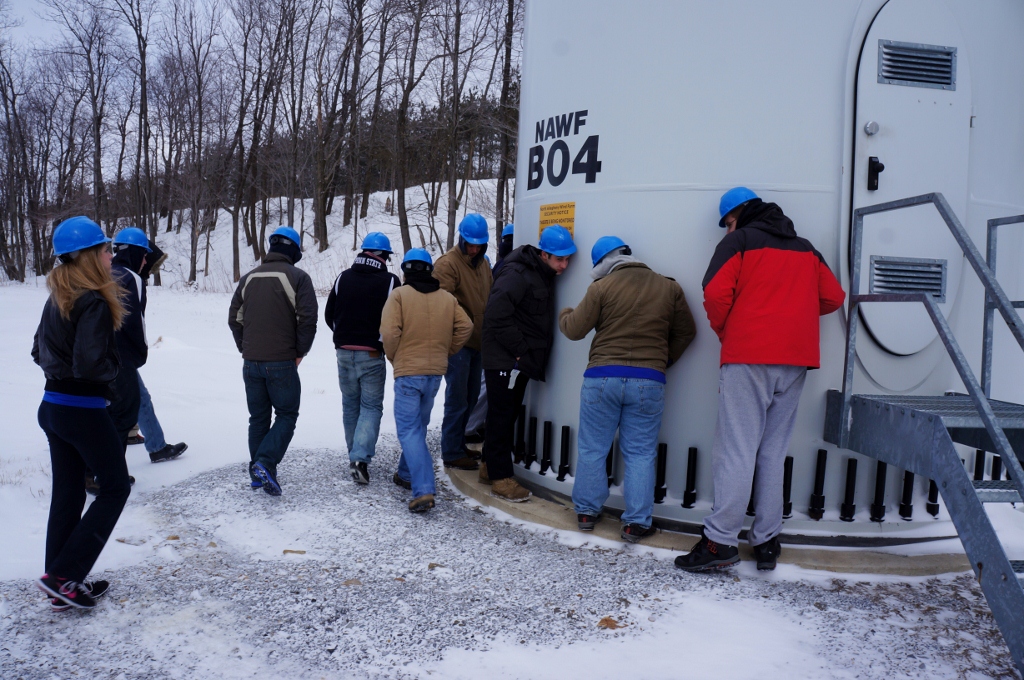
Today, Friday, March 22, my STS class (Topics in Science, Technology, and Society) went to the windmill farm in Cresson, PA, which was built by Gamesa and is currently Pennsylvania’s largest operating windmill farm (more about Allegheny Ridge Wind Farm).

Image

At 22 degrees Fahrenheit being the warm part of the morning, we enjoyed a windy and snowy experience. This is unsurprising, though, given that the mountain ridge we visited was specifically selected for its high winds. These windmills were truly impressive up close, and the students were, despite the cold, the wind, and the snow, full of questions. While the oscillation of the blades did make an audible sound, even at some distance, we were all surprised by how violent the blades seemed to rotate as compared to how quiet and motion-less the bases were … it was almost tranquil, we agreed.

Image

The ridge, which is expansive, hosts 40 turbines, which are 2MW generators. While the return on investment for a free-standing windmill like the ones pictures is about 5 years, the ones we viewed had an ROI of nearly 20 years because of early quality control issues with the blades (they were splitting apart like bananas). According the farm’s website, “Estimated annual production: 200 GW.h (for an equivalent of 2,500 hours of full load/year)” which is impressive.

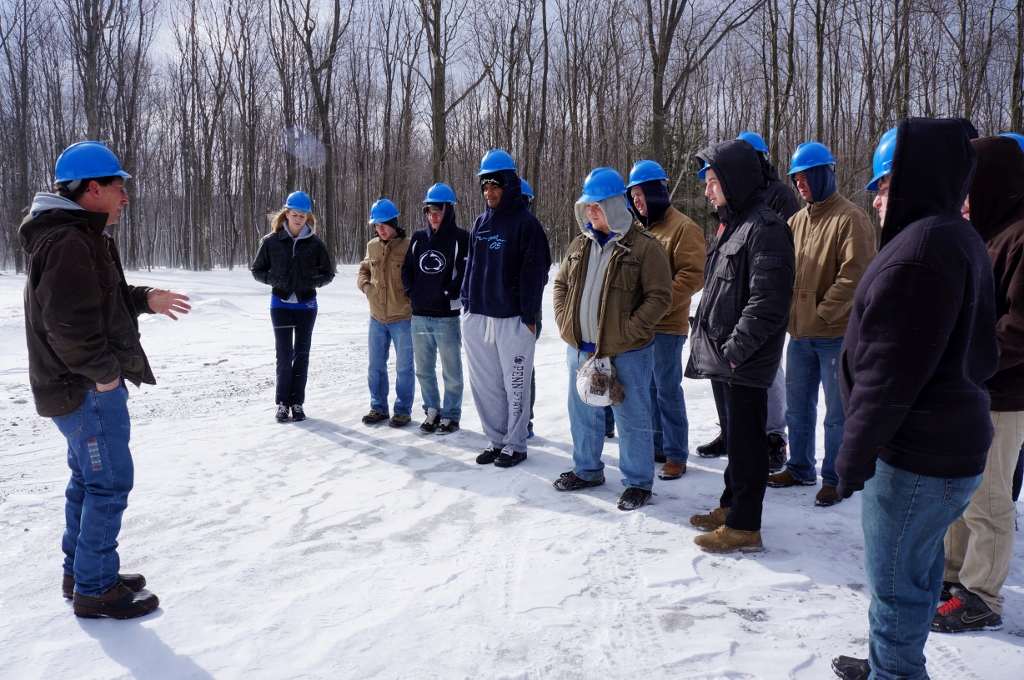
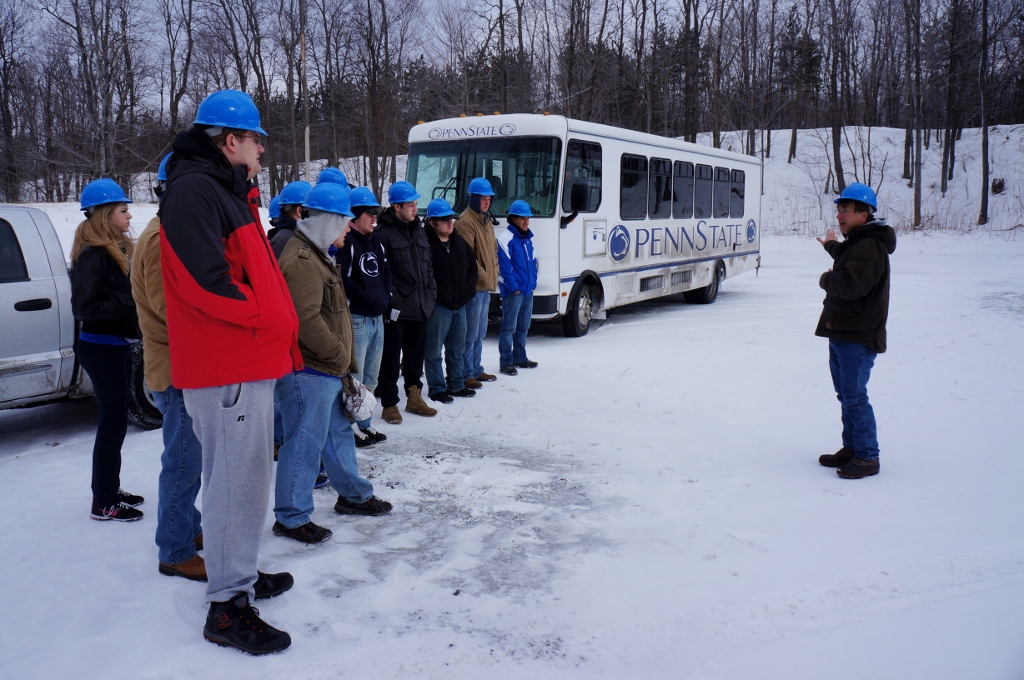
Our guide was great; his name was Michael Barton, a local forester and wind expert.

Image

About Michael Barton:

He earned a Bachelor of Science Degree in Forest Science (Forestry) from Penn State University in 1983. … In 2007, he received the “Sustainable Energy Education Award” in Pennsylvania sponsored by Gamesa Energy, USA. In 2008, Michael was the co-chairman of the Society of American Foresters (SAF) – Allegheny Section summer meeting entitled “Forest Land Issues Related to Wind Energy.” For that effort Mike was presented with the SAF Award for “outstanding service, dedication and effort for a successful Allegheny Society summer meeting.” (available here).

He told us today that this was his 248th tour of the wind farm, all of which he has done as a volunteer. I have taken students on these trips for half a decade, and will continue to. As a forester and environmental consultant, it is quite important to show students the significance of water quality on these ridge-lines. Of significance, the spot we are standing in this next photo is on the ridge that splits one-way to the Ohio Valley, and, thus, the water ends-up in the Mississippi River, and the other way to the Chesapeake Bay. Contamination on this site would pollute both directions. Barton helped oversee the environmentally safe work that went on here … also of note, this spot, it is perhaps 4FT from where a 35FT wide 1 million pound crane would have passed; cranes which are necessary to assemble the turbines). The water on site, was crystal clear.

Image

A final point of interest is that we would not have been able to take the tour earlier in the week because of the ice, rain, and snow. But not for reasons of travel. Instead, as Barton told the students, windmills of this caliber throw ice.

Image

“I’ve seen a sheet of ice as thick as my hand embed itself into the driver’s seat of a pick-up truck,” then Barton said, “if you had been sitting there, it would have probably cut you in half.” I noted the silent pause…

In all, it was a great experience. We are all in Barton’s debt for his good work.

Image

That said, later today we are going to starting viewing the only anti-windmill documentary that I have been able to find.

Image

The film is about:

Wind power… it’s sustainable … it burns no fossil fuels…it produces no air pollution. What’s more, it cuts down dependency on foreign oil. That’s what the people of Meredith, in upstate New York first thought when a wind developer looked to supplement the rural farm town’s failing economy with a farm of their own — that of 40 industrial wind turbines. WINDFALL, a beautifully photographed feature length film, documents how this proposal divides Meredith’s residents as they fight over the future of their community. Attracted at first to the financial incentives that would seemingly boost their dying economy, a group of townspeople grow increasingly alarmed as they discover the impacts that the 400-foot high windmills slated for Meredith could bring to their community as well as the potential for financial scams. With wind development in the United States growing annually at 39 percent, WINDFALL is an eye-opener that should be required viewing for anyone concerned about the environment and the future of renewable energy.

We will see how it goes.

Image

Liquid Infrastructure

I’m not sure if it is fair to say this, but … we all know that Zygmunt Bauman is a considerable force in contemporary social theory. I was first turned onto his work when reading his small tome on globalization. I was impressed by his ability, at times, to tackle seemingly insurmountable issues such as the space/time relationship and so on.
Today I got a promotional e-mail from Polity Press celebrating Bauman’s work on liquidity. This was part of the advertisement.

Capture A

So, Bauman has been developing this notion of liquidity for more than a decade (although, from what I can gather the quality of writing, the tone, and the style change little between the books). Bauman published Liquid Modernity in 2000, Liquid Love in 2003, Liquid Life in 2005, Liquid Times in 2006, and Culture in a Liquid Modern World in 2011. These pieces should be lauded for developing the same concept so slowly over such a long period of time. Obviously, there is some repetition within the titles, which will undoubtedly annoy some readers. I grabbed the titles from our library here at Penn State and started to page through them …

  • In Liquid Love, Bauman decries increasingly unfixed relational ties that bond us together, leaving the average person to connect to others with whatever resources they have at their disposal.
  • In Liquid Life, Bauman describes how we live in a world of stubborn uncertainty, perpetual self-re-creation, and which is marked by a need to rid ourselves of the worthless junk we accumulate.
  • In Liquid Modernity, Bauman in the years following the Second World War, a period of expanding wealth and commercialization in the West,
  • In Culture in a Liquid Modern World, which, while containing the liquid metaphor in the title of the book, seems not to develop the concept further within the book … at any rate, Bauman describes the history of the term culture and its failure to help or aid those cultures it was supposed designed to describe.

In the end, it is Bauman’s Liquid Times, the 4th title he published in the ‘liquid series’ that has the most insight about what a ‘liquid infrastructure’. The dust jacket reads:

Zygmunt Bauman’s brilliant writings on liquid modernity have altered the way we think about the contemporary world. In this short book he explores the sources of the endemic uncertainty which shapes our lives today and, in so doing, he provides the reader with a brief and accessible introduction to his highly original account, developed at greater length in his previous books, of life in our liquid modern times.

In Liquid Times, Bauman goes on to describe the un-fixity of social institutions, which he sees as too fluid to count and a poor base on which to plan for the future, which leaves individuals to scrape along the best they can to find alternative or innovative ways to organize themselves, their lives, and our times. Indidividuals, living under such conditions mirror them; uncertain times and unstable institutions require individuals to flexible and reactive; consequently, ever-readiness for change and personal adaptability become the hallmark of this liquidity Bauman uses to describe many facets of contemporary living.

This is perhaps the point to harvest to get some leverage on liquid infrastructure; hybrid-infrastructure, custom infrastructure, adaptable infrastructure … all seems like directions I’ve seen developed over the last few years. For example, Kathryn Furlong’s work on hybrid infrastructures or Govind Gopakumar’s work on flexible water and transportation infrastructure, both of these scholars are already dealing, to some extent, with many of the notions that Bauman is working with. My intuition is that ‘liquid infrastructure’ would be a fitting umbrella term to bring together these lines of thought. Might also make a snazzy book title.

From our friend Peer Schouten: IR and ANT at ISA

Last year, Jan-H. and I went to the Millennium conference at the London School of Economics. Following the conference, Peer and his peers put together an informal workshop to assess the relationship of International Relations with Actor-Network Theory (or just IR and ANT). It was a stunning success, in my estimation, and was quite interesting to see how the ideas in these different starting-points gelled (or failed to).

Image

Well, Peer is at it again, this year at the International Studies Association’s (ISA’s) annual meeting. ISA will meet in San Francisco, CA, and Peer is organizing another workshop.

Check it out here:

Dear all,
As we are looking forward to the great events and panels at the 2013 ISA we want to invite you for an informal (ANT) meeting. This meeting is meant to bring together the diverse group of people interested in (ANT and) IR. This should provide space for exchanging ideas on how to further the translation of ANT in IR, developing common projects including publications, future workshops or grant applications, as well as having a drink or two.
First of all the meeting is meant to stick together and to advance the drive of last ISA and the Millennium conference/workshop in London last year. The meeting is however open to everyone with an interest in ANT. We are planning to meet in the evening either towards the beginning of the conference or at the end. If you are aware of further persons interested in joining please do forward this email.
 bests,
Peer, Rocco, Maximilian, Julien and Christian

I think this direction has a lot of potential for growth over the upcoming years. So, please pass it along to any interested parties!

Reminder: March 17 is the deadline for 4S

As a reminder, the deadline for submitting abstracts to 4S this year is quickly approaching. As a break with years past, the leadership at 4S is getting a little bit stricter with each passing year so that submitting abstracts to session organizers informally is no longer been seen as an acceptable practice, and, instead, leadership would like all abstracts to flow through the formal system.

Annual Meeting of the Society for Social Studies of Science (4S)

Just a quick reminder: Only two weeks remain to submit paper and session proposals for the 4S Annual Meeting in San Diego. Deadline is March 17. Visit the meeting home page to begin. http://www.4sonline.org/meeting

October 9 – 12, 2013 — San Diego, California, Town and Country Resort and Convention Center. Meeting home page: http://www.4sonline.org/meeting

Jan-Hendrik and I (Nicholas Rowland) have organized Open Session 43, which we anticipate will host, with luck, two or three panels of presenters. Per usual, we are in pursuit of the infrastructure of the state in its multitudinous forms and incantations.

See our session proposal below:

43. State Multiplicity, Performativity and Materiality: Current STS Research on State and Stateness
Jan-Hendrik Passoth; Nicholas J. Rowland
Currently, science and technology studies is rich with opportunity to conceptualize the state and comment on its consequences for global living. While long under the conceptual jurisdiction of traditional political science, political sociology, and political history, scholars in science and technology studies have, with their own concepts and style, taken to rethinking the state and, with renewed nuance, capture its many and multiple influences in our (decidedly) material world. Similar to the move made by scholars in the social studies of finance, when they showed us how to rethink economic sociology, recent work on the machinery and infrastructure of governing is growing in significance. We see large empirical studies of water infrastructure in India, Columbia, and US states such as California, research on public transportation systems and global logistics, work about census creation and population data gathering as well as growing and genuine theoretical contributions to state theory and theories of stateness have all been published in recent years.
The upshot: Conceptual lens such as multiplicity, performativity, and materiality, which are central to contemporary science and technology studies, provide one such direction toward an explicitly science and technology studies perspective on the state. We believe that this line of thinking, if properly developed in-house by science and technology studies scholars, has the potential to produce discourse-changing research even among our friends in traditional political science, sociology, and history. This open panel will consist of two or three sessions. We invite empirical and theoretical contributions on a wide variety of topics, regions, and theoretical approaches. We encourage work-in-progress as well as more mature projects to the session. We especially invite papers on the multiple ontologies of political entities such as states, the performativity of social and political theory, and the materialities of governing modern states and their environs.

Please consider submitting to our session or writing us to inquire about whether or not your work would fit into the session’s framework.

"Viewing the Technoscientific State through the Heteroscope"

“Viewing the Technoscientific State through the Heteroscope: The State, displaced or misplaced?” (could also be called “The Dancer and the Dance”) Alexander Stingl, European University Viadrina, Frankfurt/Ode.

Dsc01021

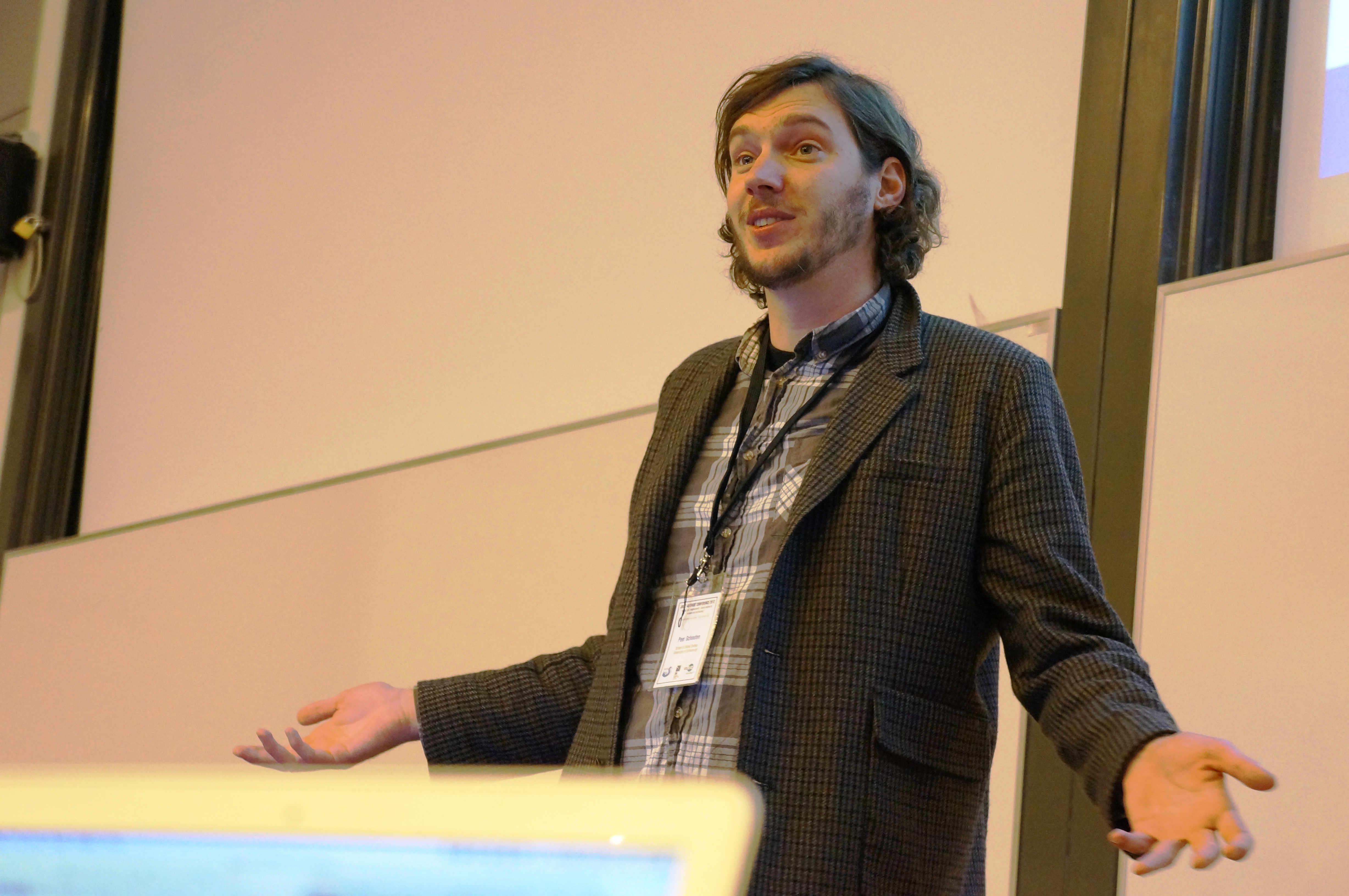
Alexander gave a dynmaic presentation in a style, for example, reminiscent of Deleuze. He opened with an interesting comment about governing and dancing, challenging audience members to rethink concepts they have happily taken for granted for decades. The high-watermark for me was hearing “The new State is, I argue, a nomadic entity that gazes at us just as heteroscopically as we gaze back at it.” The notion of a heteroscope implicates, in my best estimation, the idea of a complex state. Of course, actor-models of the state must be cast out in favor of a more diffuse and networked vision of the state. Put another way, it might imply what Patrick Carroll has been theorizing, namely, the state as a “complex gathering” or, as he sometimes says, “a thing” (the way that a party is a thing, both just one thing and also a thing made of other stuff like people and drinks and cake). The underlying theoretical justification for this ought to be found, and Alexander said as much during the talk, precisely where Patrick Carroll, Jan, and I find it … through the lens of actor-network theory.

I first met Alexander at 4S during the meeting in Copenhagen; however, I’ve seen his work, and he is quite prolific (see cv here).

I first read Alexander’s work in the American Sociologist. His paper, “Truth, Knowledge, Narratives of Selves,” is about:

Starting with a distinction of two types of discourse analysis—the analysis of a discourse and discursive analysis—the article discusses an analytical genealogy of truth and knowledge production, that can fulfill both empirical and archival requirements. The model’s main purpose lies in understanding diagnostic and therapeutic decision-making in doctor–patient interactions.

Stingl’s original abstract for 4S reads:

“How to govern?”, is a question that not only fazes governments, politicians and political parties but an increasing number of (world-)societal actors, enmeshed in the making of science policy and politics of science itself. They are subject to government while licensed to usurp governing positions over disbanded and unevenly organized societal collectivities, imbricated in regimes of governance that are post-legitimized, post-transparent, post-democratic procedures.

As STS scholars, we must critique the acceleration in dependence on techno-scientific practices of knowledge and management beyond the State: Citizens of nation-states and post-national conglomerates, and producers of techno-scientific knowledge demand legitimated representation, representative participation, and transparency, where post-democratic society and techno-scientific embeddedness of decision-making processes on the trans-local scale (trans-local meaning, broadly, that stake-holders and stock-holders do not share the same space of causes and effects) seem to suggest that people paradoxically proliferate and govern their existences in abandonment of the State, while transnational corporate entities rematerialize as quasi-state entities. STS critique demands suggestions for alternative forms of governance and novel conceptualizations of statehood: Does the techno-scientific state emerge naturally from the actual governance practices of actors such as corporations, NGOs and collective actors formed by interested private citizens as stakeholders? Will it redefine the boundaries of empirical and theoretical concepts in displacing or misplacing the State, and how does the state so placed see people and how do they look back? The new State is, I argue, a nomadic entity that gazes at us just as heteroscopically as we gaze back at it.

Call for papers: Regulation of Infrastructure Industries in an Age of Convergence

The following call for papers just came out:

2nd Annual Conference on the
Regulation of Infrastructure Industries in an Age of Convergence
organized by the Florence School of Regulation (FSR), European University Institute
to be held in Florence, 7 June 2013

The main infrastructures ??? energy, transport, and communications ??? have experienced significant liberalization processes over the past 30 years. Liberalization has generally been accompanied by market dynamics, as evidenced by the emergence of new entrants. But we have also witnessed a reinforcement of the historical operators (incumbents), which have often diversified into adjacent industries and even beyond, raising the question of their regulation as well as the question of the regulation of converging industries, as in the case of postal services and telecommunications, electricity and gas, or intermodal transport for that matter.
This evolution constitutes as many challenges for regulation, regulatory bodies and regulatory policy more generally. This conference aims at exploring these challenges for regulation and regulators across the infrastructures and in an interdisciplinary manner, combining engineering, economics, law, and political science.

Interested academics and academically oriented practitioners are invited to submit a 600 to 1000 word proposal (word document) by 15th February 2013 to FSR.transport@eui.eu. Please indicate in the subject heading ???FSR Conference 2013???.

The proposals should be structured as follows:
??? Title of the paper
??? Name of the author(s) and full address of the corresponding author (postal, phone, fax and email)
??? The aim and methodology of the paper
??? Results obtained or expected
??? A few keywords

Acceptance (or rejection) will notified by March 15th 2013. Final paper submission will be May 15th 2013. Participants who do not submit their final paper by that date and are not registered to the Conference will not be allowed to present.
Paper proposals will be reviewed by:
??? Prof. Matthias Finger | EPFL and FSR Transport director
??? Prof. Jean-Michel Glachant | FSR Energy director
??? Prof. Pier-Luigi Parcu | FSR Telecommunications director

Locating the state? Kathryn Furlong

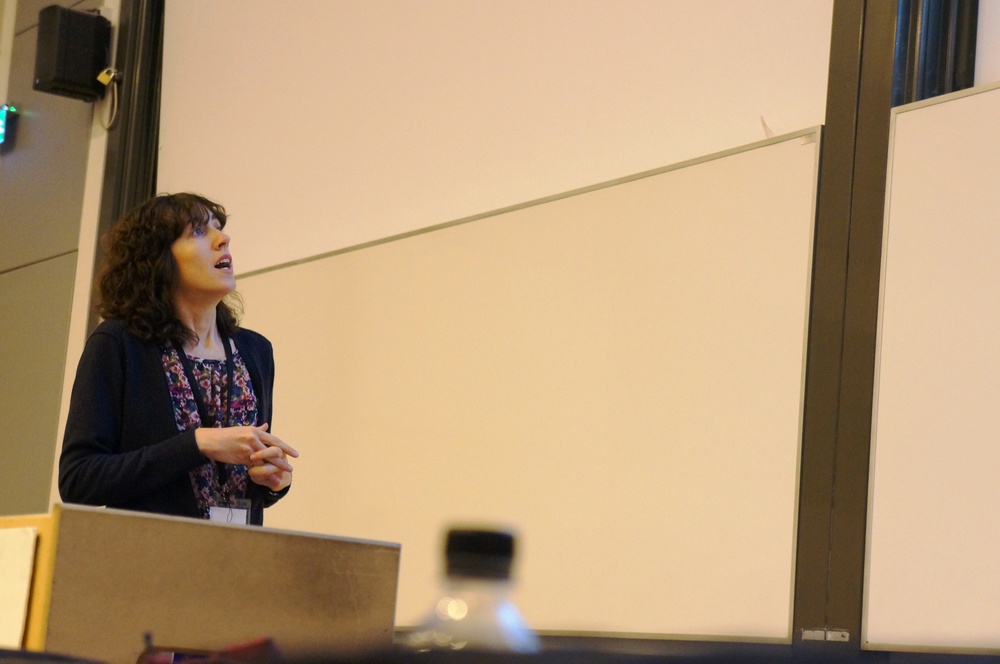
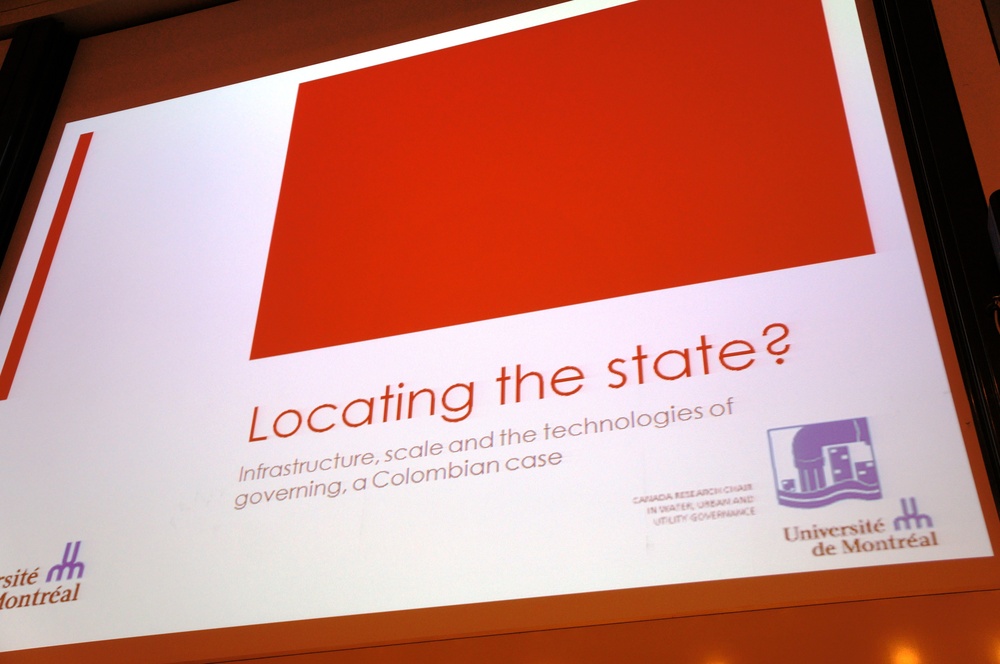
“Locating the state? Infrastructure, scale and the technologies of governing, a Colombian case.” Kathryn Furlong from Université de Montréal. Jan and I first learned about Kathryn’s work when discussing infrastructure, and in particular, the issue of scale, which was spurned by a discussion with Hendrik about flat infrastructure. Subsequently, we invited Kathryn to blog with us on installing order where we even saw a few precursors for the work she presented at 4S/EASST this year in a post from about a year ago.

Dsc01016

So, this year we saw a great presentation about understanding the relationship between scale and infrastructure. In her old published work, Kathryn Furlong in Progress in Human Geography titled “Small technologies, big change: Rethinking infrastructure through STS and geography“, we also saw the underpinnings of an understanding about scale. In the conclusion of that paper, which could have gone on at much greater length, there is an important Latourian twist included about “inversions” of scale (even if “large” and “small” are ultimately unsatisfactory with regard to measuring scale):

“This paper signals the need to look beyond infrastructure as a single unit, static in its physical state and social and environmental effects. Breaking infrastructure down into assemblages of small technologies that matter enables one to see the possibility to employ small change to mediate large problems.”

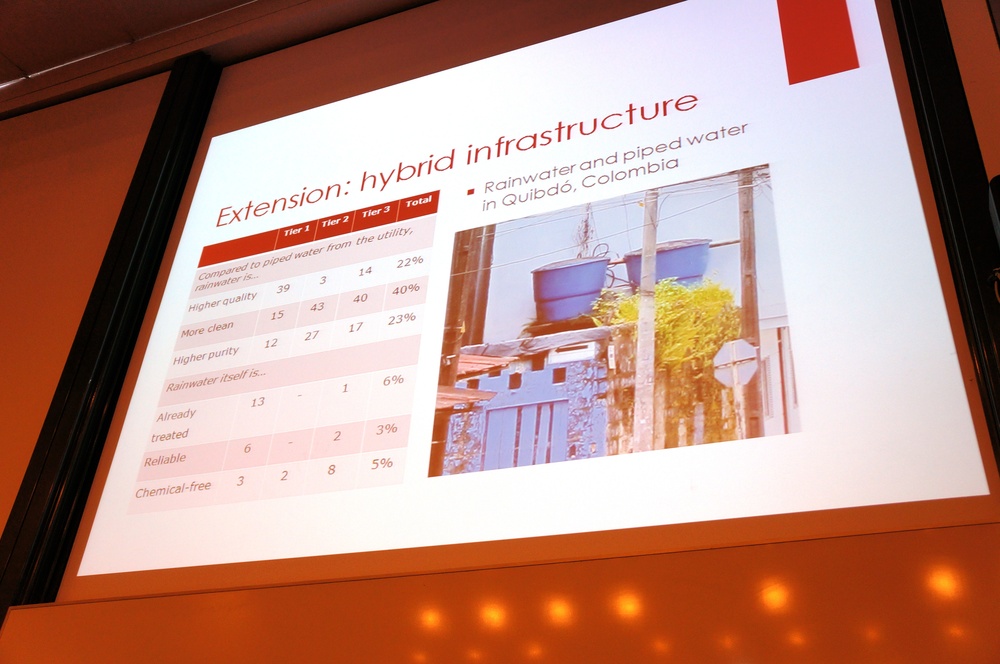
One of the ways that she ‘makes good’ on her previous claims about getting away from seeing infrastructure as ‘a single unit’ is to get at the idea that technologies might be hybrid (per the picture below) or, using my lens in ANT, seeing more of the multiplicity in water was a gathering point for many visions of water … in Kathryn’s case, this is a slide about comparing city wanter and rainwater. For example, her data collection shows that citizens consider rain water ‘more clean’ or ‘higher quality’ as compared to city water piped in from afar, but this importantly depends on the location of the person and the water.

Dsc01015

This all becomes even more interesting when applied to some of the central questions of state theory (e.g., what is a state? how do we make them? what can they do? can they do anything? etc.). Kathryn presents a commonplace distinction between the “North” and the “South”, but only for a moment, in order to get at the notion that in the Global South, the combination of government and infrastructure (which are otherwise imbricated in the Global North, comprising much of what is thought to represent ‘the state’) does not appear to operate in similar ways. Of particular importance, I think, is the idea that when a government attempts to impose a ‘unified infrastructure’ they will for sure end-up creating some sort of non-uniform thing variously composed of  especially in areas, and Kathryn contends, where infrastructure has not played a significant role in the previous years or decades (what she calls ‘omnipresent infrastructure’).

Dsc01014

Kathryn’s original abstract:

In the North, many authors have noted the passage from government to governance; that is from centralized and hierarchical to more diffuse and inclusive forms of decision-making (Jessop 1998; Peters and Savoie 1995). Infrastructure networks have experienced similar shifts, from the exclusive “black box” to more malleable and participatory systems (Furlong 2011). Yet, in many contexts in the Global South, including Colombia, neither the government, nor infrastructure managed to cover the whole of the state territory. By examining such a case, this essay seeks to add relief to some broadly held conceptualizations about the state, infrastructure and governmentality. One of these is in relation to scale. Drawing on critiques of scale (e.g. Marston et al. 2005), the essay questions where to locate the state in relation to issues of infrastructure and governing. Where the state has clearly not been omnipresent, it is easier to see how the assumed hierarchy of state scale breaks down. This is exemplified through the case of regulatory attempts to create a uniform infrastructure sector, which have yielded perhaps as much change in regulation as they have in service delivery. Moreover, where infrastructure has not been omnipresent, rather than imposing a new “black box”, managers may have to compete with a variety of pre-existing technical and social practices resulting in new forms of hybrid infrastructures. As such, just as new technologies create shifts in governing (e.g. the internet), the introduction of absent technology can yield shifts in both governing and how the technology is traditionally conceived.

Govind’s abstract

Dsc01009

The abstract for Govind’s project reads:

How do states act or exert their presence from a distance, especially when targets of action are separated by diverse and nested milieus of stateness? In addressing this question, the paper will draw centrally upon scholarship in three domains – governance of science and technology, anthropology of the state especially in postcolonial environments, and actor network theorizing of the state – to develop a conceptually grounded explanation. While a common concern across these domains has been to interpret the co-production of science/technology, society and state through concepts such as “boundary organization,” “state spatiality,” and “scaling devices,” one related theme that has attracted far less attention within these fields has been to understand how states act and make their presence felt at a distance across scale and space. This direction of inquiry is particularly intriguing when such actions intersect multiple and imbricated ontologies of stateness that exist at national, regional, provincial, and urban levels. Drawing from these literatures, in this paper I will use the example of a recent policy project in India as a case. NURM (or the Jawaharlal Nehru National Urban Renewal Mission) is a vast national policy exercise launched in 2005 that seeks to transform governance of technical infrastructures in 65 major cities in India by emplacing a host of new mechanisms, venues and devices to reconfigure state-society relations. Empirically investigating NURM, this study will situate and extend our understanding of how postcolonial states operate at a distance and across different scales from the national to the urban.

"Acting from a distance: States, scales, spatiality and STS." Govind Gopakumar

“Acting from a distance: States, scales, spatiality and STS” was presented by Govind Gopakumar of Concordia University in Canada. Govind is Associate Chair and Assistant Professor at the Centre for Engineering in Society.

Dsc01010

I first met Govind at last year’s 4S conference in Cleveland, OH, where he gave a terrific presentation on infrastructure and the Indian state. See below (CV available here):

“Knotty and Naughty: Seeing the Indian State through a Technoscientific Lens,” Society for the Social Studies of Science (4S) Annual conference, Cleveland, November 4, 2011.

I was immediately impressed by the work, which draws largely on Patrick Carroll‘s incredible and longstanding research on the technoscientific state. In fact, Govind had a book coming out that I subsequently reviewed for the Social Studies of Science, which you can check out here and was featured in a special issue about water (because Govind’s book is about water infrastructure in Indian citites and states).

Keep in mind that our 2012 theme for the panels was “On states, stateness and STS: government(ality) with a small “g”?” Govind rose to the challenge of seeing governments and governmentality with a “small g” — the small g meaning that instead of answering big questions in sociology by referring the power of macro structures that (must exist but) are always just immediately beyond firsthand observation (such as ‘the state’), we instead go to the micro-machinery of their makings (or even their underpinnings). And so, Govind did.

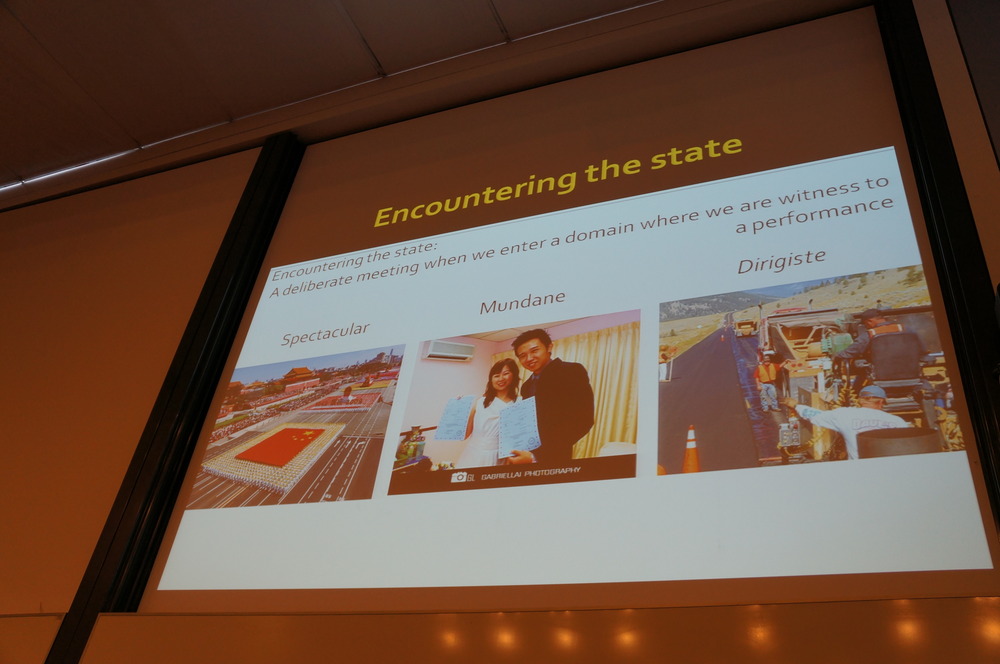
He took up the case of literally building state capacity, in this case, of infrastructural reform especially of the transformation of transportation. In the end, and these were short presentations that we asked emphasize theoretical points of relevance, Govind comes to a great conclusion. The state is not just out there (the state being the high-modern understanding of states as omnipresent actors forcefully shaping domestic and international matters of interest), the state comes to us during what he called ‘encounters’.

Dsc01011

As if Erving Goffman and Theda Skocpol had been fused together into some hybrid-Franken-theorizers, Govind suggested that of course the state is not out there, but that we occasionally come into its tenacles in the minutae of our daily lives, during spectacles where the state’s proverbial ‘muscles’ appear and are subsequently flexed, but also during (and this was quite nice) periods of construction, reform, and maintenance where the ‘dirigiste’ state is obvious.

In this way, instead of seeing like the state (a reference to Scott’s book from the 2000s), we see the state. We see these points of encounter (my words) as moments or locationalities wherein the state can be penetrated or penetrates our lives as citizens. These “close encounters” of another kind might just prove to be a great way to conceptualize the issue of macro-states from a relational, irreductive vantage point.

Bravo, Govind!

Back from 4S: Insights and Directions

This year, the Society for the Social Studies of Science meet at the Copenhagen Business School in Copenhagen, Denmark.

Dsc01007

As mentioned previously, Jan-Hendrik and I are returning to blogging again (after a long hiatus), and we’d like to start by commenting on the sessions that we proposed and that were delivered at 4S a few days ago.

We’ll take each paper in order, and comment on the work of our colleagues and friends.

Our first set of papers comes from the first panel, which ended-up being:

023. (66) On states, stateness and STS: government(ality) with a small “g”? – I

 9:00 to 10:30 am at Solbjerg Plads: SP216

Chair: Jan-Hendrik Passoth, Bielefeld University

Participants:

“Designing the Sustainable State: the Small (g}overnance of China’s Big “Ecological Civilization.”” Erich W Schienke, Penn State (cancelled)

“Acting from a distance: States, scales, spatiality and STS.” Govind Gopakumar, Concordia University

“Locating the state? Infrastructure, scale and the technologies of governing, a Colombian case.” Kathryn Furlong, Université de Montréal

ADDED: “Viewing the Technoscientific State through the Heteroscope: The State, displaced or misplaced?” (could also be called “The Dancer and the Dance”) Alexander Stingl, European University Viadrina, Frankfurt/Oder (check out his blog here)

“Territorializing, Calculating and Governing.” Peter Miller, London School of Economics and Political Science (cancelled)

“”Towards a Common Future”: On How a Diplomatic Training Programme Socialises States into the International Society.” Tobias Wille, Goethe University Frankfurt

We will comment on each paper individually, and then provide some comments about the papers as a group afterward.

After a long hiatus, we return

Planning for the 4S/EASST meeting for this year has kept us all busy working over the last month to prepare our papers, presentations, and (as Jan and I are discussants for two sessions) comments for our presenters. We will post on the blog as the conference proceeds, and following 4S/EASST in Copenhagen, we will blog about the Millennium conference at the London School of Economics in the days following 4S/EASST.

Capture

According to the website, there are a record number of presentations this year. Our panels, unsurprisingly, deal with states, government(ality), and STS. Come check out our panels on state theory, which happen to be back-to-back, both in Solbjerg Plads SP216 (for full program with abstracts, see here.

Our first panel will be:

023. (66) On states, stateness and STS: government(ality) with a small “g”? – I

 9:00 to 10:30 am at Solbjerg Plads: SP216

Chair: Jan-Hendrik Passoth, Bielefeld University

Participants:

“Designing the Sustainable State: the Small (g}overnance of China’s Big “Ecological Civilization.”” Erich W Schienke, Penn State

“Locating the state? Infrastructure, scale and the technologies of governing, a Colombian case.” Kathryn Furlong, Université de Montréal

“Acting from a distance: States, scales, spatiality and STS.” Govind Gopakumar, Concordia University

“Territorializing, Calculating and Governing.” Peter Miller, London School of Economics and Political Science

“”Towards a Common Future”: On How a Diplomatic Training Programme Socialises States into the International Society.” Tobias Wille, Goethe University Frankfurt

Our second panel will be:

051. (66) On states, stateness and STS: government(ality) with a small “g”? – II

11:00 to 12:30 pm at Solbjerg Plads: SP216

Chair: Nicholas J Rowland, Pennsylvania State University

Participants:

“The Tractor and the Plow: Commercial Agriculture and Ethiopian Statemaking since 2002.” Sarah Stefanos, University of Wisconsin, Madison

“Inside/outside again? Private security companies and the formation of ‘modern’ assemblages in Eastern Congo.” Peer Schouten, School of Global Studies (University of
Gothenburg)

“Port(al)s: How infrastructure flattens the world we live in.” Jan-Hendrik Passoth, Bielefeld University; Nicholas J Rowland, Pennsylvania State University

“Governing the environment: Guidance documents and the ‘making up’ of environmental practitioners.” Matthew Cashmore, Aalborg University; Tim Richardson, Aalborg University

“Nature, Environment, and the Technoscientific Enviro-State.” Patrick Carroll, University of California, Davis


Response to Hendrik about (ir)reductionism

Recently, Hendrik responded to one of Jan’s posts about Neil Fligstein, regarding irreductionism. He wrote:

I guess I am a little less skeptical than the two of you. Maybe it comes down to not minding reductionism that much. Some reductionism has to be accepted, obviously, if we would like to explain anything. And I remember phrases from Latour’s “Irreductions” claiming that certain things  – for example, knowledge – do not exist. Is that not reductionist? It appears to be more a matter of which reductionism (materialist, idealist, institutionalist etc.) to pick.
What would a general irreductionist epistemology look like? And if it claimed that fields did not exist by their own devices, would that not be a reductionist claim?
Anyway, thanks for bringing the Fligstein book and the orgtheory-post to my attention. I am eager to read it.

His point is a good one, no? We are left to simply accept one reductionism or another, and he rightly points out that even Latour’s move to irreductionism was a form of reductionism (in a certain light). To this, I made the following comment, which I think is a new direction for irreductionist thinking. Let me know what you think…

I wrote:

Hendrik, Sure, that is one position to take; accept one reductionism or another, its more a matter of choice than real alternatives. That sounds fine, and as you say, many people simply do not mind reducing or essentializing some facets of society and so on.
.
However, there is something of an alternative available, however, and I’ve been writing about it on the blog for the last two weeks. The basic point falls like this: how do we reject (but not fully do away with) essentializing or reductive ideas?
.
For me, of course, the state comes to mind immediately. How can we sit around like smart little scholars saying “the state does not exist” (with a Foucauldian grin), meanwhile the rest of the Western world thinks about states as actors with quasi-interests and so on (as Hobbes might have had us believe in Leviathan)? How can so many people mistake this reductive idea for what’s actually happening on the ground? How can so many people think of the state as somehow set apart from what must be, in principle, its constitutive elements?
.
From this vantage point, reductionism is not so much something to assume (as you suggest, we must assume one way or the other) and becomes a new source of questions: how did this reduction happen and how is it supported?
.
That strikes me as quite interesting, and not really such a trap; provided we think of irreductionism as a source of questions rather than just another assumption, some new territory might be pioneered (that was a nice, American metaphor, eh!?)….

New paper on crowdsourcing

An interesting paper on crowdsourcing just came out in the “Computational & Mathematical Organization Theory” journal. “Maximizing benefits from crowdsourced data” by Geoffrey Barbier et al. explores how crowdsourcing can be used for purposes of collective action and problem-solving, for example, in disaster response and by relief organizations.
Here’s the abstract:

Crowds of people can solve some problems faster than individuals or small groups. A crowd can also rapidly generate data about circumstances affecting the crowd itself. This crowdsourced data can be leveraged to benefit the crowd by providing information or solutions faster than traditional means. However, the crowdsourced data can hardly be used directly to yield usable information. Intelligently analyzing and processing crowdsourced information can help prepare data to maximize the usable information, thus returning the benefit to the crowd. This article highlights challenges and investigates opportunities associated with mining crowdsourced data to yield useful information, as well as details how crowdsource information and technologies can be used for response-coordination when needed, and finally suggests related areas for future research.

Besides being a very useful reference piece by providing a state of coverage with respect to crowdsourced data – like where to find it and what to make of it -, the paper is also a nice illustration of how social scientists become more and more involved in leveraging “big data” from informational infrastructures and from web activity in general. Crowdsourced data but also initially a lot less directed, if not accidental, information flows appear to increasingly be data-mined for a variety of purposes, not at least by – oops – us.
Check out the paper here.

STHV, Special Issue on Context: Comment Four

Comment four on the July issue of Science, Technology, & Human Values (July is volume 37, number 4).

Capture

Recently, I claimed that STHV had produced what I thought was one of the best issues in a while.

I will, in a series of posts over the next month or so, comment on each paper in the special edition on context with comments, criticisms, and occasional tangents.

Fourth paper is “Natures, Contexts, and Natural History” by Brenna.

Original Abstract:

How are contexts made and narrated? This article addresses the question of how to identify relevant contexts for understanding a work of natural history, in this case The First Natural History of Norway, published in two volumes in 1752 and 1753. In addition to offering a rich and complex description of Norwegian nature, this historical work serves as an important source for investigating the ways in which nature was perceived in the kingdom of Denmark-Norway in the middle of the eighteenth century. Nature was manifold, serving as a source of aesthetic pleasure, economic gain, religious reverence, and political power. It is argued that to understand the different natures presented in this book, we need to relate them to more than one context. But how do we determine the relevant contexts? The approach explored in this article is to read the book closely in search of the specific audiences that are addressed. By focusing on the ways audiences are addressed, it is argued, we can make better historical accounts of how natures are conceived and change in relation to different contexts.

Reaction and Commentary:

We get a great piece here about how context matters for historians and for creating historical  explanations, but not without challenging the commonsense ideas about context. In particular, the author states that the historians relationship with context results too easily “a circular logic” wherein the historian is searching for relevant contexts to write about (a precondition to doing history) but also as the outcome of their efforts to provide a historical explanation (thus, context is also the outcome of the contexts we hope to document). Of course, the only way out of this cardboard-box of theorizing is to avoid thinking of context as something “out there” and instead deal with multiplicity and enactment (both from Mol’s writing on the topics). Noting that ethnography is routinely used in ANT to understand these insights — multiplicity and enactment — she tests how they work for historical objects like the Pontoppidan book of Norway/Denmark natural history, which is the centerpiece of the article.

Brenna shows how there is no such thing as nature (as a singularity) in the text (and presummably, outside the text) and instead reveals nature to be plural; and thus, we learn about four natures invoked in the chapter, namely, the king’s nature (nature as asset), God’s nature (depicted as benevolent and orderly), the marketplace’s nature (where nature is bought and sold like so many curiosities to fill our cabinets with), and, finally, the learned community’s nature (as a source of general improvement of knowledge). The author goes onto to hint at the tensions and differences between the only occasionally overlapping contexts of nature (NOTE: for studies of multiplicity, contexts [in the plural] might be a nice way to see the “multiple contexts” of otherwise singular tems like “nature” or “the state” and so on). This part, however, was also somewhat difficult to fully appreciate because the tensions were not particularly tense, and it seemed as though a deeper, more thorough analysis could have been undertaken; however, making it through Pontoppidan’s book might have been analysis enough for one article.

The author concludes on an awesome parallel: trained to some extent in museum studies, Brenna shows us why our historical accounts of the past cannot be similar to a “period room” common to many historical museum collections. A period room tries to typify a particular period of time and pack it into a coherent room for onlookers to observe. As Brenna notes, this is occasionally good practice for the purposes of teaching, the coherent context defies what we now know about the multiplicity of times/contexts. Even if the cost is providing what appear to be less than coherent protrayals of history, we must not write our accounts like period rooms (which also hints that we should not make our period rooms like period rooms). In the final lines, however, the author turns attention to power … and this is difficult to stomach. The claim is that the multiple contexts hint at power relations. From my position, while this may be true, it is hard to say that nature is multiple while then using such a loaded (and multiple) term as power without so much as a basic definition. While ANT served the author well with regard to seeing nature multiple, apparently a few readings about how power is a dirty word among ANTers (and heroically reductive) might have helped the closing lines.

STHV, Special Issue on Context: Comment Three

Comment three on the July issue of Science, Technology, & Human Values (July is volume 37, number 4).

Capture

Recently, I claimed that STHV had produced what I thought was one of the best issues in a while.

I will, in a series of posts over the next month or so, comment on each paper in the special edition on context with comments, criticisms, and occasional tangents.

Third paper is “Context and Culling” by Law and Moser.

Original Abstract:

This article asks how contexts are made in science as well as in social science, and how the making of contexts relates to political agency and intervention. To explore these issues, it traces contexting for foot-and-mouth disease and the strategies used to control the epidemic in the United Kingdom in 2001. It argues that to depict the world is to assemble contexts and to hold them together in a mode that may be descriptive, explanatory, or predictive. In developing this argument, it explores how contexts are assembled in a series of different descriptive and explanatory narratives in epidemiology, policy, critical social science, and (feminist) social studies of science

Reaction and Commentary:

This is a good lesson piece in this new irreductive camp; however, some elements of this piece will madden readers. The piece is about the foot and mouth disease outbreak in the UK during the early 2000s. Much of the empirical material comes from a government document about the early events and a retrospective account of why the epidemiological predictions were so far off the mark either before, after, or during the events.

The best part of the article will have to wait until the end this review (it is about how epidemiological modelling might need to account for context a bit more, and in new irreductive ways), but some basic points are still worth rehashing. First, the chapter takes for granted this insight: contexts don’t really exist because contexting is done (RE: active). As it happens, contexts are constructed, and they tend to be treated as (unnecessarily) coherent constructions when observed first-hand in the wild, or when crafted second-hand by sociologists or scholars in STS. To show evidence for this, Law and Moser provide a number of accounts (which seem to layer on one another nicely), but which are unfortunately called “contexts” (rather than accounts or explanation generation techniques). These accounts become “contexts”, I will grant them, in that they begin to populate the setting and describe the relationships between relevant actors and entities (keep in mind, this is foot and mouth disease among sheep). They begin with a generically objective account of how epidemiological modelling is imperfect and takes many forms, and then take to comparing the two forms that make their way into the case study. After that context, they layer another context (RE: account) onto it, namely, one that STSers will like: a critical account where political connections among leading scientists leads to a corruption of the policy implications of the otherwise scientific models, which results in a culling of many sheep that otherwise might have lived, but that seem to have fallen under the axe of political interests too powerful and broad to protect them. <lingering pause> Then the authors backpeddle a bit, showing how none of these accounts is sufficient, and find a critical examination of both accounts, similar to accounts by Singleton about policy, where we ask: was any policy towards the culling of sheep with foot and mouth disease ever really enacted in full? (thus, making any explanation quite difficult to support) … the concluding remarks suggest that any policy being enacted is incomplete, the policy itself was different in different locations and differently applied in similar/proximal locations … there was, in fact, no one policy to assess for effectiveness and instead a plexus or cacophony of variations on the recommendations were enacted. The policy was multiple; a differentiated singularity. This is quite important because it is as easy to make errors like this (RE: treat a policy as non-multiple) when telling Whiggish retrospective accounts as it is when trying to establish prospective accounts — and this applies to both scholars as well as those persons in the public that do this sort of contexting (or account-making). In the end, and here is the best part, Law and Moser suggest that this is one way to make epidemiological modelling even more effective; erase our bias for coherent accounts where policy adherence and contextual coherence are assumed.

One serious pick at the piece, though, must be the style of writing; without being too critical or traditional, the conversational tone, which had the cadence of a bright teacher talking down to a dull student, was difficult at times to stomach…

STHV, Special Issue on Context: Comment Two

Comment two on the July issue of Science, Technology, & Human Values (July is volume 37, number 4).

Capture

Recently, I claimed that STHV had produced what I thought was one of the best issues in a while.

I will, in a series of posts over the next month or so, comment on each paper in the special edition on context with comments, criticisms, and occasional tangents.

Second paper is “Health Care Standards and the Politics of Singularities: Shifting In and Out of Context” by Moreira.

Original Abstract:

Context is a pivotal concept for social scientists in their attempt to weave singularities or universals to moral codes and political orders. However, in this, social scientists might be neglecting the ways in which individuals or groups who are excluded from the collective production of knowledge want to politicize their concerns also by claiming their uniqueness and singularity. In this article, drawing on the public controversy about access to dementia drugs on the U.K. National Health Service (NHS) and on the work of pioneering sociologist Helen McGill Hughes on “human interest stories,” the author argues that the “politics of singularities” can be articulated in two related ways within technical controversies. First, it expresses the unraveling of sociotechnical ties caused by institutional failure to take concerns into account. Second, it expresses the concrete uniqueness of persons caught by standardized, “universal” and impersonal implements and/or policies. Both these effects are underpinned by resourcing to allegorical expression, a literary form that while fostering political imagination in technological democracies might weaken Science and Technology Studies’ (STS) ambitions to influence decision making.

Reaction and Commentary:

This is an exceptional paper, but the abstract is a bit misleading, as much of it makes the clearest sense only after you’ve already read the article in its entirity. I’ll help to decode a bit. The real key to appreciating this paper is that it does not have as much to do with context or the irreductionist approach to context so much so as it is a case-in-point about how the “politics of singularity” operates (and, it might be argued, within the broader context of Big Science, in particular, in the pharmaceutical industry and, in this case, access to experimental dementia drugs in the UK).

The “politics of singularity” works like this. Big Science decontextualizes knowledge from its origins, which is a common story that some of us know from experience: considerable effort is made on the part of scientists to disentangle “data” from their messy origins so that they appear clean and universally applicable later on (or elsewhere). The goal, then, is to uncover where and how decontextualization attempts occur. In a Garfinkelian move, the author shows how decontexutalizaiton fails to decontextualize. So, what happens, then, when this model is challenged by outsiders (i.e., non-scientists), what do they use to challenge it, and why might it work? All three of the answers blend “singularities” with “politics”.

What do non-scientists use to challenge scientists conducting large-scale clinical trials? The author draws-up (and shows excellent evidence for this) a model wherein we come to see clinical trials as charateristically “generalizing” and “conclusive” (which are two things, of course, that map onto basic tenants of science quite well). When clinical trials are challenged, citizen non-scientists tend to emphasize just the opposite, their “pleas” (or “human interest stories” RE: Helen McGill Hughes) are “individuating” and “emergent”. Consider their contents, respectively. Scientific accounts of dimentia record verified tests of cognitive scores or memory evaluations, which when combined from many patients over time aids in creating generalized and conclusive knowledge about an intervention for dimentia. In contrast, personal accounts (pleas or “human interest stories”) operate according to an alternative dynamic. They emphasize dimentia as a lived experience at home where loved ones report whether or not the family member (RE: patient) is doing well and is feeling comfortable, which is drawn-up against backdrop of the home where “all this is really happening right now” with the implicit message that some sort of intervention could/should be taken.

Why might it work? According Moreira, individuating pleas have a curious political consequence. While we may assume, and plenty of sociological research about social movements suggests precisely this, that it is through large numbers of people banding together that we should expect politically-based change to, in this case, transform scientific trials. However, we do not see that in the UK dimentia controversy. Instead, the controversy is populated by “human interest stories” (RE: Helen McGill Hughes and the Chicago School analysis of “news”). These highly-individualistic portrayals of human life have a surprisingly hidden-in-plain-sight consequence: we related to them, despite their specificity, and this is a result of their un-fixity (or the quality that they are happening right now and it is not too late to do something about them).

What happens when this model is challenged by outsiders? Moriera encapsulates the answer winningly:

… the politics of singularities works in a dynamic relationship with the politics of generalization. Persons or groups locked out of the collective production of evidence capture the public imagination by shifting the frame of reference. The political imagination of the case is the delicate effect of the displacement that gathers in tension “the most extensive generalization” and “the most precise individuality.” (p.324-5).

The key being to bring the general and singular in tension, and the author means this not only hypothetically, but also in terms of a recipe for citizens that want to challenge “larger issues”. This notion of “bringing into tension” or (more actively) “gathering tension” seems like a fruitful technique for citizens and sensitizing process for scholars to keep in their analytical tool belts.

STHV, Special Issue on Context: Comment One

Comment one on the July issue of Science, Technology, & Human Values (July is volume 37, number 4).

Capture

Recently, I claimed that STHV had produced what I thought was one of the best issues in a while.

I will, in a series of posts over the next month or so, comment on each paper in the special edition on context with comments, criticisms, and occasional tangents.

First paper is “Experiments in Context and Contexting” by Asdal and Moser.

Original Abstract:

What is context and how to deal with it? The context issue has been a key concern in Science and Technology Studies (STS). This is linked to the understanding that science is culture. But how? The irreductionist program from the early eighties sought to solve the problem by doing away with context altogether—for the benefit of worlds in the making. This special issue takes its points of departure in this irreductionist program, its source of inspirations, as well as its reworkings. The aim is not to solve the context problem but rather to experiment with context and what we label contexting.

Reaction and Commentary:

The scope of this opening piece is like any introduction to the the topic, as one would expect in an edited book or special edition. Typically, and this is no exception, it is at once not broad enough or deep enough to adequately do this, but does a fine job of setting up the relevant lines of research, which are developed in papers afterward.

Still, context is not really defined (in the old fashioned, positivistic sense), even though the abstract sort of promises something of a definition. Instead, a bit of a dance is initiated. Context is raised as a hopeless sociological concept, which has traditionally been used to explain all manner of relevant issues for sociologists such as group-level human behavior, social trends, and the like. However, this traditionalist vision of context is challenged by a traditional vision of context, but this time from Science and Technology Studies, namely, the irreductivist camp otherwise commonly known as actor-network theory. From the vantage point of ANT, we can be critical of the reductive potential of “context” (and many other constructs that aid in sociological explanation generation). We see that, while context is useful for sociologists, it is also something we cannot see, that is, we cannot observe it directly; however, so reified in sociological circles, context is something you feel like you might be able to snap a picture of!

The definition of context, then, is exchanged for a ‘balance’ (like in a ledger, but for theory): the authors write:

We suggest  a series of moves [read: assumptions and rules of thumb] that may keep the irreductionist program alive while at the same time acknowledging that context is something we cannot escape (p. 293).

This is an insight drawn largely from Donna Haraway’s commentary on what to do about ‘nature’; a notion that is hopelessly troubled, but something that we nevertheless cannot do away with completely. In this way, they suggest ‘context’ is a similar sort of concept.

Here is where a missed step took place. Context is not a concept (in the singular). Instead, context triggers the same sorts of issues that ‘nature’ does, and ‘the body’, ‘the economy’, or ‘the state’ do … they are ‘differentiated singularities’ (to use a phrase from the special issue) or, to use a phrase I am more familiar with, they are multiple. In this case, hence, my insistence that ‘context’ must strike a balance (of sorts) on a ledger for theory; balancing the traditional ways of using the term with new ways for understanding both the same term and a new version of it. The trick, then, of course, is to determine what links them together or when one version/face of context appears rather than another.

As a closing comment and insight, one of the reasons that context can balance so many seemingly incommensurate definitions is because of its centrality to the social sciences. The upshot: do away with context (context dependence, cultural context, organizational field or environment, and so on) and much of the conceptual infrastructure supporting sociological analysis and explanation generation techniques goes with it. One might say that you cannot have sociology without it. Jens Bartelson once wrote a terrific book, good for students (if read slowly) and advanced colleagues (still, take your time), about ‘the state’ as a multiple concept, which he studies both historically and conceptually as it was born in political philosophy and then as the term was migrated to political science in The Critique of the State. One insight from the book: the state cannot be defined, but instead balances sets of abstractions about itself, sometimes abstractions so contradictory that they appear impossibly incommensurate; however, such (multiple) concepts as the state or the law become the fodder that disciplines are made of, so close to the heart of the discipline as they are buried.

Case in Infrastructure Failure

In the New York Times today (August 1, 2012), a headline reads:”2nd Day of Power Failures Cripples Wide Swath of India“.  Key lines read:

On Tuesday, India suffered the largest electrical blackout in history, affecting an area encompassing about 670 million people, or roughly 10 percent of the world’s population. Three of the country’s interconnected northern power grids collapsed for several hours, as blackouts extended almost 2,000 miles, from India’s eastern border with Myanmar to its western border with Pakistan.

Capture

… Blackout Tuesday — which came only a day after another major power failure — was an embarrassing reminder of the intractable problems still plaguing India: inadequate infrastructure

Interestingly, the story is backdropped in the newspaper article by invoking both the economy and the state. Regarding the economy, India is presented as many of us think of them, as a rising economic power although one that has experienced some significant stumbling along the way. The state was also criticized for their role in the matter:

India’s coalition government, battered for its stewardship of a wobbling economy, again found itself on the defensive, as top ministers could not definitively explain what had caused the grid failure or why it had happened on consecutive days.

When the train system, which is one of the busiest systems in the world, according to the article, started posting across-the-board delays and cancellations, one citizen remarked:

“Now my pocket is empty,” she said. “I am hungry. I am tired. The government is responsible.”

Incredibly, government officials agreed, citing abuses by … government officials, but, crucially, “other” government officials, here is how:

Surendra Rao, formerly India’s top electricity regulator, said the national grid had a sophisticated system of circuit breakers that should have prevented such a blackout. But he attributed this week’s problems to the bureaucrats who control the system, saying that civil servants are beholden to elected state leaders who demand that more power be diverted to their regions — even if doing so threatens the stability of the national grid.

In the end, and this is an interesting remark for later theorizing; the following comment suggests that infrastructure sits at the boundary or can be positioned at the boundary between international and domestic affairs:

“India needs to stop strutting on the world stage like it’s a great power,” Mr. Guha said, “and focus on its deep problems within.”

Teaching STS: Are military weapons used to kill other soldiers or civilians?

There is a post by Fabio Rojas over at orgtheory.net that might be of interest to those of your in STS and those of you teaching STS.

Capture

<http://www.iraqbodycount.org/database/>

He reports on a simple question: are military weapons used to kill other soldiers or civilians?

This question, if brought in front of a classroom, raises a few poignant issues for STS, engineering designs, and designers.

  1. STS has a long history — and this appears in, for example, Volti’s Society and Technological Change much more prominently than, for example, Sismondo’s Introduction to STS — of studying military technology and the rise of the post-WWII U.S. military-industrial-complex. Especially, when I was trained in STS, MacKenzie’s Inventing Accuracy, which showed how social influences impact even internally controlled technological devices (in his case, ballistic missiles, which are thought to be impervious to outside influence once launched … of course, these are two differnt forms of “influence”, but it still made for a great book about military technology and why a device is just so accurate, or just so fast, or just so efficient, and so on. The rise of civilian deaths, which was a deep concern in MacKenzie’s book and one of the manifold reasons enhanced efficiency was pursued in the first place, so this lands as an interesting issue on that regard, especially in comparison.
  2. The “use” literature has long argued that the boundary between use and design is much more porous than was once previously appreciated by the STS community. I’m thinking of How Users Matter edited by Oudshoorn and Pinch as a high-water mark in that line of work. In this case, we see all sorts of instances where use influences design directly during testing trials for particular products, instances where use influences design long after production when tools meet new contexts of use (like dental tools being used in art museums to clean ancient masks), and, of course, the SCOT discovery that uses can be imposed on new designs for public consumption. None of these approaches really captures what seems to be happening in this case, moreover, in some cases, while there is a fine line between what constitutes a “military” weapon versus something a civilian might own legally, some instances are very plain.
  3. While there is not a ton of literature that I am aware of appropriate for the student-level, this also raises the philosophical/ethical concern about what responsibility engineers have for how their designs are used. I don’t mean to come off as naïve, but this is a serious question for students considering the profession (and, in my opinion, for us more broadly as well).

So, this is a rich case to get at a number of issues regarding weapons, the (US) military, and the politics of how technologies are used.

Plagiarism in Dissertations Ending Careers

Yesterday, BBC News’ “Viewpoint” series ran a special on “The Spectre of Plagiarism Haunting Europe“, which documents how some high-profile politicians (and academics) are stepping-down from their posts after plagiarism was discovered in their dissertation theses and publicized via Wiki pages.

Capture

<http://www.mono-live.com/2012/02/free-plagiarism-scan.html>

The suggestion, in the concluding remarks, is:

Dissertations need to be published online with open access to permit easy checking, and a random sample of theses defended in the past five years needs to be reviewed in order to identify weak points. However, there is currently no funding for such measures, so it’s unclear whether German universities will really get serious about plagiarism, or keep muddling on.

Evidence suggests this is not an exclusively German plague, so similar measures may be required in other European countries too, possibly all, to ensure that higher degrees awarded in Europe’s universities continue to attract the respect they deserve.

This sort of “watchdog” work by experts and non-experts alike seems to hold back the tide of “creeping tolerance for scientific misconduct” in academia … pieces like this one, and many more, which are bound to come, should be front-page news for students and faculty alike.

Best STHV issue in a while

The July issue of Science, Technology, & Human Values is out (July is volume 37, number 4).

The entire issue is devoted to what the special issue editors Asdal and Moser are calling “contexting”. The basic issue at work is the 1980s actor-network move towards an irreductive position for STS research. Calling into question the influences of something not immediately present (but ever present) and frustratingly beyond the actors that we cannot observe directly, Latour and others in ANT camp sought to establish a sensible alternative to things like “context”.This position was nicely laid out in The Pastuerization of France (in fact, the STHV special editors open the issue with the well-known line by Latour), but I prefer the exposition in Reassembling the Social, which I once reviewed with Jan-H. and even blogged about a bit.

The basic story goes like this: social scientists routinely invoke “other” actors such as context, which help to explain events, transformations, or people’s behavior. However, context, although ever-present, seemingly inescapable, and quiet powerful, cannot be observed directly. The same could go for all manner of “other” actors that influence us but cannot be observed directly such as “the economy”, “the law”, or “the state”, and other stuff like “time“.

432176_10150604201650942_175868780941_9533602_1513576400_n

The key insight being: these contexts do not exist, but actors do and there material and organizational consequences do too.

Contexting, however, helps to avoid the following trap: if we assume none of these “other” contextual factors exist, then great, for a moment we might feel smarter than a few other people, but this does not solve the basic problem we experience in our everyday lives, that is, that people say context matters all the time, social scientists publish on it, journalists tell us about the collapse of the global economy, and media pundits bemoan the inability of the state to govern its people and induce financial austerity. As Asdal and Moser (2012:302) put it: context is a troubled notion and straightforward contextualizing a problematic assumption, but still something we cannot escape”. Thus, the game is to figure out how context is “tied” to actors (and, of course, avoid treating context as something “out there”), moreover, context is decidedly plural (but not pluralist), which also riffs on the multiplicity notion in ANT (that Mol did so much to develop with The Body Multiple).

So, the July issue of Science, Technology, & Human Values is out (July is volume 37, number 4). Check it out. While it seems to be missing from each of the pieces in this special issue, no doubt, infrastructure might be one of those “missing masses” that ties actors to context…

More on weather reporting and infrastructure

About a week ago, I wrote about weather reporting infrastructure. In particular, I wrote about a New York Times piece that describes how a major player in the US weather reporting game is about to swallow-up a funky, underground weather reporting group through corporate merger.

Capture

One of the complaints about weather.com (the major player) was that too much non-weather was seeping into the reporting of weather, but that this new underground reporting group avoided that and, in some’s opinion, just reported “better” weather.

A colleague and friend, Eric Charles wrote back, in response:

Many many mergers are about infrastructure… I’m not sure how this one would be… unless you consider customers as infrastructure. I guess the website could count as well, but code is cheap, and I don’t know if a url gets the same status as a real storefront. Hmmmm… My very limited understanding is that the vast majority of weather predictors use the same nationally available data.

This does not seem like a merger of cell phone companies, in which the technologies, factories, delivery routes, stores, and especially cell phone towers are a major target of the acquisition.

I was not sure if other readers might have had the same response, so after thinking about it a while over the weekend, I posted this response, which is something of an answer back to Eric, but also seems to have turned into (inadvertently) a defense of an STS perspective on infrastructure.

Eric, I appreciate what you mean when you use the term “infrastructure” as something that must be either fairly physical or explicitly technological. For example, the cell phone tower or satellite become the exciting stuff that corporate mergers are made of.
.
I tend to think of infrastructure as far more fluid and emphasize the notion that “infra” implies “support” so that infrastructure has more do to with understanding support structures that facilitate a process, for example, than just explicitly the material elements (like dams or highways). In fact, as someone committed to an STS perspective, seeing any technology as “just a technology” or, for example, weather data as “all the same” misses an important point (which, by the way, is one reason our blog is titled “installing (social) order”) because data are never just data, the facts are never just the facts, machines are never just alone and instead they are “used” or “interpreted” by social actors and are themselves deeply social entities owing much of their “seemingly physical” characteristics to human designs which are often deeply influenced by social effects. In fact, it is sometimes said that when a machine or fact appears most free from social influences (i.e., not tainted by personal values or what have you) that they are in fact the most social. Consider an academic paper that might try to say that it has found something new to report and that the report was published after anonymous peer review (implying that no outside social factors muddied the science), the paper is not full of persuasion or rhetorical techniques employed by politicians, and instead seems once-removed from such things … but it is at this point that it has never been more social, after all, the reference section of any good paper is like the invitation list of individuals enrolled into the paper! The insight: when things seem the least “socially influenced” it is often because they are the most social of all.
.
Infrastructure is something of a similar case. Note that the original post was about weather “reporting” infrastructure, and to me this means the social and technical apparatus that, in effect, delivers said news about weather. One might say that a news anchor is “reporting on the news”; however, from my perspective, the news anchor does not, or at least is not much of a driving force behind “the reporting of news” other than the end point of delivery. I am sure that you realize this, but it bears unpacking.
.
What made this case interesting is that “weather” (and I mean it in the most basic sense of natural environmental expressions of wind, heat, etc.) is just one reality. It is either 92 degrees or it is not, and this is based, of course, on shared, standardized measures of heat, weight, pressure, etc. In so far as this is concerned, the idea that reporting on said same weather can differ so much as to take notice (and thus be “important” to someone somewhere) is peculiar. This is not just measurement error and really not a matter of achieving scientific consensus about what the weather is so much as two different supporting structures — and all the human and non-human actors there within — for how the “one” weather should be reported to the public. This inevitably means that more, much more than merely the “real” weather influence the support structure through which weather is reported. Moreover, because weather reporting is both about “immediate reports” AND “what we think it will be like tomorrow” the former can be reported with considerably less discretion (and attention, I’d guess) than the latter. As such, and I am not really picking and complaining about the vicissitudes of trying to report on the future (which is very difficult, with even the best data and most reliable entities), so much as I mean that an entire social infrastructure about the psychology of the public, the role of the media, and the consequences of being “wrong” (and so on) seems overlain on otherwise technical infrastructure of Dopler radars and weather towers. Thus, when you mention, “My very limited understanding is that the vast majority of weather predictors use the same nationally available data,” that is precisely what makes it seemingly boring for you, but exciting for me on this blog.

Weather (Reporting) Infrastructure

An exceptional case is emerging in the US about weather reporting infrastructure. Today (July 4), according to a New York Times article:

The announcement on Monday that the Weather Channel Companies, owners of television’s Weather Channel and weather.com, would buy one of its rivals, Weather Underground, set off howls of displeasure on social media platforms and around water coolers across the nation. The purchase price was not disclosed.

Capture

Part of the controversy is about scientific versus non-scientific reporting of the news. The Weather Channel (TWC) is reportedly too personality driven and, in some conceivable way, benefits from odd reporting that over-reports the potential for (typically bad) weather, leaving its viewers in a situation where everyday has a chance of rain. Many, many news stations do exactly this — rather than report “clear skys”, they attempt to “keep watchers poised for the potential for weather” — obviously, as a way to keep people glued to the station. This, in STS, is referred to as “rhetoric” in scientific accounting; Latour and Woolgar write about this a bit where all the seeming “persuasion” interupts a true scientific account where the data speak for themselves.

Capture

In contrast, Weather Underground (WU) is more plain, and reveals details about its underlying data. This is a nice example of a different kind of “social” being pulled into scientific reporting — the less social it seems, the more social it is (as Latour and Woolgar told us years ago in Lab Life).

The controversy illustrates the deep national divide between those people who just want to know if it’s going to rain, and people who really, really, care about the data underlying the weather. Christopher Maxwell, a manager at a solar energy company in Richmond, Va., is in the really-really-cares-about-the-weather camp. He said he saw the Weather Channel deal as a sad sellout for Weather Underground.

“It seems to happen all the time,” he said. “Something great gets invented and sold in the United States, and it gets bought up and destroyed.”

This scientific versus non-scientific case about weather reporting infrastructure is a neat one because of the reversal it affords in understanding how “social” infrastructure can be (and how this happens). Additionally, the idea of “buying up” infrastructure might be an economic facet of infrastructure studies that seems only occasionally present in the STS literature.

Reflexive Ethnography of Infrastructure

Useful, relatively unknown nugget of interest for ethnography of infrastructure, buried deep in a seminal text.

Capture

(http://press.princeton.edu/images/k2417.gif)

After re-reading Laboratory Life — the 1986 paperback edition published by Princeton University Press not Sage Publishers, which published the original 1979 hardback — I am struck by a comment made in the postscript, which was published with the paperback 1986 edition only.

The authors respond to a few reviews of the book. For example, Westrum (1982, Knowledge 3(3):437-9) criticizes the format and presentation of the empirical materials; quoting Latour and Woolgar (1986:276),

Westraum speaks of a lack of a sense of unity, the lack of continuous action and the relative incoherence of the narrative. But our aim was precisely to avoid giving the kind of smoothed narrative characteristic of traditional constructions of the “way things are.”

The authors justify this move on the grounds of thier (anthropological) understanding of “ethnography” and the important role of “reflexivity”.

On ethnography, they choose it for the “analytical distance” it affords participant observers and elect “the presentation of preliminary empirical materials” (277) rather than a clean, sanitized research report.

On reflexivity, “Of course,” the authors write,

one interesting aspect of the exploration of reflexivity is that our writing is conventionally constrained by the use of report-like formats. This increases the tendancy of ethnographies to read as straightforwardly reporting on the “actual” state of affairs to be found in the laboratory. This kind of reading is not without use. … But such reading misses the point. We attempted (especially in Chapter 2) to address the issue of reflexivity by placing the burden of observational experiences on the shoulders of a mythical “observer.” We attempted to alert the reader to the nature of his relationship with the text (and by implication to the nature of readers’ relationships with all attempts to constitute objectivities through textual expression).

Now, I am not suggesting that ethnographic accounts of infrastructure — like habors, waterways, or information systems — adopt this second-order ethnographic reflexivity, although doing an ethnography of a sociologist doing an ethnography might be insightful. Instead, I am curious: how much hygiene/polish we should be putting into our research reports, especially ethnographic reports?

Here is why: As Latour enters the Salk lab he swears to report the truth about what happens in the lab, in particular, how scientists transform a series of personal observations into textual accounts called “articles.”

  • Being a reflexive ethnographer affords the observer certain advantages, especially in seeing how truths (and non-truths) are constructured and circulate, and they can do this analytically because the truth of the claim is not what self-selects it for construction or distribution.
  • Being a reflexive ethnographer also comes with another responsibility, which has, to this point, seemed more like a liability: being a reflexive ethnographer means that one must also be reflexive about one’s own ethnographic account.

As Latour and Woolgar (1986:275-6) put it,

The revision of epistemological preceptions about science raises awkward questions about the nature of its social analysis. Can we go on being instrumentally realist in our own research practices while proclaiming the need to demystify this tendency among natural scientists?

As the authors suggest, the reflexive turn seems to have reflexed only one way in the production of scientific accounts. What would further reflexivity get us in infrastructure studies? Insight into the sociological production of texutal accounts, or an infinite regress of sociolgists studying sociologists studying sociologists (and so on)?

ANT and ethnography

While the corpus of ANT research is full of ethnographic accounts, not all ANT is ethnographic. In fact, foundational work in ANT tends toward socio-historical accounts of science and technology. For example, in Latour’s (1987) work in Science and Action, which stands as the invitation to follow the actors, Latour conducts no firsthand ethnographic fieldwork. Through the lens of ANT, and as a way to hash-out constitutive concepts, he reviews historical portrayals of the genesis of scientific facts, for instance, that DNA is a double-helix, and the spread of engineering artifacts, for instance, the rise of diesel locomotives. Likewise, published shortly after, Latour (1988) presents the STS community with a historical revisionist attempt at re-telling the rise to prominence of Louis Pasteur through the lens of ANT.

Capture

(my favorite passage from The Pasteurization of France)

As Hine (2007) suggests, ethnography is also not the way, or even the best way, to conduct ANT accounts of socio-material or historical phenomenon. Law’s (2002) work, especially his early work on aircraft design and related “stories” provides a rich empirical-grounded methodological alternative to ethnographic fieldwork as was his iconic ANT-imbued exploration of Portuguese sailing. Hence, there are many ways to “follow the actors” without following them “on foot” during participant or observation data collection.

Capture

(best part of the cover of Aircraft Stories: Decentering the Object in Technoscience)

And yet, ethnography appears to be a straightforward technique for understanding one of the latest and most important concepts in ANT, namely, multiplicity. The concept — as an alternative to fragmentation as a conceptualization of a lack of fixity or stability — was implied in early ANT research and, in a number of forms, has occasionally appeared in STS work over the last three decades. However, it was not until Mol’s (2002) The Body Multiple, an unorthodox ethnographic account of atherosclerosis of leg arteries, that a robust and coherent statement was made about how to observe multiplicity in practice. Seeing medicine as a practice rather than a body of knowledge provides the analyst with an important affordance: “what we think of as a single object”, for example, a body or a disease, “may appear to be more than one”, hence, she shows how atherosclerosis is at once a singular, seemingly unified object (i.e., a disease) composed of many things because “plaque cut out of an atherosclerotic artery is not the same entity as the problem a patient with atherosclerosis talks about in the consulting room, even though they are both called by the same name” (Mol 2002:vii). However, these are not merely different social perspectives about the same object (i.e., the disease) dividing doctor and patient because this is not just another pluralist account. In principle, post-ANT studies like Mol’s are post-pluralist, which implies that adding another perspective to a scholarly account will not make the account somehow more truthful, representative, or accurate. However, social scientists, for example, of medicine have often used this trope in their research accounts. They differentiate “disease” from “illness”, the former representing the medical perspective of doctors and the latter accounting for the personal, emotional, and social experience of being a patient living with illness, which they claim doctors tend to miss, ignore, or fail to account for from their medical perspective. Thus, sociologists did not get mixed-up competing with doctors over the truth of the object of biomedicine (i.e., the disease) and instead claimed that the social dimension of disease (i.e., illness) was an added layer of meaning representing the patient’s perspective. In ANT, however, Latour (2005) challenges the idea that a social dimension exists separate from the material world. In a non-trivial challenge to sociologists, Latour demands to know how “the social” can at once be a special dimension of reality, which social scientists have access to thanks to their methodologies, and the broader context that influences the everyday life of individuals and a description of how individuals are linked together through network ties (i.e., associations). Social scientists routinely oscillate between these three registers in their accounts of the social (i.e., dimension, context, and network ties), which, reflexively, appears to be a readymade case study in multiplicity in sociology about sociological practice. Latour suggests that an emphasis on associations is the surest way to return sociology to its roots. For once we shift to the practice lens, the core epistemological concern that truth faithfully represent the nature or reality of an object, human or nonhuman, is no longer sufficient as an endpoint of analysis. How knowledge practices are enacted, overlap, and hang together, therefore, becomes the empirical question and ethnography appears to be the preferred method for scholars to observe multiplicity unfold.

Does "infrastructure" automatically imply multiplicity?

No doubt, Annamarie Mol’sThe Body Multiple (Duke University Press, 2002) helped me to fully comprehend the implications of ontological “multiplicity” (as an alternative to singular epistemological truth), more so, by far, than even Latour’s early (dare I say, seminal) work on what multiplicity would mean for research and theory in science and technology studies.

72432

Two of her key insights:

1. On the concept of entitivity (which she does not really develop, but it is so central to her argument that we see the term “entity” twice in the opening paragraph of the preface), she writes:

This means that the book comes to talk about a series of different practices. These are practices in which some entitity is being slided, colored, probed, talked about, measured, counted, cut out, countered by walking, or prevented. Which entity? A slightly different one each time. Attending to enactment rather than knowledge has an important effect: what we think of as a single object may appear to be more than one (vii).

2. On how entitivity matters for “ontological politics”, she writes:

If the objects of medicine are enacted in a variety of ways, truthfulness is no longer good enough … [thus] I contributed to theorizing medicine’s ontological politics: a politics that has to do with the way in which problems are framed, bodies are shaped, and lives are pushed and pulled into one shape or another (viii).

These two points, I contend, cannot be applied to infrastructure so simply, and here is why: “the body”, as a concept or a colloquial phrase, grammatically implies a one-ness or singularity. Therefore, when we see a title like “The Body Multiple” we note (as Mol, of course, details) a singular noun with a pluralizing adjective. Can the same be so easily said about other objects? “The <FILL IN THE BLANK>  Multiple”? I am not certain that a “The Infrastructure Multiple” really works as a sensitizing concept for infrastructure studies, despite the vast utility of multiplicity to aid us in rethinking infrastructure. After all, infrastructure is already a singular noun used to describe multiple things/objects.

According to a fast/dirty Google search:

Capture

So, the multiplicity of infrastructure is at once already a part of infrastructure, and yet the vast and multiplicitous network structure of infrastructure occasionally punctuated into a seeming singularity is an idea worth mining.

Legally Granting Entitivity, or Granting Personhood to Non-Persons

In 1886, the Supreme Court granted corporations personhood, or at least the same rights as were granted to any living person, and justified the decision based on the Fourteenth Amendment to the Constitution. The 1886 legal transformation (or imbuement) now, in retrospect, appears to figure prominently in theoretical models of organizations, corporations, and states, especially, the idea that these entities are straightforward actors, unsurprisingly, able to act. Most obviously this fits into the work of Alexander Wendt who famous (and controversially) claimed “states are people too” in his famous article in Review of International Studies, “The state as person in international theory”.

Constitution

For some background on corporations and corporate entitivity, I turn to David Korten’s (1995:185-6) well-known book The Post-Corporate World: Life After Capitalism, wherein we learn that:

In 1886, . . . in the case of Santa Clara County v. Southern Pacific Railroad Company, the U.S. Supreme Court decided that a private corporation is a person and entitled to the legal rights and protections the Constitutions affords to any person. Because the Constitution makes no mention of corporations, it is a fairly clear case of the Court’s taking it upon itself to rewrite the Constitution.

Far more remarkable, however, is that the doctrine of corporate personhood, which subsequently became a cornerstone of corporate law, was introduced into this 1886 decision without argument. According to the official case record, Supreme Court Justice Morrison Remick Waite simply pronounced before the beginning of argument in the case of Santa Clara County v. Southern Pacific Railroad Company that

The court does not wish to hear argument on the question whether the provision in the Fourteenth Amendment to the Constitution, which forbids a State to deny to any person within its jurisdiction the equal protection of the laws, applies to these corporations. We are all of opinion that it does.

The court reporter duly entered into the summary record of the Court’s findings that

The defendant Corporations are persons within the intent of the clause in section 1 of the Fourteen Amendment to the Constitution of the United States, which forbids a State to deny to any person within its jurisdiction the equal protection of the laws.

Thus it was that a two-sentence assertion by a single judge elevated corporations to the status of persons under the law, prepared the way for the rise of global corporate rule, and thereby changed the course of history.

The doctrine of corporate personhood creates an interesting legal contradiction. The corporation is owned by its shareholders and is therefore their property. If it is also a legal person, then it is a person owned by others and thus exists in a condition of slavery – a status explicitly forbidden by the Thirteenth Amendment to the Constitution. So is a corporation a person illegally held in servitude by its shareholders? Or is it a person who enjoys the rights of personhood that take precedence over the presumed ownership rights of its shareholders? So far as I have been able to determine, this contradiction has not been directly addressed by the courts.

Shifting gears back to thinking about states, the language that is used sometimes in International Relations, political sociology, and political science is “entitivity”. This is a description of legal reality, meaning that a corporation (which is really just an idea or organizational form) can be treated as an actor, entity, or, in this case, person. This is also more than a description because it has been so profoundly reified over the last decades, by which I mean to say that the we assume states are in fact the free-standing actors that we assume-them-into-being and this happens to such a great extent that statements like “The US just sent a strong message to China” can actually be comprehended by average people. So reified is the state actor idea during the neo-statist turn in sociology, history, and political science during the 1980s/90s that one got the feeling that you could have actually snapped a picture of the state.

Posable_figure

Regarding the action or behavior of “entities” such as states or corporations, there is a rule amongst neo institutional scholars, especially in organizational analysis, to avoid saying, for example, that “Apple just released the iPhone 4S” because the corporation actually did not do that and instead this comment is a shorthand for going to the trouble to say that Apple executives, based on the work of myriad employees, decided to release their product into a particular set of markets. This also explains the massive emphasis on leadership and management in organizational studies because the behavior of leadership is often mistaken for how an organization behaves or how an institution – like a university – thinks (thank you, Mary Douglas).

In this way, group-level behavior is sometimes subsumed in the emphasis on leaders (i.e., the group is spoken for by the management that leads them); other times, group-level and leader behavior (and whatever infinite nuance must go into all that) get subsumed under the seemingly single behavior/activity of the overarching entity (i.e., the entity appears to act/behave/speak for both group and its leadership). In all, there is no easy way to sort out these sorts of issues, at least, to my knowledge, as it is mainly a matter of perspective and whatever the analytical starting point is. Some might say, however, that this whole debate can be explained away because it is merely a case of category error; for example, the student taking a tour of campus during orientation is shown around The Pennsylvania State University, and, at the very end of the tour, says “I’ve seen the buildings, and the faculty and the students, but where is the University?”. The obvious and logical conclusion, therefore, must be that states, organizations, and corporations are simply operating at a different (read: hierarchically superior) level of organization from individual human beings. That might sound reasonable for sociologists from the 1950s (or even some of them now); however, while hierarchy and terms like “power” are useful for understanding such relationships, the two terms are also a shortcut for doing the hard work of describing what happens when, for example, a state appears to act in some fashion. Put another way, and one that I subscribe to: if we assume no hierarchies, and assume whatever appear to be hierarchical power relations are actually people on the ground in various network formations operating on a flat plane of existence, then we have another view (one more akin to Deleuze and Guattari’s view of the world as composed of A Thousand Plateaus).

1000platos-intro-16

A final option exists, and that is to treat this entire issue not as a legal reality or scholarly conception, and instead suggest that this is a perception issue, which has the potential to satisfy both camps. This is an argument under development, so forgive its crudeness. Consider social psychologist Jennifer L Welbourne’s very traditional paper “The Impact of Perceived Entitivity on Inconsistency Resolution for Groups and Individuals” published in the conservative psychology journal, Journal of Experimental Social Psychology. The thrust of her argument is nicely encapsulated in the final line of her abstract:

Abstract

Previous research has indicated that differences in perceived target entitivity influence the degree to which information about a group or individual is processed online. The current set of studies examines whether perceptions of entitivity are also associated with differences in the content of impressions formed of groups and individuals. Specifically, if perceptions of high entitivity motivate perceivers to seek coherence in a target, impressions of individual (high-entitivity) targets should be characterized by greater resolution of behavioral inconsistencies than impressions of group (low-entitivity) targets. Study 1 provided evidence for this hypothesis by demonstrating that perceivers were more likely to apply restrictive diagnosticity schemas to resolve inconsistent behaviors in a predicted direction when the target was an individual than when the target was a group. Two additional studies were conducted to determine the specific aspect of target entitivity that produced these results: perceiver expectations about the similarity and consistency of a target’s behaviors (Study 2) and perceiver expectations about the unity of a target’s intentions and goals (Study 3) were manipulated and the resulting impressions were examined. The results suggest that perceptions of unity in a target’s intentions and goals underlie the assumptions of entitivity and the obtained impression effects.

All we need to do is to uncover a set of cases that allow us to empirically observe instances where the perceived unity of a state’s intentions and goals fuel the underlying assumption that indeed the state is an entity, which produce the impression effects. Now, if we don’t assume states are entities in advance, which we must if we are going to chalk-up their entitivity to impression effects, then we must assume that states are, to some extent, made “anew” each time we invoke them and fortified by routine invocation. So, who does this sort of performative invocation? Finding a few cases like that would make a fine book…

Infrastructure by "other" means

Once, the phrase “politics by other means” was a way to know about technology. The same sh/could be said of infrastructure; so often we conceptualize infrastructural entities by what they are made of, which is legitimate in my mind, but is there room to see infrastructure as made of “other” stuff?

As soon as Jan-Hendrik Passoth and I (Nicholas Rowland) finished writing “Actor-Network State: Integrating Actor-Network Theory and State Theory,”  (International Sociology 2010 25: 818-841 (2010)), I started to wonder with renewed interest “what are states made of?”

World

(http://go.hrw.com/atlas/norm_htm/world.htm)

One answer might be to accept a line of thinking Jan and I outline in the above paper and suggest that the question has become something irrelevant. As we write:

“This direction for state theory does not ask same old question ‘what a state is’ – it is an actor-network, of course – because that does not say much, and instead asks ‘how states are’.” (Ibid., 826).

However, now I’m thinking there might be something more to it; that is, if the question can be reformulated so that we in political sociology, political science, and international relations and international law stop asking “what are states?” and instead start asking “what are states made of?” Perhaps this new “entry point” will aid us in rethinking states and the role of states.

Larry makes the point that we turn our attention to theories of action (mainly, an actor-network approach to the state) in the above article, which implies (to some extent) that states are what states do. If that’s an accurate and/or legitimate assumption, then the “hollow state” writers might be in some serious trouble, or at least have some serious explaining to do. If states are playing a more and more restricted role in the shape of international affairs as compared to, for example, global credit-rating firms or multi-national corporations (which Larry writes about with great success: Backer, Larry Catá, On the Tension between Public and Private Governance in the Emerging Transnational Legal Order: State Ideology and Corporation in Polycentric Asymmetric Global Orders (April 16, 2012).), then two possibilities exist.

Wolf-in-sheeps-clothing

(http://www.get-into-medicalschool.com/high-fructose-corn-syrup-wolf/)

First, if states are what they do, then this could imply that whatever it was that states previously “did” is no longer needed or privileged in international affairs, hence, because states are what they do, they are doing qualitatively less of it and shrink as a result (sometimes this logic seems to underlie the thinking in “governance without government” (Gw/oG) schools of thought, which Larry also writes about with success: Backer, Larry Catá, Governance Without Government: An Overview and Application of Interactions Between Law-State and Governance-Corporate Systems  in  Beyond Territoriality: Transnational Legal Authority in an Age of Globalization (Günther Handl and Joachim Zekoll Editors, Leiden, Netherlands & Boston, MA: Brill Academic Publishers, forthcoming 2012). (March 1, 2010). Penn State Legal Studies Research 10-2010.). Thus, whatever it was that states did, we no longer need it. Note: this is a hardcore functionalist argument. Sometimes this sort of an argument is utilized when discussing the reduced role of government not only as a descriptive account of contemporary affairs (usually, documenting liberal bellyachers fondly reminiscing a largely imagined understanding of the role of government, for example, in the US or UK) or a prescriptive account of contemporary affairs (usually, promoting a particular agenda to “save” government from having its power usurped by other actors on the international stage or, in some cases, promoted by government agencies with pro-market solutions to otherwise historically government tasks or duties such as how to “best” (by which, “most efficient” seems to be the placeholder) deliver social provisions to a deserving public (please note: this sort of a dynamic replete with descriptive and prescriptive accounts opens the door to observing “political performativity” where our ideas about the political reality unfolding in front of us is prescribed by its descriptors and described by its prescriptors – as noted in the original post by Larry, this is a potential well-spring for new research).

Second, if states are what they do, then this could imply that whatever it was that states previously “did”, someone/something else is now conducting these actions in international affairs in the stead of states, hence, because states are what they do, when someone/something steps in to assume the role(s) previously monopolized by the state, the state shrinks as a result (this logic is also adopted in “governance without government” schools of thought, although to a much different end).

Another line of reasoning, consistent with the actor-network action orientation avoids either line of reasoning described above (which currently plague the Gw/oG groups), is to see the state as it is made up of “other” stuff. As in the previous post about actor-networks, materiality (or “the physical”) plays a central role and has nearly become synonymous with ANT anytime it is invoked for the purposes of, usually, of criticism. However, this special
attention to the material can result in a fantastic re-understanding of the “state ideology” (the terms Larry sometimes uses to encapsulate the notion that something like a state actually exists and occasionally acts in a concerted way in relation to its public/subjects and/or in relation to other actors like states on the international stage). I like to call this the “state hypothesis”, which explicitly reminds us that when the earliest neostatists started their writing (before full-entitivity was assumed by neostatists carte blanche) that writers like Skocpol required that “the state” was something that unfolded in historical comparative relief and that we, thus, should not simply assume the state exists but that it occasionally appears to exist under a particular set of historical contingencies. Please note: “entitivity” is just something that I pull from organizational analysis in sociology circles, which is a term to describe what is invoked when, for example, journalist say (and can actually be understood by common people) that “Apple Unveils iPhone 4S With Voice-Recognition Features” (NY Times: http://bits.blogs.nytimes.com/2011/10/04/live-blogging-the-apple-iphone-5-announcement/) or that “Goldman-Sachs profits mask revenue decline” (LA Times: http://www.latimes.com/business/la-fi-goldman-earns-20120417,0,7737808.story). Somehow in these moments, Apple is a thing and not just the concerted efforts of its managers and board members, hence, the entitivity is a reflection of this “acting thing” called Apple. Keep in mind, that if a state is what it does, then by that same logic Apple is what it does meaning that it is what releases iPhone 4S, that is, Apple is made of iPhone in the same way that states are made of, as a soon to be published example shows, other stuff such as water.

In water infrastructure research (and for those interested in STS and state theory of course), check out Patrick Carroll’s “Water, and Technoscientific State Formation in California” which has just been published as an “online-first” article by STS journal Social Studies of Science.

Delta_waterway

(http://www.aquafornia.com/where-does-californias-water-come-from)

His abstract offers the thrust of analysis:

“This paper argues that water gradually became, over a period of more than half a century, a critical boundary object between science and governance in California. The paper historicizes ‘water’, and argues that a series of discrete problems that involved water, particularly the reclamation of ‘swampland’ in the Sacramento Valley, gradually came to be viewed as a single ‘water problem’ with many facets. My overarching theoretical aim is to rethink the ontology of the technoscientific state through the tools of actor-network theory. I conclude with the following paradox: the more the technoscientific state forms into a complex gathering – or ‘thing’ – of which humans are part, the more it is represented and perceived as a simplified and singular actor set apart from those same humans” (at:  http://sss.sagepub.com/content/early/2012/03/06/0306312712437977.abstract).

Patrick seems to be saying, and this is quite smart, that states are made of non-state stuff, in this case, water; that states can be invoked in relation to other (typically nonhuman) stuff. Although he does not go into great reflection on this matter, the empirical results very much support the position I’m staking-out here. One way to understand what states are is to observe what they do and recognize that they are constituted by this in a double-sense: they are made of their actions and whatever material constitutes their actions.

Please note: this will appear at: http://lcbackerblog.blogspot.com/ and was featured May 7, 2012 on “Law at the End of the Day.”

Derelict Olympic Stadiums Correlate with Trade Increases?

… as material leftovers, structures for mega-events stand as forensic evidence that states are communicating to each other on an international platform through a material language.

Derelict Olympic Stadiums Correlate with Trade Increases?

Recently, Jan-H. posted about the “pro-durability” bias in STS (or the possibility of it) and used the all too familiar case of derelict Olympic stadiums that pepper large urban settings; the leftovers of mega-events that struggle to find suitable use.

Athens, Greece, comes to mind…

Panathinaiko-stadium

(image from here)

In the city there is a large leftover infrastructure that was quite a joy to run on as a visitor, although, because of the intense smog in Athens’ city-center, it was difficult to run up and down the steps sometimes … well, without coughing. The stadium above is the Panathenaic Stadium, and doing some background research on it, I found a really cool blog “Urban Ghosts: Forgotten Places and Urban Curiosities” written by Tom, a journalist from Sheffield, UK. He writes:

The one stadium that refuses to give up the Olympic ghost and enjoys the lion’s share of the tourists is not a state-of the-art 21st century arena, but the Panathenaic Stadium of the ancient world.  The structure was originally used to host the athletic portion of the Panathenaic Games in honour of the Goddess Athena.  It was rebuilt in 329 BC – the only major stadium in the world to be built of white marble.  Once seating 50,000 people, the Panathenaic Stadium also hosted the Olympics in 1870, 1875 and 1896.  Its modern brethren pale into insignificance alongside such an impressive track record.

But surely vast investment like that cannot be recouped … can they?

Well, maybe, leftover infrastructure may be the by-product and correlate of trade increases.

hosting – or even bidding on — “mega-events” like the Olympics leads to a 30% increase in trade for those countries (check it out here in the Wall Street Journal).

What is so outstanding about this is how durable the trade increases are. In the academic paper, Andrew K Rose and
Mark Spiegel say this in their abstract:

Economists are skeptical about the economic benefits of hosting “mega-events” such as the Olympic Games or the World Cup, since such activities have considerable cost and seem to yield few tangible benefits. These doubts are rarely shared by policy-makers and the population, who are typically quite enthusiastic about such spectacles. In this paper, we reconcile these positions by examining the economic impact of hosting mega-events like the Olympics; we focus on trade. Using a variety of trade models, we show that hosting a mega-event like the Olympics has a positive impact on national exports. This effect is statistically robust, permanent, and large; trade is around 30% higher for countries that have hosted the Olympics. Interestingly however, we also find that unsuccessful bids to host the Olympics have a similar positive impact on exports. We conclude that the Olympic effect on trade is attributable to the signal a country sends when bidding to host the games, rather than the act of actually holding a mega-event. We develop a political economy model that formalizes this idea, and derives the conditions under which a signal like this is used by countries wishing to liberalize.

Such structures suggest that the hosting nation “is open to trade liberalization“; however, as Tom mentions (and as world events have shown), the Greeks are not enjoying this trade benefit.

Oakaworks36

(image from here)

As Greece grapples with more than $370 billion of public debt, the dormant arenas have fueled anger over a lack of forward planning as the country ramped up to the 2004 Summer Olympics.  For many, the disused venues – with their operating costs adding more pressure to the already-strained city coffers – stand as visible reminders of Greece’s age of excess spending.

Conclusion

These sorts of material leftovers stand as forensic evidence that states are communicating to each other on an international platform through a material language. If so, the durability of these structures can be seen as either an outstanding reminder of a nation’s openness to liberalized trade, or operate like a vestigal organ no longer needed that can only harm you when it does not operate properly…

Infrastructure of Science Under Attack

Seems as though one of the infrastructrual foundations of science is being challenged, and the call is form some form of process reform.

As you know, only the 8% of the Scientific Research Society’s members agreed that ‘peer review works well as it is'(Chubin and Hackett, 1990; p.192). Consequently, we invite you to participate in identifying means to improve Peer Review effectiveness.
***********************
Call for Participations through any of the following three ways to contribute in the improvement of Peer Review processes:
•   Research Blogging, and/or
•   Submitting an abstract and CV to a Conference Special Track (submission deadline: May 18, 2012), and/or
•   Submitting an article to the Journal on systemic, Cybernetics and Informatics (JSCI)
***********************
Details at http://www.peer-reviewing.org/pr12 (Where authors and articles referenced in this are included among a larger list of references)
***********************
An exponentially increasing number of studies and experience-based editors’ opinions are clear and explicit about peer review weaknesses and failures. The following affirmations are a very small sample (Many more can be found at the references included in the above mentioned URL)
***********************
“A recent U.S. Supreme Court decision and an analysis of the peer review system substantiate complaints about this fundamental aspect of scientific research. Far from filtering out junk science, peer review may be blocking the flow of innovation and corrupting public support of science.” (Horrobin,2001) Horrobin concludes that peer review “is a non-validated charade whose processes generate results little better than does chance.”

“If peer review was a drug it would never be allowed onto the market” affirmed Drummond Rennie (Smith, 2010, p.1), deputy editor of the Journal Of the American Medical Association and who intellectually provided support for the international congresses of peer review that have been held, since 1989, every four years. If peer review was a drug, he added, it “would not get onto the market because we have no convincing evidence of its benefits but a lot of evidence of its flaws.” (Ibid)

Few days ago, Carl Zimmer (2012) reported in the New York Time that, according to a study made by PubMed data base, the number of articles retracted from scientific journals increased from 3 in 2000 to 180 in 2009. 6000% of increment in 10 years! This “Sharp Rise in Retractions Prompts Calls for Reform.” (Ibid)

But, “Peer Review is one of the sacred pillars of the scientific edifice” (Goodstein, 2000), it is completely necessary as quality assurance for Scientific/Engineering publications, and “Peer Review is central to the organization of modern science… why not apply scientific [and engineering] methods to the peer review process” (Horrobin, 2001).

This is the purpose of this call for participation via 1) blogging, 2) submitting an article to the Special Track on Peer Reviewing: PR 2012, and/or 3) submitting an article to the Journal of Systemics, Cybernetics, and Informatics. More details for each of these three ways of participating can be found at http://www.peer-reviewing.org/pr12.

Sincerely,

PR 2012 Organizing Committee

Actor-Network State plugged on International Law Blog

Jan and I’s paper about the possibility of unlocking the performativity of political science through an actor-network approach to states was just plugged on Larry Backer’s exciting blog on international relations.

Larry’s summary is outstanding, and as good summaries go, it adds to the discussion in the process of reviewing it. Of particular interest to me (and presummably others) is the following point below about using an actor-network approach to understand the relationship between form and function (of presummably any object):

Taken together,  the [actor-network] framework suggests a way of de-centering ideology from the understanding of the state, or for that matter any entity with operational or situational effects.  ‘We know it when we feel it’ is a powerful tool for  examining a thing, especially  dynamic thing that is itself an abstraction.  That applied with equal force to states as it does to multinational corporations and non-governmental organizations like Amnesty International. The notion that character is not inherent in organization–a core presumption in the ideological construction of the state–is particularly useful.  Yet it may also be true that particular clusters of actors gathered within a construct that acts may indeed exhibit a proclivity to particular forms of behavior that may well be inherent in the networked relation though it may not be in the organization itself.  As such, ANT may explain that the character of states is not inherent in the form of the state, but it does not explain why peculiarities of action appear to be replicated in states and multinational corporations when they exhibit particular amalgamations that produce effect.  More importantly, the de-privileging of formal consideration s may produce distortion.  It is well understood in law (and customary system) that function may sometimes follow form, or lmore likely, that from may constrain function.  That leads to a further insight–that form itself has function.  ANT tends to avoid those considerations and thus may become overly indifferent to the form of action (law versus norm; consultation versus imposition for legitimacy effects; etc.).  The focus on ex post effects may also make it harder to provide  insights on future actions.  ANYT, in this sense, may be an approach always seeking to catch up to the present.   Yet for all that, the approach is powerfully sensitive to the internal construction of action and the importance of action on those ideological systems (also an effect) that themselves then produce and contain both the reality of the world within which action is deemed possible and impossible and their justification (also an effect designed to produce self restraint in those who are charged with behaving in appropriate ways).

Law Blog

Capture

Law at the end of the day is run by Law Professor Larry Backer (PSU, Dickinson School). Between some of the issues we deal with here and those found at a favorite site of mine (orgtheory.org), there is the potential for some synergy between organizations, law, and infrastructure.

Check it out: these days, Larry seems to be interested in the goverance without government debates that have been gonig on in IR, public administration, and international law. In particular, check out his most recent post: its about the re-stating (let’s say) of the oil infrastructure/industry in Argentina and putting it back into the hands of the state (where it previously was before mid-1990) even though a Spanish company now owns much of the industry privately. State or public intervention into market or private operations with heavy, highly-localized non-transportable/transferable infrastructure might be uniquely appreciated/analyzed from an infrastructure perspective too (although as a law professor, Larry prefer law as the inroads for analysis)…

Where’s the fun in infrastructure studies?

Capture

While this edited book came out in 2003, I only just learned about it today. The Infrastructure of Play is a book about building tourist locations in cities or “tourist friendly cities”. The editor is Judd, who also co-edited the The Tourist City in 1999.

Increasingly, city tourism plays an important role in urban economics and thus downtown areas and, in particular, waterfronts have been transformed from purely (if that was ever true) commerce/business oriented operations into pedestrian friendly spaces for “hanging out” and places to “take in”. The authors, and this is a strained metaphor, look at what it takes to turn a city into a tourist Mecca (of sorts). In the earlier book, an interesting, but not entirely explored idea was hidden in there; a kernel, really, and it goes like this: 

As cities become places to play, the authors show, tourism recasts their spatial form. In some cities, separate spaces devoted to tourism and leisure are carved out. Other cities more readily absorb tourists into daily urban life, though even these cities undergo transformation of their character.

You see the tension!? As the city recasts its form, planners must balance changing the city system enough to attract tourists but not so much that that which attracts tourists to the city (especially historical elements/places) is/are marred. Still, the newer book is all about North American cities, so this tension (given that US citites are just not that old) cannot be fully developed (in my opinion).

In a final comment, another issue that struck me while review these titles: they were about people having fun … and upon a little refelction, why is it that so little research on infrastructure is about fun?

Promising Post-4S Conference at LSE

Just got this from Peer Schouten, PhD Researcher, School of Global Studies, University of Gothenburg and it looks promising:

Call for papers

 Accounting for heterogeneities in the international: writing symmetry, engaging with criticality

A double panel and a seminar hosted by Theory Talks & Millennium during the 2012 Annual Millennium Conference


October 20-22 2012, at the London School of Economics

Conveners: Rocco Bellanova, Julien Jeandesboz, Peer Schouten

 Background

Technical devices such as algorithms, databases, and robots mediate the production of (in)security and the conduct of war; ‘non-places’ such as financial markets remap and reshape the exercise of state sovereignty; previously established distributions such as between ‘private’ and ‘public’ entities are increasingly entangled in hybrid assemblages. These and other heterogeneities of the international are part of a renewed focus on materialities and material practices in international relations (IR).

World politics is thus increasingly recognized as involving the participation of multiplicities of heterogeneous elements, many of which were until now smoothened out in mainstream IR accounts. When IR researchers shift their analytical lenses, they bring into focus agencies and practices that actively contribute to the assembling of the international—in doing so, they intervene in, and reformulate some of, IR’s most classical concerns. Point of departure for this workshop is that dealing with such seemingly new world politics, and accounting for these constitutive heterogeneities, however remains a difficult challenge.

 Aim of the event

The main goal of the event is to bring together researchers that, in different ways, depart from an understanding of IR premised on homogeneity and engage with entanglements and multiplicities that go beyond rational choice and inter-subjective social constructions. The ambition is to foster debates and exchanges on shared concerns with accounting for heterogeneities in the international. In particular, the aim of this event is to bring to the fore the potentialities and pitfalls of working with ‘thinking tools’ that hail from beyond the traditional disciplinary horizons of IR, such actor-network-theory (ANT), science, technology and society studies (STS), or performance theories.

 Structure of the event

This event consists of two conference panels and a seminar. The seminar, structured around two sessions and a keynote speech, will take place on Monday the 22nd, the day after the Millennium Conference.

 Conference panels

Each conference panel revolves around a specific theme: first, symmetries in the international; and second, the black-boxing of security. The first panel—symmetries—opens up analysis of entanglements of discourse and practice, social and material, in the constitution of the international; the second panel—black-boxing—addresses the politics of ‘securitization’ from a different angle, focusing on the processes of silencing, stabilizing, and separating out people, flows, and practices.

The participants are expected to contribute papers presenting their angle on, and use of, these concepts in relation to their own research. In order to foster a hybrid discussion, each panel will have two discussants, both an ‘outsider’ (from the fields of STS, ANT, or sociology) and a senior IR scholar discussing papers and presenting their understandings/applications of the notions at hand. The two conference panels will translate into two homonymous workshop sessions.

 Panel 1: Accounting for symmetries in the international

The first panel opens up analysis of assemblages or entanglements of for instance, discourse and practice, social and material, human and technical in the constitution of the international. It opens up space for contributions specifically trying to create balanced accounts of international phenomena that can most fruitfully be approached as heterogeneous or constituted across the ontological divides that traditionally structure analysis of international relations.

 Panel 2: Black-boxing international security

This second panel addresses the politics of ‘securitization’ from a different angle, focusing on the processes of silencing, stabilizing, and separating out people, flows, and practices. How do dominant security solutions and securitizations arise out of controversies and how are competing understandings, configurations and practices silenced and how are security practices themselves used to stabilize other assemblages?

 All participants need to submit a paper specifically focusing on one of the two panels. Co-authored contributions are particularly welcomed. Abstracts of around 300 words are due by May 1 and should be submitted both to millennium@lse.ac.uk and
to peer@theory-talks.org.

 Seminar

This second part of the event shifts the accent to ethical and methodological issues, that is, the question of how to account for heterogeneities. It will take the form of two roundtables connected to the homonymous panels in which participants (both previous paper-givers and discussants/chairs) will be asked to share and discuss their own hesitancies, their tactics and ploys when confronted with the challenge of writing accounts of heterogeneities in the international. The seminar additionally aims at addressing questions as: what are the limits of translating STS/ANT into new fields? Is critical engagement still possible when the starting point of the research is symmetry? How can we be reflexive (and do we need to be) with regard to the researcher’s own practices of translating, black-boxing and assembling?

Participation to the seminar is open to all researchers participating to the Millennium conference. While presentations will trigger the debate among participants, the chairs will ensure that stimulating questions (and answers) coming from the public will not be lost.

 Seminar: How-to account for heterogeneities in the international?

 09:00-10:30     Roundtable session 1. Accounting for symmetries in the international

Chairs: Rocco Bellanova & Nick Srnicek

 10:30-10:45     Coffee break

 10:45-12:15     Roundtable session 2. Black-boxing international security

Chairs: Julien Jeandesboz & Peer Schouten

 12:15-13:00     Keynote speech: John Law (tbc)

 13:00               Closing by Millennium/Theory Talks

"Material Powers" (?): ANT Blasphemy or Fresh Direction?

51vee9vkzl

In 2010, Tony Bennett and Patrick Joyce edited Material Powers through Routledge. The volume is mainly about bringing power back into cultural studies, especially cultural studies research that attends to issues of state and colonialism, but without losing out on the “material turn” in the anthropology of the state (on that, see a great 2006 reader, The Anthropology of the State). While the chapters are not all of equal quality, a few really stand out, provided you’re willing to swallow the cultural studies pill — there are not bolded concepts and data seems to come in many forms.

Personally, I’ve always been exceptionally tolerant (fond, even) of cultural studies because the entire enterprise is, when done well, like a theory/philosophy incubator, moreover, the writers while sometimes maddeningly opaque, often provide readers with sentizing imagry that is unforgettable (here, I’m thinking of A Thousand Plateaus). Material Powers, so far at least, has not uncovered any masterful metaphors yet, but the authors masterfully tackle a huge issue for researchers who appreciate “the material”, which is: what to do with such a dirty word as “power” without violating basic assumptions in actor-network and foucauldian models of society and governance?

Ungoverned Infrastructure; Unplanned Civil Engineering

I’ve stumbled across a great case for infrastructure studies: Chicago’s Pedway.

Against the order of the grid city of Chicago, the disorderly pedway was a surprisingly organic and inconsistent “vision” of civil engineering with no grand oversight or centralized control mechanism to insure maintenance, cleanliness, and so on. It was fascinating, and because a number of major metropolitan areas have them, comparisons for sake of research would be plentiful. This is an untapped case with tons of potential.

Pedway-map-labeled

Pedways are pedestrian walkways and they are both above ground and below; in Chicago’s case, it is a combination of the two. Here’s the upshot for us:

  • there is no overarching vision for this walkway infrastructure (and few accurate maps); 
  • there is no basic understanding of the total cost of this;
  • it is still being developed;
  • it is privately produced and owned (in sections) but explicitly designed for the public;
  • it is not goverened other than in approximately 30 meter sections (which mirror, often, the building above or below);
  • it is sectioned by revolving doors (so that the pedway does not just become a massive wind tunnel);
  • it is inconsistently developed over time (some sections are less than a year old while others are decades old);
  • nobody owns it, although it is maintained in sections, but this means that there is nobody to “ask” if you want to film it; 
  • they connect elevated train stops, but with no apparent logic;
  • legal codes within the walkway are not fully deveoped or understood;
  • and, despite many more oddities, it is inconsistently available for public use, meaning that two contiguous sections might be open during different periods of the day…

So, you can go on tours, which span from artistic and philosophical in nature to practical and even humorous in nature (I took this tour; Margaret Hicks is an ex-comedian who gives a great tour through “Chicago Elevated”). Here is a description of the “loose infrastructure” in Chicago:

Chicago’s Pedway, a series of heated walkways, passages and tunnels, serve as the backdrop for an amusing and enlightening tour of some of the hot-spots (or a least warm-spots) of downtown Chicago.  The tour focuses on interesting anecdotes and tales about some of the great buildings downtown, but it’s also a study of the city underneath the city. The Pedway is a  strange and wonderful place and adds so much to the city’s personality. These are great tours for Chicagoans who want to learn more about the city and for tourists who want a full Chicago experience without ever going outside.

Here are some pictures from my experience in the “loose infrastructure” of Chicago’s Pedway

One_way_in_is_off_of_lakeThis_hotel_is_an_entry_pointI_walked_under_the_pedway_bridge_without_noticing_itView_from_bridgeRevolving_doors_moderate_windIndicatorsPedway_has_restaurants_and_l_stopsThese_are_at_the_start_and_end_of_each_section

By re-making the Rh??ne, we re-make the French State

By Sara B. Pritchard, Confluence is a terrific book.

217691970

The two stylistic issues that stand out to me are the clever blending of historical/empirical material with conceptual/sensitizing meta-commenting as well as effortless shifting between geography, political science, STS, and other disciplines. After all, when the entire enterprise turns on the river Rhône, we cannot help but to see, for example, how hydrological changes to the river become inextricably linked to political and cultural events of the 21st century or how the river was iconic of the French state and re-building efforts after the second world war (and there is much, much more to un-tangle).

This is a rich, historical text that will not upset sociologists whom might be more interested in the generalized patterns at play or the take-away new concept for their toolkits … although, those types of sociologists will have to be patient because conceptual matters are peppered throughout the well-seasoned document. Although, the patience is reward by excellent writing; varied sentence structure, lively telling of the past, occasionally challenging vocubulary, and a deep sensitivity for differences between translated languages so that we often get the original French term alongside the translated English substitute.

My friends in infrastructure, especially water infrastructure like Patrick Carroll and Govind Gopakumar have probably already found this gem, but if they have not — take a look!

STS Handbook Takes a New Direction

Previously I posted about how another edition of the Handbook of Science and Technology Studies is coming out and a new set of editors was about to be named. Now, I own the 2001 “Revised” (or 2nd) edition, and have not closely read the 2007 (or 3rd) edition. Does anyone know what the first edition was called? I can only remember that I used to see The Science Studies Reader on the bookshelf…? Although, the editors of the 2007 edition suggest that a 1970s book titled Handbook of Science, Technology, and Society was the progenitor of the handbook series.

Apparently, the 2013 (or 4th) edition is on the make.

In the 2001 edition, the editors took the role of purported “cartographers” (2001:xi) and chose to map out the contours and meridians of STS (seemed apropos after Tom Gieryn’s Cultural Boundaries of Science in 1999). In the 2007 edition, the editors (2007:3) split the book into sections: theory and method, relations to other fields, public engagement, and something like enduring themes. Of particularly interesting note, as we shall see, is that the original 1970s handbook apparently took 6 years to complete, the 2001 edition (which was originally published in 1995 with 4S) took 7 years to complete, and the 2007 edition (the largest in terms of pages, contributors, and contributions was also published with 4S) took 8 years (2007:2).

The new edition appears to return to the original titling from the 1970s:

… the Handbook of Science, Technology and Society, to be published by Routledge … While there are other handbooks that consider science, technology and society, what we envision is a volume that addresses specific substantive domains, is unified by attention to common themes, and which uses empirical cases to illustrate theoretical claims. 

Instead of drawing a map of STS or cross-cutting into a few categories, this new edition, which is under the perview of 4S too, will be:

… a volume that addresses six substantive domains that shape and are shaped by science and technology:  Digitization, Environments, Technoscience and/ as Work, Technoscience and Bodies, Rules and Standards, and Consuming Technoscience.  Many handbooks seek to capture a field with some comprehensiveness, but without promoting coherence across essays. Instead, we ask each contributor consider one or more of three key processes in their substantive essays:  how and why ideas, artifacts, and practices come to be institutionalized or disrupted; what explains the scale at which technoscience comes to have meaning, is struggled over and travels; and/ or the means by which materiality and cultural value(s) shape science and technology.  We ask each author to read two other chapters in the volume, and to engage them in some way in their own chapter.  While much in STS is richly descriptive, we seek work that is explanatory, and that weaves a clear and cogent argument through an empirical case or cases.

Now, what is also exciting and interesting are the proposed deadlines:

an abstract … [due] by 10 March 2012, … a first draft … [due] by 5 October 2012. … A final draft … due by 5 March 2013.

If the new editors even come close to their target deadlines, this will be the most quickly prepared handbook to date. Should prove to be a most excellent edited volume.

Legit Infrastructure?

An interesting, new-ish scholar to look into is Ben Cashore, Professor, Environmental Governance & Political Science; Director of the Governance, Environment, and Markets Initiative at Yale (GEM) and Director, Program on Forest Policy and Governance.

Currently, I’m reading his co-authored paper on establishing legitimate non-state governance infrastructure, in his case, regarding the voluntary self-regulation for the development of forestlands and the sale of such harvests on the global market.

The paper is very similar to his other work, but it raises two great points worth considering:

1. While there is much ado about “governance without government” most governance seems to be about government in some way or another; put another way, most non-governmental goverance is in fact quite governmental in terms of its origins, functions, and composition. For example, the International Monetary Fund (IMF) was established by legitimate states and its body is mainly composed of individuals in or with strong ties to existing governments and it was established by states as a way for states to deal with international issues. This is good hidden-in-plain-sight observation: there is such a thing as goverance without government, but the “government” never gets too far from sight.

2. Because non-state mechanisms, such as voluntary self-regulation for the development of forestlands, have little or no power to enforce standards/norms and authority to penalize non-compliant firms, the legitimacy of these operations becomes paramount to understanding them. Their authority or power, which tend to be limited, are contingent on their legitimacy (note: this is a bit strong-handed, so please read the paper for a more nuanced interpretation).

Now, for the readers of this blog, this raises the issue of legitimate infrastructure. It is relatively rare to see work on infrastructure raise the notion of legitimacy, which is a concept that has many meanings and numerous analytical trajectories in various disciplines. In sociology, the new institutionalism is where I was first exposed to legitimacy arguments. Thinking back to Cashore’s work now, the development of non-state mechanisms such as voluntary self-regulation is influenced by the perceived legitimacy of the mechanism (and its relation to other mechanisms, conceivably), thus, might non-state infrastructural development follow the same underlying dynamic?

New book: Phenomenology, Organizational Politics, and IT Design: The Social Study of Information Systems

Description

Information systems are researched, published on, and utilized as an extremely broad and vital sector of current technology development, usually studied from the scientific or technological viewpoints therein.

Phenomenology, Organizational Politics, and IT Design: The Social Study of Information Systems offers a new look at the latest research and critical issues within the field of information systems by creating solid theoretical frameworks and the latest empirical findings of social developments. Professionals, academics, and researchers working with information will find this volume a compelling and vital resource for a cross fertilization among different, yet complementary, and strictly connected domains of scientific knowledge, consisting of information systems research, philosophy of social science, and organizational studies.
9781466603035
And, to shameless promote my portion of the book, about the micro-political order of prioritizing implementation timelines; here is an excerpt of the introductory remarks:
One example of the heightened institutional appropriation of ethnomethod’s reflexive nature emerges from Nicholas Rowland study of Enterprise Resource Planning software usage in American Universities (Rowland, this volume). His empirical case study demonstrates that the received ethnomethodological transcendental interest that the social order is always a local accomplishment—that is the result of a concerted activity of a community of co-operating fellows—requires some further discussion. Rowland’s paper provides illustrations of how people involved in large-scale information systems implementation do not know what they mean when they produce accounts. He does so by making reference to the ‘fit-gap work’ taking place during ERP implementations, but he also identifies how participants found ways to deal with these uncertainties, to manage the reflexivity of their understandings. In particular, he makes reference to the “prioritizing/de-prioritizing” work. Something that cannot be decided, or evaluated on the basis of a sufficiently accountable manner, gets de-prioritized. The most useful feature of de-prioritization is that issues related to implementation that become de-prioritized are “removed without removing” and remain in the purgatory of prospective possibilities.

The process of natural objectification of practices for organizing the orderliness of events produces tools, instruments, artefacts, benchmarks that become available for future and distant accomplishments. What the illustration deriving from the “fit-gap work” reminds us is that these commodities are certainly re-enacted in each locale, but people do not re-invent the wheel all the same all the time. Prior than the transcendent re-enactment of social order, the chief interest of social researchers in information system is on the layers of customization encrusted in organizing artifacts and ordering systems that protect people from being disbanded every time they encounter even the most routine task. What Nicholas Rowland study suggests is that it is true that people do not know what they mean when they produce accounts, but it is also true that they know that. And by knowing that, people’s major occupation is to produce work-arounds in order to reduce the noise of the reflexivity of understandings (e.g. the ‘fit-gap work’). These accomplishments, that take the form of routines, tools, instruments, artefacts and institutions, are of central interest for a social researcher in Information Infrastructures.