Extended Deadline: 2014 DASTS Conference on RUC

Capture2014 DASTS Conference on RUC

Call for papers: Enacting Futures – extended deadline for abstracts is April 4
This year’s DASTS conference wants to highlight and display the political, conceptual and practical consequences of the ontological turn. Rather than continuing with the Modern belief in grand narratives and a singular ontology, researchers within the field of STS outline an alternative history with several modes of existence and thus a plurality of truth conditions. But what are the implications of multiple modes of existence? How are diplomatic encounters and politics performed across modes? And what does the plurality of truth conditions mean for the institution of Academia? How can we envision new forms of posthumanities in socio-technical worlds? With these questions, the theme of the conference will be enactments of futures.

At the location of Roskilde University this theme is particularly fitting. Since its origin in 1972 Roskilde University has been propagating action research and problem-based group-work to not only criticize but also engage in practices for example through participatory design and research processes. When DASTS is for the first time held at Roskilde University, we find it appropriate to reflect upon a new utopian agenda for researchers. Also, as STS is growing and moves beyond its original fields of science and technology studies, contributions are invited to consider different fields of research as different modes of existence, considering the spreading of STS across disciplines as a transdisciplinary approach. Last but not least, the theme of the conference is inspired by the AIME project: An Inquiry into Modes of Existence, which contributors could reflect upon concerning its theoretical foundation and its online platform.

To address the theme of enacting futures, contributions could focus on identifying characteristics of specific modes of existence, addressing connections between different domains, comparing domains, and/or discussing diplomacy, negotiations over values, and the (re-)invention of subjectivities/posthumanities and institutions. In doing so, contributors could turn attention to research methods and practices, looking at connections to politics, private companies, and/or artistic approaches. DASTS also invite artistic contributions that can be set on display and/or shown at the conference. It is also a possibility to couple traditional conference paper presentations in dialogue with an artistic oeuvre.


The call for papers is meant as inspirational. More than inviting papers relating to the announced theme, we also welcome papers and oeuvres discussing and/or performing other STS subject matters. The DASTS annual conference is open for all and the committee welcomes entries from all areas of science and technology studies. Especially junior researchers wanting to present and discuss their research are invited to present their work. The main purpose of the conference is to fertilize STS research broadly by providing an occasion for researchers working with STS in Denmark to exchange their current works and thoughts, and of course to stimulate networking across STS-inspired environments. For this latter reason the conference fee also includes conference dinner. The main language is Danish, but presentations in English are welcome, and a few sessions as well as the key note presentations will be held in English. The conference aims to be a friendly and encouraging scientific environment in which not only well-established scholars, but also Ph.D. and master students should feel confident to present and discuss their work with colleagues.

Keynotes at DASTS 2014: Adrian MacKenzie and Kristoffer Ørum.

Registration is now open: http://ruconf.ruc.dk/index.php/DASTS2014/DASTS2014

Practical information
Dates: June 12 – 13, 2014
Place: Roskilde University, Universitetsvej 1, DK-4000 Roskilde

Deadline for submission of abstracts (max app. 300 words): April 4, 2014 (extended).
Please state in your abstract your preferred language of presentation, and if English is a possibility for you.
Abstracts should be submitted to dasts@ruc.dk.
Critical Infrastructure and Climate Change

Capture

Sometimes things juxtapose themselves. Dmfant wrote a reply about a terrific piece now available on-line, free, as an mp3. Backdoor Broadcasting Company’s academic broadcasts currently host access to the file, which is from:

The Political Life of Things: A One Day Workshop at The Imperial War Museum, London, UK; Nick Vaughan-Williams (Warwick) & Tom Lundborg (Swedish Institute of International Affairs): There’s More to Life than Biopolitics: Critical Infrastructure, Resilience Planning, and Molecular Security

The piece is about critical, self-healing infrastructure, and, of course, require this discussion requires significant use of the “human/non-human” distinction, if only to dash them to bits. Well, while this piece is years old, Dmfant just posted it in response to a previous post about an upcoming event.

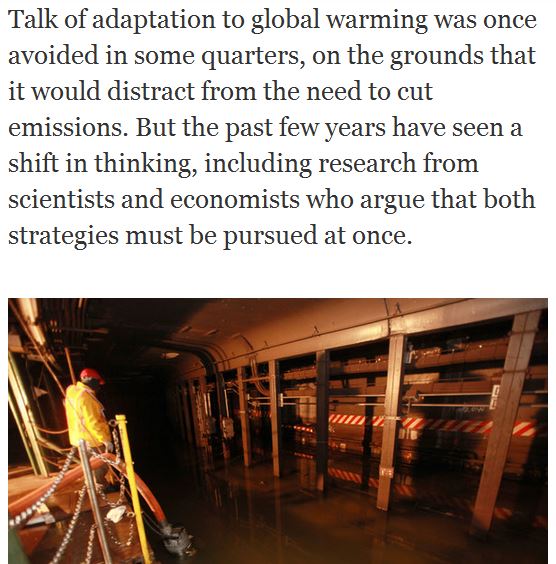
There is a piece in the New York Times today about the third time that world scientists united in order to provide a broad response to the public about the realities of climate change. How these two pieces appear to be linked together so nicely is a claim made Tom LUndborg about how the linguistic turn in political philosophy has distracted us, on the whole, from the “social” concern over materiality and a full-fledged research base of studies on infrastructure. Tom goes further, though, claiming that the linguistic turn has made it much more difficult to be fully critical as theorists or, conceivably, as government agencies or even public citizens to take the next step … although, that is where the radio show ends.

PACITA’s 2nd European TA Conference

Capture

PACITA’s 2nd European TA Conference

The overall aim of the conference is to take stock of and support the exchange on TA capacities throughout Europe. Following the successful meeting of researchers, TA practitioners, policy makers and civil society organizations at the 1st European TA Conference in Prague in March 2013 we look forward to continuing the fruitful discussions and networking at the 2nd European TA Conference in Berlin. The Conference is organized within the framework of the four-year FP7 project PACITA (“Parliaments and Civil Society in Technology Assessment”). Generally, the PACITA project and the Conference define “Technology Assessment” in a broad sense. TA comprises methods, practices and institutions for knowledge based policy making on issues involving science, technology and innovation, including TA-related fields such as Foresight, Science and Technology Studies (STS) and research on Ethical, Legal and Societal Aspects (ELSA) of science and technology.

We submitted and we’ll let you know if we get a spot (along with some invitations).

Here is our submission:

Session Title: The State as a Concept In Practice

If it is necessary to reflect upon concepts that support democratic problem solving and decision making, then no concept is more important or central to this aim than “the state.” Over the last decade, scholars in science and technology studies (STS) have developed an innovative and useful model for understanding the state. In particular, they show how the state is an academic concept — a theory, to be specific — that is used routinely in the everyday practices of contemporary Continue reading

Eternal Harvest

Geographical Imagination … interesting blog if you don’t know them (I didn’t until a colleague mentioned them to me today). Check it out.

Derek Gregory's avatargeographical imaginations

Many readers will know the remarkable work that’s been done to reconstruct the US bombing of Cambodia during the ‘Vietnam’ War: I’m thinking of Taylor Owenand Ben Kiernan‘s ‘Bombs over Cambodia’ which appeared in The Walrus in 2006: available here and here.

The still-incomplete database (it has several “dark” periods) reveals that from October 4, 1965, to August 15, 1973, the United States dropped far more ordnance on Cambodia than was previously believed: 2,756,941 tons’ worth, dropped in 230,516 sorties on 113,716 sites. Just over 10 percent of this bombing was indiscriminate, with 3,580 of the sites listed as having “unknown” targets and another 8,238 sites having no target listed at all. The database also shows that the bombing began four years earlier than is widely believed—not under Nixon, but under Lyndon Johnson. The impact of this bombing, the subject of much debate for the past three…

View original post 546 more words

Open Standards in the Digital Age: History, Ideology, and Networks

Open Standards?

dmf's avatarsynthetic zerØ

Open Standards in the Digital Age: History, Ideology, and Networks

via http://newbooksintechnology.com: We tend to take for granted that much of the innovation in the technology that we use today, in particular the communication technology, is made possible because of standards. In his book Open Standards and the Digital Age: History, Ideology, and Networks (Cambridge University Press, 2014), Dr. Andrew L. Russell examines standards and the standardization process in technology with an emphasis on standards in information networks. In particular, Russell examines the interdisciplinary historical foundations of openness and open standards by exploring the movement toward standardization in engineering, as well as the communication industry. Paying careful attention to the politics of standardization, Russell’s book considers the ideological foundations of openness, as well as the rhetoric surrounding this ideology. Notable also is the consideration of standardization as a critique of previous ideology and a rejection of centralized control.

View original post

Knowledge: Power and Production, Annual Conference CFP

readsocialthought's avatarRead Write Think... Social Thought

The Social Thought Program and the student reading group are happy to announce the dates of the 2014 Penn State Social Thought Conference: April 4th-5th on the University Park Campus. The keynote address will take place Friday afternoon, and the main conference on Saturday. All events are free and open, with lunch served on Saturday.

Call for Papers

Knowledge: Power and Production

What is knowledge? Who defines it? Who and what determines the ownership of knowledge? What is the relationship between the production and dissemination of knowledge? What are the power dynamics of knowledge in contemporary society? How does the constriction and control of knowledge influence politics? How is our conceptualization of knowledge changing with technology?

We would like to facilitate a discussion of the changing conceptualization and commodification of knowledge in a world in which a library can occupy both a multi-story building and a computer’s hard drive. Perspectives…

View original post 142 more words

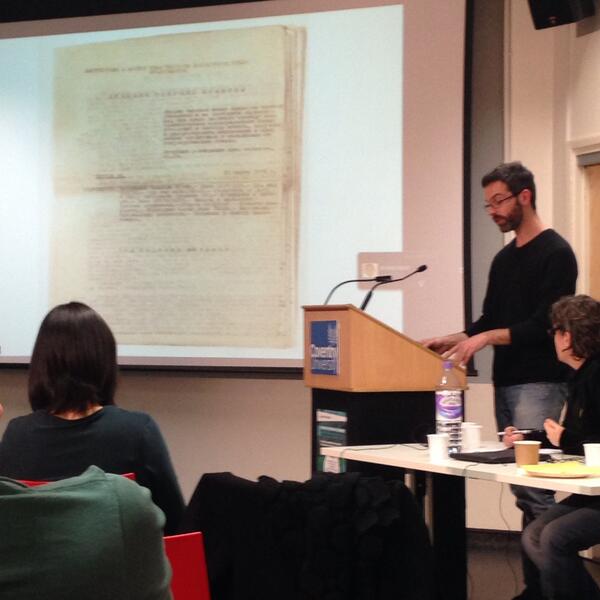
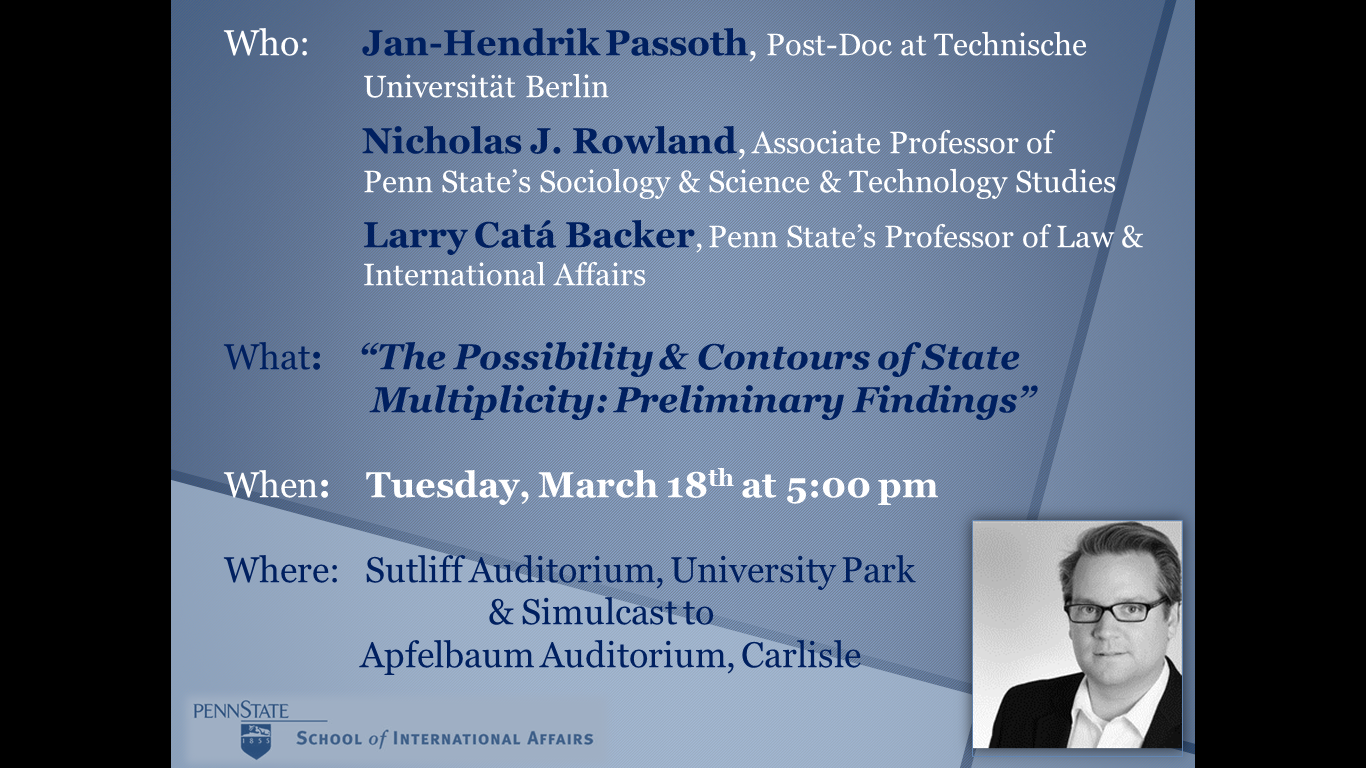
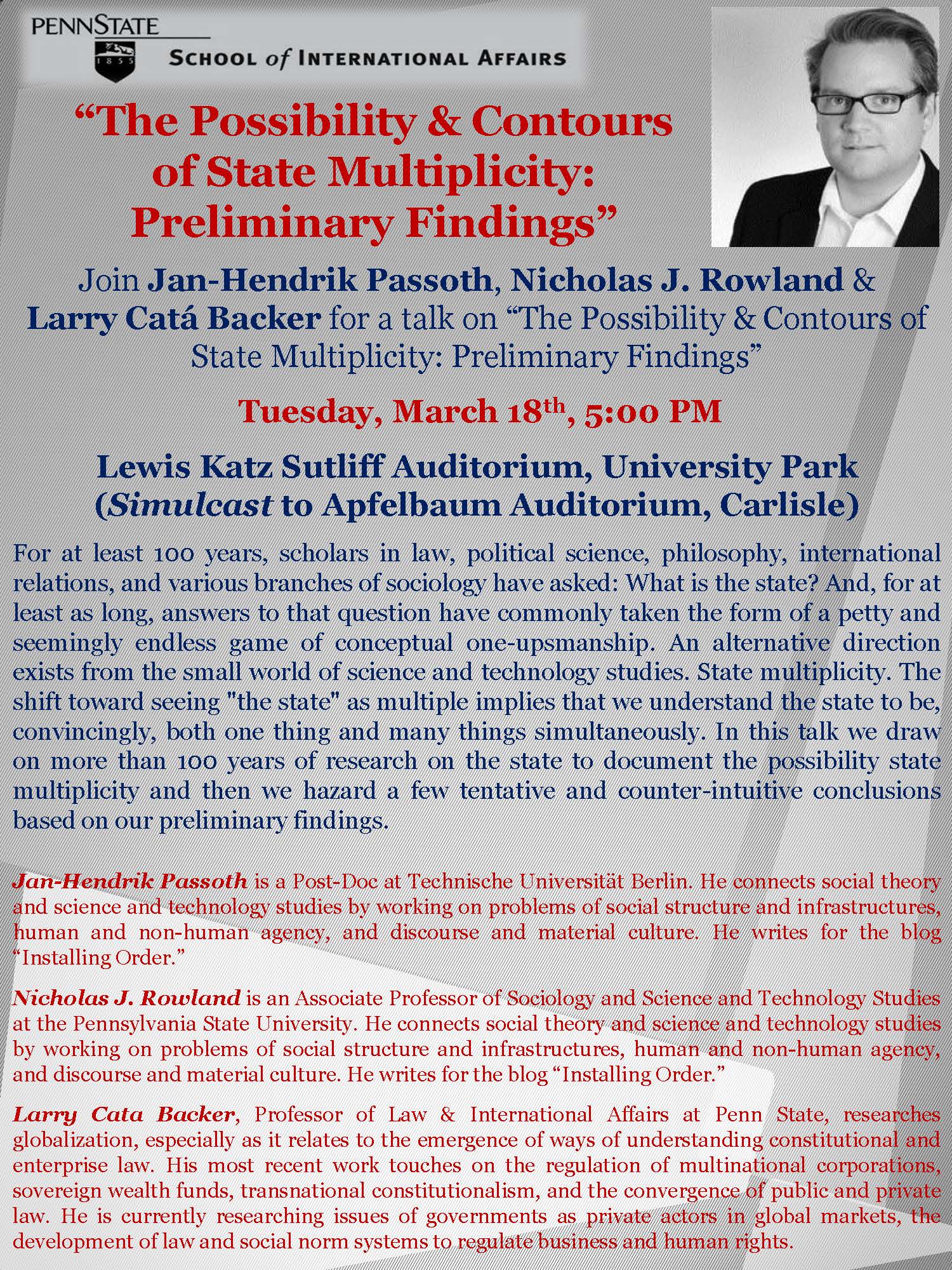
Presentation and Roundtable: Jan-Hendrik Passoth and Nicholas Rowland on “The Possibility & Contours of State Multiplicity: Preliminary Findings”

Capture

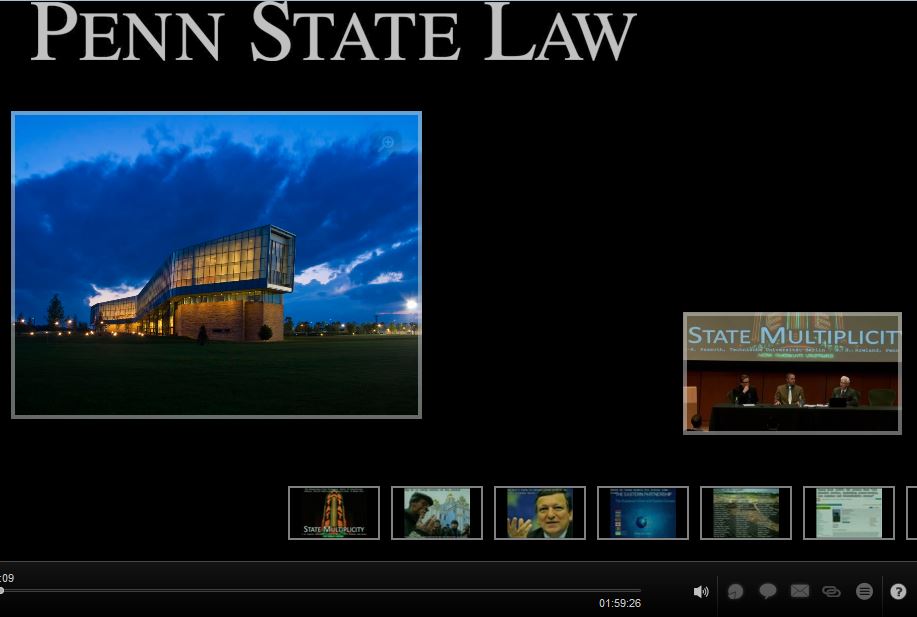
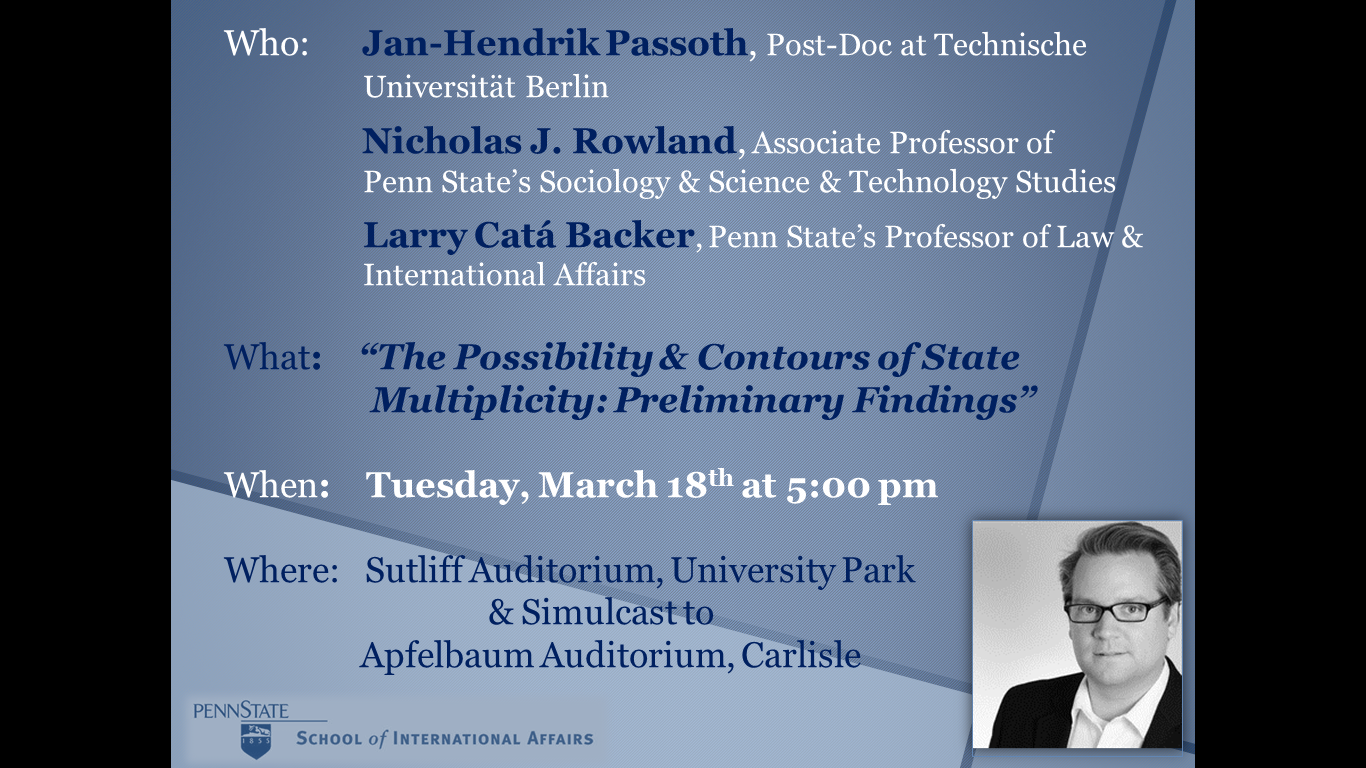
Jan and I recently gave a talk at the School for International Affairs in the Law School at The Pennsylvania State University, which is available HERE.

The presentation, “The Possibilities and Contours of State Multiplicity: Preliminary Findings”, featured Jan-Hendrik Passoth (Technische Universität Berlin), Nicholas Rowland (Penn State University) presenting their latest research work on state theory, and Larry Catá Backer (Penn State) as discussant.  The conference was recorded and all are welcome to watch and comment, engage.

Description of the talk:

For at least 100 years, scholars in law, political science, philosophy, international relations, and various branches of sociology have asked: What is the state? And, for at least as long, answers to that question have commonly taken the form of a petty and seemingly endless game of conceptual one-upsmanship. An alternative direction exists from the small world of science and technology studies. State multiplicity. The shift toward seeing “the state” as multiple implies that we understand the state to be, convincingly, both one thing and many things simultaneously. In this talk we draw on more than 100 years of research on the state to document the possibility state multiplicity and then we hazard a few tentative and counter-intuitive conclusions based on our preliminary findings.


The Passoth-Rowland Presentation and Roundtable may be viewed HERE (via mediasite) or on Penn State Law’s Multimedia Page.  It may also be accessed through the Coalition for Peace & Ethics Website: HERE.

Continue reading

Understanding the City: Henri Lefebvre and Urban Studies

Henri Lefebvre on city infrastructure

stuartelden's avatarProgressive Geographies

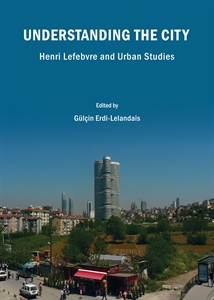
Understanding the City: Henri Lefebvre and Urban Studies  – a collection edited by Gülçin Erdi-Lelandais (via here ).

0069758_understanding-the-city_300

Henri Lefebvre is undoubtedly one of the most influential thinkers in the field of urban space and its organization; his theories offer reflections still valid for analyzing social relations in urban areas affected by the crisis of the neoliberal economic system. Lefebvre’s ideal of the “right to the city” is now more widely accepted given today’s current cultural and social situation. Most current research on Henri Lefebvre refers solely to his ideas and their theoretical discussion, without focusing on the empirical transcription of the philosopher. This book fills this gap, and proposes examples about the empirical use of Henri Lefebvre’s sociology from the perspective of different cities and researchers in order to understand the city and its evolutions in the context of neoliberal globalization. The book’s main purpose is to revisit Lefebvre’s still-relevant key…

View original post 97 more words

The Crimea Precedent & the Post-Soviet De Facto States

Both this post and the post it references are fascinating for seeing an interesting intersection of “practical politics” and “academic models” … if you go to the original post on “Monkey Cage” you’ll notice that survey responses to question 3 are about state entitivity.

Dr Gerard Toal's avatarCritical Geopolitics

IMG_5144.JPG - Version 2

The well-known Political Science blog The Monkey Cage, now owned by the Washington Post (now owned by Jeff Bezoswe all work for Amazon nowposted earlier today a concise 3 graph summary of what our De Facto State Research Survey reveals about likely attitudes amongst different ethnic groups in South Ossetia, Abkhazia and Transnistria (we left out our research results from Nagorny Karabakh since it is not directly supported by the Russian Federation and has its own unique features). We want to thank The Washington Post and particularly Erik Voeten of Georgetown for his assistance in swinging open the door of the Monkey Cage sufficiently to let two Irish political geographers propel some hopefully useful place-based knowledge into the maelstrom of debate that engulfs us post-Crimea. It is painful to summarize years of research into a few paragraphs but at least we didn’t have to write…

View original post 6 more words

Kyle McGee’s ‘Bruno Latour: The Normativity of Networks’

Thanks a lot to Philip for pointing us to Klye McGee´s new book, and especially to the three pieces on the AIME website:

There are three extracts from the book on the AIME website (registration required):
The co-presence of [pol] and [law]
The ontology of lawyer jokes
Legal reasoning as de-stratification

I am so looking forward to checking the book out. Or maybe i just wait for a review on: Circling Squares: Kyle McGee’s ‘Bruno Latour: The Normativity of Networks’.

Bruno and (Star)bucks

Capture

Teaching ANT to students at the undergraduate level can be a difficult endeavor; however, I have come across a viable solution.

Coffee.

But not to keep students awake during boring lectures about Bruno so much as a case study. The rise of gourmet-style coffee in the United States via the mass producer and distributor Starbucks.

The lecture is here; if you’ll use it, drop me a line (njr12 <at> psu.edu).

Continue reading

Samizdat lessons for Mattering Press

Capture

Many thanks, Nicholas, for the kind introduction – it’s great to be back as a guest blogger! Last time I was here, I wrote a series of posts about the material practices of democratic politics, and the ways in which they were being coordinated and distributed by the Hungarian Parliament as a complex political technology. That was in late 2011. Since then I’ve become a postdoc researcher at the Department of Sociology at the Goethe University in Frankfurt am Main, and got involved in the setting up of an Open Access book publisher called Mattering Press.

Last week I participated in a very interesting symposium, organised by the Centre of Disruptive Media at Coventry University (more precisely, by Janneke Adema and Gary Hall). It was the first of a series of events called Disrupting the Humanities, and I was asked to talk about Mattering Press as an initiative that aims to rethink scholarly publishing. While preparing for the event, I remembered an older project of mine, which was about the technologies and techniques of illegal publishing in communist Hungary, and decided to use that as a case to articulate what might be called the politics of self-publishing. What follows is a shortened version of my talk – hope you’ll find it interesting.

matters

Mattering Press and STS

Mattering Press started in early 2012 as a publishing initiative of the Flows, Doings, Edges collective: a peer-support group of young scholars interested in relational research. Sensitive to the politics of knowledge production we began to explore the possibilities of alternative modes of engaging with works we find interesting and important. (Our first books are due to appear in the end of 2014.)

The term ‘mattering’ comes from science and technology studies (more precisely from Karen Barad’s 2003 paper). Since the appearance of the first lab studies in the late 1970s and 1980s, STS scholars have been busy extending their gaze to a wide range of sites, from hospitals through high-tech innovation centres to stock exchange trading rooms, in order to explore how scientific knowledge is being produced and distributed through seemingly trivial material practices – and how it could be produced and distributed differently. Ironically, what’s been largely missing from the list of the usual sites in STS-inspired works are the institutions that play one of the most important roles in shaping the academic world STS scholars themselves operate in, namely publishers.

Continue reading

CALL FOR PROPOSALS: digitalSTS Volume Deadline: May 15 2014

We invite one-page proposals for an edited volume on “digitalSTS” that advance our understanding of digital objects, phenomena, processes, and methods in Science and Technology Studies. Proposals will be solicited and adjudicated in one of three categories: (1) Theory and Cases, (2) Methods, and (3) Making. To best tailor your proposed submission, we outline the three categories and their expectations below. For more information please see http://www.digitalsts.net or email the digitalSTS editorial team at digitalSTS@zoho.com.

Strong contributions will draw direct connections to topics, literatures, and inquiries of central importance to STS. They may also engage contributions from intersecting fields such as anthropology, communications, media studies, computer-supported cooperative work, and human-computer interaction. We encourage the broadest possible participation from individuals and groups working across Science and Technology Studies and its constitutive or intersecting domains.

In line with the principles and practices of the growing digitalSTS community, this Call for Proposals (and Things!) was generated by community members at the digitalSTS Workshop at 4S in October 2013. Submissions will be discussed and adjudicated in an open, online peer review format before the Editorial Team will select and solicit papers. We welcome all members of the STS community to participate in the process of reviewing proposals.

1. Theory and Cases (a.k.a. “The Handbook”): Submissions to the “Theory and Cases” section should explore or propose a significant or novel contribution to STS theory through an empirical case study focused on digital environments, objects, or practices. Through such studies, we aim tobuild a corpus of theory around the digital within STS, and also contribute to larger debates and established topics within the field (for example: social shaping, actor-networks, ontologies, expertise, feminist STS, science and technology policy, etc.).

2. Methods (a.k.a. “The Field-guide”): We seek submissions that address methods and methodologies for studies of the digital, broadly construed, as well as novel approaches that draw on the enabling capacities of digital approaches for investigations of STS topics. The digital presents many novel phenomena and also provokes a reexamination of existing objects of analysis for STS. The styles for submission are broad: we seek exemplary studies that demonstrate methods, or reflexive papers that explore high level methodologies and hands-on approaches.

3. Making (a.k.a. “The Scrapbook”): This section of the Handbook issues a “Call for Things” targeted at an audience of scholars, designers and makers as well as hybrid identities such as scholar/makers. The call is intended to bring together texts as well as visual materials (such as diagrams, images, prototypes, videos) that use design/making to engage with themes and theories about STS (such as power, materiality), design/making for STS (such as how visual materials and hands-on methods can be incorporated into STS) and design with STS (such as collaborations between scholars and makers).

* Note: We recognize that submissions may cross categories; these are provisional and it may be the case that the final handbook is organized otherwise.

Deadlines: Online Submission System will open in early April, 2014 Submissions Due May 15, 2014 Review period: May 16, 2014 – June 15, 2014

EASST is a lock for STS and the state

Capture

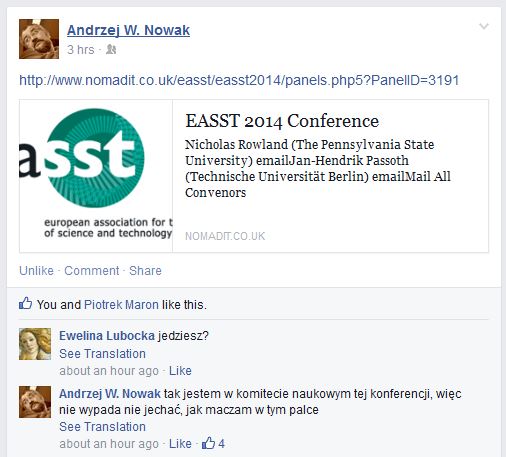
Sometimes you find out about these things on facebook!

At any rate, our session about STS, infrastructure, and the state is secured for EASST — please consider submitting an abstract.

STS and “the state”

Convenors

Nicholas Rowland (The Pennsylvania State University) email
Jan-Hendrik Passoth (Technische Universität Berlin) email
Mail All Convenors

Long Abstract

For “Situating Solidarities,” let’s return to classic issues of science, technology and politics. Normative answer exist: of how science, technology and politics should be related. However, we have seen a rising interest on how the practices of governing and “the state” are interwoven with science and technology. We would like to see:


1. Empirical cases of “the state” as manifest in infrastructure and everyday life: Recent work on

infrastructural developments offers cases to reconsider theoretical approaches to understanding what the state is. “The state in everyday life” offers a perspective that gets at mundane experiences and routine activities that either bring us closer to the state or fend us off from it.

2. Empirical cases of “the state” as manifest materially in institutional arrangements: State formation has been a perennial question in state theory. However, as scholarship develops, the old theories of the state, which emphasize war-making and international treaties, have given way to new research on the practical aspects of state formation and transformation.

3. Where is the state and where is not the state? State absense/state presence: This topic emerged organically from the last 4S meeting in San Diego, and while it is new to us and is far more experimental than the above themes, we consider it of vast potential.

Chair: Jan-H. Passoth, Nicholas J. Rowland

Propose paper

Hacker-Mullins Student Paper Award, 2014

March 15, 2014 is the deadline for graduate students papers for the Hacker-Mullins Student Paper Award, 2014. So if you know a grad student that published a decent paper in the last two or so years, nominate them … or, graduate students, nominate yourselves!

Hacker-Mullins Student Paper Award, 2014

The Science, Knowledge and Technology Section invites submissions for the 2014 Hacker-Mullins Graduate Student Paper Award. The winner will be honored at the ASA meetings in San Francisco (August 16-19, 2014) and will receive a plaque. The award also comes with a $350 prize. The deadline for submissions is March 15, 2014. Self-nominations are welcome. To be eligible, an author must be a student at the time of submission. Published and unpublished papers are accepted; if published, the article must have been published no earlier than 2012. This year’s committee members are Daniel Breslau (Chair), Erin Leahy, Dan Morrison, Elizabeth Sweeney, and Steven Epstein (ex officio). Please send the nominated paper and a brief nominating statement in one PDF document, via email, to Daniel Breslau at dbreslau@vt.edu.

Here are some past winners of the award published in SSS.

Guest blogger: Endre Dányi for one time only

Capture

Long time blog readers, you may recall that Endre was a guest blogger for us doing a great, great series on Parliaments (6 parts in all, count them, one, two, three, four, five, and six!). Looking back, the six posts make a nice collection.

He has been keeping busy lately in a project that was featured on the EASST website (for his collaborative work on “Mattering Press: New forms of care for STS books.”).

He will join us again for a blog post specifically about mattering press and perhaps tell us a little about a talk he recently did about open-access and samizdat.

As Endre told me:

The term ‘samizdat’, coined by the Russian poet Nikolai Glazkov in the early 1950s, means self-publishing and refers to both the various processes of producing texts unauthorised by the state, and the outcomes of those processes: mostly literary and political writings that could not have appeared in official periodicals.

Image from: http://pbs.twimg.com/media/BiIbVQSIYAAICQb.jpg

Diagnosing Bridge Collapse

Capture

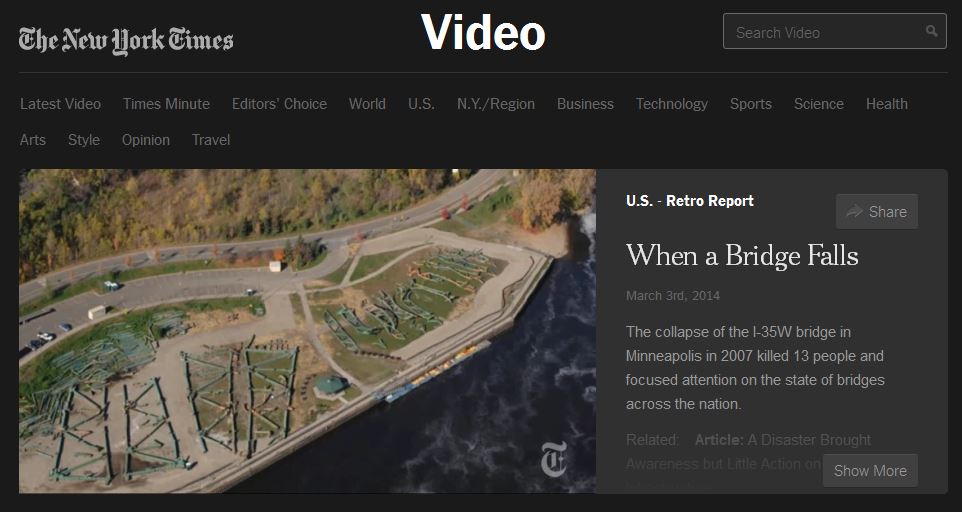
New York Times has a nice retrospective video on the “collapse of the I-35W bridge in Minneapolis in 2007 killed 13 people and focused attention on the state of bridges across the nation.” As a native Minnesotan, this event is one of the moments I look back and can easily pinpoint my growing interest in infrastructure, especially, infrastructural decay as a major present and future concern in the US and beyond.

STS Summer School: Science and Governance at the Frontiers of Life

This weeklong summer school is intended for graduate students and early postdocs in science and technology studies, history, philosophy, sociology, and anthropology of science, legal studies or related fields.  We also invite applications from students in the biomedical sciences, life sciences and bioengineering who can demonstrate strong commitment to investigating the interconnections between science and society. Graduate students must have completed at least one year of study at the doctoral level.

Developments in the biosciences in the last half-century have posed novel challenges for governance. These have emerged as biological knowledge becomes more central to matters of safety, health and welfare; as biology is called upon to address moral uncertainty around ideas of human nature, identity and dignity; and as biology plays an increasingly central role in the technological alteration of human bodies, non-human entities and environments. Governance challenges have unfolded across several domains: internally within the research enterprise itself; externally where the biosciences are called upon to address social problems; and in moments of ethical doubt, for example, when institutions of governance are called upon to distinguish bioengineered artifacts from entities with human dignity. Scholarship in Science and Technology Studies (STS) has developed varied approaches and techniques for examining such phenomena, and drawing theoretically grounded generalizations from site-specific studies. This summer school will introduce participants to major approaches, and explore new research frontiers and possible directions for synthesis and innovation. It will emphasize engagement with theoretical issues in STS, with particular attention to moments of friction between science and institutions of democratic governance.

Through a mix of lectures, group workshops and discussions of individual projects, participants will be exposed to contemporary STS research frontiers. The main emphasis of the summer school will be on discussion and exchange of ideas and insights across different research topics, methodologies and theoretical frameworks. Each day during the workshop faculty participants will give overview presentations addressing different themes. These will be accompanied by interactive, in-depth discussion sessions. Students in the summer school are expected to be present and actively involved throughout the course.

The summer school will be held at Harvard University in Cambridge, Massachusetts, July 27 to August 2, 2014. Room and board will be provided. Students are responsible for their own travel expenses and for their visa status, if relevant. Modest subventions may be available upon request, based on a demonstration of need.

The course is limited to 20 participants and the application deadline is April 4, 2014. Please complete the application form at http://sts.hks.harvard.edu/events/sts-summer-school-application-form/. The form includes a place to upload a statement of interest (300 words) and a short professional CV (maximum 2 pages), as well as space to enter the name and email address of a nominating faculty member. The statement of interest should describe the applicant’s background and qualifications and describe their current research and its relevance to the aims of the summer school. The nominating letter should be from a faculty member in the applicant’s program who is familiar with the applicant’s work and interests. The letter should be sent by the nominating faculty member to shana_rabinowich@hks.harvard.edu.

Conveners: Sheila Jasanoff (Harvard University), Krishanu Saha (University of Wisconsin-Madison), Benjamin Hurlbut (Arizona State University)

Faculty Participants

·         Ulrike Felt (University of Vienna)

·         Jeremy Greene (Johns Hopkins University)

·         Steve Hilgartner (Cornell University)

·         Benjamin Hurlbut (Arizona State University)

·         Sheila Jasanoff (Harvard University)

·         Pierre-Benoit Joly (INRA and IFRIS)

·         Shobita Parthasarathy (University of Michigan)

·         Joanna Radin (Yale University)

·         Jenny Reardon (University of California, Santa Cruz)

·         Krishanu Saha (University of Wisconsin, Madison)

·         Giuseppe Testa (University of Milan, European School for Molecular Medicine)

·         David Winickoff (University of California, Berkeley)

Surveillance Infrastructure Novel

Image

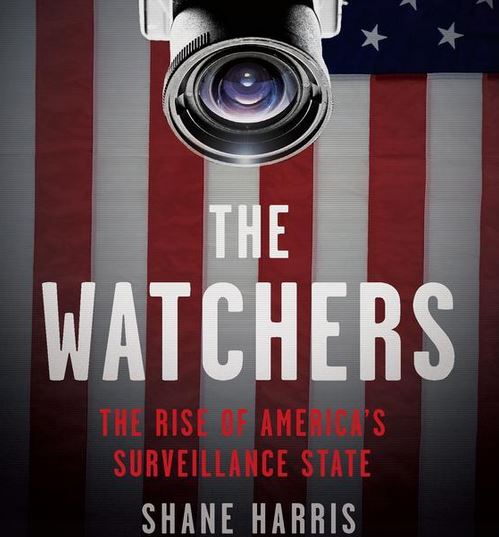
As weird as it sounds, that’s what “The Watchers” is, but it is also written by Shane Harris who has something of an academic/journalistic background, which the subtitle “The rise of the American surveillance state” clarifies.

The concept developed, the surveillance state, is not really developed for use in theory, but it does seem to have applications for the general public as a (new) way to think about these issues (that Foucault cued us to long ago). Likewise, the book is written in a novelistic style even though it is based largely (if not entirely) on first-hand accounts from people Harris has interviewed. Makes for an interesting discussion: is it worth using the novel format to learn empirical truths about the state, or does the style/format reduce the “weight” of the argument?

I don’t know, but the more our ideas here get in congress with dmfant’s, I wonder if “more useful” is not always better provided “still true” is the baseline.

The Birth of Territory wins the 2013 Association of American Geographers Meridian Book Award for Outstanding Scholarly Work in Geography

The Birth of Territory wins the 2013 Association of American Geographers Meridian Book Award for Outstanding Scholarly Work in Geography

stuartelden's avatarProgressive Geographies

12 The Birth of Territory I have recently been given the good news that the The Birth of Territory has been awarded the 2013 Association of American Geographers Meridian Book Award for Outstanding Scholarly Work in Geography .

I’m obviously delighted by the news, but also surprised, in part because Terror and Territory won their other major book award just a few years ago. I will receive the award at the AAG meeting in Tampa in April, where there will also be an ‘author meets critics’ session on the book.
View original post

Dingpolitik and Other Things

The time has come to talk of many things: 

Of Oysters–and Windfarms–

Of hurricanes–and oil spills–

And why politics needs these things–

and whether bacteria eats oil


In Making Things Public, Latour sets forth to “designate a risky and tentative set of experiments in probing just what it could mean for political thought to turn ‘things’ around, or ‘What would an object-oriented politics look like?” (p.14).  It was this chapter–”From Realpolitik to Dingpolitik or How to Make Things Public”–that prompted much of my thought about what a “thing” oriented International Relations might look like. My research is focused on bacteria and microbiomes and bodies and parasites, but sometimes other things make themselves known. This is the most magical part of a “thing” oriented politics: those objects demanding attention, making themselves known, pushing us to respond to the world and everything in it.
I have a forthcoming chapter in a book taking objects in IR as its subject entitled Making Things International.  This book is something new and exciting from a disciplinary standpoint, and my chapter on microbes joins others on corpses, passports, viruses, drones, dirt, bodies, and barbed wire, to name just a few from the collection. Now, hanging out with STS folks makes this seem easy, but IR has chosen its objects of study from a rather short list.  We talk about the State with a capital S, sometimes NGOs, admittedly, more and more attention is focused on the individual, but it is generally bounded by international law or rationalist assumptions of individuality over sociality. The International Criminal Court has brought individual accountability to a system of sovereign immunity, but progress is slow and fitful and markedly anthropocentric. Even with global climate change, decline in biodiversity globally, and the countless number of extinctions, IR doesn’t really talk about “nature” as much as it should given the climate crisis as the acme of politics now immanent to the globe.   

That said, a good place to start with objects in politics is with disasters, or “What can things do for us?”  Let’s look at a recent study proposing wind turbine “farms” off the coast and then one about oysters and their role in curbing superstorms off the US Atlantic coast.

Admittedly, this is still looking at objects anthropocentrically, but it’s a start. Also, I know that recognizing “things” as crucial to survival, safety, or health, or happiness doesn’t translate to a democracy that incorporates them explicitly, but even finding these actants on the radar can open a dialogue about the role humans and others play in complex eco(social)systems. 

 A recent study by Stanford, published in Nature Climate Change, has concluded that wind turbines can aid in lessening the damage from superstorms like Sandy and Katrina. Unlike seawalls, they can also generate electricity. Using a climate-weather model, the study found that “large turbine arrays” of 300+ would significantly reduce windspeed, rarely suffer damage during high wind storms, and that the net cost is estimated to be less (“capital plus operation cost less cost reduction from electricity generation and from health, climate, and hurricane damage avoidance) than the net cost of fossil fuel electricity generation.  Unfortunately, the number of turbines to take the edge off of Katrina would be 78,000 wind turbines placed offshore. Currently, there is political resistance to any wind turbines in many areas of the US and many question whether this would be worth the cost.  The two largest wind farms in the works in New England and Texas have only 200 turbines. 

Futurity writes that the cost of Sandy totaled $82 billion, and there is the added bonus of electricity generation to sweeten the financial deal. A further question would be the ecological impact to the ocean. This was not addressed in the articles I found.

popsci.com

This article on the role oysters in taming superstorms is a wonderful example of an object oriented look at the world.  In October 2012, Paul Greenberg wrote about the destruction of the indigenous oyster in New York, Crassostrea virginica, and the effects their underwater reefs have had on stabilizing the shoreline previous to over-harvesting by humans. To quote from the article:

“Just as corals protect tropical islands, these oyster beds created undulation and contour on the harbor bottom that broke up wave action before it could pound the shore with its full force. Beds closer to shore clarified the water through their assiduous filtration (a single oyster can filter as much as 50 gallons of water a day); this allowed marsh grasses to grow, which in turn held the shores together with their extensive root structure.”

Of course, as Greenberg points out, our protection is at an end due to our “poor behavior”. Like the Walrus and the Carpenter from Lewis Carroll’s Through the Looking Glass, we ate them all up. 


“O Oysters,” said the Carpenter,
“You’ve had a pleasant run!
Shall we be trotting home again?’
But answer came there none–
And this was scarcely odd, because
They’d eaten every one.


Then we started farming oyster beds, but that didn’t go so well after dumping raw sewage in the ocean.

In conclusion, he points out that storms like Sandy will both increase in savagery and frequency, and that we need the  oysters back in the bays to protect us (and they taste good, too).  This is made difficult because of poaching and pollution, but human-run programs have tried to get reefs started again. From the perspective of an object oriented democracy, oysters need NY reps, right? And wind turbines  should have their say against those arguing against them– “ugly” skylines or electricity?

Future blog posts along this line could involve oil eating bacteria in the Gulf coast….anti-bacterial handsoap and our “superbugs”…    

Is possible to switch-off war?

Capture

In this post from Andrzej, we ask the question: can we switch-off war?

I am from Poland. These days, we are a little over-sensitive about Ukraine, and now even more so about Crimea crisis. I would like to show you very interesting article, which I found here: http://www.slate.com/articles/news_and_politics/foreigners/2014/03/vladimir_putin_s_crimean_mistake_the_russian_president_is_miscalculating.html.

The author is analyzing the possibility of war and future existence of puppet pro-Russian Yanukovith Crimea state from an “infrastructure perspective”. It reads:

The Crimea could explode into bloodshed. To prevent if from happening, maybe turning off the power for 15 minutes will force a reboot in Putin’s aggressive, misguided, and ultimately doomed scheme.

The main idea is quite simple: most of the electric power, water supplies, and 70% of food is from the Ukraine mainland, and, as a result, peninsula is not self-sustainable. The author’s idea, copied form Ukrainian internet, is that Ukrainian government should make this fact visible to Putin and the world by switching power for 15 minutes:

The Crimea’s dependence on Ukraine for nearly all of it electricity makes it equally vulnerable to nonviolent retaliation. One suggestion making the rounds of the Ukrainian Internet is that the mainland, with warning, shut off the power for 15 minutes. It may not normalize the situation, but it could give Moscow pause. Of course, Russia could retaliate by cutting off Ukrainian gas supplies, but that would mean cutting off much of Europe as well. Besides, Ukrainians proved this winter that they aren’t afraid of the cold, and spring is coming.

Do You think is possible to use infrastructure to defend in the way that an army does? Is possible to switch off war?


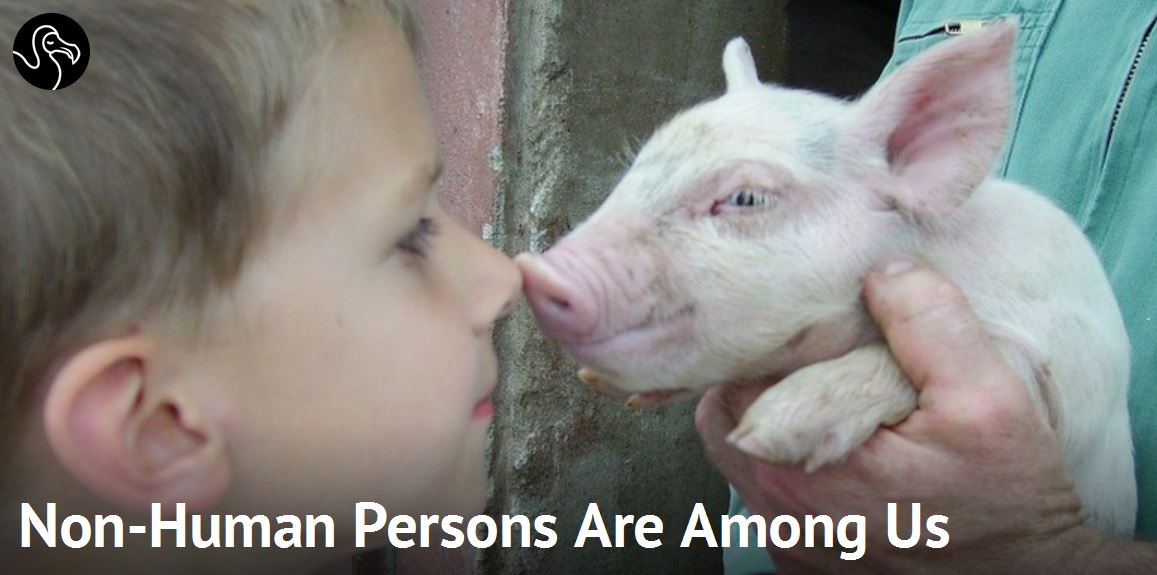
Non-human persons are among us

Capture

The dodo-community has a blog that utilizes some concepts we are generally interested in on the blog, for example, non-human. Check it out.

Some of the links are pretty incredible, like dolphin stampedes and so on. At any rate, it is an interesting source that I was not aware of. Might be more exciting or interesting if there was a more academic focus (that is, specifically interesting to me as an academic), but some of these issues, like the protection of animals, would suffer from a pedantic streak …

Disaster art?

DSC07403

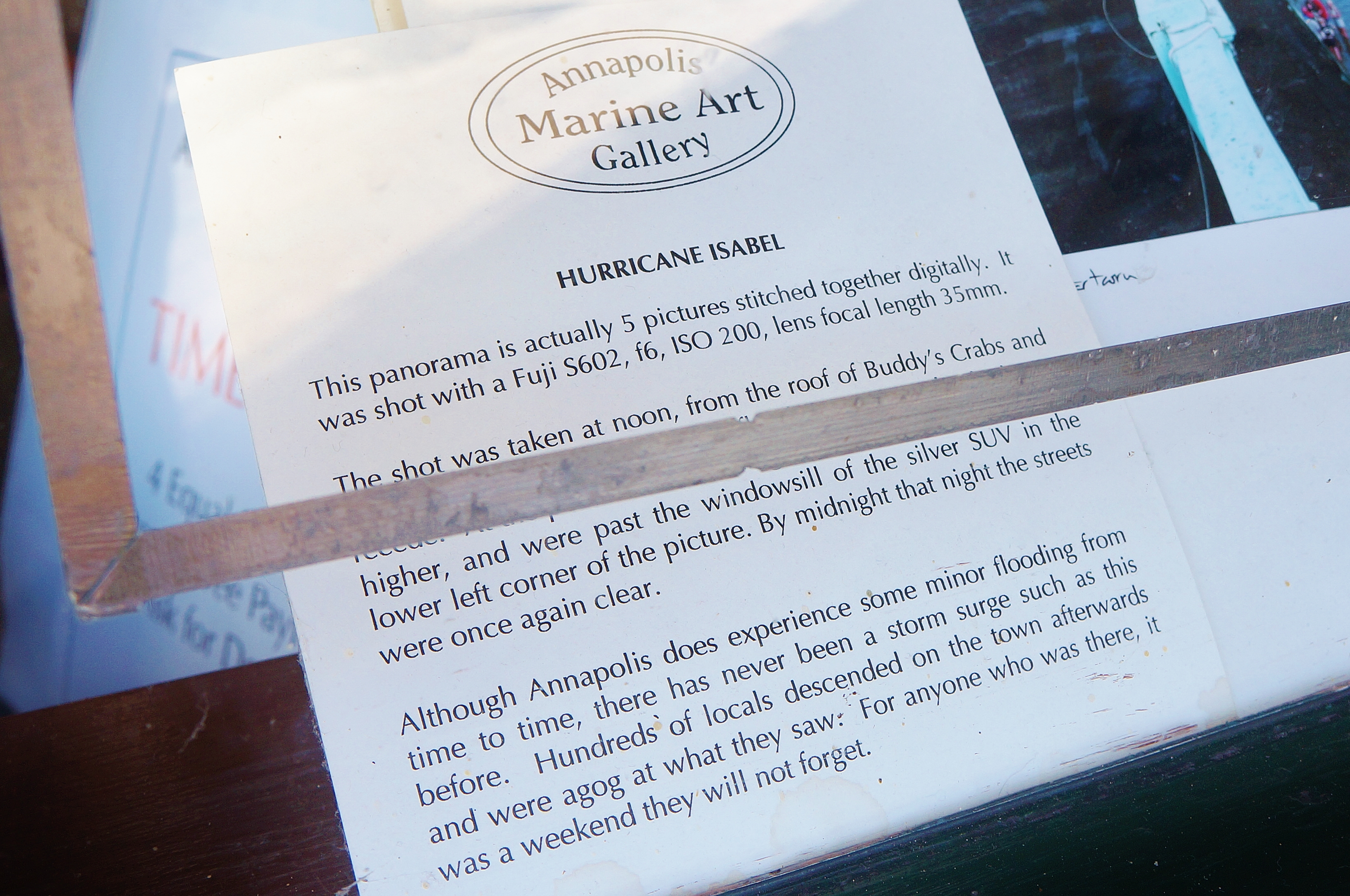
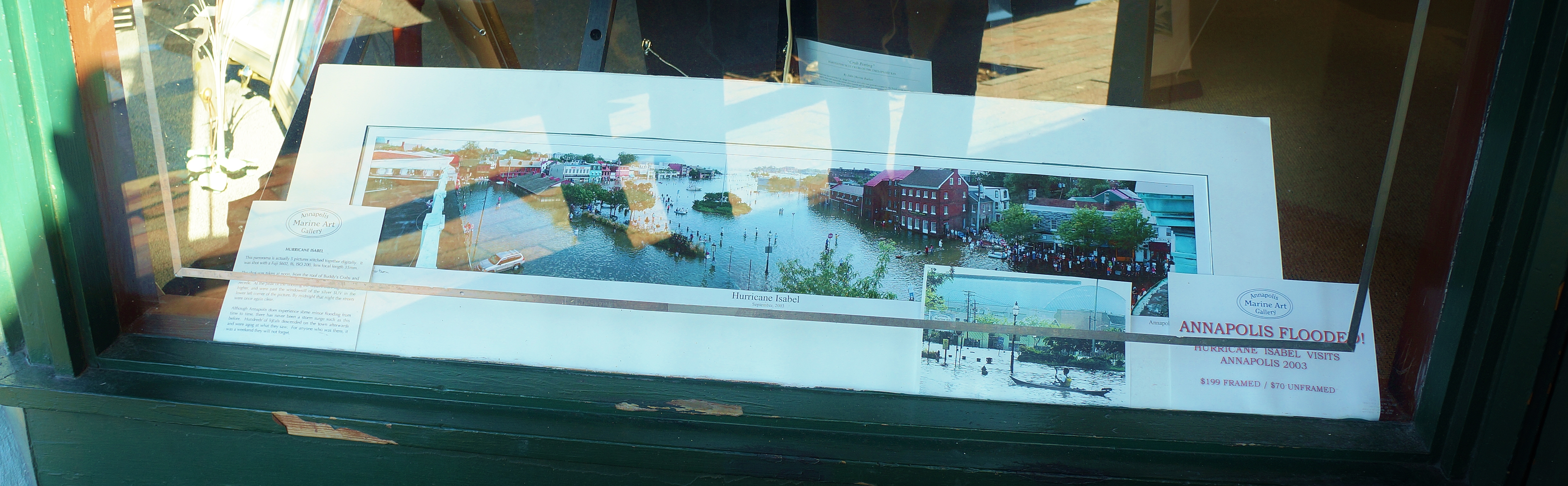
I was in Anapolis, MD, last weekend and saw something that I thought was a bit odd (above): disaster art. At first, I was stunned; how could a place celebrate (but potentially profit) from local disasters? How would that appeal to tourists? In this case, of course, its an image of flooding after a hurricane where the infrastructure of the harbor is damaged and, in may cases, submerged.

DSC07402

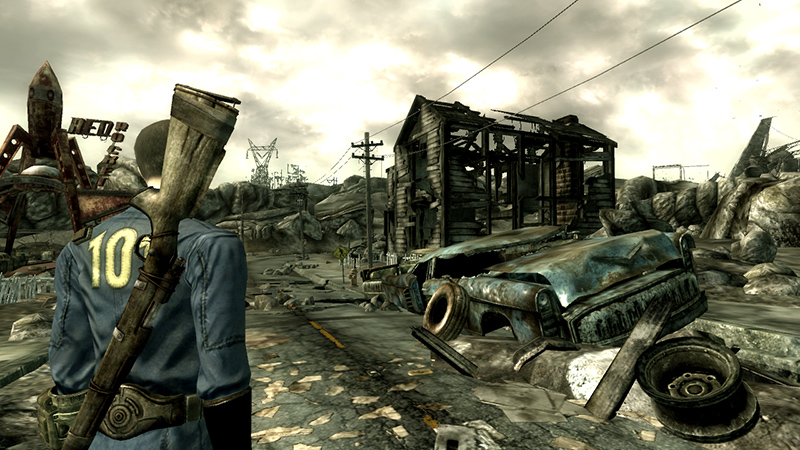
“Why would folks want pictures of broken infrastructure?” I thought. And that’s when my art history training came in and I had a “duh” moment. Disaster art — fictional and non-fictional — has been common for centuries. See, for example, this blog post about sunken ships or this one featuring a number of examples of fictional disaster art.This pintrest board sums it up nicely, saying disaster begets creativity, and includes a number of other obvious pieces of this puzzle like disaster memorials and post-disaster reassembly work like art from tsunami rubble in Japan. I’d also be remiss not to include the massive amount of disaster art in video games, for example, post-apocalyptic games like the Fallout (below), Gears of War, or Halo series.

Capture

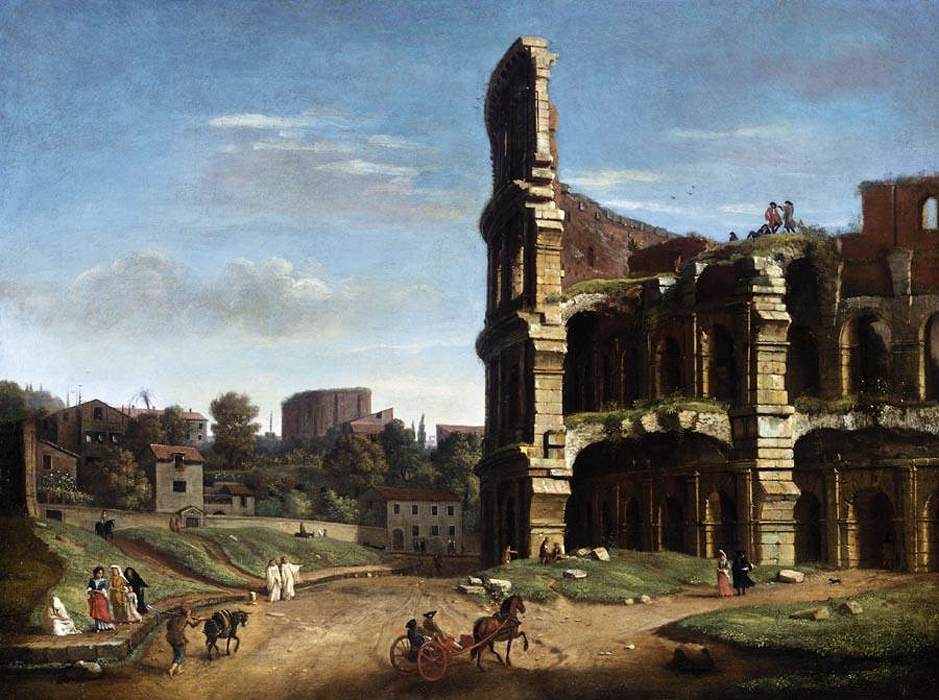
Still, people’s love for depicting ruins is far older than all that. I’m thinking, in particular, of the many depictions — often with a romantic feel — of derelict Greek temples or statues like this image (contemporary, lame, background wallpaper) or this painting of the Colosseum (from the second half of 17th century).

Capture

Seems we love our ruins, after all.


Using search engines to teach reading

Capture

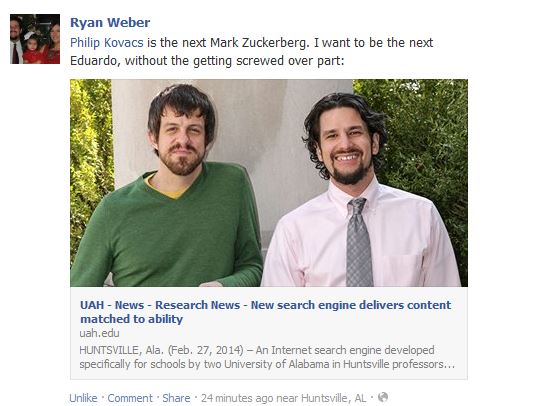
Interesting development in Alabama:

HUNTSVILLE, Ala. (Feb. 27, 2014) – An Internet search engine developed specifically for schools by two University of Alabama in Huntsville professors is being tested as a way to increase reading abilities in challenged students and help motivate intellectual development in gifted students, while saving schools money on textbooks.

Check out the full story here.

The long shot heard round the world

Capture

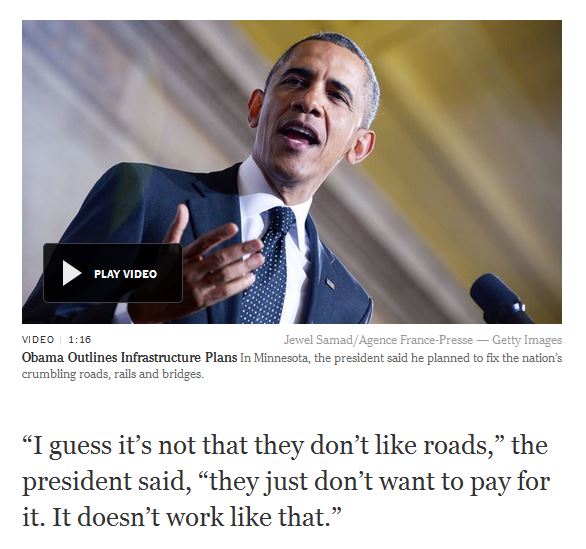
Well, not exactly around the world. President Obama asks for a tax increase on gasoline to improve American infrastructure … only, it is not a gas tax, it is just another corporate tax, according to a NYT report. Obama appears to be using commonsense; if you like to use roads, then we need to pay to upkeep them … only that is what scares me because commonsense on the hill seems to have left the building a decade (or more) ago.

Crowdsourcing light pollution data: A means of infrastructure awareness?

Crowdsourcing infrastructure data/awareness?

Max Liboiron's avatarDiscard Studies

The Globe at Night project  is an international citizen-science campaign to measure the impact of light pollution. It invites citizen-scientists (aka: you) to measure their night sky brightness and  submit their observations  from a computer or smart phone. Light pollution is often left out of discussions about waste and discards, possibly because of its un-material, non-toxic status. Yet, if waste is broadly defined as the externalities of social-technical systems, then light that exceeds its use or that effects areas outside of designed intentions certainly qualifies as waste. Light pollution is usually defined as “excessive, misdirected, or obtrusive artificial” (usually outdoor) light. Too much light pollution has consequences: it washes out starlight in the night sky, interferes with astronomical research, disrupts ecosystems )particularly nocturnal animals), has adverse health effects (particularly circadian rhythms) and wastes energy. There is even something called “ light trespass ,” where light shone onto a property prevents the owner from…

View original post 625 more words

The Anthropocene, Cabinet of Curiosities Slam, Nov. 8-10, 2014, Call for Submissions

FYI–great looking conference coming up! It seems that NIck and I return to this cabinet of curiosities quite often…

The Anthropocene, Cabinet of Curiosities Slam

Nov. 8-10, 2014 University of Wisconsin, Madison

Call for Submissions

We are in the midst of a great reawakening to questions of time—across the
spans of geological, ecological, evolutionary, and human history.  It is a
reawakening precipitated, not by a nostalgia for the past, but by a sense
of urgency about the future.  The Anthropocene, coined in 2000 by
ecologist Eugene Stoermer and popularized by Nobel Prize-winning
atmospheric chemist, Paul Crutzen, is one of the most resonant examples of
how the urgency of the future has prompted scientists, artists, humanities
scholars, and social scientists to engage creatively with the emerging
legacy of our geomorphic and biomorphic powers. The advent of this new
scientific object—the Anthropocene—is altering how we conceptualize,
imagine, and inhabit time.  The Anthropocene encourages us to reenvisage
(in Nigel Clark’s phrase) future and past relations between “earthly
volatility and bodily vulnerability.”  What images and stories can we
create that speak with conceptual richness and emotional energy to our
rapidly changing visions of future possibilities?  For in a world deluged
with data, arresting stories and images matter immeasurably, and play a
critical role in the making of environmental publics and in shaping
environmental policy.

The Anthropocene is just one among many moments in time when new
scientific objects have altered humanity’s relationship to the past,
present, and future.  The coming-into-being of scientific objects such as
fossils, radioactivity, genetic mutations, toxic pesticides, and ice
cores, to name a few, have precipitated different narratives and
imaginings of the human past and the human future.  What might a cabinet
of curiosities for the age of the Anthropocene look like?  What objects
might jolt us into reimagining environmental time across diverse scales,
from the recent past to deep history?  How might certain kinds of objects
make visible the differential impacts—past, present, and future—that have
come to shape the relationships among human and non-human beings, living
in an era of extreme hydrocarbon extraction, extreme weather events, and
extreme economic disparity?

The Nelson Institute’s Center for Culture, History, and Environment (CHE)
and the Center for German and European Studies (CGES) at the University of
Wisconsin-Madison are pleased to be partnering with the Rachel Carson
Center for Environment and Society (RCC) in Munich and the KTH
Environmental Humanities Laboratory (EHL) in Stockholm to host an
international workshop that invites artists and writers, scientists and
humanists, scholars and activists, to participate in “The Anthropocene,
Cabinet of Curiosities Slam.”  The workshop will take place in Madison,
Wisconsin from Nov. 8-10, 2014.  In the spirit of poetry/spoken word
slams, contributors will be asked to pitch in a public fishbowl setting an
object for the Anthropocene that asks us to rethink humanity’s
relationship to time, place, and the agency of things that shape planetary
change.  How is the appearance and impact of homo sapiens as a geomorphic
force registered in the sediments of history, the objects around us, and
the things yet to be?  What emotionally layered Anthropocene objects can
surprise, disturb, startle, or delight us into new ways of thinking and
feeling?  What objects speak to resilience or adaptation, to vanishing
biota or emerging morphologies?  Based on the audience response at the
slam, contributors will be invited to participate in the design of an
Anthropocene cabinet of curiosities as part of a larger exhibit on the
Anthropocene being planned by the Deutsches Museum in Munich.
Presentations will also form the basis of a collected series of short
essays to be published as part of the CHE, RCC, EHL collaborative project
on Environmental Futures.

To apply, please submit a 200-word abstract of your proposed object and
its importance in opening up questions of time, agency, and/or
intergenerational equity in the Anthropocene, along with a visual
rendering of the object.  Please also include a CV or artist profile.
Materials should be submitted to Garrett Dash Nelson, ggnelson@wisc.edu
by Friday, April 11th.  A limited amount of funding is available to cover
the travel costs of participants.

For more information, please visit
http://che.nelson.wisc.edu/activities/environmentalfutures/

And another thing…

In case you missed it—and you might have if you aren’t in US academia—Nicholas Kristof wrote a NYT blog about the alleged disengagement of America’s professors, especially those in Political Science and International Relations.  Since then, there have been multiple replies and responses to his opinion about the state of the professoriate in the US. I wasn’t going to respond until I read Kristoff’s reply to the replies and realized this dialogue should continue. In the spirit of his call to action, as Claire Potter wrote in her letter to Kristof, I will add my two cents from the frontline in the brave new world of neoliberal postsecondary education.  I have blogged on many of the issues before so I won’t rehash what I’ve gone on record saying previously or spend too much time on what others have written already.

To sum up, Kristof writes in “Dear Professors, We Need You” that most professors are smart, but are irrelevant, arcane, willfully unintelligible, and disdainful of  non-academic audiences. In short, we hide behind our walls when we could be doing SO MUCH MORE.

To begin, I want to say, “I hear you, man.” I appreciate your sincerity and belief in the academic’s role in society.  You are right in your concern that there is a recurring sentiment of anti-intellectual feelings in politics.  Progressive intellectuals should be more active, yes. You are right that jargon sucks and willfully obscuring ideas through pretentious language is counter-productive.

But let me add to the story here. Accessibility of university research to the “average” American is not just blocked by vagueness, jargon, and an increasingly quantitative focus (by this I assume you mean a continued support of positivist approaches), but also by mega publishing companies that firewall and charge exorbitant amounts of money for the regular reader to access our work. Often this is research funded by public money and yet is inaccessible to the public through no fault of the professor. The publishing companies are profiting from the charges, not the authors and, to add insult to injury, we are required to publish in these journals by this “publish or perish tenure process” you call out. Or, in my case, I publish to even have a shot at permanent employment. I am part of a group–Occupy IR Theory–that is fighting this constriction of our scholarly output.  We want our word to be accessed by wider audiences and to have debates in the public sphere, but we are blocked by for profit publishing companies who own our work.  We are forced to “sell” our work to keep our jobs or get jobs in academia.  To chime in with Mr. Vouten: We are right here, Mr. Kristoff.   Many academics are forging ahead with Internet publishing and alternative presses in order for our voices to be heard. While I am first to line to echo your frustration on willful jargon in Political Science, it is a piece of a larger problem that you identify solely with individual academics not pulling their weight in the public arena.

There is also the matter of punching your weight in the public arena.  You don’t acknowledge the plight of many recent PhDs.  Jobs are down by 40%, there’s no work in the private sector either, and many are in tenuous and exploited positions.  I can’t believe you haven’t read these statistics. This elephant in the room is the reality of finding and keeping employment in academia. Most young scholars are spending their time applying for food stamps, working in horrible conditions for low pay, and spending hours and hours applying for jobs that we don’t get. Doesn’t leave much room for engagement, but many of us do anyway. It’s a labor of love. Adjunct, visiting, tenure track, tenured professors all know that it is not uncommon to spend 60-80 hours a week teaching, doing service to our university, advising students, researching, and writing. We work more than full-time jobs. In some cases for those in adjunct positions, as Miya Tokumitsu writes in the Jacobin, they provide high-skilled labor for low wages because the “do what you love” ideology is so embedded in academia. Tokumitsu also stresses that this helps to explain why (and this will resonate with you, Mr. Kristof) the tenured and “proudly left leaning faculty remain oddly silent about the working conditions of their peers. Because academic research should be done out of pure love, the actual conditions of and compensation for this labor become afterthoughts.”

This leads to another conclusion: Quite frankly, some academics are better placed to engage and support public engagement than others. Perhaps you, and others who are well placed, can secure a place for others to speak? This means using your privilege and then stepping back to let those marginalized by the system have a go. In short, yes, academics often marginalize ourselves, but some of us have more help in our disenfranchisement from public intellectuality than others. Some aren’t “cloistered like monks,” but exploited like peasants, to use your metaphor.

Okay, so what is this public intellectual anyway? You write that “over all, there are, I think, fewer public intellectuals on American university campuses today than a generation ago.” This brings me to another point. Unless employed at an R-1 university, professors are also teachers. Is this not public engagement? To be honest, I spend most of my time teaching, grading, and responding to the students in my classes and not writing my jargon-y, esoteric, and specialized research.  I am also active in my community. I organize for primary and secondary education reform and organize talks and films that are open to the public.

You also assume that it is a good idea for professors to be involved in policy. This sometimes goes badly.  I am hoping to see another blog about the role of academics in justifying slavery, colonialism, and in economic departments, wanton destruction of national and international economies by spreading belief in factually incorrect and harmful ideologies like free market capitalism, austerity, and trickle-down economics. These professor/consultants earn fortunes hocking weak theory and bad public policy. This doesn’t even address the revolving door in politics.  Who is allowed to speak to policy makers? Corporations, ex-CEOs, and lobbyists, that’s who.  Maybe that problem should be debated, too. Dear Corporations, we don’t need you.

Just some food for thought.  I think any of these academics below (and there are many more listed in Corey’s response), warrant a guest blog in the NYT to address these issues with you in more depth.  What do you say? Maybe Anne-Marie Slaughter or the Brookings Institute can find some space for adjuncts who would like to be heard?

The responses have been varied and productive.  I will list some of the links here:

Nick Voeten’s reply from the Washington Post  “Dear Nicholas Kristof: We are right here.”

Corey Robin reply “Look Who Nick Kristoff’s Saving Now”

Claire Potter on the Tenure Radical “A Letter From a Public Intellectual”

Mischiefs of Faction “Nicolas Kristof still doesn’t get it”


Legos Shutting-Down Gender Criticism?

1779091_678509118859183_356860788_n

Girls, Blox, Bricks, and “Childhood Engineering”: We’ve written about the new craze for Goldiblox a bunch of times recently (here, here, and here), now that that young engineer from Stanford has formally “launched” the product. Legos appear to be joining the battle-cry … or they also might have started it (well, they seem to claim as much).

Here is some recent text I’ve been seeing all-over discussions about gender and, let’s say, “childhood engineering” (its a WYSK EXCLUSIVE — but seems to be difficult to load the stuff right now … not sure why). Here is the text, and above is the original picture:

“In 1981,” explains Giordano, “LEGOs were ‘Universal Building Sets’ and that’s exactly what they were…for boys and girls. Toys are supposed to foster creativity. But nowadays, it seems that a lot more toys already have messages built into them before a child even opens the pink or blue package. In 1981, LEGOs were simple and gender-neutral, and the creativity of the child produced the message. In 2014, it’s the reverse: the toy delivers a message to the child, and this message is weirdly about gender.”

Not sure if Legos has seized this little tid-bit trying to shut it down, and that explains why it is down, or perhaps the traffic to it is too high (though that seems unlikely, at best). Here is the piece, at least as I can see it from my facebook:

Capture

If you can find it, check out the commentary. You could save this and write a modest piece in STS or even have students analyze the responses in an activity about gender and engineering…


Infrastructure: The New New Deal

Capture

Following government discussion of whether or not investment in infrastructure will or will not improve the economy and boost job growth seems like a no-brainer for the STS crowd (i.e., as a rich topic for discussion); however, to the best of my knowledge, this is relatively rare to find in the pages of our journals (even if the insights we could glean may very well have helped such dire governmental circumstances).

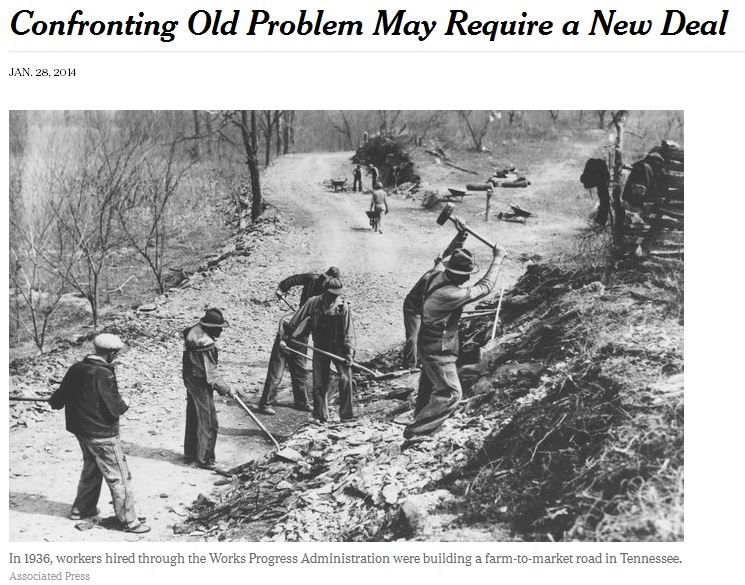
Eduardo Porter, writer for the New York Times “Economic Scene” section, recently wrote a piece on infrastructure. The piece, “Confronting Old Problem May Require a New Deal,” provides readers with the predictable ‘public’ perspective on the relationship between employment and infrastructural development painting the all-too-familiar picture that more of the former requires more (investment) in the latter. This is hardly  new. During times of economic strife, low investment in (even crumbling infrastructure) further diminishes job growth on a grand scale (which we’ve discussed with regard to Germany, the US, and the austerity-infrastructure relationship).

Porter takes us on a tour of political and economic history, showing readers that this relationship may not be so clear-cut. For example, Keynes predicted — thanks to technological efficiencies, improvements in management, and so on — a persistent level of unemployment is inevitable. A solution is investment in infrastructure, and such discussion, Porter reports, go a ways back:

In “Freedom From Fear,” his history of the United States through the Great Depression and World War II, David Kennedy notes that fears that what Keynes called “technological unemployment” might become a permanent feature of the labor market, especially among the less skilled and the elderly, date back to the administration of President Herbert Hoover.

The inability or complete failure of the American government to produce enough consensus regarding new programming as aggressive as those of FDR’s era has lead to concerns and fear that we are on a path toward permanent employment stagnation.

However, at this moment in history, it may not be possible, even if the political will did exist, to invest in enough infrastructure to get us out of this mess. In the 1970s,  a failed job stimulus plan (similar to Obama’s failed plan) showed Americans that, and we’ll go to a Harvard specialist for this:

“It works best if you hire people that would not otherwise be hired, to do something productive that is not already being done by somebody else,” said Lawrence Katz of Harvard, formerly chief labor economist in the Clinton administration.

Katz goes on:

“Long overdue infrastructure investments would be a good place to start, coupled with funding for positions cleaning parks and the like, which could help disadvantaged workers like the long-term unemployed.”

And then Porter intercedes:

Not every unemployed worker may be qualified to build infrastructure. But many might. Today, there are 1.5 million fewer jobs in construction than there were before the financial crisis six years ago. Plenty of unemployed workers out there know how to build things.

Only, we don’t need house-builders, we need re-construction, de-construction, and renovation. Perhaps that is not so unlikely to be fulfilled; after all, the cost of borrowing money is low and the amounts of money needed for such massive projects is available, but it simply will not — no matter how many libertarians tell me so — be done if not by the government. My intuition is that large firms in the US that use such infrastructure with regularity would only step-in after it all far too late … we are getting closer by the day, after all. The last serious investment in nation-scale infrastructure might very will be during the Great Depression.


Bibliography of work on Foucault and education

Foucauldians … this one is for you: a useful bibliography.

Clare O'Farrell's avatarFoucault News

I have just finished (more or less) compiling a list of English language works on Foucault and education for my M.Ed (Master of Education) students. I thought this might also be of use to others so I have set up a permanent page for it here at Foucault News.

Large as it is, the bibliography is by no means comprehensive, and you are invited to post any missing items, corrections or other additions in the comments section on the page for the bibliography for inclusion in the main document. As such, the bibliography will remain a work in progress.

With thanks to Megan Kimber for assistance in finding many of the journal articles.

View original post

Questions arising from discards and ‘An Inquiry into Modes of Existence’

This is interesting; Learning from Discarding.

guestauth0r's avatarDiscard Studies

By Josh Lepawsky
Reblogged from Reassembling Rubbish

What happens to the narrative of modernity – what do we learn – when we make an inquiry into what centres of modernism (science, technology, law, urbanism, religion, politics) discard from themselves? Clearly, this question is nothing more than a restatement of Latour’s in this video. In asking this question I don’t necessarily want to just attach my interests to Latour’s work in general or to his project in An Inquiry into Modes of Existence (AIME) (Latour 2013) specifically. However, my hypothesis – very tentative – is that perhaps asking this question actually illuminates something(s) passed over or missed in the AIME project.My hypothesis is triggered by remembering Harman’s claim that Latour has an ‘industrial model of truth’:

Truth is best described not by the optical or pictorial metaphor of copying a true state of affairs in our mind, but by…

View original post 2,061 more words

Song as a emotional and political attractor

In this interesting post, Andrzej talks about singing, and the political significance of breaking-out into song and the state infrastructures of em0tion.–Nicholas

Tunisia already signed a new, more democratic constitution. It is a small step toward rebuilding the state after the Arab Spring.

Using this example, I would like to discuss something different — the role of emotions in the making of politics. Such a statement is, today, quite obvious. We discuss the role of emotion in politics since at least Machiavelli. This subject takes Martha C. Nussbaum in her latest book Political Emotions Why Love Matters for Justice. But as an STS scholar, I think that we should be more specific and empirical.

What is interesting for me is looking for concrete emotional machines, emotional attractors, which are creating a political force. I am thinking about particular songs, which bring people together (remember Tarde’a law of imitation); I would like to threat such songs a attractors which starts, condense processes of self-organization.

Let me follow one of such songs, let begin form Tunisian version, by Emel Mathlouthi:

and other version of this song form Tunisia:

This song is a Arabic version of Catalan song “L’Estaca” written by Lluís Llach against dictatorship of Franco.

And it was very popular under title “Mury” as anticommunist song in Poland during Communist regime:

Maybe, if we care about “the State,” democratic politics and social emancipation, we should sing more? But remember that song is only a attractor — an empty container — which can be filled by different thing. This ambiguity is quite nice shown by Zizek analysis of Beethoven “Ode to Joy” in his last movie “Pervert guide to ideology”.

Israel Bayer and Street Roots: A Snowstorm, a tent city….

Here in US we have been struggling through the coldest winter in a lifetime. What is invisible to most of us while we scrape our cars, pay outrageous heat bills, and hope for summer is a that snow day for the school kids means potential deaths for those on the streets.
This is a pointed institutional analysis of the battle in downtown Portland around compassion, “livability” and the “rejuvenation” of downtown areas.

Check out his latest blog:

http://news.streetroots.org/2014/02/07/snowstorm-tent-city-and-portland-police-chief-mike-reese

New Journal!

A group of stellar and amazing scholars in International Relations have hatched a new journal entitled “Journal of Narrative Politics”.  Keep your eye out for the first issue–it’s going to be a great addition to the complex and reflective scholarship we would all like to see more of in the social sciences.

From the website:

Journal of Narrative Politics is an interdisciplinary journal rooted in the study of global politics that explores narrative voice in academic research, writing, and pedagogy, and in the diverse expressions of non-academic communities and social formations. Normatively committed to human dignity, fairness, and peace, Journal of Narrative Politics aims to imagine futures free from colonial, racial, gendered, and economic violences. As a result, Journal of Narrative Politics also commits to forging deep linkages with communities seeking or practicing alternative modes of sociality and governance, and it seeks to challenge the varying tropes of hegemony and oppression in the academy and elsewhere. The journal foregrounds the embeddedness of authors and storytellers in their craft and it aims to publish a diverse range of expressions from this engagement.

While concerned with aesthetics, Journal of Narrative Politics is not a literary journal, but is instead committed to exploring the overlaps between aesthetics, politics, theory, and ethics. However, unlike other scholarly social science journals devoted to narrative, Journal of Narrative Politics is less concerned with the academic analysis of narrative, and more with the expression of narrative itself as a mode of knowing. The journal therefore aims to operate in the overlap between the languages of science and literature with the goal of showing how theory becomes practice and practice theory. It commits to diverse ways of storytelling as knowledge appropriate to the academy, rather than as merely the objects of scholarly inquiry.

Here’s a link to the page. 

http://journalofnarrativepolitics.com/


Teaching the Public Understanding of Science with Ancient Aliens

819jpokH4AL._SL1500_

I have had unprecedented success with a new lesson in STS and I thought I’d share it with you all on the blog. NOTE: I’ve also got a sheet that can be used for students to follow along and it provides some questions to orient discussion after viewing (if you’d like it, it is like some others I’ve shared, for example, related to the “King of Kong” as an easy way to teach students about the scientific community and philosophy of science or a handout used to teach students about controversies in science through a documentary on intelligent design). So, every semester, the chapters on the “public understanding of science” in Sismondo’s introductory text end-up being sort of boring to students.

However, working with a student over the last year, we found another way to “get at” the information. Instead of dealing directly with some of the issues associated with the public and science through the typical lens of “understanding,” we look for the public and science through another lens, that of “misunderstanding,” in this case about what is and is not science.

Enter: Ancient Alien Theorists!

91ehsF3LplL._SL1500_

Ancient Aliens” is a series on the History Channel, self-described as:

Ancient Aliens explores the controversial theory that extraterrestrials have visited Earth for millions of years. From the age of the dinosaurs to ancient Egypt, from early cave drawings to continued mass sightings in the US, each episode in this hit H2 series gives historic depth to the questions, speculations, provocative controversies, first-hand accounts and grounded theories surrounding this age old debate.

In class, we just watch one episode, and it has been an incredible source of discussion ever since. During Season One, the fourth episode (which is just perfect for this lesson) is called “The Visitors.” Here is the summary:

If ancient aliens visited Earth, who were they, and where did they come from? Possible historic evidence and beliefs are examined around the world. The Dogon people possess knowledge of a galaxy they claim was given to them by a star god named Amma. The Hopi and Zuni people celebrate Kachinas, gods from the sky, whose headdresses and costumes appear to resemble modern helmets and protective clothing. Halfway around the world, Chinese legends tell of the Han leader, Huangdi, arriving on Earth on a flying, yellow dragon. Was this dragon more likely a spacecraft? Ancient astronaut theorists believe that these are far from chance encounters and that extraterrestrials not only interacted with us, but changed the course of human history.

The key is to ask questions after viewing like:

1. How do these “theorists” use the tools, rhetoric, and, thus, credibility of science to launch their claims?

2. What statements might be made or what portrayals do you see that link ancient aliens to the scientific enterprise? 

After we watched this, understanding how the presentation of scientific ideas (in this case, non-science), the students have literally no trouble dealing with Sismondo’s chapter, which features the deficit model of public understanding and the presentation of science and the scientific enterprise by journalists. The real joy, though, comes when Sismondo starts to discuss how some scientists short-cut the journalism process and go to the public directly — often, out of desperation (enter, again: Ancient Alien Theorists!)

Again, write me if you’d like a copy of the sheet or to discuss the teaching idea.

Images from: http://www.amazon.com/Ancient-Aliens-Season-One/dp/B0038M2AWI

A new direction in political sociology?

Capture

These are the proofs for a new paper/article that I’m working on. The piece is based-off of a few new books in political sociology, which I review, tie-together, and then admittedly and self-servingly I use them to suggest that a little STS would help matters out in political sociology. It is a bit academic in places, somewhat nit-picky, but I tried to keep the tone at least a little playful.

The Productive Body by Didier Deleule and François Guéry

Making an old book new again … by translating it into English.

stuartelden's avatarProgressive Geographies

An important 1972 book, mentioned by Foucault in Discipline and Punish, is finally coming out in English translation in March 2014, with an excellent introduction by the translators.

Productive BodyThe Productive Body asks how the human body and its labor have been expropriated and re-engineered through successive stages of capitalism; and how capitalism’s transformation of the body is related to the rise of scientific psychology and social science disciplines complicit with modern regimes of control. In Discipline and Punish, Foucault cited Guéry and Deleule in order to link Marx’s diagnosis of capitalism with his own critique of power/knowledge. The Productive Body brings together Marxism and theories of the body-machine for the goal of political revolution.

  • Very interesting analysis… The technological mutations of the apparatus of production, the division of labour and the elaboration of the disciplinary techniques sustained an ensemble of very close relations (cf. Marx, Capital,  vol. i, chapter XIII and…

View original post 24 more words