Unknown's avatar

About Nicholas

Professor of Sociology, Environmental Studies, and Science and Technology Studies at Penn State, Nicholas writes about scientific study of states and the future.

3:1 — Post-Disciplinarity or “Committing Sociology” — Pre-Posting Post

keep-calm-and-commit-sociology-4*

We are continuing the 3:1 format into 2015. We are kicking off the New Year with a series of posts on Post-Disciplinarity or “Committing Sociology.” It might be a stretch to treat Post-Disciplinarity and Committing Sociology as synonyms, but we could not resist, and our panel of three scholars have some unique perspectives on the topic worth reviewing. This time, none of the blog administrators are going to contribute to this week’s 3:1 and instead we have a completely new group of scholars responding to, reflecting upon, and criticizing the notion of and instances of “committing sociology.”

This week contributors — who we are grateful to and eager to hear from — include:

Monday — 1 of 3 — Michael Lait: You might know him from his solid review of Lemke’s Biopolitics, Michael is a student at Carleton UniversitySociology and Anthropology working under rock n’ roll state theorist Bruce Curtis. Michael’s current work is about controversy: his “research maps the political situation of Gatineau Park, a 361km² semi-wilderness area located near the Canadian cities of Ottawa, Hull, and Gatineau. … [and, in particular,] how controversies have been mediated by the Park’s publics by way of formal and informal negotiations with the NCC as well as other institutional and government bodies.” He’ll fit right in around here.

Wednesday — 2 of 3 — Phillip Primeau: Phillip is also a graduate student in the same program as Michael at Carleton UniversitySociology and Anthropology. His research interests makes for a fine stable of topics: “Governmentality studies, historical sociology, moral regulation, state formation, municipal governance, community capacity building and resilience training.” He also, I have come to find, makes some killer Prezi presentations.

Friday — 3 of 3 — Aaron Henry: Like Michael and Phillip, Aaron is of the great program at Carleton UniversitySociology and Anthropology. Like me, Aaron is into states and state theory. He has a cool paper about how privacy figures into discussions/controversies regarding security and pacification that is worth reading. He works with Bruce too, but Justin Paulson appears to be his main advisor (I know Paulson only by reputation and a book he co-edit Capitalism and Confrontation).
Welcome aboard, gents!

* Image from: http://sd.keepcalm-o-matic.co.uk/i/keep-calm-and-commit-sociology-4.png

The first rule of math club is “You don’t talk about math club”

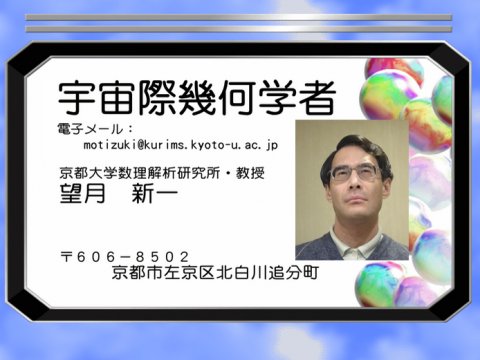
mochizuki

In a peculiar turn of events, Shinichi Mochizuki, a mathematician from Kyoto University, is really peeved — maybe even more than a little irksome — that nobody will read and review his solution to the ABC conjecture. To date, no errors have been uncovered, and yet the proof remains unverified. His work sits in a scientific nether region; his work is neither falsified nor supported as truth.

Part of the concern at work in this controversy, we learn, is that the ABC conjecture (also known as the Oesterlé–Masser conjecture) gets its name from a simple equation — a + b = c — but the implications run deep in the mathematical community, especially that it provides answer to deep questions in the theory of numbers (number theory).

“[F]ellow mathematicians,” he claims, “are failing to get to grips with his work.” On balance, however, his proof is 500 pages long of extremely dense material. Mochizuki’s current strategy: Put the proof on-line and wait. 

The solution from the mathematical community is for him go on a world tour and share his proof in person. According to a New Scientist essay, however, Mochizuki’s refuses to share his work through a series of talks and lectures — I Will Not Lecture, he is all but saying. Instead, he is proposing to train a few scholars in his technique so that at least someone is able to review his work and determine if there are any errors. My understanding of the math community is limited, but I am fairly confident that this is seen as abnormal behavior among insiders.

I’d welcome some insight from the social studies of science community on this matter. The notion that some discoveries are, in effect, peerless — meaning, even seemingly equal peers in the scholarly community are unable to verify or falsify a truth claim — is relatively rare. Moreover, that Mochizuki won’t go on a “public tour” (let’s say) is also interesting because research in SSS has routinely shown that the frontier of math research is often a dynamic activity undertaken in person with others, which makes Mochizuki’s refusal all the more interesting.

The New Scientist piece chalks it up to pride. I can understand that. It is unconfirmed, but a few stories on Mochizuki indicate that it took him four solid years of work to complete this proof. Possibly, he expected to be warmly embraced by the mathematics community, rewarded, lauded, and raised-up as a public figure of math for the world. Who knows? Mochizuki won’t talk, so we don’t know yet.

This would be great to teach with: because his work sits in a scientific nether region; his work is neither falsified nor supported as truth, which makes this a good case study for teaching students about the philosophy of science, especially about the role of consensus among scholars as well as some more general notions of falsificationism and the work of the early logical positivists.

Slavoj Žižek on Kafka and Love

Slavoj Žižek explains his concept of “The Event” on Big Think; the event, get this, “retroactively creates it’s own causes.”

He describes how literary predecessors do this (i.e., it is only once the new author is established that the predecessors are obvious or “produced”) and how falling in love is a good example of an event (i.e., the lighting bolt of first love immediately revising all which came before it as merely a precursor for the moment which had not — until that moment — happened yet).

“You are not in love, you just make one night stands maybe here and there. You meet every evening with friends. You drink. You go to blah, blah. Then all of a sudden in a totally contingent way let’s say you stumble on the street, somebody helps you to stand up. It’s a young girl or boy blah, blah. And, of course, it’s the love of your life. A totally contingent encounter but the result can be that your whole life changes. Nothing is the same as they say. You even spontaneously perceive your entire past life as leading towards this unique moment, you know, the illusion of love is oh my God, I was waiting all my life for you. This – something like this would have been the love event. And I think it’s getting more and more rare today. “

Zizek has previously appeared in other Big Think videos like “The Purpose of Philosophy is to Ask the Right Questions,” and “Why be Happy When You Could be Interesting?

Degrowth

The degrowth movement(s) for alternative economics have picked up a bit more steam with this new book, which includes contributions and endorsements from a wide array of scholars. There is also this introductory video that makes a few peculiar claims.*

*found at: http://jeremyjschmidt.com/2014/12/01/new-book-out-degrowth-a-vocabulary-for-a-new-era/

Latour on how forests think

Untitled-6

Check out an essay by Latour on How Forests Think — free, and oddly interesting.

The essay, which is featured in the Journal of Ethnographic Theory (an awesome, peer-reviewed, open-access on-line journal), is about far more than just reviewing Eduardo Kohn’s fascinating and fascinatingly odd book How Forests Think. Latour, using a conversational tone that at times annoying but still quite engaging because of its seriousness, positions Kohn’s book as a tiny little part of a broader movement to equip social scientists in the new shift toward ontology with methods for studying things like nature (i.e., these human-nonhuman carpets of existence).

Latour is an interesting choice to review the book because Kohn — armed with Pierce and semiosis — dishes on good old actor-network theory. Now, it was my thinking that Latour had sort of left behind that old theory-not-a-theory, but in this essay (posted only days ago) Latour defends ANT. Kohn dishes on ANT a bit, but Latour sees the two directions — his and Kohn’s — as more like allies than enemies. In the end, Latour specifies that Greimas’s semiotics allows for some analytical moves that Pierce’s semiotics (adopted by Kohn) does not and vice versa — sharp analysis here:

And that’s the problem I have with the powerful counterpoison Kohn had to rely on to avoid exoticism, namely the use of Peirce’s semiotics. Since ANT has made large use of another semiotics to escape the narrow “realism” that passes as a description of “societies,” I understand the move. But it’s not the same semiotic at all. Whereas Greimas’ semiotics allows multiple registers since every actant can be played out by many actors, Peirce’s semiotics (at least in Kohn’s treatment of it) claims to be an alternative description of what the world is. Each semiotics risks losing what the other gains. If it’s true that Greimas could have difficulties making ontological claims, he can entertain a vast diversity of registers well beyond relations among selves; while Peirce allows strong ontological claims but has to stabilize much too fast all connections into auto-morphisms. And yet, no matter how good Kohn’s book is, the Runa qua Peircian ontology have not become for everybody else the definition of their common world. Hence the danger of stabilizing too quickly what the furniture of the world is, and the necessity of having a semiotic toolkit able to restart the negotiation whenever it has stalled. Such is for me the advantage of Greimas over (Kohn’s) Peirce.

3:1 — Post-Method — 3 of 3

junk-mess

The problem with 99% of the more general discussion about post-method is that it is not about post-method. What’s wrong with 99% of post-method discussion, in general? His name is Jon Law and he titled a book After Method. Much of what we know about post-method is, naturally, influenced by that which is deemed “after method.” It is here that I stop because the subtitle of the book is especially significant. The subtitle “Mess in Social Science Research” is the real title of this book; this is because the book was about finding some way to engage — rather than paste-over and wipe-away — data anomalies or faint “traces” in our findings. There was probably some bogus publisher pressure to use a provocative title, so perhaps this is forgivable, but because the operative discussion about post-method is really about “dealing with mess” so is this post.

After reading that book, I was not post-method. I had a new attitude toward inquiry, but I was not post-method. I avoided seeing method as a privileged avenue with which truth sprang forth, but I was not post-method. I stopped conceptualizing methods as a way to “clear away the junk” and practice “good mental hygiene,” but I was not post-method. Still, we can refer to this general shift in attitude toward and conceptualization of method (perhaps, quite wrongly, as it implicates pre-method, now-method, and so on) as the operative post-method thing most scholars talk about.

What I learned was how to do research a little differently from that book of Law’s. I would not have conceived of writing a research paper about the development of a research paper as a means to tease-out how reflexivity is practically produced in actor-network accounts. Perhaps one of Law’s great contributions, and he is not the only one who gets at “the mess” this way, of course, was to take theoretical questions and make them practical and vice-versa. Just because something is compatible in theory does not mean that we should expect to see this compatibility in the field; in fact, viscous moments like these, Lynch once said, are often the most interesting. Likewise, problems that should not in theory be a problem are a problem in the field. I think of Law’s work on “foot and mouth” some years ago, “Context and Culling.” It did not occur to me that messy findings were findings at all, or that messy findings could help us understand when it was time to improve models of our subject matter based messy findings. In Law and Moser’s paper, they find that — this summary is glossy to a fault, by the way — a government program (designed to cull (i.e., the selective slaughter of, in this case,) herd animals) appeared to be a “success” on the government’s side of things, but upon closer examination, it was revealed that many herders did not kill a single animal in these areas where foot and mouth disease was now under control. The outcome, in Law and Moser’s accounting, was: now that we know this, we need to build better epidemiological models for how such diseases will be handled because a one-size fits all model, which appears to have worked, in fact, only was a success for reasons unrelated to the epidemiological modeling. 

What’s wrong with all that? 

1. Do we remake Borges’ map, but messier, if that is even possible? (good point, Michael; if we embrace the mess only to reproduce models of the mess that are life-sized equivalents, then nothing has been gained, beyond satisfying cartophilic tendencies)

2. Or, do we imply that messiness is a new one-way ticket — or detour — to scientific credibility now? (an argument Jan and I warned against strongly in our reflexivity paper) 

3. Or, do we probe and challenge the mess?  (and you can use, as Michael notes, new forms of visual or experimental methods, but, as Jan follows-up in the commentary on Michael’s post, you can also make attempts to wrangle the mess with traditional methods used with a “post-method” attitude)

*Image from: http://www.nccivitas.org/civitasreview/files/2013/09/junk-mess.jpg

e-mail Breaching Experiments

cropped-FYI-logo-22

Good-old Ian Bogost writes about “FYI” and “See below” forwarded e-mails — the bane of corporate (and dare I say academic) e-mail culture!* Of course, his piece in the Atlantic is meant to be funny — and it is — but the real gem for me was in the penultimate paragraph where a kernel of extra-special fun — applicable fun — was available.

He proposes — as a form of micro-office-place-playfulness — a breaching experiment. He writes:

So, what to do with emails like FYI and See below? You can’t ignore them; sending an email always trumps letting one go unanswered (or even unseen). Unfortunately, the only move left is to respond, but play dumb, asking your interlocutor to clarify what, precisely, is the relevance of the enclosed “information” in the FYI, or which aspect of the material below in the See belowrequires action—and what type of action, as long as we’re at it. (Or maybe, if you’re really feeling punchy, you could respond with nothing more than a link to this article.)

*Thanks Object Oriented Philosophy for the original link.

**Image from: http://bereabaptist.org/wordpress2/wp-content/uploads/2012/11/cropped-FYI-logo-22.jpg

Computer Engineer Barbie, ugh

81HMv7bi6ML._SL1500_-4

This is gonna hurt. The empowering “I can be an actress” and “I can be a computer engineer” are part of the “I can be” Barbie Seriesthe reviews on Amazon.com are interesting, some saying that this book if “Great for lighting fires during power outages” or less veiled “Why Do People Who Make Toys for Girls Seem to Hate Them?Books like these make great, great fodder for teaching issues related to gender and engineering. There has also been tons of flack that students might sift through and reflect upon — here, here, or here.

If you want a solid run-down of “I can be a computer engineer” — a story were Barbie gives Skipper’s computer a virus by accident and then the only way to fix it is to get some young guys to take care of it for Barbie — then check out this thorough blog post. The Barbie Facebook community responded to these and other concerns, indicating that “The Barbie I Can Be A Computer Engineer book was published in 2010. Since that time we have reworked our Barbie books” as if, perhaps, to say that things have really changed since 2010…

For a healthier example, we’ve most recently related to girl’s building-blocks called GoldiBlox.

Not since my childhood have I seen something this bad from Barbie related to math, science, and engineering (i.e., the Barbie doll that said “Math is hard”). 

20 Ethnographic Films to Teach With

shutterstock_92369284

Worth checking-out: visual psychological anthropology films that can be used for teaching from our friends over at Psychocultural Cinema:

Despite the rich history of innovative methods and techniques employed by documentary filmmakers across a range of genres, there seems to be little awareness or integration of the findings and approaches of psychological anthropology in ethnographic film

Infrastructure Makes Prime Time Slot

Infrastructure Makes Prime Time Slot

This Sunday, Nov. 23, CBS’ 60 Minutes will feature an interview with American Society of Civil Engineers Past President Andrew W. Herrmann, P.E. SECB, F.ASCE discussing our nation’s infrastructure deficit while flying via helicopter over Pittsburgh.

The interview is part of a larger piece on the Highway Trust Fund hurtling once again toward insolvency. Tune in or set your DVR to 60 Minutes, which airs at 7:30 p.m. ET7 p.m. PT, to see ASCE tell the story behind our nation’s bridges.

Below are additional details of the segment.

AMERICA’S INFRASTRUCTURE IS “ON LIFE SUPPORT,” SAYS FORMER TRANSPORTATION SECRETARY RAY LAHOOD.  NEARLY 70,000 BRIDGES IN THE UNITED STATES NEED TO BE REPLACED OR SIGNIFICANTLY REPAIRED – “60 MINUTES” SUNDAY
November 21, 2014
Federal Highway Trust Fund  – Which Funds Road and Bridge Repair – is Nearly Broke

Ray LaHood, the former U.S. transportation secretary, tells 60 MINUTES  many of the roads and bridges we drive on every day are “on life support.” What’s more, nearly 70,000 bridges in the U.S. are deemed structurally deficient.   “I don’t want to say they’re unsafe. But they’re dangerous,” says Ray LaHood, the secretary of transportation during President Obama’s first term.  “Our infrastructure’s on life supports right now. That’s what we’re on,” says LaHood, now co-chair of Building America Future, a bipartisan coalition of current and former elected officials seeking to increase spending on infrastructure. LaHood  speaks to Steve Kroft for a

60 MINUTES report on the state of America’s crumbling infrastructure.  It will be broadcast Sunday, Nov. 23 (7:30-8:30 PM, ET/7:00-8:00 PM, PT) on the CBS Television Network. Watch an excerpt.

60 MINUTES cameras capture the rust and the cracked concrete on bridges across the country, especially in Pennsylvania, where the problem is most acute according to the American Society of Civil Engineers.  LaHood says that the broken roads and bridges need to be fixed now, but the Federal Highway Trust Fund, the pot of money states rely on for new construction and maintenance of roads and bridges is just as broken.  The Highway Trust Fund is financed by the federal gas tax – about 18 cents per gallon – and it hasn’t been raised in 20 years.

“It’s falling apart because we haven’t made the investments. We haven’t got the money,” says LaHood.  “The last time we raised the gas tax, which is how we built the interstate system, was 1993.”  LaHood goes on to say “Politicians in Washington don’t have the political courage to say, ‘This is what we have to do.’ That’s what it takes…They don’t want to raise the taxes. They don’t really have a vision of America the way that other Congresses have had a vision of America,” he tells Kroft.

The failure is a bipartisan one says Rep. Earle Blumenauer (D.-Ore.),  a member the House Ways and Means Committee, just one of a handful of Committee’s responsible for funding long term transportation bills. Blumenauer says he’s been asking for a hearing on funding for the Highway Trust Fund for 44 months “It has, to this point, not raised to the level of priority for the Republican leadership. Although,  in fairness, when the Democrats were in charge, we had a few hearings, but not much action.”

Why the humanities: a call for papers

Call for Papers

International Conference

Why the Humanities:
Answers from the Cognitive and Neurosciences

http://www.kent.edu/cas/why-humanities

Kent State University Hotel and Conference Center
Kent, Ohio, USA
July 9-12, 2015

The purpose of this conference is to highlight and enhance the contributions that humanities education makes to personal well being, responsible citizenship, and social justice.

Continue reading

Call for Papers

cropped-hooverdam5

ecomaterialismscollective's avatarEcoMaterialisms: Organizing Life and Matter

EcoMaterialisms: Organizing Life and Matter

University of California, Irvine

Friday 15th May 2015

“EcoMaterialisms: Organizing Life and Matter” will bring interdisciplinary graduate work to  bear on the ongoing critical discussions grouped under the umbrella of “new materialisms.” While what exactly these new materialisms might be or look like remains a vitally open question, this conference is an attempt to map a number of conceptual coordinates that give this emergent field of inquiry some consistency. As Diana Coole and Samantha Frost write in the introduction to their edited collection on new  materialism, “If we persist in our call for an observation of a new materialism, it is because we  are aware that unprecedented things are currently being done with and to matter, nature, life,  production, and reproduction. It is in this contemporary context that theorists are compelled to  rediscover older materialist traditions while pushing them in novel, and sometimes experimental,  directions…

View original post 236 more words

Welcome Ranjit Singh (Cornell University)

Cornell_Rockefeller_Hall

“Greetings from Ithaca,” our guest blogger Ranjit writes.

He is currently working on the history of the turn to technology studies within STS in the mid-1980s (which is, I think, related to this talk he gave a while back cleverly called “Back to the Future“) under the supervision of Prof. Trevor Pinch (who graciously loaned us all those 4S newsletters — they are on their back to you in the mail, Trevor, I promise).

He will be the final blogger for this week’s 3:1 on Post-STS.

Welcome aboard from the @installingorder.org community, Ranjit Singh!

*The image is of Rockefeller Hall on Cornell University’s campus where Trevor and Ranjit work.

3:1 — Post-STS — 1 of 3

1475938_697465996954350_1637523083_n

For this 3:1, we consider “Post-STS,” not because we know what that means exactly, but as an experiment to explore what a Post-STS world might mean, signify, or imply.

I’m going to go out on a limb and say that a Post-STS world would be a mark of success. What I mean by that is that STS, from the start, to my mind, was always a little on the defensive and positioned themselves as self-proclaimed inhabitants of the margins. Merton, during the very first year of 4S, claimed that we were a rag-tag bunch, but that what we were doing – making legitimate space for social inquiry into science and technology – was possibly a little bit noble. The message to me what clear: we were doing what the social and political sciences weren’t; we were attending to science and technology.

When the interdisciplinary space of STS is framed like that, a few consequences emerge, in particular, when STS is not seen as marginal. I primarily think of a meeting a couple years back, a “Theory Talks” meeting organized by Peer Schouten and company, after a Millennium conference at the London School of Economics the previous few days. The point of the meeting was for a bunch of STS scholars to get together with a bunch of IR (international relations) scholars. The Millennium conference itself is an IR event, and this meant that we STSers were “invited guests.”

That it appeared that IR scholars were coming to STS scholars for new ideas, possible collaborations (we found Stef there, after all!), and fresh directions for inquiry in IR. This surprised me. Really. That STS would intentionally be injected into a major line of inquiry in Political Science was, in my naïve understanding at the time, truly surprising. “Wait,” I thought, “has STS made it?”

The inroads of STS into IR is not exactly a cake-walk, but the very idea of a field coming to us in STS for direction was thought-provoking if only to contemplate the following scenario: STS does not have many programs to train students, and, from my read of things, most of the scholars that have ever called themselves STSers hailed from “other” disciplinary homes such as sociology, history, political science, and so on (possibly an anthropologist or two in there). But IR folks, instead of jumping ship and joining the ranks of STS, apparently wanted to import some of the ideas, tends, and theories associated with the STS attitude toward inquiry into IR. Their scholars are not leaving IR to come to STS; they brought the STS to IR.

With that in mind, I provide my closing remarks: my read on STS is that from the start, scholars in STS have always dreamt of a world where STS isn’t necessary. I once read a book about heavy metal (music) that made much the same argument: a lot of heavy metal is about a world that does not need heavy metal anymore. I guess a Post-STS world, to me, would be a victory because we would no longer need to carve out “special space” to do STS in.

4S, reflections on Buenos Aires

bird_watching

In this thoughtful blog post on CASTAC,* Luis Felipe R. Murillo (pictured, who is or was a grad student in anthropology at UCLA) reflects on the 4S meeting in Buenos Aires (this August) with special attention on the relationship between (American) anthropology and (nationality not defined) STS.

Some relatively fresh ideas include the notion of “fault lines” as a way to characterize cross-disciplinary work:

This is where we operate as STS scholars: at intersecting research areas, bridging “fault lines” (as Traweek’s felicitous expression puts it), and doing anthropology with and not without anthropologists.

The blog post reviews two sessions, mainly just relaying what was discussed and who does that sort of research, but the common thread pulled through all this description is an earnest inquiry into how do we do the anthropology/STS relationship and how should we do the anthropology/STS relationship. The piece closes with a somewhat haunting quote:

As suggested by Michael Fortun, we are just collectively conjuring – with much more empiria than magic – a new beginning in the experimental tradition for world anthropologies of sciences and technologies.

The blog supporting that post also has some cool posts about pedagogy and other research issues worth peaking through.

*Committee on the Anthropology of Science, Technology, and Computing.

Relative realities, theoretical sensitivities

http://vimeo.com/108273539

Annemarie Mol’s take on empirical philosophy; I saw this talk, or a nearly identical one, when she later gave it at Københavns Universitet this fall. There is a thread to be curious about, however, and that is a comment she made during the Q&A of the session I attend. I asked: “I have read much of your work and recall words like “ontology,” “multiplicity,” and so on, which are now missing in your new work — why?” Mol’s answer, roughly paraphrased: “I like to keep things fresh so now I use “onto-norms”…” I thought: that’s a little odd, but perhaps new concepts for every new project has some appeal, but the “I don’t like them anymore” or “I prefer fresh concepts” just strikes me as more of an aesthetic decision than anything else, not that I dislike aesthetic decisions, but it just struck me as odd in a talk about empirical philosophy.

dmf's avatarsynthetic zerØ

http://vimeo.com/108273539
Annemarie Mol’s take on empirical philosophy.

View original post

Reflexivity, The Post-Modern Predicament

IMG_1245

Been reading a good book on reflexivity, Reflexivity: The Post-Modern Predicament by Hilary Lawson, after our 3:1 week on postmodernism and after thinking about some new directions for Jan and I’s old paper on reflexivity.

Here is a choice quote from the opening passage, in discussions about reflexivity being at the core of Western philosophical thinking:

This questioning, however, has led to views which are unstable. Such claims are ‘there are no facts’, ‘there are no lessons of history’, ‘there are no definitive answers or solutions’, are all reflexively paradoxical. For, is it not a fact that ‘there are no facts’, and a lesson of history that ‘there are not lessons of history’, and a definitive answer that ‘there are no definitive answers’? (page 1)

* Imagine from Roskilde University in Copenhagen, Denmark.

If Latour were a craft-beer-brewer, his name’d be …

lrgscalemagnet-beer-will-change-the-world

… Steve Wright. Check out this innovative ANT account of craft beer tasting, now on-line, free of charge. Investigation into the flavor profiling of craft beers as well as auto-ethnographic blind beer tasting and tasting exams, this paper — and by paper, I am referring to a 277 page thesis — is replete with outstanding detail.

Also, upon even modest reflection, the teaching potential of this document is striking.

My favorite part is the explanation of language-sensory experience:

The historical construction of the contemporary language of sensory assessment supports the construction of the style guides. Once assembled into an information infrastructure the style guide is extended to act in multiple different ways: its propositions are translated into testable facts with multiple choices, it functions as a technology of material ordering and coordination, as a regulatory technology placing limits on how taste judgements can and cannot be expressed or recorded, and as a re-enactment and materialisation of individual cognitivist models of assessment.

Latour’s inconsistencies unveiled

IMG_1322

In this terrific article in New Literary History, Graham Harman draws-out some of Latour’s inconsistencies in his shift from old ANT days (i.e., the early Latour) to the more recent emphasis on “modes” (i.e., the late Latour) related to his culture-nature rejection-reficiation (played with a few of these idea a decade ago reviewing his book PoN).

Teaching STS: Construction of Time and Daylight Savings

432176_10150604201650942_175868780941_9533602_1513576400_n-scaled500

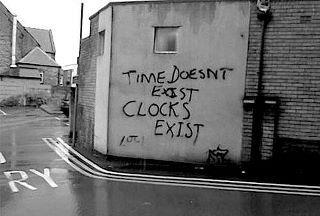
In the “Teaching STS” collection, we’ve discussed teaching lessons (with some resources) about the social construction of time a number of times related to whether or not time exists at all (with research from the Max Planck Institute), reflections on the notion of aberrant time such as “leap seconds” (students are bothered by this one), and, even though when we write about the olympics, it is usually about derelict stadiums, it occurs to me that when the atomic clock was adopted and the length of the second transformed, “timing” at the Olympic games might have been an interesting topic to think about for students who imagine that the length of the second back in 1936 should be identical to the length of the second that Michael Phelps was swimming in 2008 (in Beijing).

At any rate, a nice entry point for a classroom situation for discussing time might be to use humor before you get into the nitty-gritty of “existence” or whether or not the basic units of measurement are less stable than we previously thought. Enter a satirical trailer about daylight savings … it would work to kick off a class on the topic of time.

Infrastructural Lives — new book out now

9780415748537

Add this one to your reading list. Steve Graham and Colin McFarlane have edited a book, which has just come out, Infrastructural Lives (http://www.routledge.com/books/details/9780415748537/).

Contributors include AbdouMaliq Simone, Maria Kaika, Vyjayanthi Rao, Mariana Cavalcanti, Stephanie Terrani-Brown, Omar Jabary Salamanca, Rob Shaw, Harriet Bulkeley, Vanesa Caston-Broto, Simon Marvin, Mike Hodson, Renu Desai, Steve Graham, and myself.  Arjun Appaduria kindly provided a thoughtful foreword for the book.

Doing ANT on ANT

Plectroctena_sp_ants

In Gad and Jensen’s (2009) excellent paper “On the consequences of Post-ANT” — available here free — we read a number of slightly cheeky comments in the abstract, but the one I am curious about I put in bold below:

Since the 1980s the concept of ANT has remained unsettled. ANT has continuously been critiqued and hailed, ridiculed and praised. It is still an open question whether ANT should be considered a theory or a method or whether ANT is better understood as entailing the dissolution of such modern ‘‘genres’’. In this paper the authors engage with some important reflections by John Law and Bruno Latour in order to analyze what it means to ‘‘do ANT,’’ and (even worse), doing so after ‘‘doing ANT on ANT.’’ In particular the authors examine two post-ANT case studies by Annemarie Mol and Marilyn Strathern and outline the notions of complexity, multiplicity, and fractality. The purpose is to illustrate the analytical consequences of thinking with post-ANT. The analysis offers insights into how it is possible to ‘‘go beyond ANT,’’ without leaving it entirely behind.

Question: Does anyone know precisely what paper or presentation — or “other” sort of document — they are referring to when stating “doing so after “doing ANT on ANT”? 

*Also, please forgive in advance the image of mating ants used for this post on “ant on ant.”

3:1 — Postmodernity — 1 of 3

NYS_PM

In the ‘90s, as a student, I was mesmerized by postmodernity’s rejection of all things holy to sociology. In place of depth, we emphasized surface. In place of a singular self, we emphasized multiple selves. In their vision of the academy, scholars were ironic in earnest rather than dry and serious. I was dumbstruck; this seeming reset of all things sociology was inspiring. That is not to say that I knew what to do with it, and after my interest being piqued I put all things postmodern on the shelf and focused on ‘serious sociology’ — the kind that ‘gets you a job.’ After a couple of years doing neo-institutional organizational analysis, I was drawn back into ‘things’ postmodern — literally — through actor-network theory, which took the form of Jan and I’s ‘actor-network state’ concept. I’ve hardly left it behind since, but a recent invitation to the Eastern Sociological Association’s next meeting to oversee presentations on ‘decoloniality’ has helped me to rethink postmodernity a bit.

How has decoloniality made me rethink/reconsider postmodernity? Decoloniality has primarily been developed in the Latin American context as a critical theory approach to ethnic studies, and constitutes practical and academic ‘options [for] confronting … the colonial matrix of power,” which is constituted by the imposition of colonial measures like race, ethnicity, gender, and all other manner of imperial state categorization schemes (Mignolo 2011: xxvii) (in this way it dovetails nicely with the “social studies of politics” that Jan and I have been cultivating over the last half-decade). The decoloniality project problematizes ‘modernity’ not as an intellectual or industrial sea change, but through emphasis on all the ‘other’ things modernity brought with it like ecocide, genocide, and the foundational self-defining notion of modernity that situates Europe in the center of the world and others on the periphery.

That’s the hang-up. Postmodern theory — I’m thinking of Lyotard, for example — meaningfully questioned modern rationality and knowledge production. This was a boon for science and technology studies, no doubt. Recognition that scientific facts are not as stable as previously believed (if that itself was ever true) resulted in research emphasis on the creation of scientific facts, which, in turn, revealed so much about the exigencies of producing “truth” and how the scientific enterprise “worked.” Postmodern theory also — I’m thinking of Harvey or Jameson now — meaningfully questioned modern industrial production and the rise of service economy and rationality of ‘late capitalism.’ This too was insightful because in addition to rationality, modernity brought industrialization with it.

According to members of the decoloniality project, while attending to knowledge and industry, postmodernists tend to reify some of the most foundational elements of modernity, namely, genocide, ecocide, and the foundational self-defining notion of modernity that situates Europe in the center of the world and others on the periphery, which advanced sociological theory might just as well serve to perpetuate. With rare exception, postmodernity contains few practical solutions to these ‘other’ thoroughly modern problems.

*Image from: http://karaflaherty.com/infographic-new-york-school-postmodernism/

Latour on “Digital Methods”

Capture

In a fascinating, apparently not-peer-reviewed non-article available free online here, Tommaso Venturini and Bruno Latour discuss the potential of “digital methods” for the contemporary social sciences.

The paper summarizes, and quite nicely, the split of sociological methods to the statistical aggregate using quantitative methods (capturing supposedly macro-phenomenon) and irreducibly basic interactions using qualitative methods (capturing supposedly micro-phenomenon). The problem is that neither of which aided the sociologist in capture emergent phenomenon, that is, capturing controversies and events as they happen rather than estimate them after they have emerged (quantitative macro structures) or capture them divorced from non-local influences (qualitative micro phenomenon).

The solution, they claim, is to adopt digital methods in the social sciences. The paper is not exactly a methodological outline of how to accomplish these methods, but there is something of a justification available for it, and it sounds something like this:

Thanks to digital traceability, researchers no longer need to choose between precision and scope in their observations: it is now possible to follow a multitude of interactions and, simultaneously, to distinguish the specific contribution that each one makes to the construction of social phenomena. Born in an era of scarcity, the social sciences are entering an age of abundance. In the face of the richness of these new data, nothing justifies keeping old distinctions. Endowed with a quantity of data comparable to the natural sciences, the social sciences can finally correct their lazy eyes and simultaneously maintain the focus and scope of their observations.

The 3:1 Experiment’s First Experiment

Countdown

This is “The 3:1 Project.”

The concept is simple: three scholars respond to one idea, hence, 3:1 (or 3 to 1). But there is another meaning and that reading is more like “3, 2, 1, go!” because we are to write short pieces that are written, in effect, without reflection or editing (around 500 words). Sort of like when you’re delivering a presentation at a conference venue and the organizer shows you the “you have 2 minutes left” card even though you’ve got 10 more slides in your presentation. What do you do in that situation? You skip to the end and rapid-fire deliver only the essentials. That is what we are hoping to do. Only the essentials rapid-fire.

The format is simple too: we will provide three posts, the first on Monday, the second on Wednesday, and the third on Friday. Together the three will constitute a 3:1 bundling and can be read apart or separately, or however you like.

Posted in 3-1

FREE Review of Lemke’s “Biopolitics”

buffaloreport_foucault11

Great review of Thomas Lemke’s excellent book Biopolitics: An Advanced Introduction is available here free. The review is written by Michael Lait, who was, at the time, a PhD student at Carleton University (Ottawa) (I think he still is a PhD student there). We look forward to more good work from Michael, and, just recently, we have seen it! His new draft paper neatly titled “The rotting heart of Gatineau Park: Mapping issues, institutions and publics in a unique political situation” is now on-line and worth a read, available also free here.

* Picture shamelessly borrowed from: http://foucaultsociety.files.wordpress.com/2010/09/buffaloreport_foucault11.jpg

Teaching STS: Sexual Harassment in the Field

Untitled-5

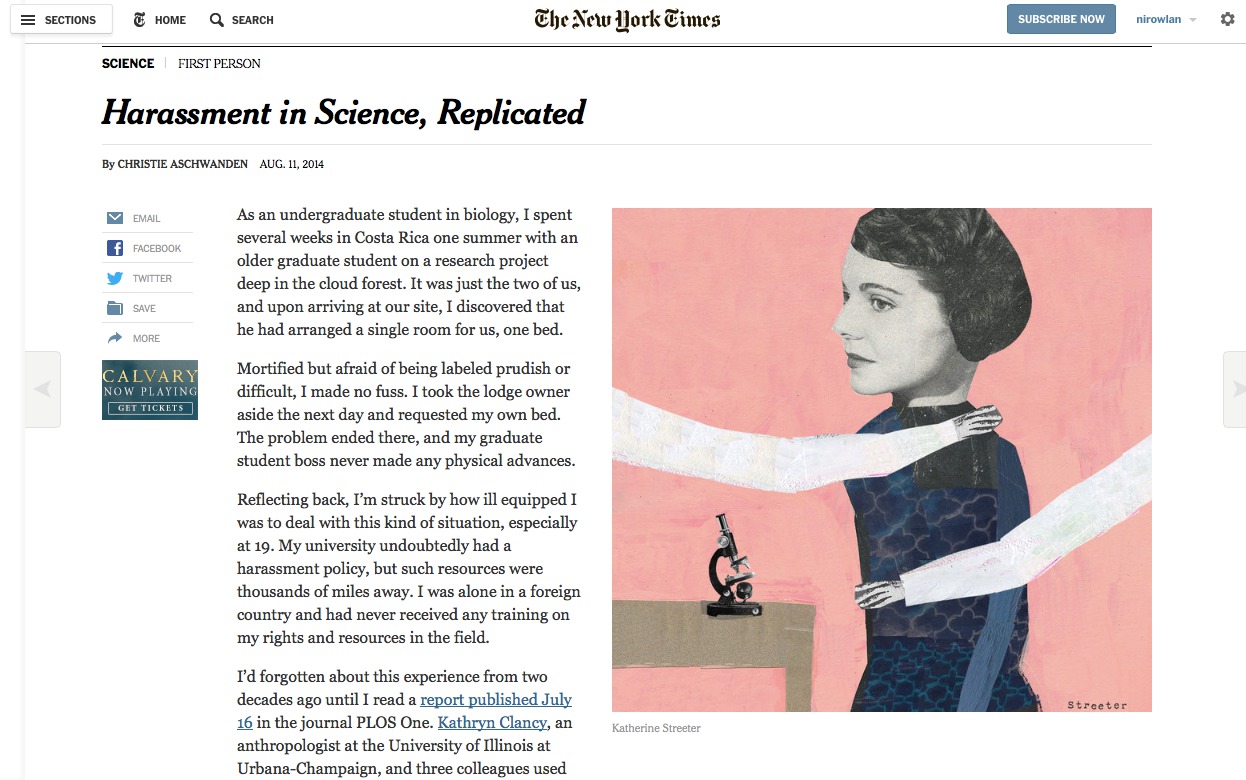
A piece in the New York Times recently discusses sexual harassment while scholars are out in the field conducting research.

A topic worth of discussion in its own right, I can see this being a solid introductory read for undergraduate students interested in how gender and science meet. A lot of the literature in that area centers of feminist technology, seeing the underlying sexism in scientific depictions (i.e., the sperm is active while the egg lays in waiting, and so on), and, of course, access to and participation in science and engineering broken-down by gender (sort of like a version of the Matthew Effect, only with women falling out of the pipeline to professional scientist/engineer, perhaps it should be called the Molly Effect or something like that).

At any rate, the piece covers a number of important issues such as power/gender dynamics while in the field, the issue of “sleeping arrangements” while conducting research at non-local venues, as well as the reality that when sexual harassment looms in university-based research activities the matters are often settled internally (rather than in a public forum).

These are matters worth of more public discuss, especially on college campuses, and, to my mind, the sooner the better (perhaps, even in high school) 

4S Newsletter Volume 02 Issue 03 (Summer, 1977)

Untitled-4

Quote of the issue: “On 26 August 1975 … fifty scholars assembled … [to] declare themselves members incorporate in 4S” (August 26th is 4S’s birthday!) Aarnold Thackray and Daryl Chubin, 1977.

Issue in brief (PDF is here: 1977 Volume 2 Issue 3 Summer).

  1. Editorial on the origins of the professional society — interesting,
  2. Preliminary program for the 2nd annual meeting — at Harvard University. You’ll also note that in the elections for members, the status hierarchies of old are all represented,
  3. Fact Sheet for 2nd annual meeting — $15 pre-registration; $20 at the door … makes me wonder what a 1976-2014 registration fee chart might look like,
  4. Thought and opinion section about citation research with an odd opening remark that I think might be about Latour’s 1976 presentation at 4S (but I can’t be sure),
  5. David Edge offers a retort — an excellent one — to the (at best peripheral) acceptance of quantitative (co-)citation analysis in the sociology of science. Well done!
  6. Commentary on the Psychology of Science, which is a field no longer in strong standing (to my knowledge),
  7. A piece on teaching STS in Papa New Guinea — interesting,
  8. STS in the Netherlands,
  9. Excellent reviews of about Zuckerman’s Scientific Elite (a text that challenged the idea that scientists needed to have their great breakthrough by 30, but a book that also did not necessarily support Merton’s Matthew Effect among elites … where it was thought to be strongest), and
  10. The closing pages contain the freshly revised charter.

This newsletter contains information about the origins of the society. According to opening editorial, in connection with the Montreal Congress of the International Sociological Association (who knew?), the earliest foundations of the professional society were laid and an informal committee was established in 1974-75. On 26 August 1975, 50 members assembled in San Francisco to ratify a charter for 4S. Apparently, the 26th of August is 4S’s birthday!

Continue reading

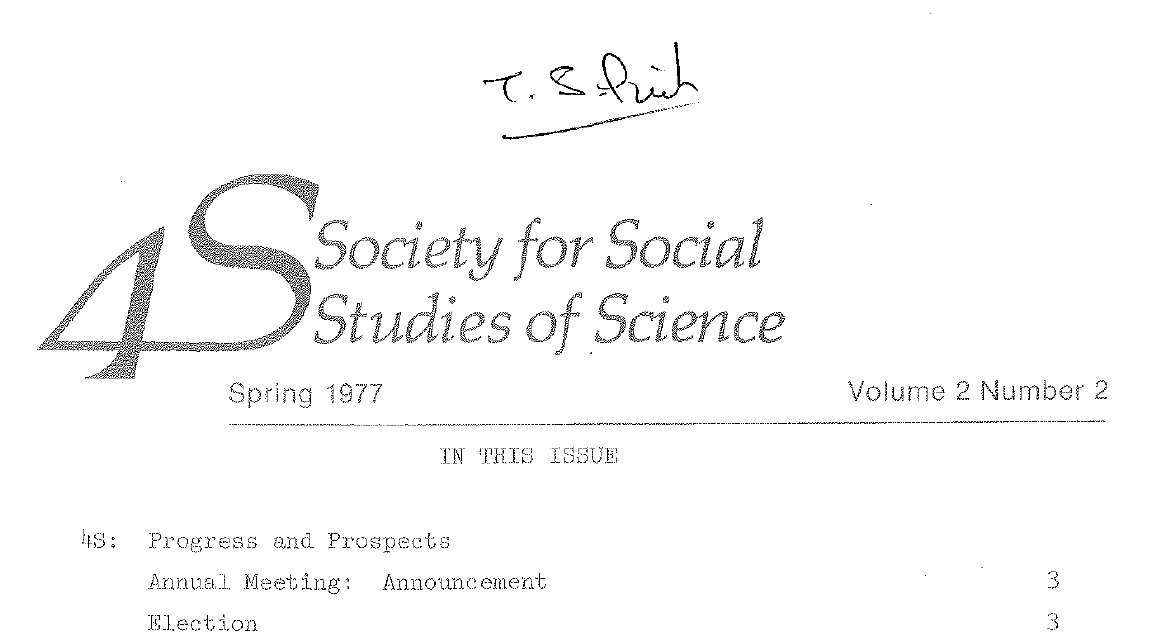
4S Newsletter Volume 02 Issue 02 (Spring, 1977)

Untitled

Quote of the issue: “A new society resembles a new baby: all hope and weak sphincters,” (about the 4S professional society in 1977) Harold Orlans.

Issue in brief (PDF is here: 1977 Volume 2 Issue 2 Spring).

  1. The call for the second annual meeting (to be held in Cambridge, Mass.) is in here, but the real fun is in the “Thoughts and Opinion” section, which features:
  2. “Councillor’s Commentary: Nicholas Mullins”
  3. “On 4S: Harold Orlans”
  4. “The Internationality of 4S: Michael Moravcsik”
  5. “Retrospective TA: Ruth Schwartz Cowan, et al”
  6. “Letter to the Editor: David Bloor”

This newsletter (see the picture, as if it where signed by Trevor Pinch for us later on) is a nice historical piece. According to the council minutes, by January of 1977, 4S boasted 539 members (note to self: chart these). Council minutes also indicate that the professional society was still working hard to determine if a professional society journal partnership could be developed — candidates at the time were none other than the Social Studies of Science, Minerva, and Newsletter on Science, Technology & Human Values. I know that it is just part of training in STS, but we all develop early-on an appreciation for the question (roughly paraphrased here) “how did now-stable things get that way?” and (thank you chapter 7 of David Noble’s Forces of Production) “What roads were not taken?” … might be interesting, as a thought-experiment, to consider what STS might look like if the professional journal were Minerva rather than STHV …

Continue reading

More on Lego gender battle

shopping

BBC chimes in on the Lego gender battle, which we discussed here and here.

CHOICE QUOTE:

David Robertson, a former Lego professor of innovation at Switzerland’s Institute for Management Development, says such criticisms are unfair. “If Lego was still marketing sets the way it used to, it’d be out of business.”

In his book Brick by Brick, he details the company’s fear in the late 90s that Lego would soon be obsolete. The patents were out of date and a new approach was needed. Instead, the company focused on stories, which in practice meant tie-ins like Star Wars and Harry Potter.

Law on fish ponds and multiplicity

37184

“A salmon is … ?” that is the ontological question. 

In this free paper, Jon Law addresses practice and theory, and he does it nice and slow with great care to unpack the context of this paper and the broader fields he contributes to, chiefly, of course, Science and Technology Studies. 

Of all people, of course, Law can direct readers through the maze of ANT, but does an even nicer job than usual. For example, regarding theory as coterminous with practice (rather than an appreciable divide):

… And that is the problem when we start to talk about ‘actor-network theory’, or indeed ‘theory’ tout court. Theory including ANT sounds – and often it is – formulaic. It is as if it were there, sitting in a box fully formed, waiting to be applied whole and ready.

Then he shifts gears and moves to “animals,” … “But let me come to the question of actor-network theory in a different way by thinking about how it relates to animals.” He reminds readers that the differences between people and things like animals is not “natural” so much as the difference is an effect of their relationality (and an important step away from “human exceptionality”). Instead of studying scallops (like Callon in 1986), Law studies farmed Atlantic salmon in Hordaland in West Norway. Still, scallops are not irrelevant: “Starting with a focus on multiplicity, I consider how ANT started to put entities such as ‘animals’ back together again after the 1986 relational storm. This, then, is an exploration of strategies for reassembling objects within the ANT tradition.”

I won’t ruin the concluding remarks for readers, but suffice to say, he concludes trying to answer the basic ontological question: “A salmon is … ?”

4S Volume 02 Issue 01 (Winter, 1977)

Untitled-3

Issue in brief (PDF repository for all issues is here, just click the issue you want to view in PDF format):

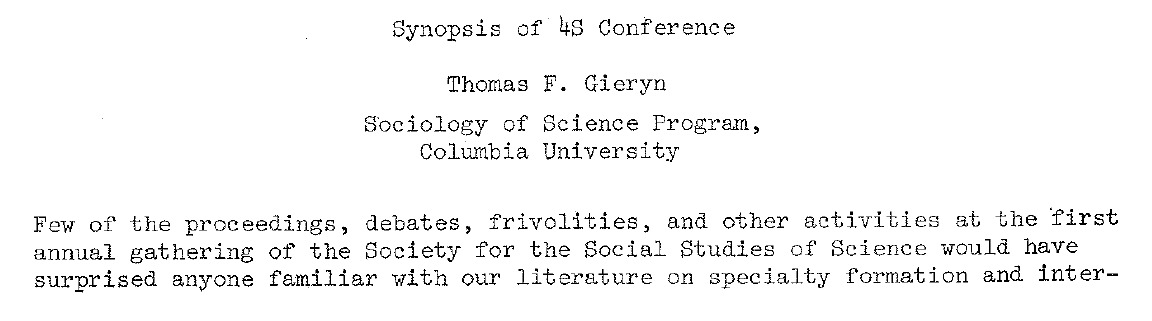
  1. HM Collins, Dorothy Nelkin, and a young Thomas F. Gieryn reflect on the first annual meeting of the Society for the Social Studies of Science.
  2. Abstracts from all the papers presented at the first meeting in Ithaca, NY — nice.
  3. A flattering transcript of Polsby’s introduction to Merton’s presidential address.
  4. A lengthy review of Bloor’s “Knowledge and Social Imagery.”
  5. In the “recently completed dissertations” section, we see that Thomas F. Gieryn has just completed his work at Columbia working under Merton.

I will devote my commentary primarily about the reflections — by HM Collins, Dorothy Nelkin, and a young Thomas F. Gieryn — on the first annual meeting. However, Polsby’s introduction to Merton is a must-read for history buffs.

First, Collins is way funnier than I remember him. His opening remarks are about his fears of America and mention fertilization after marriage! Also, he hits on a part of the professional society that is alive today — “for meeting the unsuspected individuals here and there, often in isolation, with whom one was immediately “on a wavelength.”” He goes on to make some outlandish comments about the organization of tables during the banquet and how he “took too much wine.” Still, he closes mentioning that he hopes that the friendly criticism and international flavor of the event can be extended into the future years.

After the meeting, Nelkin refers to the society as operating in a “postpartal stage” — odd. She mentions that sociologists essentially thought of the professional society — or, at least, had dominant numbers during the foundation — but that the society attended to issues far beyond sociology as usual (even sociology of science as usual). Dorothy mentions a number of “troublesome” observations such as why there seemed to be little methodological coherence among the papers, why developing countries were rarely mentioned, or why political science seemed so distant from the concerns of the presenters (by the way, one might mention those same concerns at any of the meetings I’ve been to, but perhaps they are less pronounced now than then, but it is interesting to see how enduring these concerns are). Her comments on Latour are fun:

Latour proposed another interesting tool through which to understand normal science: using anthropological methods, he investigated science as “action,” studying the smallest units of research activity, its patterns of gestures and informal communication. In the early development of an organization that has formed on the basis of common interest in a topic, such methodological innovation is crucial.

While Nelkin acknowledges that the diversity of presentations cut both ways — annoying that there was no common approach or core, but also that it was one of the most endearing part of the meeting as a whole — still, it ought to be preserved in future years, she concludes. Nice.

Gieryn, having perhaps just completed his dissertation and presumably going to Ithaca with Merton himself, provides an astute set of reflections, opens with:

The self-exemplifying character of the 4S Conference is, for one sociologist, the prominent memory of three packed days. Our actions in Ithaca provided many examples of our ideas about such occasions.

He balances his observation that the meeting signifies a stage of advancing institutionalization of the previously invisible college of STS, while:

The dialogues and often satirical criticisms following just about every paper at the Conference demonstrate that the 4S is following the modal pattern of scientific societies which adopt a pluralistic position with regard to intellectual aims and methodological strategies.

His final paragraph includes “Dutch Uncle” and reference to Simmel’s “Stranger,” after which he concludes that:

The stimulating Conference would have sunk to an insipid state were it not for these and other unignorable figures who cause us to look to the second 4S gathering not with weariness but with eager anticipation.

As always, all issues are here.

4S Volume 1 Issue 4 (Fall, 1976)

Untitled

Issue in brief (PDF is here: 1976 Volume 1 Issue 4 Fall).

  1. Specific but preliminary schedule for the first annual meeting — John Law, Karen Knorr, Nicholas Mullins, Sal Restivo, Robert Merton, Steve Woolgar, Bruno Latour (at the Salk Labs at the time!), H.M. Collins, and a 6:00pm cocktail hour.
  2. Plans for the second meeting chaired by Nicholas Mullins.
  3. List of current publications includes a few from Kuhn, Merton, and Nelkin.
  4. In the dissertations section, H.M. Collins’s dissertation from University of Bath is mentioned along with Donald McKenzie’s dissertation from University of Edinbugh and Steve Woolgar’s dissertation from University of Cambridge. A good year…
  5. Extremely odd: there must have been a misprint this issue because, as Trever Pinch’s bold arrow drawing verifies, we go from page 8 to page 21.

Given that a few pages are missing, this review is a bit limited. I wish I had a full copy — if anybody does, please write (njr12@psu.edu).

Arnold Thackray writes a short innocuous piece about the future of the burgeoning — purportedly, the society boasts 400+ members since its inception in a San Francisco meeting (anybody know anything about that particular founding meeting?) — society that reflections on the need for professional societies to attend to annual meetings and publication outlets for its members.

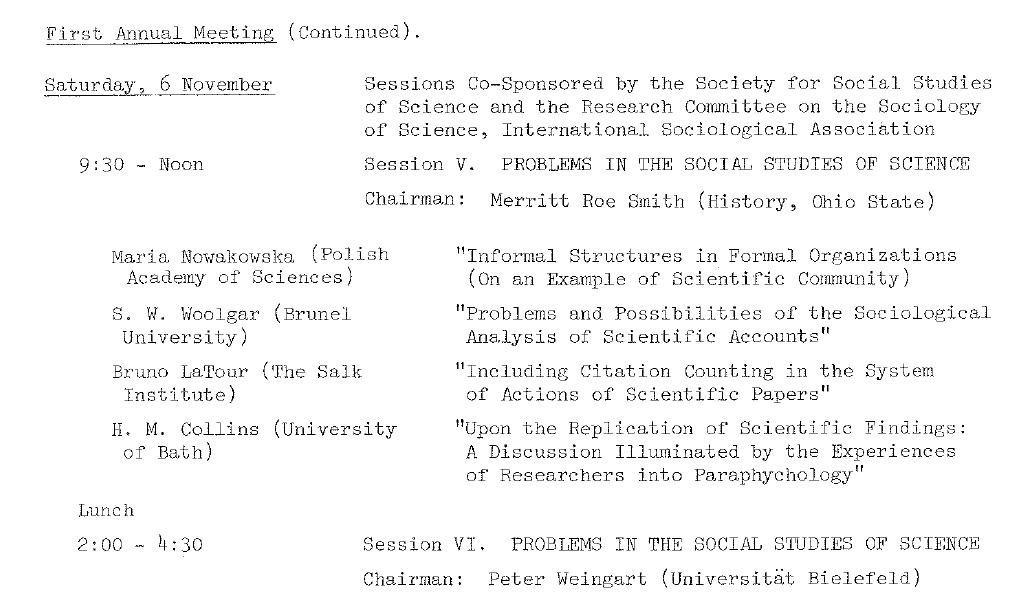
The first annual meeting program is in this issue too. The meeting was held in Ithaca, NY, at Cornell University. The meeting started November 4 (Thursday) with an invited panel on interdisciplinary in the social studies of science (including Jean-Jacque Salomon). After lunch, John Law give a talk “Anomie and Normal Science” (I’m not sure what project this relates to in his long publication history) and Karen Knorr gives a talk “Policy Makers’ use of social science knowledge: Symbolic or instrumental?”. The next session is about the structure of science where Nicholas Mullins and a big group from Indiana University present. On Friday morning the next session starts with Karen Knorr giving another presentation, this time about the organization of research units, along with Sal Restivo’s talk about Chinese social studies of science — interesting. After lunch, business meetings ensue, a cocktail hour at 6:00pm, and then during the banquet Nelson Polsby introduces Robert Merton’s presidential address. On Saturday morning (November 6, 1976) — I would really have loved to see this session, although I was not yet alive — “Problems in the Social Studies of Science” could be applied to the topics (and the participants), which includes Steve Woolgar’s (Brunel University) “Problems and Possibilities of the Sociological Analysis of Scientific Accounts,” Bruno Latour’s (The Salk Institute) “Including Citation Counting in the System of Actions of Scientific Papers,” and — another classic — H.M. Collins’ (University of Bath) “Upon the Replication of Scientific Findings: A Discussion Illuminated by the Experiences of Researchers into Paraphychology” (the research project that Ashmore later lambastes him for in The Reflexivity Thesis under … Steve Woolgar’s tutelage — perhaps Ashmore attended the session). After lunch we see another session by the same title with invited scholars — possibly from the ISA — from Bielefeld, Kiev, Hungary, and East Berlin).

Not a lot more of interest given that a few pages are missing — the missing pages include notes on the forthcoming meeting as well as an unnamed book review — but the list of just-completed dissertations is a fun tour of the past.

Prologue of “Sciencecraft”

419jDEIOGTL

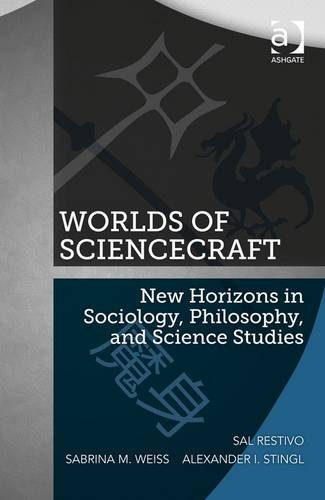
As promised, I will review the new-ish book Worlds of Sciencecraft bit by bit (the book is priced at a screaming-hot $100+ USD on Amazon.com).

Here is the first installment from the Prologue:

The book’s tone is personal, at least in the prologue. You get the feeling that you are sitting down with the three authors to engage in a discussion (although I’m not sure what the reader is doing beyond listening). The tone is academic but conversational; maybe an academic conversational tone. The prologue opens with a quote from Sal Restivo that is not from a book or article. It seems that in 2012 (Ghent, Belgium), he just “said” it — to whom we do not know, although it might be Sabrina Weiss, the other author of the chapter, but, again, we do not know.

The prose opens with a story about where the book came from:

The inspiration for the title of this work, “Worlds of Sciencecraft,” came from the popular massively-multiplayer online roleplaying game (MMORPG), World of Warcraft. This connection arose out of a series of discussions between Restivo and Weisss and only later was crafted as an homage to this title.

The game, to them, raised fundamental questions about humans and human interaction as well as human/nonhuman interaction. From there, the authors claim that they could reconstruct a Whig history of the title choice, for example, retroactively searching for explanations about how sociology is sort of like the Horde or how philosophy was like the Alliance and so on … but this would, as they say, “merely reflections (rationalizations) after the fact.” The book was born of conversation.

The personal tone is understandable in this context — “[t]his book was born in a contentious dialogue between two scholars who stubbornly argued their perspectives and who decided to seek coexistence through this book.” The book is conversational because it is dialogic in origin. But there is a twist. The twist is named Alex. “In the process of writing this book we acquired our own Third in the form of Stingl: in so doing we have managed to per formatively enact the shift from dyadic to triadic interactions, and we are richer for it.”

The level of self-reflective meta-reflexivity employed might engage some readers but it will no doubt frustrate others — it is honest, but it is also navel-gazing. Scholars no doubt are familiar with long discussions about reflexivity in STS — best handled by Ashmore early on (The Reflexivity Thesis) or Lynch’s reflections on reflexivity in 2000 (Against Reflexivity as an Academic Virtue and Source of Privileged Knowledge) or maybe even our recent paper about infra-reflexivity (Beware of Allies! Notes on Analytical Hygiene in Actor-Network Account-making).

After summarizing the basic aim of the book, namely, conceptualizing ideas about bodies, minds, and interaction beyond business-as-usual in sociology, philosophy, and STS, the self-reflexive discussion re-commences:

[t]his book emerges at the intersection of three different biographies, three different intellectual paths, three different educational and training regimens, and two generational trajectories … If you understand that our intersection is also the intersection of a postmodern moment, an inflection point, a cusp characterized by a movement from old to new cultural and epistemic regimes you will be better prepared for the journey you are about to embark on. In this liminal age, we have mustered all of the resources we have at our disposal to get a glimpse of what lies ahead in the post-liminal age. … This book is the story of three thinkers in search of a way out of the liminal trap, trying to find our way to some light at the end of the postmodern tunnel.

Thus, if you are “on board” for a personalized journey and some gilded language, then this is the book for you. As we shall see, things get better from here …

4S Volume 1 Issue 3 (Spring, 1976)

4S Newsletter

Issue in brief (PDF is here: 1976 Volume 1 Issue 3 Spring).

  1. Presidential Address by Robert K. Merton
  2. Preliminary Program for the first Society for the Social Studies of Science meeting
  3. Report on STS training in the US

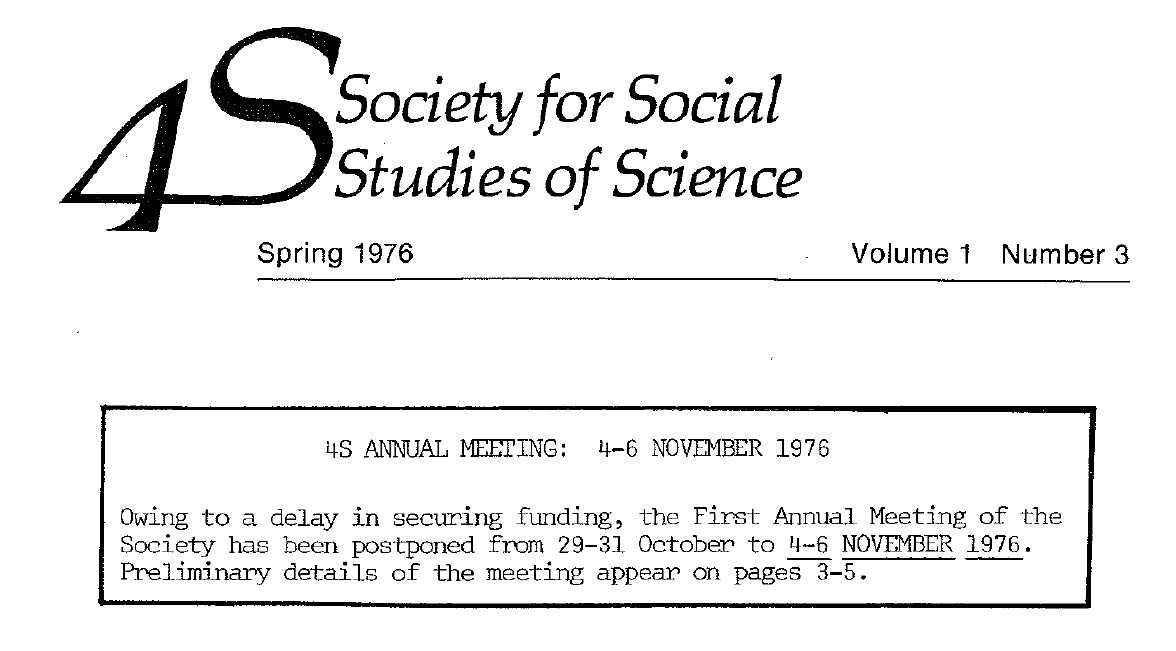
This is the earliest issue of the 4S newsletter we have and it contains the preliminary program for the first meeting (ever) of the Society for the Social Studies of Science. We learned that the first meeting was delayed. The first meeting, which was held at Cornell University (Ithaca, NY), was supposed to be in late October (29-31); however, because of funding (unclear precisely what the issue was other than lack of funding) the conference was delayed one week until November 4-6 (one week later, which is oddly unfriendly to international guests, although so is holding a meeting in Ithaca). Never heard of delaying a professional conferences, but, at the time, it was a very young organization with small enrollment so perhaps this sort of thing just happens. The first meeting was a joint meeting (4S, apparently, has always had a history of joint meetings); held conjointly with the Research Committee on the Sociology of Science of the International Sociology Association.

In the presidential address, by Robert K. Merton, we learn that the social studies of science had 300 members at the outset (which is possibly untrue, given details in the next paragraph). With eloquence common to Merton’s writing, he mentions something that I still find true today: that in STS, though we are drawn from numerous disciplinary backgrounds, we feel more at home with the rag-tag bunch at 4S than we do in our parent disciplines. It also reminds me that while interdisciplinary was big news in mid-70s, it no longer seems so subversive (although that is up for debate). Merton encourages members to “avoid the double parochialism of disciplinary and national boundaries” as part of its “originating efforts.”

In the preliminary program, we learn that 22 papers were to hosted at Cornell that year that would be selected by a committee of 5. The newsletters are also a resource for advertising other events, in this issue, the International Symposium for Quantitative Methods in the History of Science, PAREX (a symposium on the Role of Research Organizations in Orienting Scientific Activities hosted by Karen Knorr), and Sektion Wissenschaftsforshung.

There is also a ballot for council members and we see some familiar faces: Nicholas Mullins on the selection committee (who we see in the research notes) and Dorothy Nelkin for a two year stint. Also, in the council meeting notes, we learn that the professional organization was working with the now flagship journal Social Studies of Science for a reduced rate for members. Interesting to consider a time when our primary professional society was haggling with journals for better prices from printed materials.

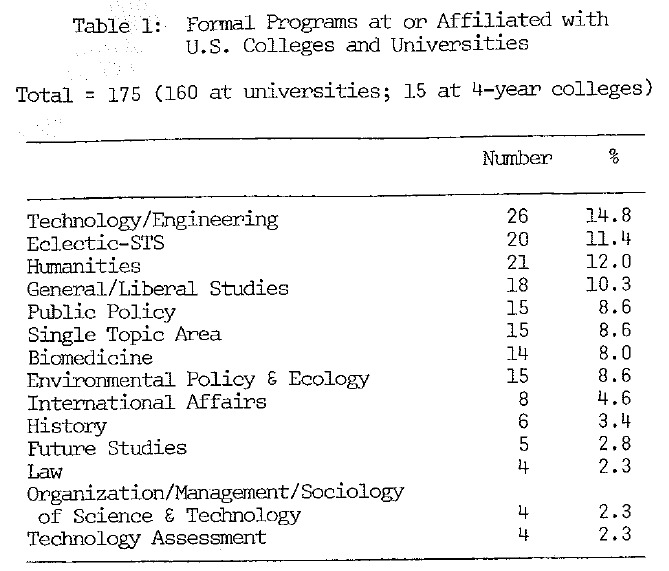
The report on STS programs in the US is more preliminary than conclusive, but it does identify 175 STS programs in various forms even in ’76. The “Eclectic-STS” category is particularly interesting, and the programs are detailed in the issue.

Untitled

The issue concludes with some recent publications, new job appointments (apparently, Paul Allison just landed his first job at Cornell that year),

Revisiting historic 4S Newsletters

DSC07164 - Copy (640x64)

Thanks to Trever Pinch, we now have 4S newsletters from 1976 until the present, mainly of them I thought were lost forever. There are a couple of gaps, and as that becomes obvious we will ask around to see if anybody has a few of the old copies.

Please share with anyone you think might have an interest; the series of posts should last nearly one year as I scan these old paper documents and read slowly digest them.

I will start to post these periodically as a series commenting on what is the issue, who is named, and then reflect on the field. Should be interesting (and, if we’re lucky, occasionally uncomfortable to see our old dirty laundry). Of special note, long-time scholars will recall that annual meeting programs were embedded in these old issues, so that will be exceptionally interesting — even if only for purposes of nostalgia — to see how 4S meetings changed in form, function, and content over the years.

I will add a tab to the blog’s front page for easy access to these pieces as well as for easy access to the PDFs of the old newsletters.

Cheers and thanks to Trever Pinch!

Science and the Public in the Nation-State: Historic and Current Configurations in Global Perspective, 1800-2010

Science and the Public in the Nation-State: Historic and Current Configurations in Global Perspective, 1800-2010

Interdisciplinary workshop at the University of Tübingen, Sept. 11-13, 2014

Conveners: Andreas Franzmann (Tübingen), Axel Jansen (Tübingen, Cambridge/UK), Peter Münte (Bielefeld)
Organization and contact: Lars Weitbrecht (scienceinthenationstate AT gmail.com)

The workshop allows for the exploration of the relationship between science and the nation-state from a new perspective. In nation-states that have traditionally supported research science (such as England, France, Germany, and the US), the profession evolved under the protective wing and as an ally of the political sovereign. Academic professions have played a significant role in the consolidation of national states. The conference focuses on historical configurations of science and the nation-state in Europe and in North America in order to compare these configurations to emerging science-oriented states such as China and India – countries that have significantly expanded their science budgets in recent decades. The relationship between science as a profession and the nation-state will provide an analytical framework for discussing important historic developments in different countries. What has been the public role of the academic professions? And what are the effects on research of “national policy decisions”? Click here for full workshop exposé.

The workshop meets at Universität Tübingen, Alte Aula, Münzgasse 22-30, 72070 Tübingen/Germany (click here for map).

All welcome, attendance is free. If you wish to attend, please use our online form (click here).

The workshop is supported by the Volkswagen Foundation (Project “Public Context of Science”) and the Vereinigung der Freunde der Universität Tübingen (Universitätsbund) e.V.

Obama on infrastructure and business retention

Obama

President Obama links infrastructural improvements to business retention, specifically, that unless American start to improve the country’s infrastructure, which will require Congress to discontinue divisive austerity-politics, or else we will continue to lose businesses abroad as they pursue higher-quality infrastructure for their business needs.

Perhaps this is a pathway that will result in some of the changes that are much needed. Whether this linkage is true or not (i.e., whether infrastructural improvement is linked meaningfully to business retention) is essentially unimportant; whether it results in actual political or economic change seems to be the only operant quality of concern given that truth in politics seems at most a tertiary concern for a generation of politicians.

Appropriately, Obama gives the speech near The Governor Malcolm Wilson Tappan Zee Bridge, the crumbling cantilever bridge spanning the Hudson River at one of its widest points. 

Twitter as a tool for political protests

ios_homescreen_icon

Just out is a new paper on using Twitter as a tool for social protest, written by Lisa Ems “Twitter’s place in the tussle: how old power struggles play out on a new stage” being published in Media Culture Society.

Abstract: 

The recent proliferation and impact of protest events in the Middle East, northern Africa, and the development of a worldwide Occupy Wall Street movement have ignited inquiry into the people, social structures and technologies that have helped give these social movements form. Three cases are described here which add to this discussion and lead to a pruning of the analytical landscape in this subject area. By looking to the use of Twitter as a tool for political protest in Iran in 2009, Moldova in 2009 and the G-20 Summit in Pittsburgh in 2009, the complexity of the intertwined social and technological strands that have given rise to these new political protests is acknowledged. By realizing that this distinction is salient yet fuzzy, it becomes possible to make new observations, ask new questions and begin to understand the nature of recent political tussles and the communication tools used in them. For instance, this article posits that by seeing the particular use of a new communication tool – a socio-technical assemblage – as an artifact, analysts can learn something new about the motivations of those sitting at the negotiating table.

If you’re standing in front of the pay wall, consider this useful little link here.

Destratifying In-Zomia: A cartography of a people in Southeast Asia

Interesting case about escaping war machines only to encounter ecological crisis — a good spot for it too, “Destratifying In-Zomia”

voltarzi_samsa's avatarUnlimited Dream Company ('Despairing at last, I decided to die' -J.G. Ballard)


___________________

This paper will build on the rhizomatic intricacies of a cartography of a people in Southeast Asia in James Scott’s (2009) description of the stateless inhabitants of Zomia, arguably lawless peoples whose migration from island assemblages in the region was caused by early 20th century ‘state-making projects’, oppression and colonialism. These peoples to this day still exist in a region assembled by mountain ranges the size of Western Europe.

Escaping state-making projects and their concomitant use of war machines is the imprint of a people who in A Thousand Plateaus (1987) Deleuze and Guattari liken to abstract art: ‘Multidirectional, with neither inside nor outside, form nor background, delimiting nothing, describing no contour, passing between spots or points, filling a smooth space.’ The peoples of Zomia, nonetheless, are prone, much more in these days, to ecological catastrophe that in all likelihood Deleuze must have in mind when he…

View original post 199 more words

Talking with Latour about Anthropocene

Latour

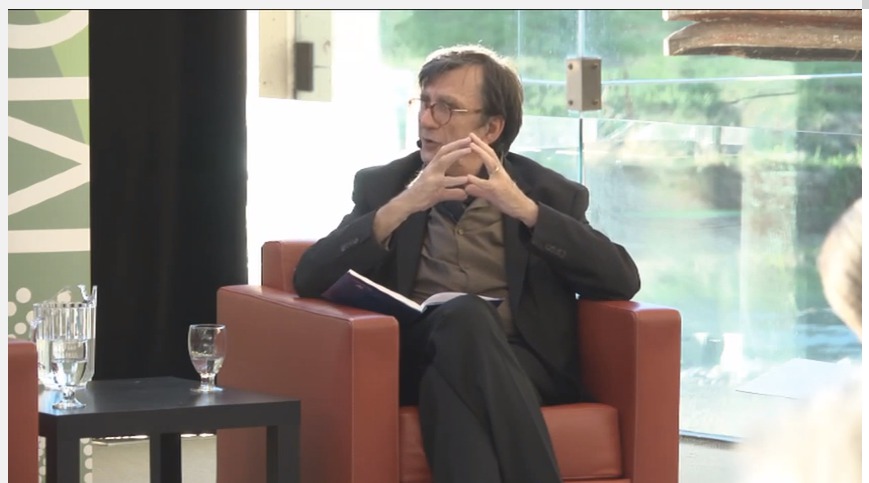
Latour is at it again! This time Latour is at the Anthropology Museum in Vancouver, British Columbia, taking over Canada. 

Check him out here, it is excellent work.

Short description:

Published on Oct 11, 2013

Dr. Philippe Descola was a Distinguished Visiting Professor at the Peter Wall Institute and Dr. Bruno Latour was the fall 2013 Wall Exchange lecturer, and on September 25, 2013 engaged in a discussion at the Museum of Anthropology in Vancouver about the concept of the “Anthropocene”.

Thanks (STS-Africa) Network for Science and Technology Studies in Africa!